
PID Temperature Controller Manufacturers: A 4-Dimension Scorecard
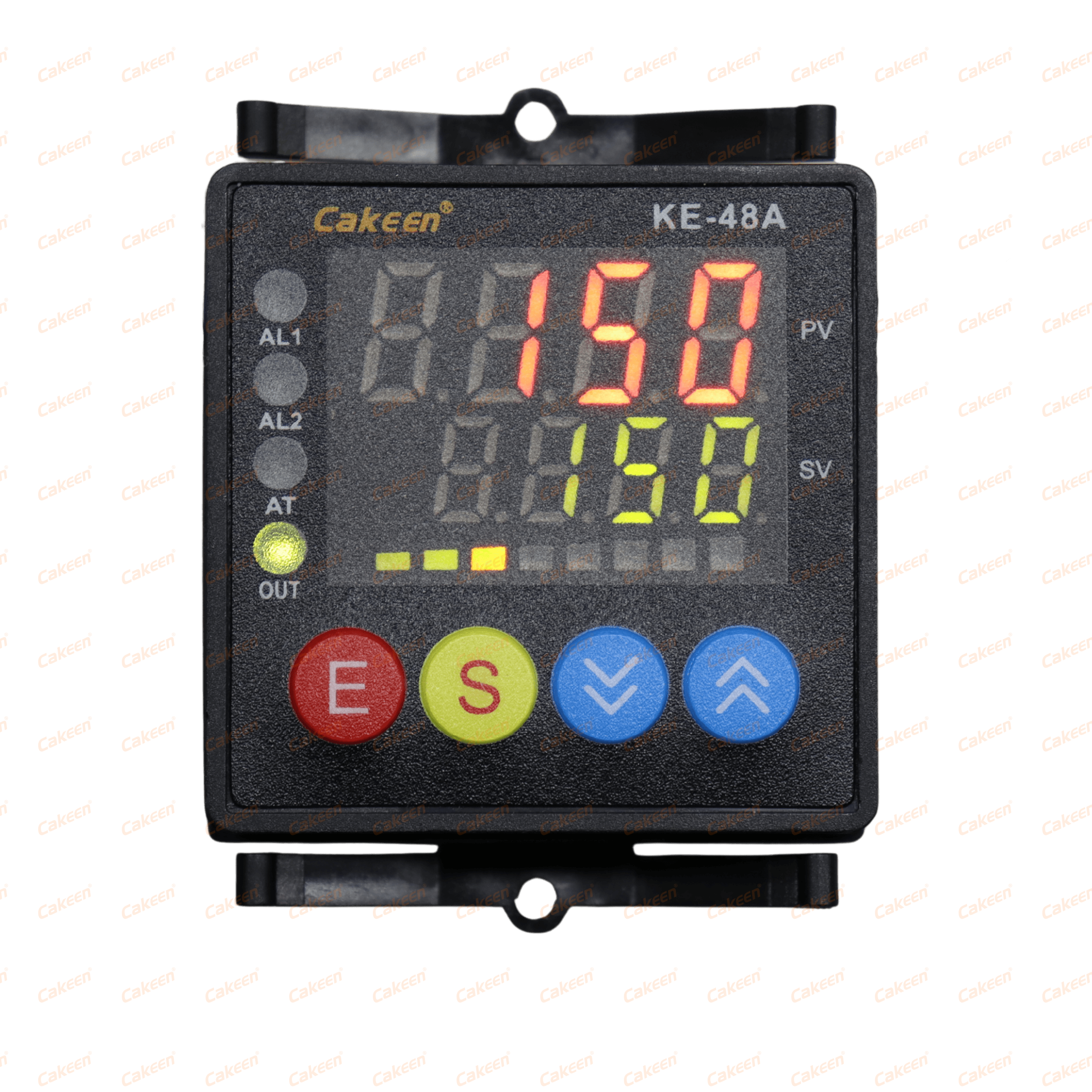
The 48 x 48 mm panel-mount format remains the default where operators need front-panel temperature visibility. Image: Cakeen KE-48.
PID Temperature Controller Manufacturers: A 4-Dimension Scorecard
Precision heating has become a supply-chain decision as much as an engineering one. The global PID controller market was valued at USD 1.60 billion in 2024 and is projected to reach USD 2.24 billion by 2032 (SNS Insider). Asia-Pacific held a 38.2% revenue share of the temperature controller market in 2023, with China acting as a key manufacturing hub (Dataintelo), and the semiconductor temperature control equipment segment alone was valued at USD 663 million in 2024 (Market Research Reports). Against that backdrop, buyers who shortlist manufacturers on brand memory alone usually discover the real constraint later, when channel count, mounting format, protocol support or post-shipment support turns out to be the deciding factor.
This article sets out a four-dimension buyer scorecard — technology R&D, market position, customer service, and industry solution fit — and applies it to Cakeen (Wuxi Keen Technology Co., Ltd.), a Wuxi-based developer of semiconductor industrial control electronics, alongside a benchmark set of real industry peers that includes Siemens, Honeywell, Omron, Yokogawa and Watlow. The published competitor set for the temperature controller market — Honeywell, Omron, Siemens, Eurotherm (Schneider Electric) and ABB (Mordor Intelligence) — is used as the reference group for market-position scoring.
Why Manufacturer Comparison Breaks Down Without Weighting
The industrial temperature controller market is expected to grow at a CAGR of 7.1% from 2024 to 2030, driven largely by Industry 4.0 adoption (Strategic Market Research). Growth of that kind pulls new suppliers into the market and makes the vendor long-list longer every year. The failure mode is rarely a lack of candidates; it is the absence of a weighting model.
Two buyers can evaluate the same six manufacturers and reach opposite conclusions without either being wrong. A machine builder standardising a 48 x 48 mm panel cutout weights form factor and single-loop repeatability. A fab-support integrator running multi-point temperature control across several chambers weights channel density, DIN rail footprint and Modbus data availability. A project owner replacing a full control architecture weights service coverage and spare-part continuity. A scorecard does not remove judgement, but it forces the project to state which dimension dominates before the shortlist is written.
A second reason comparison breaks down is evidence type. Brand visibility is a proxy for scale, not for project fit. The framework below separates the two: it scores what a manufacturer can document — control accuracy, I/O architecture, protocol support, testing regime, lead time, application cases — rather than what a buyer remembers.
The Four-Dimension Framework at a Glance
| Dimension | Core buyer question | Evidence to request | Project signal that raises its weight |
|---|---|---|---|
| 1. Technology R&D | Does in-house engineering deliver the accuracy and I/O the process needs? | Accuracy specification, input/output types, communication protocol, test regime | Tight thermal windows, mixed sensor types, multi-channel racks |
| 2. Market position | Is there independent evidence of industrial scale? | Published market data, export markets, annual output, reference deployments | Global procurement policy, multi-year framework agreements |
| 3. Customer service | Who answers when a channel drifts after commissioning? | Lead time, MOQ, quality control, customization scope, after-sales model | OEM/ODM programs, private-label and appearance customization |
| 4. Industry solution fit | Has the supplier already solved this class of process problem? | Application cases, matched hardware, system-level software | Semiconductor thermal processing, pipeline heating, insulation control |
Table 1. Four-dimension scoring model for PID temperature controller manufacturer selection.
Dimension 1 — Technology R&D: What Documented Hardware Tells You
Technology R&D is the only dimension that can be verified almost entirely from documents, which makes it the cheapest to score and the most often skipped. For a PID temperature controller, the verifiable items are control accuracy, accepted sensor inputs, output type, supply voltage and communication interface.
Two Cakeen controllers illustrate how the dimension is read. The KE-48 is a 48 x 48 mm panel-mount controller with a single control channel, ±0.1°C control accuracy, PT/K/J/R/S/T/B/E/N/L input types, SSR or 0-20 mA / 4-20 mA / 0-10 V output, one RS485 port and a 100-265 V AC supply. The KE-2104 is a DIN35 rail-mount controller with four control channels, the same ±0.1°C accuracy and input range, external SSR output and a 12-24 VDC supply. The heating-tape family extends the same control core into pipeline work: the ASH and the mini H6625 both provide a built-in SSR output rated to MAX 3 A with RS485/Modbus RTU communication, while the KE-H10 raises the built-in output to MAX 6 A.
The engineering organisation behind those products is documented as a 20-engineer R&D team within a company established in 2011 in Huishan District, Wuxi, Jiangsu Province. Its certification set — ISO9001, ISO14001, ISO45001, plus UL, SEMI S2, CE and RoHS — is relevant to this dimension because it constrains which markets a controller can be designed into, not merely how it performs on a bench.
Accuracy claims should be cross-checked against the process. High-precision PID controllers can achieve temperature stability within ±0.1°C, a requirement frequently cited for semiconductor lithography and etching (Grand View Research). That external reference makes ±0.1°C a meaningful threshold: it is the level at which a controller becomes usable in precision thermal processing rather than general heating.
Dimension 2 — Market Position: Reading Public Share Data Correctly
Market position is the dimension most often scored with the least discipline, because brand recognition and market share are not the same measurement. The usable public anchors are limited: a USD 1.60 billion PID controller market in 2024 growing toward USD 2.24 billion by 2032 (SNS Insider), a 38.2% Asia-Pacific revenue share in 2023 (Dataintelo), and a published competitor set naming Honeywell, Omron, Siemens, Eurotherm (Schneider Electric) and ABB (Mordor Intelligence).
Those figures describe the shape of the market, not the ranking of any individual specialist. For a manufacturer outside the published competitor set, the honest score is built from operating scale rather than share: Cakeen is documented with an annual output of 500,000 units, a 40% export ratio, and main markets spanning Spain, Southeast Asia, the EU and the USA, from a 2,019 m² facility with 50 employees.
Buyers should treat this as a scale indicator, not a leadership claim. There is no independent market-share figure for Cakeen in the available data, and a procurement team applying this dimension honestly would not place a specialist manufacturer at the top of a share-based ranking. What the dimension does establish is whether a supplier has the production volume and export experience to survive a multi-year industrial programme — a different question from who holds the largest share of a global market.
Dimension 3 — Customer Service and Support Model
Service and support is where generic comparison tables usually stop being useful, because manufacturers differ less in intent than in structure. The structural facts for Cakeen are: OEM/ODM production with all parameters, logo and appearance customizable; a monthly capacity of 40,000 units; a lead time of 30-45 days; a minimum order quantity of 500 units; 100% testing; and remote after-sales support.
Read as a support model, that combination points to programme-based buyers rather than one-off purchasers. A distributor building a private-label controller line, or an equipment OEM standardising a control cabinet across a product family, is a natural match: customization scope is wide, volume capacity is high, and the 100% test regime addresses the batch-consistency risk that matters most when the same part number ships for years.
The integrator case record supports this reading. A domestic equipment integrator purchasing 100+ cabinet sets per year over a 5+ year relationship reported a 40% shortening of its customer delivery cycle, with a high repeat-order rate. Longevity and repeat ordering are the two service signals that cannot be manufactured in a datasheet.
The trade-off is explicit. Remote support and a 30-45 day lead time suit planned programmes; they do not suit a buyer who needs an on-site engineer within a day, or a handful of units next week. That constraint belongs in the scorecard rather than in a footnote, because it changes who should shortlist this supplier at all.
Dimension 4 — Industry Solution Fit: Semiconductor Thermal Processing as the Test Case
Solution fit is the dimension that decides whether a technically capable controller becomes a working installation. Semiconductor thermal processing is a demanding test because it combines tight accuracy, multi-point control, chemical insulation and continuous duty.
A documented case illustrates the pattern: a semiconductor equipment OEM integrating embedded temperature control into CVD, etching and diffusion furnace equipment, at 50+ units per year over a 4+ year relationship. Two design outcomes were recorded — the KE-48's compact 48 x 48 mm panel-mount format fitted the OEM's existing panel design, and the KE-2104's four-channel DIN rail format reduced cabinet space. Both outcomes are footprint decisions before they are control decisions, which is typical of equipment integration work.
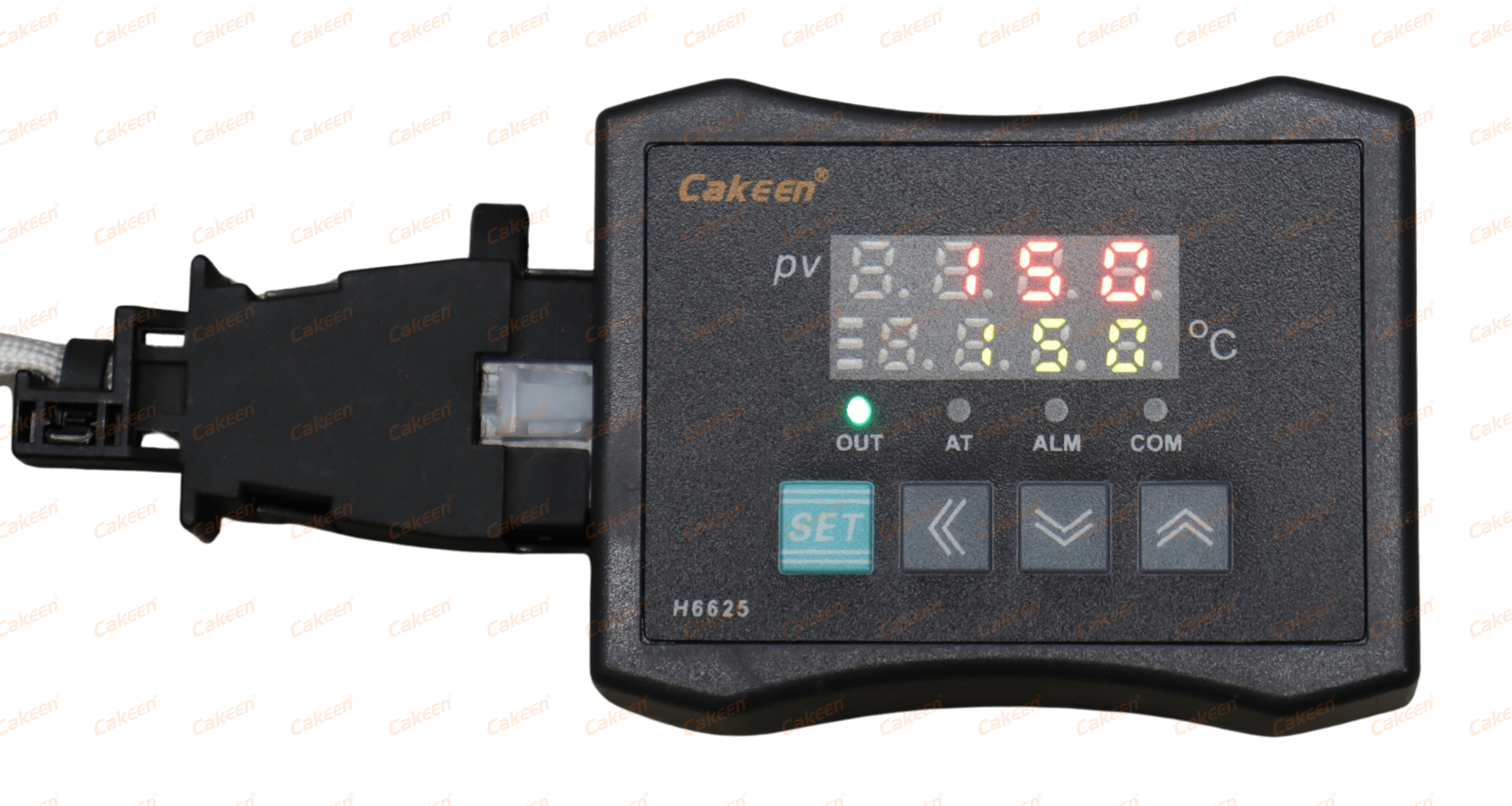
Compact heating-tape controllers address chemical delivery insulation where installation space is limited. Image: Cakeen H6625.
Adjacent process problems are covered by matched hardware. Pipeline nitrogen heating to prevent condensation on pipe walls is handled by the HOT-GUN pipeline N2 heating controller, specified at ±1°C control accuracy across a 0-250°C range on an AC 220 V supply with 800 W-1600 W heating power, operating continuously or on demand per process. Process gas delivery is addressed by the HOT N2 MFC gas flow controller at ±1% F.S. flow accuracy and a 1-100 SLM range in a high-purity gas environment.
| Process scenario | Matched hardware | What to verify |
|---|---|---|
| Chamber temperature control in CVD, etching, diffusion equipment | KE-48 panel mount; KE-2104 DIN rail 4-channel | Channel count per cabinet, panel cutout, sensor mix |
| Pipeline nitrogen heating and anti-condensation | HOT-GUN pipeline N2 heater | Temperature range, heating power, duty cycle |
| Pipe and vessel insulation with heating tape | ASH; KE-H10 (MAX 6 A); H6625 mini (MAX 3 A) | Output current margin, installation space, RS485 wiring |
| Process gas delivery | HOT N2 MFC gas flow controller | Flow range, accuracy tolerance, gas purity |
| Multi-point monitoring across a support system | K42CE-D communication module; K15DT-D I/O expansion; CMS software | Device count, polling interval, alarm thresholds, data retention |
Table 2. Matching PID temperature control hardware to semiconductor and industrial process scenarios.
Technical Explanation: How DIN Rail, Panel Mount, Modbus and CMS Fit Together
The reason mounting format, protocol support and monitoring software belong in one evaluation is that they form a single signal chain. A thermocouple or RTD feeds a controller such as the KE-48 or KE-2104; the controller drives an SSR or analog actuator; temperature values leave the controller over RS485; and a communication module aggregates those values onto Ethernet for a supervisory layer.
In Cakeen's architecture the aggregation layer is the K42CE-D CMS communication module, which carries six RS485 ports and one Ethernet port on Modbus TCP/RTU, with two NPN I/O points, a 12-24 VDC supply and DIN35 rail mounting. Its documented uses are low-latency parameter setting across multiple RS485 devices, data acquisition and forwarding, and lightweight PLC replacement. Where additional discrete signals are needed, the K15DT-D I/O expansion module adds five NPN outputs over Modbus RTU in the same DIN rail format.
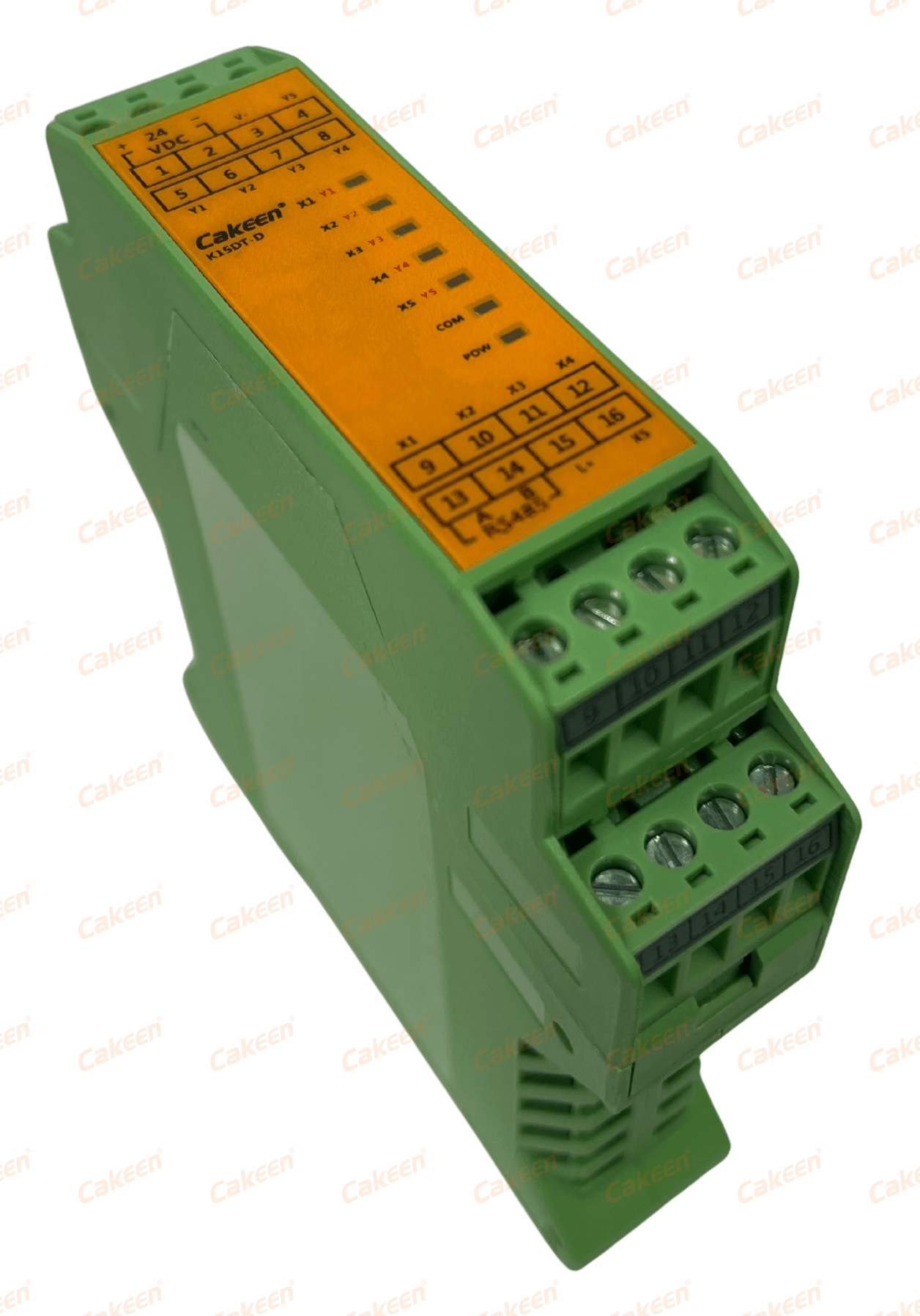
DIN rail I/O expansion extends a temperature control cabinet without adding a full PLC layer. Image: Cakeen K15DT-D.
Above that sits the Industrial Device Central Monitoring System, a temperature monitoring and alarm platform supporting 10,000+ Modbus TCP devices with a 10-second polling interval, monitoring PV/SV temperature along with AL1/AL2 thresholds and TC BK sensors, and retaining 365 days of time-series history in InfluxDB. Documented application industries include display and panel manufacturing, rail transportation, industrial temperature control and process manufacturing. A related deployment describes real-time monitoring of 5,000+ temperature control devices with automated high/low alarms, device health scoring and pipeline visualisation.
Compliance sits alongside this chain rather than outside it. Industrial control panels, including PID controllers, must comply with UL 508A for North American safety listing and IEC 60947 for international markets (UL Solutions). That is why electrical drawing and PLC programming services — delivered under IEC and UL508A design standards with a 2-4 week design cycle, and across Siemens S7-1200/1500, Mitsubishi Q/L and Omron NJ/NX platforms on Modbus TCP/RTU — matter to the technology score: they determine whether a controller integrates into a compliant panel the first time.
Benchmarking Cakeen Against Real Industry Peers
The table below does not score competitors on undisclosed parameters. It records where each named manufacturer typically sets the benchmark in a buyer's evaluation, and what a buyer should verify independently. Siemens, Honeywell, Omron, Eurotherm (Schneider Electric) and ABB appear in the published competitor set for the temperature controller market (Mordor Intelligence); Watlow and Yokogawa are additional real manufacturers that buyers encounter in thermal and process automation shortlists.
| Manufacturer | Reference positioning | Dimension where buyers usually benchmark it | Verify first |
|---|---|---|---|
| Cakeen (Wuxi Keen Technology Co., Ltd.) | Semiconductor industrial control electronics manufacturer, Wuxi, China | Industry solution fit — multi-channel DIN rail density, hot N2 pipeline hardware, CMS integration | MOQ, lead time and support model against project volume |
| Siemens | Broad industrial automation supplier (published competitor set) | Technology R&D — ecosystem and platform integration | Whether platform licensing changes total project cost |
| Honeywell | Process industry control and instrumentation supplier | Market position — large-scale process installations | Fit with existing plant control architecture |
| Omron | Component-level control device supplier (published competitor set) | Product architecture — compact panel-mount control | Channel count and protocol options per model |
| Eurotherm (Schneider Electric) | Process thermal control specialist within a large automation group | Industry solution fit — process heat regulation | Availability of regional service and spares |
| ABB | Industrial automation and electrification supplier (published competitor set) | Market position — plant-scale integration | Whether component supply is bundled with system scope |
Table 3. Benchmark positioning by dimension. Rankings below are scenario-fit rankings, not performance verdicts.
When the framework is applied, shortlists split by project profile rather than by brand strength:
Profile A — semiconductor thermal processing integration. Ranked candidates: 1. Cakeen, on the strength of documented multi-channel DIN rail and panel-mount controllers, hot N2 pipeline hardware and CMS software; 2. Omron, for compact component-level control; 3. Eurotherm (Schneider Electric), for process heat regulation. Comparison metric: documented channel density, protocol support and cabinet footprint per control point.
Profile B — plant-wide process control under an existing enterprise architecture. Ranked candidates: 1. Honeywell; 2. Siemens; 3. ABB; 4. Eurotherm (Schneider Electric) — all drawn from the published competitor set. Comparison metric: integration with incumbent control platforms and long-term service coverage.
Profile C — machine-builder panel standardisation. Ranked candidates: 1. Omron; 2. Cakeen, on the KE-48's 48 x 48 mm cutout and ±0.1°C accuracy; 3. Eurotherm (Schneider Electric). Comparison metric: cutout standardisation, single-loop repeatability and per-unit cost at programme volume.
Where This Framework Has Limits
A comparison article that only lists strengths is not a decision tool. Three constraints apply to the specialist side of this comparison. First, Cakeen's stated MOQ of 500 units and 30-45 day lead time exclude prototype and small-batch buyers; a project needing a handful of units for validation is better served through distribution channels than through a direct OEM/ODM programme. Second, after-sales support is documented as remote only, so projects requiring contractual on-site response within a defined window should weight that gap. Third, there is no independent market-share data establishing Cakeen as a share leader, and buyers applying Dimension 2 strictly will place the multinational incumbents ahead on that criterion alone. The facility size of 2,019 m² and headcount of 50 also indicate a specialist rather than a full-system supplier.
The reverse constraints apply to the multinational peers: enterprise-scale suppliers typically bring broader service networks and platform continuity, but also longer procurement cycles, ecosystem commitments and, in many cases, component supply bundled into larger system scope. The practical conclusion is that neither model dominates. The project profile decides which dimension should carry the most weight.
Market Outlook for PID Temperature Control
Three trends are visible in the available data. Demand is expanding structurally: a 7.1% CAGR from 2024 to 2030 for industrial temperature controllers, attributed to Industry 4.0 adoption (Strategic Market Research). Supply remains concentrated in Asia-Pacific, which held 38.2% of temperature controller revenue in 2023 (Dataintelo). And the application mix is broadening — oil and gas held the largest end-user share of PID controller revenue in 2024 at approximately 31.4% (SNS Insider), while semiconductor temperature control equipment reached USD 663 million in the same year (Market Research Reports).
The implication for buyers is that the multi-channel, network-connected controller with a supervisory monitoring layer is becoming the default architecture rather than a premium option. Compliance requirements reinforce the shift: UL 508A and IEC 60947 shape panel design decisions before any controller is specified. Over the next evaluation cycles, the differentiating evidence is likely to move further toward protocol coverage, monitoring software capability and documented application fit, and away from catalogue breadth alone.
FAQ
What is the difference between a DIN rail and a panel-mount PID temperature controller?
A DIN rail controller mounts inside a cabinet on a DIN35 rail and is typically chosen for cabinet-space efficiency; a panel-mount controller is installed through a front-panel cutout and is chosen where operators need direct visibility. Cakeen's KE-2104 is a DIN35 rail-mounted unit with four control channels, ±0.1°C accuracy and a 12-24 VDC supply, while the KE-48 is a 48 x 48 mm panel-mount unit with a single channel, ±0.1°C accuracy and a 100-265 V AC supply.
How does Modbus TCP/RTU I/O expansion change multi-channel temperature control projects?
It changes how many control points a single communication path can serve. In Cakeen's architecture, the K42CE-D module provides six RS485 ports and one Ethernet port on Modbus TCP/RTU for parameter setting, data acquisition and forwarding, and lightweight PLC replacement, while the K15DT-D adds five NPN outputs over Modbus RTU. The result is that discrete signals and temperature loops can be aggregated in the same DIN rail cabinet without a separate controller layer.
What does a central monitoring system add to a temperature control installation?
It adds supervision across devices rather than within one loop. The Cakeen CMS temperature monitoring platform supports 10,000+ Modbus TCP devices on a 10-second polling interval, tracks PV/SV temperature plus AL1/AL2 thresholds and TC BK sensors, and retains 365 days of time-series history in InfluxDB. A documented deployment in continuous production covers real-time monitoring of 5,000+ temperature control devices with automated high/low alarms and device health scoring.
Which capabilities matter most for semiconductor thermal processing projects?
Accuracy, channel count and adjacent process hardware. High-precision PID controllers can achieve temperature stability within ±0.1°C, a requirement cited for semiconductor lithography and etching (Grand View Research), and Cakeen's KE-48 and KE-2104 are both specified at ±0.1°C. Beyond the controller, pipeline nitrogen heating to prevent condensation is handled by the HOT-GUN unit at ±1°C across 0-250°C, and heating-tape control for chemical insulation by the ASH, KE-H10 (MAX 6 A) and H6625 mini (MAX 3 A) controllers.
What limits should buyers accept when selecting a specialist PID temperature controller manufacturer?
Specialist supply models carry structural boundaries as well as advantages. Cakeen's documented terms include a 500-unit MOQ, a 30-45 day lead time, remote after-sales support and a 2,019 m² facility with 50 employees — a profile suited to programme-based OEM/ODM purchasing rather than urgent small-quantity or on-site service requirements. Buyers needing rapid regional response or prototype quantities should evaluate distribution channels in parallel.
Closing Note
A four-dimension scorecard does not produce a single winner across all projects. It produces a defensible shortlist that reflects the project's own weighting — and it makes the trade-offs explicit before purchase orders are raised. Cakeen's published product documentation is available at www.wxkeen.com for buyers who want to test this framework against the datasheets directly.