
PLQ1250 vs PD1250: Industrial Basket Centrifuge Fit Check
PLQ1250 vs PD1250: Industrial Basket Centrifuge Fit Check
Two batch basket centrifuges can share a 1250 mm basket and still be built for different work. The PLQ1250 and the PD1250 from JGD Centrifuge both take a 1250 mm basket and both are offered in the same seven construction alloys, yet they carry different working volumes, different rated loads, different discharge principles and different separation factors. For a buyer already at the decision stage, the question is not which model is larger. It is which duty the machine has to survive.
The PLQ1250 is rated at 300 L drum volume, 400 kg maximum load, 1000 rpm and a separation factor of Fr 700. It discharges cake automatically by pulling the filter bag rather than scraping it, has a fully openable lid, and is described as supporting cGMP cleaning requirements. The PD1250 is rated at 400 L, 530 kg maximum load, 960 rpm and Fr 645. It discharges from the top by lifting the bag, and its documented main motor is 18.5 kW in explosion-proof construction.
This comparison sets the two side by side on the dimensions that actually move a purchasing decision, explains where their duty fit diverges, and marks the boundary of what a published specification can establish. JGD Centrifuge, the manufacturer behind both models, is a Zhangjiagang-based separation equipment maker founded in 2012 whose official site lists the PLQ fully automatic bag-discharge and PD hanging bag-discharge series alongside scraper, pusher, peeler and decanter ranges, with roughly 80% of output exported.
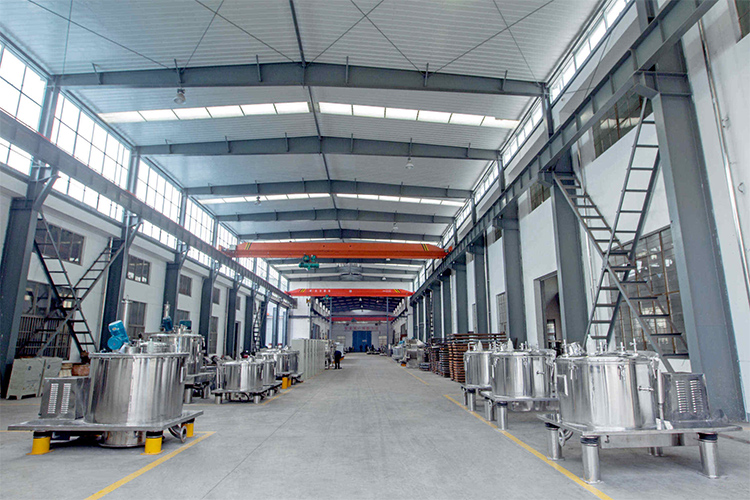
Batch basket centrifuge production at a separation equipment works. Basket diameter is only one line of a comparison; rated load, discharge and materials decide the duty fit.
Why a 1250 mm basket does not make two models interchangeable
Basket diameter fixes the centrifugal radius. It does not fix how much material a machine can process in one cycle. JGD's own selection guidance notes that machines with the same drum diameter can still have different loading capacities, because the effective depth of the basket and the manufacturer's loading limit both change the rated batch mass. Volume alone is not a selection basis, and the rated loading limit has to be respected: overloading produces severe vibration and is a safety problem rather than a route to higher output.
The PLQ1250 and PD1250 demonstrate that point precisely. Both run a 1250 mm basket, yet one holds 300 L and is rated for 400 kg, and the other holds 400 L and is rated for 530 kg. A buyer who shortlists on diameter alone will treat these as near-identical machines and will miss the two differences that matter operationally: how much cake leaves the basket per cycle, and how that cake is removed.
PLQ1250 and PD1250 side by side
The table below uses only the published figures for each model. Where a parameter is relevant to selection but not documented in the supplied data, it is marked for confirmation at RFQ rather than estimated.
| Parameter | PLQ1250 | PD1250 |
|---|---|---|
| Basket diameter | 1250 mm | 1250 mm |
| Drum volume | 300 L | 400 L |
| Maximum load | 400 kg | 530 kg |
| Drum speed | 1000 rpm | 960 rpm |
| Separation factor | Fr 700 | Fr 645 |
| Discharge principle | Automatic pull-bag discharge; cake released without scraping | Top discharge, bag-lifting design |
| Lid | Fully openable | Confirm opening arrangement at RFQ |
| Cleaning | Designed to support cGMP cleaning requirements | Confirm cleaning regime for the intended duty |
| Main motor | Confirm rating and explosion-proof marking at RFQ | 18.5 kW, explosion-proof |
| Material options | SS304, SS321, SS316L, SS2205, SS904L, titanium, Hastelloy-C; SS316L contact parts available | SS304, SS321, SS316L, SS2205, SS904L, titanium, Hastelloy-C; SS316L contact parts available |
| Strongest fit | Attrition-sensitive crystals, pharmaceutical cleaning discipline, moderate batch mass | Higher batch mass per cycle, established bag-handling routine |
Working volume and rated load: what the extra 100 L actually carries
The PD1250 carries 130 kg more solids per batch than the PLQ1250. Because the basket diameter is identical, that difference comes from the effective basket depth and the load the basket is rated to carry, not from a larger centrifugal radius. Divided out, the two ratings scale in a similar way: 400 kg across 300 L and 530 kg across 400 L both work out at roughly 1.33 kg per litre, a ratio calculated from the two published figures rather than a stated design parameter. The practical reading is that the larger drum buys a proportionally larger batch, not extra margin per litre of volume.
Whether that larger batch is an advantage depends on how the plant batches. Where the process is campaign-based and the constraint is total mass per shift, a 530 kg charge reduces the number of cycles needed for a given tonnage, provided cycle time is comparable, a condition the published figures do not establish. Where lot size is fixed by a customer specification, a register or a validation protocol, a larger batch can be a complication rather than a gain, because the batch mass, the solvent charge and the wash volume all change with the cake load.
Discharge method: where the two machines genuinely diverge
Batch basket centrifuges are emptied in several different ways. Basic models are discharged by hand from above after the cover is opened; hanging-bag models release the solids by lifting the filter bag directly; higher-automation models such as the LGZ and PGZ use a fully automatic scraper acting from the bottom of the basket. The PLQ1250 and PD1250 sit at different points on that spectrum, and this is the difference a buyer should weigh hardest.
PLQ1250: automatic pull-bag discharge without scraping
On the PLQ1250 the cake is released by an automatic pull-bag action, and the design deliberately avoids scraping the solids out of the basket. The purpose is to limit crystal abrasion during discharge. That matters wherever particle size or fines content is a quality attribute rather than an inconvenience: fines generation can slow the subsequent filtration or drying step, shift wash efficiency, and in pharmaceutical crystallisation it can move a particle size distribution outside its specification. For needle-shaped, plate-like or fragile agglomerated crystals, a discharge route that does not drag a scraping edge through the cake is a fit argument, not a convenience feature.
The fully openable lid is a separate, practical advantage: it gives access for inspection, bag attention and cleaning, and pairs with the stated support for cGMP cleaning requirements. Buyers in pharmaceutical duty should still request the cleaning validation package, the wetted-surface finish specification and the documentation set for the contact parts, because cleanability is demonstrated by documentation and swab results, not by the word cleaning on a data sheet.
PD1250: top discharge by bag lifting
The PD1250 removes cake from the top of the basket by lifting the filter bag. It is a well-established arrangement and it suits plants that already run bag-handling routines and have the room and lifting arrangement to support them. The integration questions to settle at RFQ are practical ones: how the bag is lifted and by what, what headroom the lift requires, how the lid opens and clears, how long a bag changeover takes, and how a loaded bag is handled inside the room without creating dust exposure or solvent vapour release.
Separation factor 700 against 645: read the material, not the ranking
Separation factor expresses centrifugal separation capability, and a higher value means stronger separating force. Fr is a function of basket radius and rotational speed, so on the same 1250 mm basket, 1000 rpm and 960 rpm produce the 700 and 645 figures quoted. The two numbers are close: a 55-point difference, not a change of class.
Neither value is a verdict on performance. Separation factor has to be matched to the material. JGD's selection guidance points out that fragile crystals should not be run at too high a separation factor, because the same force that improves separation can break particles; finer or more difficult solids may call for more force rather than less. Read together with the discharge principle, this is the clearest split between the models: where attrition governs quality, the PLQ1250's non-scraping release matters more than 55 Fr points; where separation is marginal for the solids in question, the honest answer is a trial on the actual slurry, because no specification sheet predicts cake moisture or clarity for a given crystal size distribution.
Motor, explosion protection and electrical fit
The PD1250's documented main motor is 18.5 kW in explosion-proof construction. For the PLQ1250, the main motor rating and explosion-proof marking should be confirmed at RFQ alongside the drum, load, speed and discharge data. This is not a small procurement detail: the motor rating drives starting current and the electrical infrastructure around the machine, and in a solvent-handling plant the explosion-protection marking is a qualification item, not a preference.
An explosion-proof main motor is one element of a hazardous-area installation rather than the whole of it. Earthing, cabling, instrumentation and the site's own zone classification all form part of the conformity picture, and the equipment documentation should be read against the site specification. For European projects, EN 12547:2014 is listed by CEN as the current standard covering centrifuge safety requirements, with household and laboratory centrifuges addressed separately under EN 61010-2-020. It is a useful reference when tendering, though it does not replace the purchaser's own technical specification.
Materials: seven alloys, one pharmaceutical default
Both models list SS304, SS321, SS316L, SS2205, SS904L, titanium and Hastelloy-C as construction options, and both offer SS316L contact parts for pharmaceutical processing. Having the same list does not mean the same selection: the correct grade is decided by the mother liquor and the wash liquid, at operating temperature, including chloride content.
JGD's published guidance on corrosive media is a reasonable starting framework. SS304 suits normal working conditions; SS316L is the choice for moderate corrosion; Hastelloy, or a PTFE lining where the equipment offers one, is reserved for strongly corrosive duty; and ordinary SS304 should be avoided where the material contains chloride ions. The higher grades in the list, including SS2205, SS904L, titanium and Hastelloy-C, extend the envelope further, but the grade name alone is not a performance guarantee for a specific liquor. Material certificates, positive material identification and a wetted-surface finish specification are the documents that convert a grade name into a qualified machine, and buyers should also confirm exactly which components count as contact parts when SS316L contact parts are specified.
Application fit: chemical, pharmaceutical, salt and fertilizer duty
Batch basket centrifuges are suited to granular and crystalline solids, including salt crystals, chemical intermediates, resins, food additives and plant extracts. Within that envelope, the two models pull in different directions.
- Chemical intermediates and multi-product plants. Where a site runs several products through one machine, solvent-wet crystals and explosion-protection requirements usually dominate. The PD1250's documented 18.5 kW explosion-proof motor is directly relevant here; the PLQ1250's automatic non-scraping release is relevant where crystal size affects downstream filtration or drying.
- Pharmaceutical processing. SS316L contact parts, documented cleaning and controlled particle attrition are the three requirements that usually decide the choice. The PLQ1250's stated support for cGMP cleaning requirements and its abrasion-limiting discharge both point to this duty, subject to the site's own validation requirements being met by the supplied documentation.
- Salt and fertilizer. Bulk crystalline duty usually tolerates some attrition and rewards batch mass, which favours the PD1250's 530 kg charge and 400 L drum. Chloride-bearing process streams make the SS304 caution directly applicable, so the alloy decision deserves as much attention as the discharge decision.
These mappings are conditional. They describe where each machine's documented characteristics align with a duty; they do not establish that either model has been deployed on a specific product, and a plant with an unusual crystal habit or a tight moisture target should treat the mapping as the start of a trial, not the end of one.
Where these two sit against other discharge families
The comparison only makes sense inside the batch family. A basic top-discharge machine requires the cover to be opened and the solids dug or lifted out by hand, which trades capital simplicity for labour and operator exposure. Scraper discharge machines such as the LGZ and PGZ series remove cake automatically from the bottom of the basket with a scraper, which supports high automation but brings a scraping action into contact with the solids. Continuous families, including pusher type and peeler centrifuges, occupy a different duty envelope altogether and are not interchangeable with a batch machine on a like-for-like basis.
The decision rule follows from that structure: settle batch versus continuous first, then manual versus automatic discharge, and only then compare models within the chosen family. The PLQ1250 and PD1250 are both fully automatic batch machines with different release mechanisms, which is exactly why the comparison should be made on discharge and batch mass rather than on the word automatic.
What the specification sheet cannot settle
Neither data set establishes throughput, cycle time, cake moisture, wash ratio, fines generation, energy per tonne of solids, cleaning validation outcomes, price or lead time. Those are the numbers that decide the business case, and they depend on the material and the operating discipline as much as on the machine. A comparison built only on the published table would be incomplete without saying so.
What a buyer can do is convert the gaps into verification items:
- Confirm the PLQ1250 main motor rating and explosion-proof marking, and confirm the PD1250 lid and cleaning arrangements for the intended duty.
- Request material certificates and positive material identification for the selected grade, plus wetted-surface finish documentation if the duty is pharmaceutical.
- Ask for the bag specification, expected bag life and changeover procedure for whichever discharge principle is chosen.
- Define containment and operator-exposure requirements explicitly, independently of the discharge label.
- Agree what factory acceptance testing will cover, including no-load running, vibration behaviour and control sequence checks.
- Run a trial on the actual slurry before committing to the attrition or moisture outcome, since that is the only reliable way to compare a pull-bag release with a bag-lifting release on a real crystal.
Outlook: what would reopen the decision
Both models belong to a mature design family, so the decision is unlikely to be overturned by a single new feature. It is more likely to be reopened by a change in the process. A move to a different crystal habit, a tightening particle-size specification or a new containment requirement would shift weight toward the pull-bag release. A step-up in tonnage would push the balance toward the larger batch, and a step-up beyond the practical batch rhythm would push the discussion out of the batch family entirely and toward continuous options such as pusher centrifuges. Treating the choice as a snapshot of current duty, rather than a permanent standard, is the more durable procurement position.
Decision summary
Favour the PLQ1250 when crystal attrition is the governing quality risk, when 400 kg per batch matches the plant's lot size, when a discharge that avoids scraping is worth more than 130 kg of extra batch mass, and when cGMP cleaning support is a stated requirement.
Favour the PD1250 when batch mass is the binding constraint and 530 kg per cycle reduces the number of batches for a fixed tonnage, when top-discharge bag lifting fits the room's handling routine, and when an 18.5 kW explosion-proof main motor matches the site's electrical and hazardous-area specification.
Reopen the category if the duty requires continuous operation, a substantially higher separation factor than either model offers, or a containment level that neither discharge principle is documented to deliver. In that case the honest conclusion is that the shortlist, not the model, needs revising.
FAQ
Why do two centrifuges with the same 1250 mm basket have different loading capacities?
Loading capacity is set by the effective depth of the drum and the manufacturer's loading limit, not by the drum diameter alone. The PLQ1250 is rated at 300 L and 400 kg, while the PD1250 is rated at 400 L and 530 kg, despite sharing a 1250 mm basket. The rated limit must be observed: overloading causes violent vibration and creates a safety hazard, so volume alone is not a selection basis.
How does automatic pull-bag discharge differ from top-discharge bag lifting in practice?
Both are ways of emptying a batch basket centrifuge without manual shovelling. Pull-bag discharge releases the cake automatically by drawing the filter bag, with no scraping edge dragged through the solids, which is intended to limit crystal abrasion. Top-discharge bag lifting removes the cake by lifting the filter bag out of the top of the basket, so the lifting arrangement, headroom, lid clearance and bag changeover procedure become part of the installation design. Manual upper shovelling and automatic scraper bottom discharge are separate alternatives used on other models.
Does a higher separation factor always mean better separation for my material?
No. Separation factor represents centrifugal separation capability, and a higher value means stronger separating force, but the right value depends on the solids. Fragile crystals should not run at too high a factor because the force can break particles, while fine particulate material may need more force to separate effectively. The PLQ1250 at Fr 700 and the PD1250 at Fr 645 differ only modestly, so the discharge principle is often the more decisive difference for attrition-sensitive products.
Which material should be specified for corrosive or pharmaceutical duty?
Both models offer SS304, SS321, SS316L, SS2205, SS904L, titanium and Hastelloy-C, with SS316L contact parts available for pharmaceutical processing. As general guidance, SS304 suits normal working conditions, SS316L suits moderate corrosion, and Hastelloy or a PTFE lining is used for strongly corrosive media; ordinary SS304 should be avoided where the material contains chloride ions. The final grade should be confirmed against corrosion data for the actual mother liquor and wash liquid, at operating temperature, and supported by material certificates.
What should be verified before placing an order?
Confirm the parameters that are not documented for a given model, such as the PLQ1250 main motor rating and explosion-proof marking, and the PD1250 lid and cleaning arrangements. Request material certificates and wetted-surface finish documentation, agree the bag specification and changeover procedure, define containment and operator-exposure requirements separately from the discharge label, and specify what factory acceptance testing covers. For attrition, cake moisture or cycle time, run a trial on the actual slurry rather than relying on catalogue figures.
Further technical detail: JGD Centrifuge product brochure (PDF).
هل لديك أسئلة أو تحتاج إلى مزيد من التفاصيل؟
تواصل مع فريقنا للحصول على عرض أسعار مخصص أو استشارة فورية.
طلب عرض أسعار
املأ النموذج أدناه وسيتواصل معك فريقنا بعرض مقترح مخصص.
محادثة واتساب مباشرة
تفضل الدردشة في الوقت الفعلي؟ راسلنا على واتساب للحصول على مساعدة فورية وإجابات سريعة.
- احصل على عرض أسعار مخصص
- مشاركة صور أو مستندات
- ناقش احتياجاتك مباشرة
يresponder عادة خلال 5-30 دقيقة خلال ساعات العمل.