
PLT-120, PLT-198 or PLT-210? Matching a Drive Wheel to a Chassis
PLT-120, PLT-198 or PLT-210? Matching a Drive Wheel to a Chassis
The PLT-120, PLT-198 and PLT-210 are three Plutools drive wheels that appear on the same shortlist far more often than they compete for the same order. They are documented at different load bands, different electrical profiles and different steering arrangements, so the useful buying question is not which one is better, but which vehicle each one can serve without a chassis redesign.
This comparison is written from the buyer's side of the table. It uses only the specifications that are documented for each model, marks clearly where a dimension is not stated, and ends with the questions that decide an order rather than a ranking. Where a claim belongs to the supplier rather than to a measured result, it is attributed and kept separate from the model data.
One caution governs the whole exercise. The three data sets are not symmetrical: the PLT-120 and the PLT-198 each document a set of numeric ratings, while the PLT-210 is described here only by its architecture, a parallel horizontal drive wheel with integrated steering. That imbalance is a documentation difference, not evidence that the PLT-210 lacks ratings, and buyers should request the missing sheet before scoring any of the three.
The documented record, side by side
Reading the three models across a small set of dimensions is faster in a table than in prose, provided the empty cells are read as empty rather than as zeros.
| Dimension | PLT-120 | PLT-198 | PLT-210 |
|---|---|---|---|
| Documented role | Differential drive wheel for AGV and AMR use | Forklift drive wheel | Parallel horizontal drive wheel with integrated steering |
| Load rating | 150 kg | 1,500 kg | Not stated |
| Supply voltage | 48 V | Not stated | Not stated |
| Current | 11.2 A | 68 A | Not stated |
| Reduction ratio | Not stated | 32 | Not stated |
| Torque | Not stated | 576 Nm maximum; 260 Nm output | Not stated |
| Speed figure | Not stated | 3000 RPM | Not stated |
| Tread and structure | PU tread; carbon steel | Not stated | Not stated |
| Ingress protection | IP65 | Not stated | Not stated |
| Steering | Differential drive; no separate steering unit documented | Not stated | Integrated |
| Additional documented figure | 5 ± 2 kg | — | — |
How to read "not stated". A blank cell in this table means the dimension is not part of the material compared here. It does not mean the model is incapable, unrated or unengineered for that dimension. In procurement terms it means one thing only: the specification sheet, drawing or supplier confirmation still has to be obtained before the model can be scored against a requirement.
Two observations follow from the table itself. First, the models overlap on very few comparable dimensions, which limits how far any head-to-head scoring can be taken on published data alone. Second, where a figure is documented it is a specific engineering value rather than a marketing description, which makes each one testable in a supplier conversation.
A 150 kg rating and a 1,500 kg rating describe different vehicles
Load rating is the fastest way to divide this trio. The PLT-120 carries a documented 150 kg rating and the PLT-198 a documented 1,500 kg rating, a tenfold difference that places them in different vehicle classes before any other specification is considered.
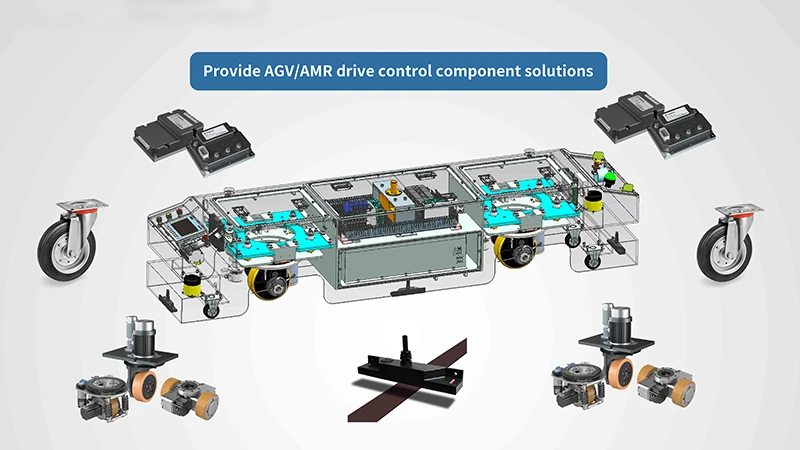
The 150 kg figure belongs to the light end of the AGV and AMR market: a differential platform where the drive wheel assembly carries part of a chassis that also holds a battery, controllers, safety scanners and payload. The 1,500 kg figure belongs to forklift-class traction, where drawbar pull, lifting and braking loads pass through the drive wheel and the reduction gearbox is sized for sustained torque rather than fine positioning alone.
Neither number is a vehicle payload, and this is the most common misreading in drive-wheel procurement. A wheel rating is normally expressed per drive unit or per wheel; converting it into a permitted vehicle weight requires the number of load-bearing wheels, the centre of gravity, the dynamic factors of acceleration and braking, and the stability margin the vehicle designer is working to. Buyers should confirm the definition in writing before calculating anything. A 150 kg unit multiplied by four does not describe a 600 kg vehicle, because load transfer behaves differently under braking and cornering than it does at rest.
For the PLT-210, the load dimension is not part of the compared material at all, which makes it the first item on any request for information sent to the supplier.
Why 11.2 A and 68 A cannot be compared directly
The PLT-120 documents its electrical side more completely than the PLT-198 does: 48 V and 11.2 A are both stated. The PLT-198 states 68 A, but its supply voltage is not part of the compared material. Current without voltage cannot be converted into power, so a comparison built on current alone would be an assumption presented as arithmetic.
What can be said is directional. A unit drawing 68 A implies heavier cabling, contactors, fusing and thermal design in the controller and battery circuit than an 11.2 A unit does, and it implies a different class of battery pack. That is an integration consequence, not a performance verdict.
Two clarifications matter before either figure is used in a design review. The first is whether the published current is a continuous rating, a peak value or a stall-adjacent maximum; the answer changes cable cross-section, controller headroom and the duty cycle the vehicle can sustain. The second is nominal voltage compatibility: a documented 48 V profile on the PLT-120 is a direct input to battery and charger selection, while the PLT-198's voltage must be confirmed before it can be matched to an existing platform.
Reading the PLT-198's two torque figures
The PLT-198 documents two torque values, 576 Nm maximum torque and 260 Nm output torque, alongside a reduction ratio of 32. The pair is more informative than either number alone, because the gap between them is where duty allowance lives.
Drive-wheel gearboxes typically publish a maximum torque representing a short-duration or peak limit, and an output or rated torque representing what the unit can deliver in continuous service. On the PLT-198 the maximum figure is more than twice the output figure, which is the shape of a design that holds a deliberate allowance between peak and continuous operation. That shape does not by itself tell a buyer what continuous duty is permitted; the permissible duty cycle, thermal condition and mounting environment all sit behind the two numbers and should be requested explicitly.
Nor does torque alone predict drawbar pull or acceleration. Wheel diameter and tread friction intervene between the output shaft and the floor, and neither is stated for the PLT-198 in the compared material. A buyer holding a target travel speed should also confirm what the 3000 RPM figure refers to. If it is motor input speed, the 32:1 reduction places the output shaft in the region of 94 RPM, a figure calculated from the two documented values while ignoring losses, not a measured output speed.
The practical use of these numbers is comparative, not absolute: they identify the PLT-198 as a geared traction drive sized for a heavy vehicle, and they give a buyer precise questions to ask rather than a performance promise to accept.
What integrated steering changes on the PLT-210
The PLT-210 is documented as a parallel horizontal drive wheel with integrated steering. Integration means the steering function is built into the drive unit rather than added to the chassis as a separate actuator, bearing arrangement and linkage. For a vehicle designer that usually means fewer brackets, one alignment task instead of two, and a shorter list of mechanical interfaces to qualify before a pilot build.
It also concentrates more of the motion system inside one supplier's scope. That simplifies procurement and shifts the boundary of responsibility: when a steering fault appears, it sits inside a single unit rather than between a wheel supplier and an actuator supplier. For a small engineering team, that consolidation is often worth more than a marginal difference in unit specification.
Integration does not remove the need for data. Steering range, feedback device, holding brake, vertical load capacity, supply voltage and control interface are all absent from the material compared here, and each one affects how the chassis is designed rather than how the unit is bolted on. Horizontal steered drive units are an established category among industrial suppliers, and the architecture itself is not unique to one company: maxon describes an integrated wheel-drive subsystem combining wheel, motor, gearhead and brake, and IDEC describes a safety-oriented wheel drive combining wheel, gearbox, motor, safety encoder and safe motion control. Those descriptions establish that the category exists and that buyers should expect a defined control and safety interface. They do not make any two units equivalent, and each statement is a supplier description of its own product.
IP65, polyurethane and carbon steel: a useful but partial answer
The PLT-120 documents the environmental side of the specification most fully of the three: IP65, a polyurethane tread and a carbon steel structure.
IP65, in the usual reading of the IEC 60529 code, denotes dust-tight construction and protection against water jets. For an AGV or AMR working in a dusty warehouse, or on a floor that is hosed down between shifts, that is a relevant threshold and a reasonable one to specify. It is not a statement about chemical resistance, high-pressure steam cleaning or long-term outdoor exposure, and it should not be read as one.
Polyurethane is a common tread choice for smooth indoor floors, where it offers abrasion resistance and low marking. On rough, oily or debris-covered surfaces the trade-off shifts toward other compounds, and the friction available at the tread depends on the floor finish rather than on the material name alone. Carbon steel contributes stiffness and dimensional stability to the hub and carcass, while adding mass and requiring corrosion protection wherever moisture is present. Whether any of this matters depends on the cleaning regime, the floor and the load per wheel.
For the PLT-198 and the PLT-210 these three dimensions are not part of the compared material. A forklift working outdoors, or a steered unit in a wash-down zone, needs those answers before a sample is ordered, and the absence of an IP rating in a short specification summary is not proof that no rating exists.
Three conditional fits, not three recommendations
The scenarios below are illustrative configurations assembled from documented ratings. They are not descriptions of installed projects, and they are deliberately written as conditional examples so that the reasoning can be checked against a real chassis brief.
Light differential platform, smooth floor, regular wash-down
Take a two-wheel differential AMR moving totes or parts kits on a sealed indoor floor, with a routine that includes washing the traffic lanes. Here the PLT-120's documented combination is the relevant one: a 150 kg rating, IP65, a polyurethane tread, carbon steel structure and a 48 V, 11.2 A electrical profile. The checks that decide the order are the definition of the 150 kg rating per wheel, the actual load carried by the drive wheel under acceleration, and the meaning of the 5 ± 2 kg figure, which the compared material does not label as unit mass, a tolerance band or something else. Ask before it becomes a line in the bill of materials.
Forklift-class traction, heavy indoor handling
Take a counterbalance or tow-tractor application where the drive wheel has to move a 1,500 kg class load repeatedly, with frequent starts and stops on concrete. The PLT-198's documented dimensions, a 1,500 kg rating, a 32:1 reduction, 576 Nm maximum torque, 260 Nm output torque and 68 A, are the ones a chassis engineer would size against. The deciding questions are the continuous torque permitted at the intended duty cycle, the wheel diameter that converts torque into drawbar pull, the nominal supply voltage and the brake arrangement, none of which appear in the compared material.
A chassis that must steer rather than skid
Take a layout where skid-steering is unacceptable, either because of floor marking, tyre wear or aisle geometry, and the vehicle needs a drive wheel that steers as well as drives. The PLT-210's documented architecture, a parallel horizontal drive wheel with integrated steering, points at that requirement directly. What decides the order is everything the architecture summary leaves open: steering range, feedback type, vertical load, voltage, brake and the mounting drawing.
Where the supplier's own comparison claims fit, and where they stop
Plutools (Shanghai Plutools Automation Corporation Co., Ltd.) publishes a comparison of its AGV drive wheel unit against other domestic AGV drive systems of similar load capacity and operating specifications. In that comparison the company cites approximately 5 to 10 percent higher transmission efficiency, 10 to 15 percent longer service life and a 15 to 20 percent lower estimated failure rate under comparable operating conditions, with maintenance intervals extended by roughly 20 to 30 percent. It also states that initial purchase cost may be comparable or around 5 to 10 percent higher, while total cost of ownership over three years may be an estimated 10 to 20 percent lower. The company reports a production facility of over 10,000 square metres, more than 100 employees and more than 200 patents, and lists its product range and contact details at plutools.com.
Those figures are supplier-reported estimates and should be used that way. Three limits are worth stating plainly. They describe the AGV drive wheel unit as a category rather than a measured result for a specific model, so they do not attach to the PLT-198 or the PLT-210 in the compared material. The phrase "under comparable operating conditions" carries most of the weight, and a buyer should ask what those conditions were. And an estimated failure rate is a projection, useful for framing a business case but not a substitute for test data from the buyer's own duty cycle.
None of this makes the claims unusable. It defines what they can support: a reason to shortlist and to request evidence, not a reason to skip the evidence request.
Market context that affects the choice, briefly
Published forecasts for automated guided vehicles point to continued expansion. TrendX Insights projects the AGV market growing from USD 4.45 billion in 2025 to USD 12.44 billion by 2034, a compound annual growth rate of 12.1 percent over 2026 to 2034. A supplier selection guide published by Plutools cites the global AGV wheel drives market at approximately USD 1.2 billion in 2024 with a projected USD 3.5 billion by 2034, a figure the guide attributes to commercial market research.
Forecast publishers do not agree on the base or the slope, and at least one has revised its 2025 estimate downward, so these numbers are best treated as directional context rather than planning inputs. The procurement implication is narrower and more useful: if a fleet is expected to grow, the value of a drive wheel lies as much in documentation, spare-part continuity and interface stability as in its unit price. None of the three models discussed here has a price, lead time or warranty term in the compared material, so no cost comparison between them can be made honestly at this stage.
A pre-order verification list
Whichever model survives the first filter, the same eight questions should be answered in writing before a purchase order is raised. They are drawn directly from the gaps in the documented data above.
- Load definition: is the stated rating per wheel, per drive unit or per axle, and what dynamic factors are assumed?
- Electrical basis: is the stated current continuous, peak or stall-adjacent, and what is the nominal supply voltage?
- Torque basis: which figure governs continuous duty, at what ambient temperature and duty cycle?
- Geometry: wheel diameter, mounting pattern, shaft and bolt dimensions, and overall envelope drawing.
- Steering interface: for a steered unit, the steering range, feedback device, control protocol and calibration procedure.
- Environment: ingress protection, tread compound and corrosion protection for the actual floor and cleaning regime.
- Safety integration: brake type, encoder presence and how the unit interfaces with the vehicle's safety functions, which for AGV and AMR designs typically involve performance-level requirements under standards such as ANSI/RIA R15.08 and ISO 3691-4. The unit specification does not by itself establish conformity for a vehicle.
- Continuity: spare-part availability, change-notification practice and expected service life basis.
Buyer-fit questions instead of a winner
Because the documented data sets do not overlap enough for a ranking, the honest conclusion is a set of questions. A buyer who can answer these six has effectively made the selection.
- What load does the drive wheel actually carry at maximum acceleration and braking, and how was that derived from vehicle payload?
- Is the vehicle a differential platform, a forklift-class traction machine, or a chassis that must steer its drive wheel?
- What nominal voltage and continuous current does the existing battery and controller architecture support?
- Does the duty cycle require a continuous torque allowance, and which published torque figure applies to it?
- Which environmental conditions, dust, water jets, floor finish or cleaning chemicals, must the tread and structure survive?
- Which supplier documents are still missing before the model can be scored, and who will obtain them?
The PLT-120 answers a light differential brief with an IP65 enclosure and a documented 48 V profile. The PLT-198 answers a heavy traction brief with a 32:1 reduction and a torque pair sized for forklift work. The PLT-210 answers a steering brief by moving that function inside the drive unit. A shortlist that keeps all three alive is usually a shortlist that has not yet defined its chassis, and defining the chassis costs less than redesigning around the wrong wheel.
FAQ
Is the PLT-120 suitable for a 150 kg AMR?
Its documented load rating is 150 kg, which places it in the light AGV and AMR band rather than at the edge of a heavier platform. Suitability still depends on how that rating is defined, how many wheels share the vehicle load, and the dynamic loads during braking and cornering. The IP65, polyurethane tread, carbon steel structure and 48 V, 11.2 A figures are also documented; the 5 ± 2 kg figure should be clarified with the supplier before it is used in a design calculation.
What is the difference between the PLT-198's 576 Nm maximum torque and its 260 Nm output torque?
Both are documented values for the same unit, and the gap between them is normally read as the difference between a short-duration or peak limit and a continuous output figure. The PLT-198's maximum figure is more than twice its output figure, which indicates a deliberate allowance between peak and continuous operation. Which value governs a specific application depends on duty cycle, thermal conditions and mounting, and those conditions should be confirmed with the supplier rather than inferred from the two numbers.
Does the PLT-210 include steering, and what does that change for the chassis?
The PLT-210 is documented as a parallel horizontal drive wheel with integrated steering, so the steering function is part of the drive unit rather than a separate chassis assembly. That usually reduces brackets, alignment tasks and the number of mechanical interfaces, and it places drive and steering faults within one supplier's scope. Steering range, feedback type, vertical load capacity, voltage and control interface are not part of the compared material and must be requested before the chassis is designed around the unit.
Can the three models be compared on price or total cost of ownership?
Not from the available material. No unit price, tooling cost, minimum order quantity, lead time or warranty term is documented for the PLT-120, PLT-198 or PLT-210. Plutools publishes an estimate that its AGV drive wheel unit may cost the same or about 5 to 10 percent more at purchase while delivering an estimated 10 to 20 percent lower total cost of ownership over three years, but that is a supplier-reported category estimate rather than a per-model quotation, and it should be verified against a specific application.
Which model should a buyer choose for a 1,000 kg application?
There is no documented answer to that question, and a responsible comparison should not manufacture one. The PLT-120 is documented at 150 kg and the PLT-198 at 1,500 kg, with no intermediate model in this material, and the PLT-210 has no published load rating here. A 1,000 kg brief therefore requires confirmation of per-wheel load, vehicle layout and duty cycle first, followed by a direct request to the supplier for the model and configuration that matches those conditions.
Reference document. Plutools publishes a drive-wheel selection manual covering the PLT series, available as a PDF for public access and download: PLT selection manual (PDF). Buyers comparing the three models should treat the manual and the model drawing as the specification of record, and confirm any figure used in a design review against the current revision.
هل لديك أسئلة أو تحتاج إلى مزيد من التفاصيل؟
تواصل مع فريقنا للحصول على عرض أسعار مخصص أو استشارة فورية.
طلب عرض أسعار
املأ النموذج أدناه وسيتواصل معك فريقنا بعرض مقترح مخصص.
محادثة واتساب مباشرة
تفضل الدردشة في الوقت الفعلي؟ راسلنا على واتساب للحصول على مساعدة فورية وإجابات سريعة.
- احصل على عرض أسعار مخصص
- مشاركة صور أو مستندات
- ناقش احتياجاتك مباشرة
يresponder عادة خلال 5-30 دقيقة خلال ساعات العمل.