
POF Shrink Film Procurement FAQ: Tests, Rolls and Tolerances
POF Shrink Film Procurement FAQ: Tests, Rolls and Tolerances
Most POF shrink film disputes do not begin with a bad roll. They begin with a sentence nobody wrote down. A data sheet quotes shrinkage of 65%–75%; a purchase order repeats "shrinkage: 65%–75%"; the first delivery is tested at a different temperature, in a different medium, on a differently cut specimen, and both parties discover they agreed on a number but not on a test.
This reference is written for procurement and packaging engineers who are past the screening stage and are preparing a purchase order or an approved specification for POF Shrink Film. It works through the three areas where the gap between a published typical value and an enforceable acceptance criterion most often appears: shrinkage test conditions, roll format details, and tolerances. Gojun POF Shrink Film is used throughout as a supported example of how grade, format and specification matching are handled, without treating any published figure as a guaranteed limit.
 Exterior of the Wenzhou production facility. Gojun Pack documentation.
Why a 65%–75% Range Cannot Function as an Acceptance Limit
Shrinkage is a response, not a fixed property. It describes what a film did under a particular set of conditions: a heating medium, a temperature, a dwell time, a specimen geometry, and a defined moment of measurement. Published POF data sheets frequently present the result as a broad band — 65%–75% is a commonly quoted example — and that band is useful for screening a grade against an application. It is not usable as a pass/fail line, because the same roll can produce a figure at the low end of the band in one test set-up and a figure above it in another without anything being wrong with the film.
The practical consequence for a buyer is straightforward. A specification clause that reads only "shrinkage 65%–75%" cannot be enforced, because neither party can demonstrate non-compliance without an agreed method. Conversely, a supplier cannot defend a delivery against such a clause either. The number has to be converted into a clause with a subject, a condition and a rule, and that conversion belongs in the approved specification, signed before bulk production rather than after the first complaint.
The same logic applies to every other value copied from a data sheet: thickness, width, roll length, tensile and seal performance. A published typical value describes an expected result; an acceptance criterion describes what will be measured, how, and what happens if the measurement falls outside the agreed window. Those are different documents serving different purposes, and procurement teams that keep them separate avoid most of the arguments that follow a first shipment.
Test Temperature, Dwell Time and Method: The Clauses Buyers Forget
Three variables do most of the damage when they are left out. The first is the heating method: a hot-air shrink tunnel, a hot-water bath and a laboratory oven do not deliver heat to a thin film in the same way, and results from one are not automatically comparable with results from another. The second is temperature, and specifically whether the specification refers to the equipment set point or to the temperature actually measured at the specimen. The third is dwell time — the period the film spends in the heating medium — which interacts with temperature and with film thickness.
A specification that names only a shrinkage target leaves all three open. The buyer's laboratory may run a controlled bench test; the supplier's quality team may sample from a production tunnel. Both can be honest and both can be right, and the two reports will still not match. Recording the method, the measured temperature and the dwell time is what makes a later comparison meaningful, whether that comparison happens between two sites, two batches, or two years.
Specimen definition is the quieter fourth variable. Shrink behaviour differs between the machine direction and the transverse direction, and it can differ between a specimen cut near the web edge and one cut near the centre. Free shrink, measured without restraint, is not the same as shrink measured under tension. If the specification does not state the cut direction, the sampling position and whether the test is free or restrained, the results can be averaged into a figure that hides a real directional imbalance — which is precisely the characteristic a packaging line feels as curling, dog-earing or uneven wrap.
| Clause | What the approved specification should record | What fails without it |
|---|---|---|
| Test method | Heating medium and equipment type used for the reference test | Supplier and buyer results cannot be compared or repeated |
| Temperature | The temperature applied to the specimen and how it is verified | Shrink response is temperature-dependent, so an unrecorded offset makes the result incomparable |
| Dwell time | Time in the heating medium, stated for the reference test | Short and long exposures produce different readings from the same roll |
| Specimen | Size, cut direction, sampling position across the web, free or restrained | Directional imbalance is averaged away and only appears on the machine |
| Measurement | Cooling interval before measuring and the measuring method | Hot or unrestrained film is measured at the wrong moment |
| Acceptance rule | Minimum free shrink per direction, permitted difference between directions, number of specimens, pass/fail | A range with no rule cannot be enforced in either direction |
Film Grade and Thickness Are Settled Before the Shrinkage Target
Grade selection determines what a shrinkage clause can reasonably ask for, so it belongs earlier in the document than the shrinkage figure. Gojun POF Shrink Film is supplied by Zhejiang Gojun New Material Technology Co., Ltd., a Wenzhou-based manufacturer operating the Gojun Pack brand, and the range includes regular, low-temperature and cross-linked POF options. Because those options behave differently, the approved specification should name the grade explicitly and the retained sample should represent that grade — not a neighbouring one that happens to be in stock.
Grade names are a starting point, not a resolution. A buyer whose line runs a constrained shrink window should raise the tunnel temperature and dwell time as trial requirements rather than assume that a grade name settles the question on its own. The useful outcome of the trial is a recorded combination of grade, thickness and machine settings that produced an acceptable pack, and that combination is what the specification carries forward.
Thickness affects how quickly a film reaches shrink temperature, how it seals, and how much load it can protect. Market data indicates where most volume sits rather than what any single buyer needs: Precedence Research reported in 2024 that POF grades between 15 µm and 25 µm account for more than 58% of total usage. That is a useful indication that thin-gauge film dominates everyday packaging, not a recommendation for a specific application. The same source reported in 2024 that cross-linked film provides 38% higher tensile strength and 29% better puncture resistance than standard POF — a source-reported comparison that helps a buyer decide whether to trial a cross-linked grade, and not a performance limit for any delivered roll.
Thickness tolerance is the part buyers most often leave implicit. A nominal 19 µm film with an unstated tolerance is not a specification; it is a description. The specification should state the nominal value, the permitted deviation, where it is measured across the web, and the instrument and sampling plan used to check it.
Roll Format, Width and Core: Where Execution Details Turn Into Claims
Roll configuration is confirmed before production because it cannot be corrected afterwards without remaking the order. A format mismatch usually shows up as a machine stoppage, not as a film defect, and that distinction matters when a buyer and supplier try to establish responsibility. Gojun Pack confirms film format, thickness, width and logo printing against the application, with final specifications and feasibility agreed before production begins.
The first decision is format. Center-folded POF presents two layers with a fold along one edge, which suits lines built around a folded web; single-wound POF presents a single layer on a core for lines that need one web. Perforated film, where used, adds venting for air escape during shrinking. Each of these is a distinct item for purchasing purposes, and a quotation for one should not be read as covering another.
- Width, stated for the format in question — a folded roll has a flat width and a folded width, and confusing the two is a common error in first orders.
- Roll length or roll mass, which sets changeover frequency and end-of-roll waste; a longer roll reduces splices per shift but may exceed the unwind stand's capacity.
- Core diameter and core type, which must match the machine chuck and resist crushing in storage and transit.
- Roll diameter and mass limits, so the roll can be lifted and mounted safely on the intended equipment.
- Winding direction and trailing edge, which determine whether the web feeds correctly on the first attempt.
- Splice limits, stated as a maximum number per roll and a minimum distance between splices.
- Printing, where used — artwork, layout and colours approved on a sample before the run, since logo-printed POF is a separate specification item.
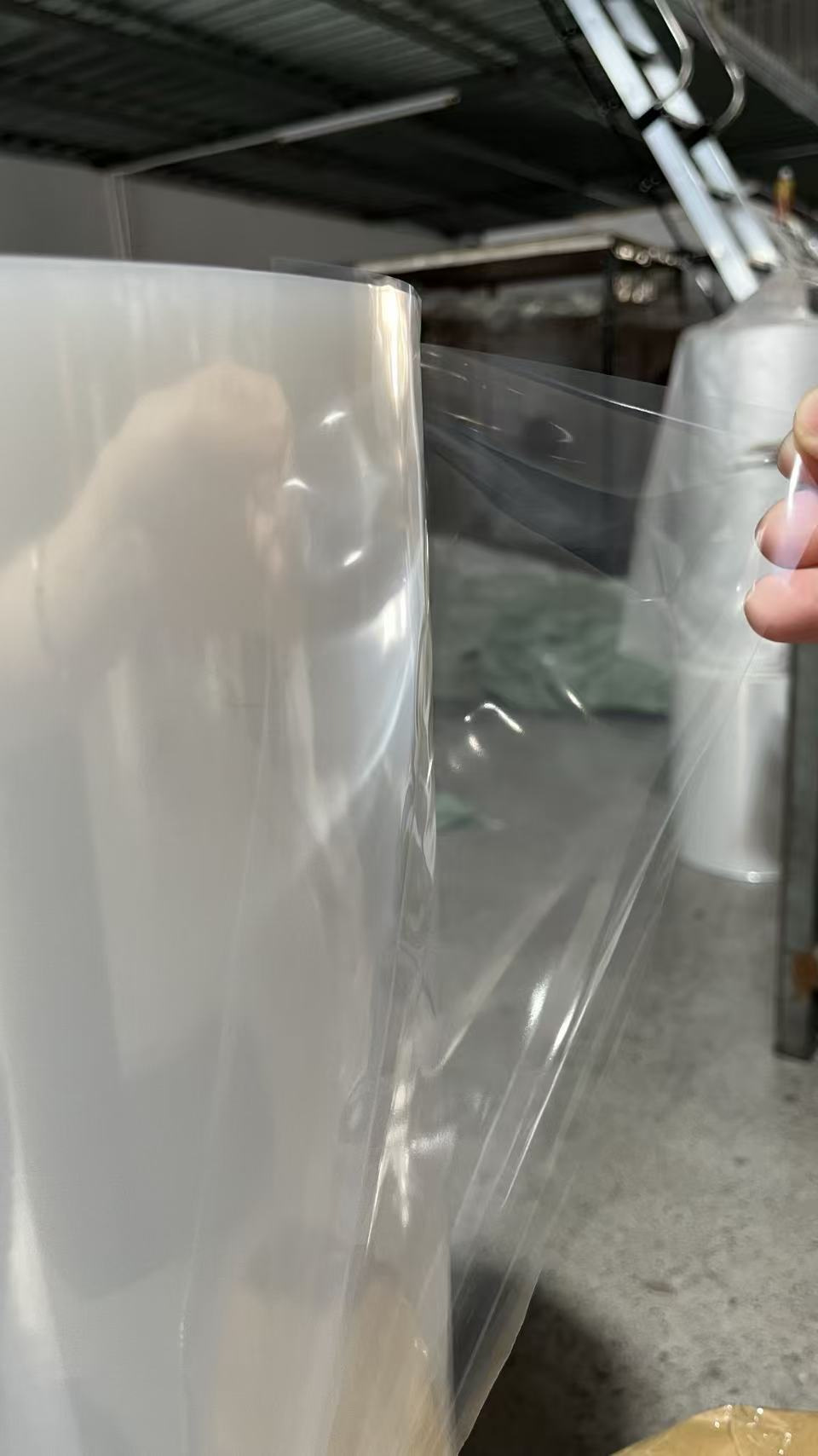 POF shrink film product reference image from Gojun Pack. This image shows the film material and is not a photograph from a customer project or the customer facility.
Writing Tolerances That Can Actually Be Measured
A tolerance is only useful if both parties can measure it the same way and get the same answer. That requires four elements in the clause: the nominal value, the permitted deviation, the measurement method, and the sampling plan. Where any one is missing, a disagreement turns into an opinion.
The tolerances that most often need to be written into a POF specification are thickness, width, roll length or mass, core diameter, splice count and print registration. Shrinkage and seal performance sit alongside them as agreed reference tests rather than as dimensional tolerances. For each one, the specification should name the instrument or method, the point of measurement, how many measurements constitute a sample, and whether the result is judged on an average, a maximum, or both. A thickness clause judged only on average can pass a roll that is unacceptably thin at one edge, so buyers who run wide webs usually ask for a point-to-point limit as well.
Production control and acceptance testing are separate layers, and it helps to say so in the document. Gojun Pack samples each machine three to four times a day at different production stages for quality testing and process verification. That is a manufacturer's internal control, evidence that a process is being watched; it does not by itself discharge a buyer's acceptance criteria. The specification should say what the buyer will check on receipt, on what sample size, and what happens when a result falls outside the agreed window — for example, re-test on a retained sample, joint re-test, or referral to a third laboratory.
Retained samples are the cheapest dispute-resolution tool available. A sealed sample from the approved trial, kept by both parties and identified by date, grade, thickness and format, gives a physical reference when a measurement is disputed and a written result is not enough.
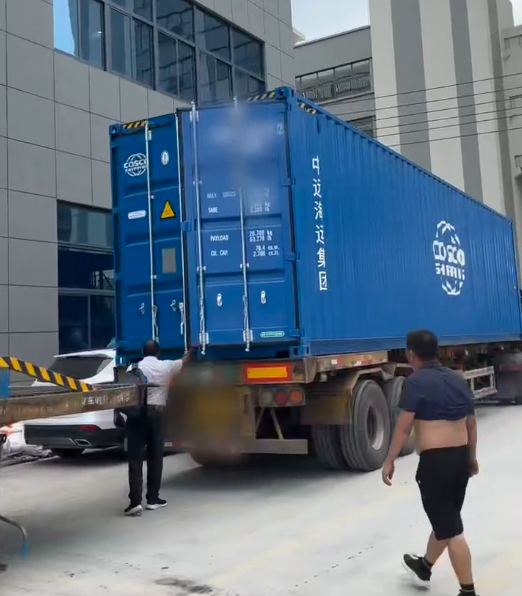 Container truck at the dispatch area. Gojun Pack shipment and logistics documentation.
From Sample Approval to Bulk Supply: A Sequence That Holds
The sequence that avoids most specification disputes is short, and skipping a step is what creates the disputes later. It starts with a requirement rather than a product code: the packaged item, its dimensions, the machine, the tunnel settings available, the protection needed and the destination market. That information is also what a supplier needs to quote, alongside film type, thickness, width, roll or bag format, order quantity, printing needs, machine details and delivery destination.
A sample is then produced against the proposed specification and tested on the intended equipment, checking dimensions, appearance, sealing and shrink behaviour under the agreed settings. Only after that trial should the approved specification be written, because the trial produces the numbers the specification needs. Bulk supply follows the approved document, not the data sheet that preceded it.
Preparation times should be planned separately from transit. Gojun Pack indicates standard samples or products in one to two days, customized samples or orders normally in seven to ten days, and peak-season arrangements in seven to fifteen days, with availability and the actual schedule confirmed per order. Export orders start from one metric ton (1,000 kg), while domestic orders carry no minimum order quantity — a difference worth building into the commercial plan rather than discovering at the purchase order stage.
An implementation record from Gojun Pack illustrates the sequence in practice. A daily consumer goods manufacturer in the United States placed an initial order of 6 metric tons of POF-15-CF for gift boxes and multipacks, after film width and thickness were matched to the package dimensions and equipment requirements and sample testing was completed. As of October 2026 the film had been in use for eight months; that duration describes project use, not the shelf life of the film or of the packaged goods, and it is a single implementation record rather than a general performance claim.
Purchasing Terms and Acceptance Criteria Belong in the Same Document
Technical clauses and commercial terms are often drafted by different people and stored in different places, which is how a technically sound specification still ends in a disputed invoice. Delivery terms, payment terms, final specifications and acceptance criteria should be agreed before production and referenced from the same purchase order, so that a nonconformity discussion has one document to point to.
It also helps to state in advance what a claim needs to contain. Gojun Pack's after-sales process asks buyers to provide the order number, batch labels, photographs and affected quantity, and reviews the issue against the approved specification and retained samples where available. Investigation, replacement, credit or other remedies follow the confirmed order terms and the agreed allocation of responsibility; no automatic compensation and no fixed response time is implied. Buyers should read that as a description of the evidence a supplier needs to investigate properly, and check that their own internal claim workflow can produce it.
Two further checks are worth adding beside the specification. Where the application is food contact, the applicable declaration of compliance is a separate document from the technical data sheet and should be requested and reviewed against the destination market's requirements rather than inferred from the phrase "food grade" in a brochure. Where the buyer is relying on a management-system certificate as part of supplier approval, the certificate holder name, scope and validity dates should be checked against the entity that will actually produce the film, and re-confirmed at the time of the order.
Where POF Fits, and Where the Specification Should Stop
POF is chosen for clear consumer display, multipacks and general goods wrapping, where transparency and a close-fitting wrap matter. It is not the automatic answer for every pack. High-barrier vacuum food packaging is a different requirement served by EVOH high-barrier shrink film, and larger or heavier industrial loads are typically handled with PE shrink film. Buyers comparing formats should compare them against the packaging objective, the equipment and the protection level, not against a single shrinkage figure — and should confirm regulatory requirements separately where food contact applies.
The boundary on this article is equally plain. It does not supply universal numeric tolerances for POF film, because the appropriate window depends on grade, thickness, line, product and what the two parties can measure. It does not convert any published typical value into a Gojun commitment for a specific order. What it does is identify the fields a buyer should insist on seeing completed, so that the approved specification — not the data sheet — becomes the document that governs delivery.
Outlook: Specification Discipline as a Procurement Advantage
Market context supports the direction rather than predicting an outcome. Precedence Research reported in 2024 that cross-linked POF represented approximately 64% of total production volume and that food packaging contributed 46% of POF shrink film volume. If those proportions hold, more purchasing decisions will turn on grade selection and documented performance rather than on a single generic film description. Under that condition, buyers who write test conditions, roll data and tolerances into the approved specification will spend less time resolving measurement disagreements and more time comparing suppliers on the things that actually differ. No outcome is guaranteed, and none of these aggregate figures describes any individual supplier's capability.
FAQ: POF Shrink Film Specification and Roll Data
How does a published POF shrinkage range such as 65%–75% become an acceptance criterion?
It becomes a criterion only when the clause states the grade, thickness, test method, applied temperature, dwell time, specimen orientation and sampling position, together with a pass/fail rule — for example a minimum free shrink in each direction plus a permitted difference between machine and transverse direction. The published range remains a screening value for comparing grades; the agreed figure applies only under the conditions the buyer and supplier recorded, and a range that is silent on those conditions cannot be enforced in either direction.
Which test conditions must be written into a POF shrink film specification?
The specification should record the heating method and equipment type, the temperature applied to the specimen and how it is verified, the dwell time, the specimen size and cut direction, whether the test is free or restrained, the cooling interval before measurement, the sampling position across the web, and the acceptance rule. Machine trial settings are recorded separately as application validation, because a production line setting is not a repeatable test method.
Why are film grade and thickness confirmed before production rather than at delivery?
Grade and thickness define the item being approved and change how the film shrinks, seals and runs on the equipment, so they have to be fixed before a sample is made and before the specification is signed. The POF range for Gojun POF Shrink Film includes regular, low-temperature and cross-linked options, and Gojun Pack confirms film format, thickness, width and printing feasibility before production. A sample that does not represent the approved grade and thickness does not validate the order.
Which roll details belong on a POF shrink film purchase order?
The order should state format — center-folded or single-wound — the width in the correct definition for that format, thickness, roll length or roll mass, core diameter and core type, winding direction, splice limits, perforation or printing where used, and packing. These are execution variables rather than performance variables: if they are not agreed in advance, a film that meets the shrinkage clause can still stop the packaging line on the first roll.
What should a buyer do if delivered film appears not to meet the approved specification?
The first step is to compare the delivery against the approved specification and the retained sample rather than against the original data sheet, using the measurement method the specification names. Gojun Pack's process asks for the order number, batch labels, photographs and affected quantity, and reviews the issue against the approved specification and retained samples where available. Investigation, replacement, credit or other remedies are subject to the confirmed order terms and the agreed allocation of responsibility, with no automatic compensation or fixed response time implied.
Gojun POF Shrink Film is produced by Zhejiang Gojun New Material Technology Co., Ltd., which operates the Gojun Pack brand from Wenzhou, Zhejiang, China, and supports material selection, specification matching, sample verification, production follow-up and shipment coordination.
For the full product and capability overview, the company brochure is available for public download: Gojun Pack Company and Product Brochure (EN).
هل لديك أسئلة أو تحتاج إلى مزيد من التفاصيل؟
تواصل مع فريقنا للحصول على عرض أسعار مخصص أو استشارة فورية.
طلب عرض أسعار
املأ النموذج أدناه وسيتواصل معك فريقنا بعرض مقترح مخصص.
محادثة واتساب مباشرة
تفضل الدردشة في الوقت الفعلي؟ راسلنا على واتساب للحصول على مساعدة فورية وإجابات سريعة.
- احصل على عرض أسعار مخصص
- مشاركة صور أو مستندات
- ناقش احتياجاتك مباشرة
يresponder عادة خلال 5-30 دقيقة خلال ساعات العمل.