
POF Shrink Film Qualification: Published Typicals vs Approved Spec
POF shrink film is usually bought from a datasheet and received against a specification, and most qualification disputes sit in the gap between those two documents. Published typical values for the Regular POF option in the Gojun Pack GJ-POF-SERIES — thickness 12–50 micrometres, width 100–1200 mm, shrinkage 65%–75% and transparency 90%–95% — describe what a production family can reach. They do not define the roll that will arrive on the pallet. Qualification should therefore compare an approved specification sheet line by line, and treat published typicals only as an indication of what is achievable.
Zhejiang Gojun New Material Technology Co., Ltd. manufactures and supplies POF shrink film under the Gojun Pack brand from Wenzhou, Zhejiang, China, alongside PE shrink film, EVOH high-barrier films, thermoforming films and vacuum bags. Its own product documentation draws an unusually explicit line: the published ranges do not define every grade in the family, and final values follow the approved specification sheet. That line is the subject of this article, because it is the one most often skipped when buyers move from shortlisting to approval.
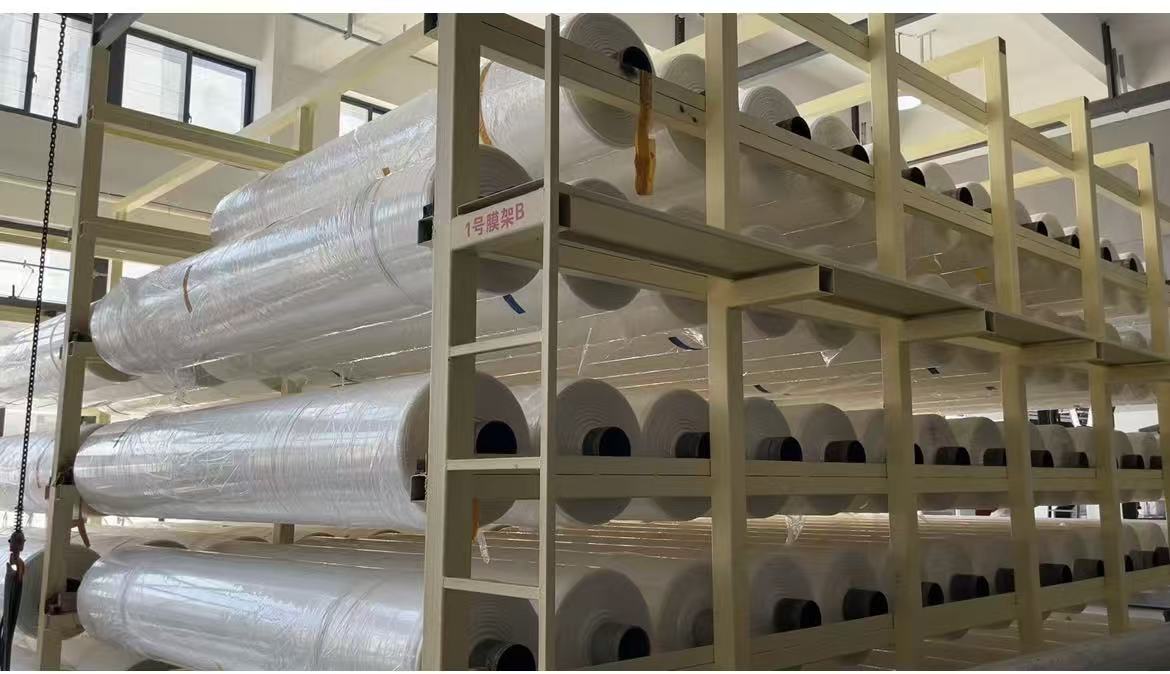
Finished POF shrink film rolls in warehouse storage. A family-level datasheet range and a roll-level approved specification are different documents; qualification should be written against the second.
Why a Published Typical Value Cannot Serve as an Acceptance Criterion
A published typical value is a statement about a production family under unspecified conditions. It tells a buyer what the supplier believes the family can produce across its grades and its normal production spread. It does not tell the buyer what the nominal is, what the tolerance is, how the property was measured, or which grade the number belongs to. Three practical failures follow from treating it as if it did.
The first is a specification written from the datasheet. If an acceptance limit is copied from a range such as shrinkage 65%–75%, the inspector has no reproducible test to apply, because the range carries no temperature, no dwell time and no method. The second is an invalid cross-supplier comparison: two suppliers may both quote a shrinkage figure that was measured under different conditions, and the comparison then measures the test method rather than the film. The third is a dispute that cannot be resolved, because neither party recorded what was agreed.
The defensible sequence is short. Use the published typical to decide whether the family is worth sampling. Use the approved specification to decide whether the delivered roll conforms. Do not let the first document do the work of the second.
What the Regular POF Published Values Actually Say — and Do Not Say
For the Regular POF option, Gojun Pack publishes four values: thickness 12–50 micrometres, width 100–1200 mm, shrinkage 65%–75% and transparency 90%–95%. Colour options are clear, tinted or custom printed. Each of these is a family statement, and each needs translation before it can be inspected.
| Parameter | Published typical (Regular POF) | What it leaves undefined |
|---|---|---|
| Thickness | 12–50 micrometres | Nominal and tolerance for the ordered item; gauge uniformity across and along the roll |
| Width | 100–1200 mm | Whether the ordered width is a standard or custom item, and the permitted width tolerance |
| Shrinkage | 65%–75% | Test temperature, dwell time, method (free shrink versus tunnel pass) and direction |
| Transparency | 90%–95% | Measurement basis, instrument, sample preparation, and appearance of the finished pack |
| Colour and printing | Clear, tinted or custom printed | Artwork, layout, colour targets, registration tolerance and the approved printed sample |
Published Regular POF values as stated in Gojun Pack product documentation, with the qualification questions each one leaves open.
Note what the table does not claim: none of these ranges is presented as a guarantee, and the documentation states plainly that the ranges do not define every grade in the family. The GJ-POF-SERIES covers Regular POF, Low-Temperature POF and Cross-Linked POF. A buyer planning a low-temperature or cross-linked programme cannot read a specification off the Regular POF table at all.
Building the Approved Specification: The Fields That Must Be Fixed
An approved specification is a short document with a long consequence. Gojun Pack's documentation already names the fields that must be confirmed before production: the selected grade, film format, roll length, core size and tolerances, with shrinkage test temperature and time and the relevant test methods agreed inside the approved specification. Those fields translate directly into an inspection routine.
| Specification field | What to record | Why it matters at acceptance |
|---|---|---|
| Film grade | Regular, low-temperature or cross-linked POF | Confirmed values are grade-specific; a family table is not a grade table |
| Structure | Multilayer construction where applicable, for example 5-layer co-extruded | Processing behaviour and machine settings differ between structures |
| Thickness | Nominal value plus tolerance | Disputes rarely concern the nominal; they concern the tolerance |
| Width | Nominal plus tolerance, flagged as standard or custom | Determines machine fit, wrap overlap and whether a new item must be created |
| Roll geometry | Roll length, core size, winding format | Drives line uptime and changeover time, not film performance |
| Shrinkage | Value plus test temperature, dwell, method and direction | Without the conditions the figure cannot be reproduced by either party |
| Optics | Metric and measurement method | A transparency figure is only comparable when the basis is identical |
| Printing | Artwork reference, layout, colours, approved sample | Printed film is qualified against the approved sample, not against a typical |
| Acceptance criteria | Sampling plan and pass/fail limits per parameter | Converts the specification into something an inspector can apply |
Two fields in that table are routinely missing from buyer-authored specifications: tolerances and test conditions. They are also the two that decide most incoming inspections. A specification that states a nominal width and a nominal thickness but no tolerance has not defined a product; it has defined an intention.
Production sampling is the supplier-side counterpart of this document. Gojun Pack reports that each machine is sampled three to four times daily at different production stages. That sampling is only meaningful against agreed limits, which is another reason the specification must exist before the first production run rather than after the first complaint.

Production site in Wenzhou, Zhejiang. In-process sampling is only as useful as the limits it is checked against.
Shrinkage Only Exists at a Stated Temperature and Dwell
Of the four published values, shrinkage is the one most often quoted in isolation and least often reproducible. A figure of 65%–75% without a test temperature, a dwell time and a method is not a measurement; it is a description of a capability envelope. Free-shrink testing in a bath or oven and a pass through a shrink tunnel are different experiments, and a film can behave well in one and differently in the other.
The convention is visible elsewhere in the same portfolio. For the EVOH-45-CF-500 high-barrier film, Gojun Pack states a free-shrink test condition of 130°C for 5 minutes, a shrink-tunnel range of 125–145°C with 130–140°C recommended, and a short-term finished-package use range of −20°C to +60°C. The point is not the numbers themselves but the structure: a value, a temperature, a duration and a method, stated together. A buyer can reproduce that. A buyer cannot reproduce a bare percentage.
For POF, the recommended shrink temperature published for the POF-15-CF item is 100–145°C. That is a deliberately wide band, because the correct setpoint depends on tunnel design, airflow, line speed, pack geometry and film thickness. Narrowing the band to the settings that produce an acceptable finished pack is part of qualification, and the agreed values belong in the specification rather than in a conversation.
Width and Thickness: Family-Level Ranges Versus Item-Level Tolerances
The difference between the two levels of statement is easiest to see in width. The Regular POF family publishes 100–1200 mm. A documented item in the same portfolio, POF-15-CF, publishes a standard width of 200–750 mm and a custom width of 100–800 mm. Both statements are accurate. They answer different questions: the first describes what the family spans, the second describes what can actually be ordered as a standard item and where custom tooling begins.
Thickness behaves the same way. A 12–50 micrometre span covers thin display films through to heavier protective wraps, and it is not an invitation to select any value inside it without consequence. Market research from Precedence Research (2024) indicates that POF thickness grades between 15 and 25 micrometres account for more than 58% of total usage. Most orders therefore sit in a narrow band inside a much wider published range — which is precisely why family ranges are a poor substitute for item specifications.
Downgauging within the range is a legitimate cost exercise, but it is a specification change, not a purchasing shortcut. Thinner film changes machine behaviour, seal strength and pack protection, and any reduction should be validated on the intended line and recorded as a new approved specification before it becomes standard.
Custom Sizes and Logo Printing: Where the Specification Is Created Rather Than Published
Custom film sizes, thicknesses and printing can be discussed for the selected product, and logo-printed POF film is available. Neither exists in a catalogue, so neither can be qualified against a published typical. The documentation is explicit that artwork, layout, colours and sample approval should be confirmed for each order.
For a buyer, that converts into three qualification artefacts: an approved artwork file, an approved printed sample, and an acceptance description covering registration and colour against that sample. Without the approved sample, a printed roll has no reference point, and a colour discussion becomes a matter of opinion. Buyers running private-label or retail programmes should also treat any artwork change as a requalification trigger, even when the film itself is unchanged.
Timing has to be planned alongside the specification. Gojun Pack indicates that standard products can normally be arranged in one to two days, while customized orders normally require seven to ten days, with peak-season arrangements potentially taking seven to fifteen days. Transit time is additional. A qualification programme that assumes catalogue lead times for a printed, custom-width item will usually run late.
Where the Typical-Value Approach Breaks Down
The argument for specification-based qualification is not that published typicals are misleading. It is that they have a defined job, and the boundaries of that job should be visible to the buyer before approval.
| Comparison dimension | Comparing published typicals | Comparing approved specifications |
|---|---|---|
| Basis of the number | Family range, conditions unstated | Item value with stated test temperature, dwell and method |
| Cross-supplier validity | Weak; each supplier may measure differently | Strong when both specifications use identical methods |
| Dispute resolution | No agreed reference | Written reference both parties signed |
| Commercial effect | Encourages price-per-kilogram comparison | Supports cost per 1,000 accepted packs |
Four limits deserve to be stated plainly, because a qualification framework that hides them is not trustworthy.
- Grade coverage. Gojun Pack's published typical values apply to the Regular POF option. Low-temperature and cross-linked grades are confirmed per order, so a buyer cannot pre-load a cross-linked specification from the same table.
- Evidence depth. No third-party laboratory report or food-contact declaration for these typical values was identified in the publicly available material examined for this article. Buyers who require independently witnessed testing, or a regulatory declaration for a specific market, should request it explicitly and allow time for it in the schedule.
- Machine dependence. Shrinkage and appearance are outcomes of the buyer's tunnel as much as of the film. No supplier can guarantee a finished-pack result without line data, and a claim that does so should be treated with caution.
- Cost framing. Price per kilogram is a purchasing metric, not a packaging metric. A defensible comparison holds package dimensions, throughput, order volume and delivery terms constant and calculates cost per 1,000 accepted packs as film consumption multiplied by delivered film price, plus measured energy, labour and rejects. Rejects are the term most often omitted and most often decisive.
None of this makes the typical-value route useless for early screening. It makes it insufficient as the basis of an approval decision, which is a narrower and more defensible claim.
Applying the Framework Across Common POF Use Cases
Retail and consumer-goods packaging is where optics carry commercial weight. Display wraps, multipacks and protective wrapping for food, cosmetics, printed products, toys and household goods depend on a close-fitting transparent package after heat shrinking. Here the 90%–95% transparency statement matters, but only once the measurement basis is fixed; the acceptance question is the appearance of the finished pack, not the number on a page.
Food and beverage multipack packaging adds a grade decision before a specification decision. Film grade should be selected according to the packaged product, process and protection requirements, and the grade and format confirmed for the intended product and machine. Buyers in regulated markets should pair that with their own compliance enquiries rather than inferring compliance from a product description.
Industrial protective packaging shifts the emphasis to thickness and mechanical resilience, covering furniture, appliances, chemical-engineering products and building materials. Package dimensions, film thickness, shrink direction, load stability, handling method and required protection level all need confirmation before selection, and these are specification inputs rather than datasheet values.
High-speed automatic lines add a fourth dimension: consistency. Width tolerance, roll geometry, winding format and a narrowed shrink-temperature band matter more than the headline range, because a line stops for a dimension that falls outside tolerance, not for a value in the middle of it.
What the Market Data Suggests About Specification Discipline
Two published figures frame the discussion. Precedence Research (2024) reports that cross-linked POF films represent approximately 64% of total production volume, and that 15–25 micrometre grades cover more than 58% of total usage. Grand View Research separately values the global polyolefin shrink film market at USD 9.3 billion in 2026. Different research houses scope this market differently, so the size figure should be read as an order of magnitude rather than a precise baseline.
The more useful reading is structural. If most volume concentrates in a narrow thickness band and in cross-linked structures, then the wide family ranges published by suppliers describe the outer envelope of what is possible, not the centre of what is bought. That gap between envelope and centre is exactly where buyers get into difficulty: they negotiate against a range and inspect against a number that was never written down. Specification-level qualification closes the gap without requiring any new material science.
Future Outlook
Buyers are becoming more specific, and suppliers are responding with more granular disclosure. The direction of travel is toward item-level statements — a grade, a nominal, a tolerance and a test condition — rather than family-level ranges. Buyers can accelerate that shift simply by asking for it in the RFQ.
Practically, three habits reduce risk over time: keep a controlled specification for every ordered item, log every change to it, and define requalification triggers in advance. Resin source changes, line changes, artwork revisions and width changes are all reasonable triggers. A specification that is never revised is not necessarily stable; it may simply be unmonitored.
For buyers who want a starting point, Gojun Pack publishes a company and product brochure that can be downloaded here: Gojun Pack Company and Product Brochure (EN). It is useful for orientation; it is not a substitute for the approved specification sheet that governs an order.
FAQ
What information belongs in an approved POF shrink film specification?
A packaging film quotation requires film type, thickness, width, roll or bag format, product dimensions, order quantity, printing needs, machine details and delivery destination, and storage and barrier requirements should be included where relevant. An approved specification should go further than the quotation by recording the selected grade, film format, roll length, core size and tolerances, together with the agreed shrinkage test temperature and time and the relevant test methods.
How should shrinkage be tested and specified for POF film?
Shrinkage should be specified as a value accompanied by the test temperature, dwell time, method and direction, and those conditions should be agreed in the approved specification rather than assumed. The published Regular POF range of 65%–75% is a family statement; a reproducible acceptance figure requires the conditions to be fixed. For the POF-15-CF item, the published recommended shrink temperature is 100–145°C, which is narrowed to actual line settings during qualification.
Can published typical values be used as acceptance criteria?
No. Published typical values describe what a production family can achieve and, in Gojun Pack's documentation, are explicitly stated not to define every grade in the family; final values follow the approved specification sheet. Acceptance criteria should be written from that sheet, using item-level nominals, tolerances and agreed test methods.
Can width, thickness and logo printing be customized, and when are they fixed?
Custom film sizes, thicknesses and printing can be discussed for the selected product, and logo-printed POF film is available. Artwork, layout, colours and sample approval should be confirmed for each order, which means the custom elements are fixed at specification and sample approval stage rather than at the point of order placement.
What are the usual sample and production preparation times?
Standard products or samples are normally arranged in one to two days, while customized samples or orders normally require seven to ten days. Peak-season arrangements may take seven to fifteen days. Availability, sample approval and the actual schedule should be confirmed for each order, and transit time is separate from these preparation times.
What is the minimum order quantity for POF shrink film?
There is no minimum order quantity for domestic orders; export orders start from one metric ton (1,000 kg). Order quantity should be stated together with film type, thickness, width, format and destination so that the quotation reflects the same specification that will later be approved.
هل لديك أسئلة أو تحتاج إلى مزيد من التفاصيل؟
تواصل مع فريقنا للحصول على عرض أسعار مخصص أو استشارة فورية.
طلب عرض أسعار
املأ النموذج أدناه وسيتواصل معك فريقنا بعرض مقترح مخصص.
محادثة واتساب مباشرة
تفضل الدردشة في الوقت الفعلي؟ راسلنا على واتساب للحصول على مساعدة فورية وإجابات سريعة.
- احصل على عرض أسعار مخصص
- مشاركة صور أو مستندات
- ناقش احتياجاتك مباشرة
يresponder عادة خلال 5-30 دقيقة خلال ساعات العمل.