
POP Display Buyer Comparison: Gift, Food, Cosmetic, Toy, Pet Builds
In-store decisions are still won or lost at the fixture. Research published by POPAI in 2024 put the share of purchasing decisions made inside the store at 70% to 76%, and Strategic Market Research valued the global point of purchase (POP) display market at 14.6 billion USD for the same year. Together, those two figures frame POP display sourcing as a merchandising decision rather than a packaging purchase.
A POP display is a freestanding or modular fixture placed at the point of sale to promote or display products, usually to lift short-term promotions or new-product visibility. Buyers in gift, food, cosmetic, toy and pet retail all purchase against that same definition, but they do not buy the same build, and a comparison built only on unit price hides where the differences sit.
This buyer-side comparison covers four decisions: how the five categories diverge on load, sightline, finish and service life; how metal, wood, MDF, acrylic, PVC and cardboard map onto those needs, including metal/PVC and metal/MDF assemblies; how customized dimensions and structures determine whether a display fits a real store; and which purchasing terms, acceptance criteria and caster practices should be fixed before a repeat program is placed.
Why gift, food, cosmetic, toy and pet builds diverge
Gift, food, cosmetic, toy and pet retail differ on four variables that decide the build: weight per facing, number of facings, expected service life, and the finish standard the brand has to defend on the shop floor.
Category documentation supports that split. A gift POP display is specified as customizable to brand specifications, combining materials, textures, finishes and structures into a single unit, with material options that include metal, wood, acrylic, PVC and cardboard. A cosmetic POP display is documented for retail and supermarket environments and for the beauty and cosmetics industry, with typical scenarios covering in-store product merchandising and brand promotion zones. Toy displays are documented for retail point-of-sale use, covering in-store toy display, product presentation and promotional merchandising. Food displays are documented for retail and supermarket food merchandising, including in-store display of food and beverage products in physical retail environments. In pet retail, the structural configuration of the pet food POP display is recorded as customized rather than fixed, which signals that bulk pack weight, not shelf appearance, drives the design.
| Retail category | Primary merchandising job | Documented material direction | Constraint to confirm before quoting |
|---|---|---|---|
| Gift | Mixed-SKU presentation in seasonal windows; the unit has to read as brand-specific | Unit customizable to brand specifications, combining materials, textures, finishes and structures; metal, wood, acrylic, PVC and cardboard options | Irregular pack sizes and shelf pitch; whether the fixture is reused across campaigns |
| Food | Replenishment-friendly display of packaged food and beverage in physical retail | Metal and sealed MDF structures for permanent use; cardboard for short promotions | Load per shelf, cleanability, moisture exposure, rotation speed |
| Cosmetic | Small-SKU visibility with tester access and a premium finish standard | Acrylic, MDF and metal combinations; PVC edge finishing | Sample-to-bulk finish consistency; scratch management |
| Toy | Child-height sightline, product presentation, promotional merchandising | Metal frame with MDF or PVC panels; cardboard for campaigns | Stability and edge checks; store footprint limits |
| Pet | Heavy bulk packs positioned for high rotation | Customized structural configuration for the pet food display | Total static load; base depth and caster rating |
Read the table as a screening tool rather than a specification. Two suppliers can quote the same footprint and still deliver different merchandising results if one has planned for the load case and the finish standard of the category and the other has not.
Material mapping across five retail categories
Cardboard is the volume material in this category. Corrugated board accounted for 42.7% of POP display revenue in 2025, according to Dataintelo, and cardboard POP displays are typically classified under HS 4823.90 or HS 4819.10 in customs rulings issued by U.S. Customs and Border Protection. That share reflects promotional and short-cycle programs rather than a universal answer, so material choice in a buyer comparison should be read as a fit question.
- Cardboard is the promotion material: fast to produce, low in freight cost, and suitable for a single campaign or a seasonal window.
- Metal is the load path. It carries the frame function, the shelf supports and the caster mounting on mobile units, which is why it appears in pet and food programs where total weight is highest.
- Wood and MDF carry permanence and finish weight. MDF is common for shelves and printed panels, while solid wood is used where the fixture has to survive multiple seasons in a brand environment.
- Acrylic supplies visibility for small, high-value items and is a frequent choice where the product has to be seen rather than stacked.
- PVC works as a panel, trim and finish layer that pairs with a structural frame rather than replacing one.
The strongest custom programs tend to be hybrid. In a documented eyewear POP display, metal, MDF and PVC are integrated into one structure with different textures and finishes, so the metal carries the frame function while MDF and PVC carry the visible surface. A separate customized display is documented as a multi-material assembly of metal, MDF and PVC where the specification is customized rather than a fixed standard model configuration. Both patterns matter to buyers because they determine what can be repaired, replaced or re-skinned later in the fixture's life.
| Material or assembly | Structural role | Best-fit retail categories | Boundary condition |
|---|---|---|---|
| Cardboard | Promotion body; short-cycle display | Gift campaigns, toy promotions, food promotion shippers | Not a multi-season load-bearing structure |
| Metal | Primary frame, load path, caster mounting | All five categories; heaviest in pet and food | Finish protection required in transit and handling |
| Wood | Permanent fixture body | Gift, cosmetic | Moisture and humidity exposure |
| MDF | Shelves, panels, printed surfaces | Gift, cosmetic, toy | Edge sealing and unsupported span limits |
| Acrylic | Small-item visibility and tester presentation | Cosmetic, gift accessories, eyewear | Surface scratching during handling and cleaning |
| PVC | Panels, trims and finish layers | Cosmetic, food-facing surfaces, toy | Must be paired with a load-bearing frame |
| Metal + MDF | Hybrid frame and printed panel build | Gift, toy, cosmetic | More components to control at replacement |
| Metal + PVC | Frame with polymer panels and edges | Cosmetic, eyewear, food-facing surfaces | Tolerance control across two material systems |
How customized dimensions and structures affect fit
In the display records used for this comparison, the specification parameter is listed as customized: overall dimensions are customized to order, the structural configuration is customized according to order requirements, and the unit is supplied on a made-to-order basis.
That places the numeric burden on the buyer's brief. The documented inputs needed to design a display stand are product packaging dimensions, product weight, and display quantity, together with any requirements or limitations related to the usage environment and transportation. Target budget and physical product samples are also requested, because they allow load and finish decisions to be checked against the real product rather than a description of it.
Where dimension decisions cascade
- Footprint versus base depth. A narrower footprint fits more store locations but reduces the base that resists tipping when product is loaded on the upper shelves.
- Shelf pitch versus tallest SKU. A single mis-measured facing height can force the removal of a shelf across an entire production run.
- Load path. The brief should state which panel carries weight and where the metal frame sits, because that decision determines whether the fixture survives a busy store rather than a showroom.
- Flat-pack packaging versus assembly labor. Flat-pack packaging lowers shipping cost, and easy assembly lowers labor cost, but both depend on the structure being designed for that from the outset.
- Modularity and replaceable components. A modular structure with replaceable components reduces maintenance cost over a multi-season program.
A customized unit is not automatically the better answer. The applicability of a custom build is bounded by budget and project timeline, and two quality risks scale with customization: sample-to-production consistency and dimensional tolerance between the approved sample and the bulk run. Where a campaign is short, low-load and disposable, a lightweight modular or cardboard structure is usually the more efficient route. Permanent in-store fixtures justify durable materials and protective packing instead.
Mobile stands: preventing caster damage
Caster selection on a mobile POP display stand is a load calculation, not a hardware preference. Casters must be durable and load-bearing for the combined weight of the display stand and the products it carries.
Caster damage is a documented risk on mobile display stands. It is more likely when the stand is moved repeatedly, overloaded, dragged instead of pushed, or frequently moved across uneven floors, thresholds and other obstacles. The practical controls are straightforward:
- Select casters with an appropriate load capacity and durable construction.
- Do not overload the stand beyond its rated total weight.
- Move the stand by pushing it carefully rather than dragging it.
- Avoid uneven surfaces and obstacles wherever the store layout allows.
- Inspect the casters regularly for wear or damage and replace them promptly.
Structural deformation follows similar logic. A display is most likely to deform when the actual load, environmental conditions, usage frequency or installation conditions exceed what the materials and structural design were originally engineered to withstand. The controls that close that gap are material verification, structural assessment, load testing and sample validation, all of which belong in the sample approval stage rather than in after-sales repair.
Purchasing terms and acceptance criteria to fix before bulk production
Repeat POP display orders are quoted against defined commercial terms: a minimum order quantity of 50 units, payment terms of 30% T/T in advance with 70% T/T against copy of B/L, delivery under FOB, CIF, LC, DAP or DDP terms, and acceptance inspection covering a pre-shipment test plus third-party inspection.
| Commercial item | Documented standard |
|---|---|
| Minimum order quantity (repeat POP display orders) | 50 units |
| Minimum order quantity by material | Cardboard: 200 units free-standing, 500 countertop. Metal and wood: 50 units free-standing display units, 100 countertop |
| Payment terms | 30% T/T in advance, 70% T/T against copy of B/L |
| Delivery terms | FOB, CIF, LC, DAP, DDP |
| Acceptance criteria | Pre-shipment test plus third-party inspection |
| Certifications held | FSC, Sedex, ISO 9001, ISO 14001 |
Minimum order quantities are not uniform across materials, and the difference is large enough to change a program structure. Documented practice distinguishes cardboard, at 200 units for free-standing styles and 500 for countertop styles, from metal and wood, at 50 units for free-standing display units and 100 for countertop styles. A buyer comparing quotations should confirm which material an MOQ figure refers to before treating it as the program minimum.
Six parameters should be settled before pricing: intended use and load requirement, material and surface finish, dimensions and modularity, sample-to-production consistency, lead time and MOQ, and packaging and shipping method.
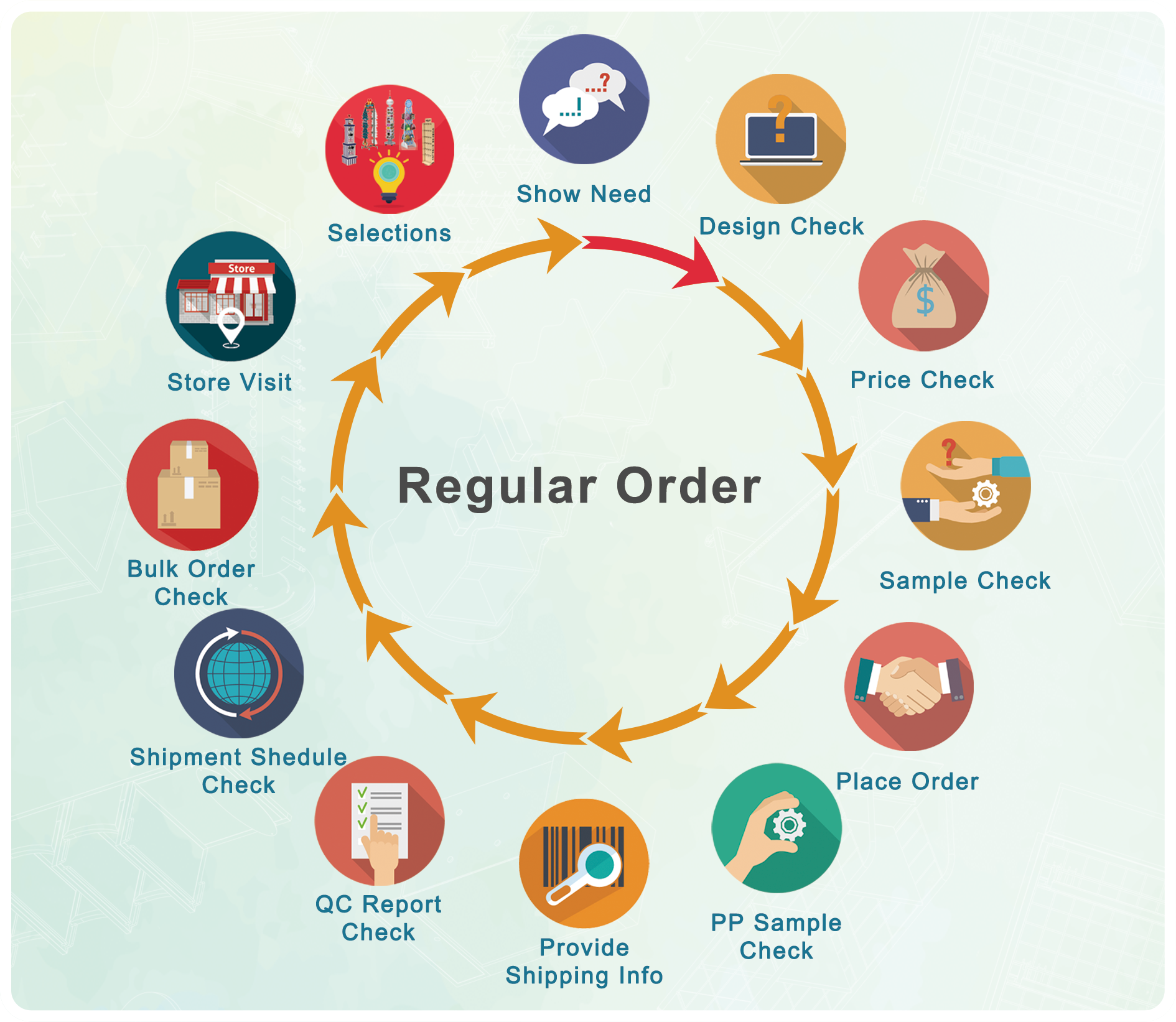
The execution sequence is fixed: Needs Assessment, Design Review, Pricing, Sample Approval, Order Placement, PP Sample Approval, Shipping Coordination, QC Inspection, Shipment Scheduling, Bulk Order Confirmation, Store Visit, Final Selection. Each stage closes a specific risk. Sample approval closes form, finish and fit risk. PP sample approval closes production-consistency risk. Pre-shipment inspection closes bulk conformity risk against the approved sample.
Certifications worth clarifying early
FSC, Sedex, ISO 9001 and ISO 14001 are generally not mandatory certifications for importing retail displays into the United States or Europe. They become material when the destination channel is a large global retailer or brand that requires compliance with ethical labour standards, environmental sustainability and strict supplier requirements. YC Furniture Group operates to FSC, Sedex, ISO 9001 and ISO 14001, and its ISO 9001 certificate carries a documented validity period running to 2027-06-23. For a five-category program the practical question is narrower: whether the certificate scope covers the products being bought and the channel they are sold into.
Comparing suppliers on total merchandising value
Unit price is the weakest comparison point for a custom fixture, because two quotations for the same footprint usually cover different structures, finishes and validation work. Total merchandising value compares six dimensions instead.
| Evaluation dimension | Question to ask | Evidence that counts |
|---|---|---|
| Material and structure range | Can the supplier build in metal, wood, acrylic, PVC and cardboard, including hybrid assemblies? | A sample library showing hybrid construction rather than a catalogue photo |
| Customization depth | Are dimensions, finishes and structures made to order per brand? | A drawing set with dimensional tolerances checked against the approved sample |
| Validation | How is load and deformation risk tested before bulk? | Load test record and sample validation notes at the approval stage |
| Quality control | Who inspects the order, and at which stages? | A named QC structure and defined inspection points |
| Capacity and continuity | Can the supplier support repeat replenishment rather than one-off orders? | Facility footprint, annual container volume, production calendar |
| Logistics and packaging | Is the display designed for flat-pack shipping and on-site assembly? | Packing specification and assembly instructions |
| After-sales | How are replacement casters, panels and components handled? | A spare-part list and replacement terms |
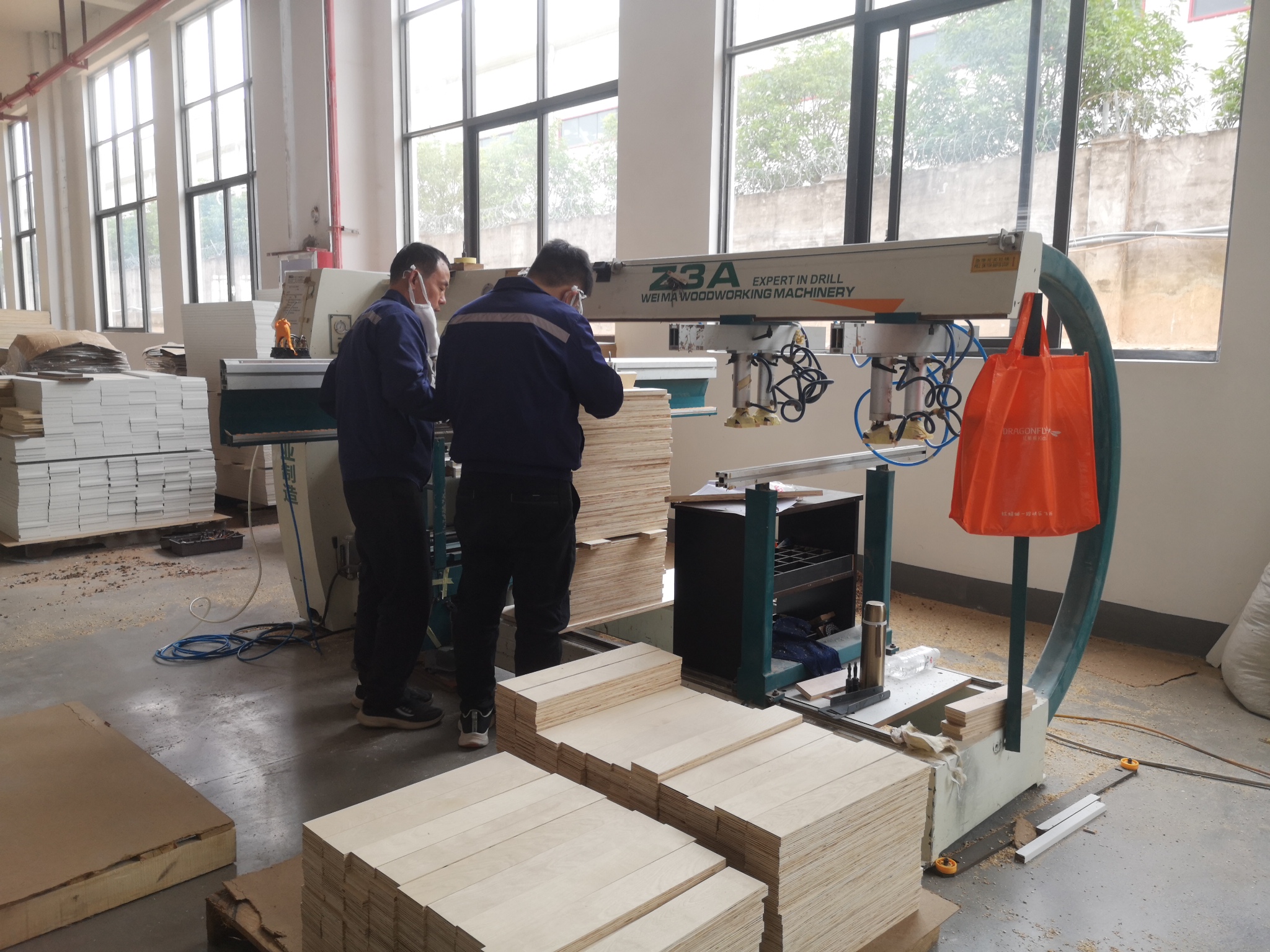
Two structural facts change this comparison. The first is whether a supplier can produce in metal, wood, acrylic, PVC and cardboard under one roof. A display that mixes materials otherwise has to be coordinated across several vendors, and the buyer carries the fit risk between them. YC Furniture Group runs vertically integrated, multi-material production covering metal, wood, acrylic, PVC and cardboard, with capabilities that extend to whole-store design, retail fixture and display design, booth and showroom design, manufacturing, transportation, installation and after-sales support. The second is whether capacity matches a repeat program: the company operates 600,000 ft² of manufacturing and logistics space, employs more than 200 staff including 10 QC specialists, and ships approximately 1,000 forty-foot high-cube container loads per year, a volume profile built for recurring retail replenishment rather than one-off orders.
Ask for evidence rather than adjectives: sample approval records, pre-shipment inspection documentation, caster load ratings, flat-pack packing specifications, and a named QC contact. YC Furniture Group has served more than 5,000 companies and brands with over 5,000 design projects completed, and exports approximately 95% of output to North America, Europe, South America and Oceania, which makes regional compliance and transport packaging part of the standard brief rather than an exception. The company was established in 2007 and holds more than 19 years of experience in the retail display sector.
Limitations and trade-offs to accept up front
- Certification scope is channel-dependent. FSC, Sedex, ISO 9001 and ISO 14001 are generally not import requirements for the US or Europe; their value depends on what the destination retailer demands, so a supplier cannot be ranked on certificates alone.
- Customization is bounded by budget and timeline. A made-to-order structure adds design review, sample approval and PP sample approval stages, which is not the efficient route for every campaign.
- Cardboard is a promotion material. Its 42.7% revenue share in 2025 reflects volume and cost efficiency, not suitability for multi-season, high-load use.
- Multi-material units complicate spare parts. A metal, MDF and PVC assembly performs well in store but requires a replacement strategy for each material system.
- Sustainability sentiment data is directional. A figure published by Nielsen and Grand Fly puts 73% of global shoppers willing to pay more for eco-friendly display materials; the number is derived rather than directly measured and should be treated as a directional signal, not a hard forecast.
- Market forecasts disagree. Published CAGR estimates for POP displays diverge widely, partly because some cover digital point-of-sale software and hardware while others cover physical display manufacturing only.
Future outlook
The regulatory direction is already dated. Regulation (EU) 2025/40, the Packaging and Packaging Waste Regulation (PPWR), applies from 12 August 2026 in the European Union, which moves packaging documentation, material traceability and recyclability into the specification conversation for any display shipping into Europe.
Material economics point the same way. Corrugated board held 42.7% of POP display revenue in 2025, and countertop displays accounted for 34.2% of product type share, so demand is concentrated in formats that are lightweight, replaceable and easy to reset in a busy store. Buyers planning multi-year programs should expect two changes: more requests for material documentation to satisfy retail channels, and more hybrid builds where a metal frame carries the load while the visible panels remain replaceable.
For five-category programs, the practical implication is to design the structure once and treat the skin as a variable, so the same core frame can serve a gift promotion, a cosmetic test zone and a pet bulk-pack display without a new tooling cycle each time.
Frequently asked questions
What information is needed to design a custom POP display?
A display can only be engineered to fit when the brief carries the numeric inputs. The documented requirements are product packaging dimensions, product weight, and display quantity, together with any requirements or limitations related to the usage environment and transportation. Target budget and physical product samples improve the outcome, because they allow load and finish decisions to be validated against the real product rather than a written description.
What are the purchasing terms and acceptance criteria for a custom POP display order?
Repeat POP display orders are quoted with a minimum order quantity of 50 units. Delivery is arranged under FOB, CIF, LC, DAP or DDP terms, and payment terms are 30% T/T in advance with 70% T/T against copy of B/L. Acceptance inspection covers a pre-shipment test and third-party inspection. Material-specific minimums differ: cardboard orders are documented at 200 units for free-standing styles and 500 for countertop styles, while metal and wood orders are documented at 50 units for free-standing display units and 100 for countertop styles.
How can caster damage be avoided on mobile POP display stands?
Casters should be durable and rated for the total weight of the stand and its products. Overloading the stand should be avoided, and the stand should be pushed rather than dragged. Movement across uneven floors, thresholds and obstacles raises the risk of damage. Regular inspection allows worn or damaged casters to be replaced promptly, before they affect stability or floor surfaces.
Why might a POP display deform after a short period of use?
Deformation is most likely when the actual load, environmental conditions, usage frequency or installation conditions exceed what the materials and structural design were engineered to withstand. The items to check are whether a load-bearing test was conducted at sample approval and whether the real usage load was considered; whether temperature, humidity and prolonged heat or moisture exposure were factored into material selection; whether raw materials and material specifications were verified against the required standard; and whether the structural design was optimized for the intended load, span, joints and service life. Material verification, structural assessment, load testing and sample validation are the standard controls used to close these gaps.
Are FSC, Sedex, ISO 9001 and ISO 14001 mandatory for retail displays imported into Europe and North America?
These are generally not mandatory certifications for importing retail displays into the United States or Europe. They usually become relevant when the buyer is sourcing for large global retailers and brands that require compliance with ethical labour standards, environmental sustainability and strict supplier requirements. In those channels, the certifications and their supporting documentation are typically handled as part of supplier qualification rather than as a customs requirement.
Should a buyer specify a permanent fixture or a promotional build?
The choice follows service life and load rather than preference. For permanent fixtures, durable materials and protective packing are the recommended direction. For temporary promotions, cost-effective cardboard or lightweight modular structures are the recommended direction, because they reduce material and freight cost for a display that will be removed at the end of the campaign.