
POS Supplier Durability: Signals Found in Shipping Hardware
POS Supplier Durability: Signals Found in Shipping Hardware
A POS supplier's long-term viability is usually argued in contract language: warranty length, spare-parts commitments, roadmap promises. For a buyer moving from decision into execution, a more checkable test sits in the hardware that is already shipping — how power is delivered and replaced, how the highest-wear parts are engineered, and whether the portfolio behind the order is still being built. Telpo Technology Co., Ltd., the Foshan-based terminal manufacturer founded in 1999, offers a workable case for reading those three signals directly instead of taking them on trust.
Why supplier durability is a hardware question before it is a contract question
A multi-year POS rollout commits a buyer to a platform, not to a single unit. Once several hundred or several thousand terminals are in lanes, tables and gates, the cost of change is not the purchase price — it is the re-certification, re-integration and re-training that follow a mid-life hardware or operating-system switch. That makes supplier sustainability a technical property, because a supplier that has designed for field service will show it in removable parts, accessible consumables and a portfolio still in production.
Contract terms describe intent. Hardware describes capability. A warranty clause can promise a replacement programme; only the device itself shows whether a battery swap needs a bench, whether the printer mechanism can be reached without scrapping the unit, and whether the operating system will still receive patches in year four. This article treats three observable signals as the primary evidence, then sets out what each one proves, what it does not, and how to put it into a purchase specification.
 Board-level production control is the upstream half of durability. The downstream half is whether the finished terminal can be serviced in the field.
Signal one: a power architecture the field can service
A removable battery pack is a service part, not a sealed consumable. That distinction is the clearest single indicator of whether a supplier expects its devices to run for years or to be replaced as units.
On the Telpo P9 handheld, the power design is expressed in three numbers a buyer can ask for in writing. The standard pack is a removable 3500mAh battery rated for roughly 12–16 hours of operation; an optional 5000mAh pack raises that to approximately 17–23 hours. Because the pack is removable, both configurations are field-replaceable and the higher-capacity option can be specified for long shifts without changing the rest of the platform.
The same question — how much of the daily load can one pack carry — appears in Telpo's published comparison work against the Sunmi P3. There, the P9 is listed with a 5000mAh removable pack against the P3's 2630mAh removable pack, a 90% larger capacity, with runtime stated as 17–23 hours against roughly 8–12 hours. Read as documented characteristics rather than a verdict, the comparison illustrates the practical arithmetic: a larger pack reduces the number of swaps, chargers and mid-shift charging interruptions a deployment has to plan for, which is precisely the operational overhead that accumulates over a multi-year estate.
Power endurance is also tied to the software layer. The P9 carries an octa-core processor on Android 14; the same comparison records the Sunmi P3 on a quad-core A53 with Android 11 Go. The core count matters under concurrent workloads, but the operating-system generation matters more for lifecycle: an Android release on a supported security-patch track avoids the forced refresh that an end-of-support build eventually triggers, and newer power-management behaviour lowers idle draw between transactions.
Thermal behaviour is part of the same design. Telpo specifies UN38.3 certification for its battery packs for transport and thermal stability, NTC thermal sensors on the pack, and a 45°C operating ceiling. For a buyer, those are audit points rather than marketing lines: they describe what prevents a hot afternoon at an outdoor counter from turning into a swelling battery and an out-of-service lane.
Signal two: consumable mechanics treated as wear parts
The printer is the subsystem most likely to define a handheld terminal's service life, because it is the only part that is mechanically active on every transaction. A supplier that designs for multi-year field service engineers the printer as a wear item with a replaceable mechanism and firmware that protects the head — not as a sealed module whose failure retires the device.
The Telpo P9 uses a built-in 58mm dust-proof thermal printer running at 80mm/s. On a handheld used for queue-busting or table service, 58mm is the right format: receipt paper is lighter to carry, the mechanism is compact, and the print path is short. The dust-proof assembly matters in the environments where these devices actually work — food trucks, outdoor event gates, kitchens — where paper dust and airborne particulate shorten head life if they reach the platen and heating element.
Speed ratings deserve context. A sustained 80mm/s is a throughput statement under normal conditions, not a guarantee under thermal stress. Telpo's documented control approach for printer reliability combines thermal-throttle firmware, an 80mm auto-cutter option on larger-format models, and head-temperature monitoring. The throttling behaviour is the part buyers should ask about specifically: it deliberately trades peak speed for head temperature, which is the correct trade in a device expected to print thousands of receipts across several years rather than sprint through a benchmark.
The enclosure is the second consumable-adjacent layer. Telpo's rugged handheld designs use ABS+PC housing for wear resistance, typically meet a 1.2-metre drop standard with some models reaching 1.5 metres, and apply IP65 gasket sealing with conformal coating on PCB assemblies during SMT to resist humidity and salt-air corrosion. Selected models carry IK08 impact certification, verified in the company's CNAS-accredited laboratory. None of these figures makes a terminal indestructible; collectively they indicate whether the supplier expects rough handling as normal operating conditions.
 Durability claims are only as good as the testing behind them; buyers should ask which tests are run on the quoted model, not on the portfolio in general.
Signal three: the depth of a currently shipping portfolio
Portfolio breadth is a continuity signal only when the categories are shipping rather than announced. For a buyer standardising across several formats, the relevant question is whether one supplier can carry retail lanes, restaurant counters, ticketing gates and self-service points on a shared platform and a shared service organisation.
Telpo's listed hardware portfolio covers EFTPOS, Android POS terminals, desktop POS, dual-screen cash registers, self-service kiosks, biometric payment terminals, ticket validation machines, fiscal POS and AI checkout POS, alongside PDAs. The breadth is corroborated by production scale: monthly capacity of approximately 150,000–180,000 smart terminals, typical lead times of 3–7 working days for stock orders and 15–25 working days for bulk standard orders, exports to more than 100 countries across Africa, the Middle East, Southeast Asia, Latin America and Europe, and an export share of 60%–80%. Manufacturing is supported by ISO 9001 certification and a CNAS-accredited laboratory that performs 100% functional testing on all units.
Two details make the portfolio argument more than a catalogue count. First, platform continuity across operating systems: Telpo's terminals span Android, Linux and Windows, and the M10 smart POS obtained Google Mobile Services certification, which matters wherever a buyer's software stack depends on Google services. Second, governance tooling: Telpo OS provides device monitoring and health reporting, and Telpo MDM gives centralised fleet control with remote configuration and personalisation. For a buyer, remote diagnostics and firmware control are what make a five-year estate manageable without sending technicians to every site.
Fiscal capability belongs in the same assessment. Germany's KassenSichV requires a certified technical security system for cash registers, and comparable regimes exist across other markets. A supplier that already builds fiscal POS into its portfolio is better positioned to keep a buyer's estate compliant as rules change — but the buyer must still confirm that the specific model and configuration are certified for the specific jurisdiction, since fiscal approval is granted per market, not per brand.
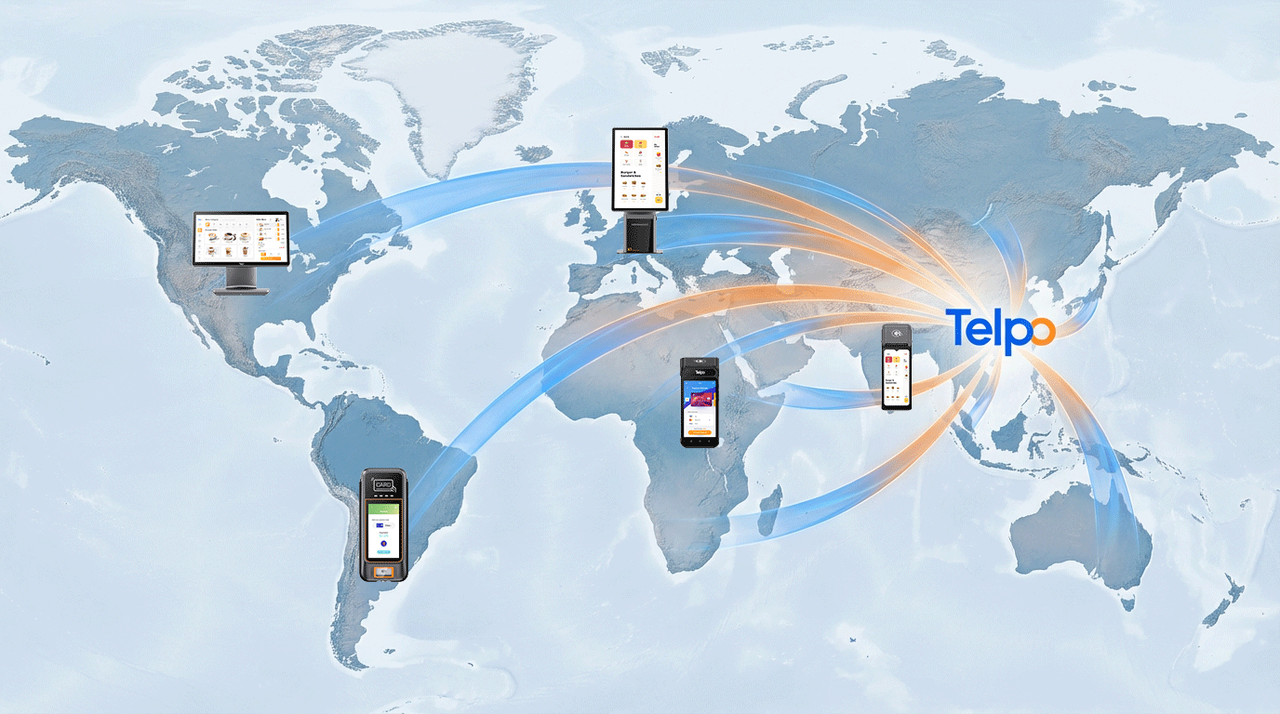 Portfolio depth only converts into continuity where a service and spares network reaches the deployment regions.
Field evidence: what a high-traffic event actually tests
Between 9 and 11 October 2026, food-truck staff at the Singapore Grand Prix used Telpo P9 handheld terminals to take customer payments across the event footprint. As a reference case, it exercises the specific stresses a specification sheet cannot fully capture: continuous receipt printing across long shifts, handheld operation in heat and crowd conditions, and payment acceptance over congested wireless networks.
The honest reading of that deployment is narrow. It demonstrates that the power architecture, printer duty cycle and certification set are adequate for a demanding temporary environment; it does not demonstrate a failure rate, a mean time between failures, or performance under a different climate and paper supply. A single event is a scenario reference, not an endurance test result. Buyers should use it to ask better questions — how many units, over how many hours, with what swap routine — rather than to infer general reliability.
The deployment is nevertheless informative for procurement because it mirrors the operating pattern of many commercial fleets: devices that move, print constantly, and cannot be taken offline for charging. A terminal designed around a swappable pack and a serviceable printer maps to that pattern without special configuration.
Where handheld durability matters less: the fixed-lane boundary
Battery-centric durability is not universally the right design target. A countertop or dual-screen cash register on a permanent power feed avoids the battery as a wear item altogether, and typically offers a larger display, a fuller keyboard and a fixed receipt path — advantages in a supermarket lane where the terminal never moves.
The trade-off runs the other way in table service, queue-busting, pop-up retail and event ticketing, where a fixed lane is simply not available. There, the removable pack is not a compromise but the enabling component, and the associated costs — spare packs, charging logistics, swap discipline — are real and should be budgeted rather than discovered in year two. The correct conclusion is fit, not superiority: match the power architecture to the workflow, and hold the supplier to the same engineering standard either way.
A verification checklist for the purchase file
The practical use of these signals is to convert them into questions with written answers attached to the order. The table below maps each signal to an inspection point and the reason it changes the total cost of ownership.
| Signal | What to inspect | Question to put in writing | Why it matters |
|---|---|---|---|
| Power design | Battery removability, capacity options, pack certification | Which pack ships as standard, which is optional, and what runtime is stated for each under your workload? | Determines swap frequency, charger count and mid-shift downtime across the estate |
| Thermal safety | NTC sensors, UN38.3 documentation, stated operating ceiling | What is the maximum operating temperature and what protection is built into the pack? | Prevents heat-driven failures at outdoor and kitchen counters |
| Consumable mechanics | Printer format, speed, dust sealing, head-temperature handling | Is the printer mechanism field-replaceable, and does firmware report head temperature and usage? | The printer is usually the first subsystem to fail; replaceability decides repair versus scrap |
| Enclosure | Housing material, drop and impact ratings, IP sealing, battery-bay seal | Which ratings apply to the exact model quoted, and were they verified in-house or by a third party? | Rating claims are model-specific; portfolio-level statements do not transfer automatically |
| Software lifecycle | OS version, patch track, device management tooling | How long will this build receive security patches, and can firmware be controlled centrally? | An end-of-support OS forces early hardware refresh regardless of physical condition |
| Portfolio status | Current production status of each required format | Which of these categories are shipping today, and what is the spares position for each? | A wide catalogue with thin accessory supply still leaves a multi-format estate exposed |
| Supply continuity | Capacity, lead times, MOQ structure | What lead time applies to repeat orders at our volume, and what are the sample and OEM thresholds? | Repeat-order responsiveness is what keeps a rollout on schedule after the first shipment |
On the commercial side, Telpo publishes an MOQ structure of 2–50 units for samples or trial batches and 200+ units for OEM logo printing and custom packaging, with delivery terms of FOB, FCA, CPT or CIF. Those are procurement mechanics rather than durability evidence, but they belong in the same file: a supplier that cannot support a small validation batch is difficult to test properly before a large commitment.
Market context and a conditional outlook
The reason these hardware signals now carry more weight is platform consolidation. Counterpoint Research reported that Android-based POS terminals reached approximately 48% of global POS shipments in 2025. As Android becomes the default smart-terminal platform, buyers gain application portability but take on a shared dependency: the operating-system patch track becomes a fleet-wide asset with a fleet-wide expiry date.
On the commercial-research side, Fortune Business Insights valued the global point-of-sale market at USD 38.57 billion in 2025, spanning hardware, software and services. Different research houses scope that market differently, so the figure is useful only as an order-of-magnitude signal that the installed base is large enough for service-part availability to be a competitive variable in its own right.
The conditional outlook follows from the same logic. If platform consolidation continues, the differentiator between suppliers shifts from unit specifications toward service-part depth, firmware governance and the willingness to publish verified test results. That is a projection about competitive emphasis, not a forecast of any supplier's performance, and it holds only to the extent that buyers actually write those criteria into tenders rather than accepting portfolio-level claims.
Frequently asked questions
How can a buyer verify a POS supplier's long-term durability before signing?
Verify at the model level rather than the brand level. Request the battery configuration and stated runtime for the exact unit quoted, the printer mechanism's field-replaceability, the specific drop, impact and ingress ratings that apply to that model, and the operating-system version with its stated patch track. Then ask which of those properties were verified in an accredited laboratory. Portfolio-level statements are useful context but do not transfer automatically to an individual configuration.
What does a removable battery indicate about a POS terminal's serviceability?
It indicates that the supplier treats power as a replaceable service part rather than a sealed consumable. A removable pack allows capacity to be matched to shift length — for example a 3500mAh pack rated at 12–16 hours, or an optional 5000mAh pack rated at approximately 17–23 hours on the Telpo P9 — and it allows a depleted pack to be swapped without withdrawing the terminal. The design only delivers that benefit if the battery bay is properly sealed, since removability adds contact points and a sealing interface.
How does printer design affect the total cost of ownership of a handheld POS terminal?
The printer is the only mechanically active subsystem on most handheld terminals, so its duty cycle usually sets the service life of the device. Relevant details are the paper format, the sustained print speed, whether the mechanism is dust-protected and field-replaceable, and whether firmware monitors head temperature and throttles output to protect the head. A terminal whose printer can be replaced on site stays in service; one with a sealed mechanism may be retired for a single worn component.
Does a broad POS portfolio guarantee long-term supply continuity?
No. Breadth is evidence of engineering and production capability only when the categories are genuinely shipping and when spares exist behind them. Buyers should ask which formats are in current production, what the spares position is for each, and what lead times apply to repeat orders at their volume. A portfolio that spans EFTPOS, Android POS, desktop POS, kiosks, fiscal POS and AI checkout reduces the number of supplier relationships a multi-format estate needs, but it does not by itself guarantee availability for a specific configuration.
How should a buyer interpret event deployments such as the Singapore Grand Prix?
As a scenario reference rather than a reliability measurement. A deployment of Telpo P9 handhelds by food-truck staff at the Singapore Grand Prix on 9–11 October 2026 shows that the power design, printer duty cycle and payment certification set were adequate for a high-traffic, multi-day event. It does not disclose a failure rate or establish performance under different climate, paper or network conditions. The useful follow-up questions are how many units ran, over how many hours, and with what battery-swap routine.
Conclusion: read the shipping hardware, then write the clause
Long-term supplier evaluation becomes tractable when it stops relying on adjectives. Serviceable power design shows whether a supplier plans for year three; consumable-mechanics engineering shows whether it expects the printer to fail and has designed the failure to be cheap; portfolio depth shows whether the platform will still be built when the first batch reaches end of life. Read together, those three signals turn a sustainability discussion into a set of inspection points that can be attached to a purchase order.
The Telpo P9 illustrates the approach rather than settling it: a removable 3500mAh pack rated at 12–16 hours with an optional 5000mAh upgrade at 17–23 hours, a built-in 58mm dust-proof thermal printer at 80mm/s backed by head-temperature monitoring, octa-core Android 14, and PCI PTS 6.x along with EMV, UnionPay, JCB, Discover, American Express, RuPay, PayPass and PayWave coverage. Each detail is checkable, and each should be checked on the exact configuration being ordered.
Telpo Technology Co., Ltd. is a Foshan-based manufacturer of POS terminals and adjacent smart terminals, founded in 1999 and exporting to more than 100 countries. Product and company information is available at Telpo Technology Co., Ltd. The current product brochure covering payment and retail terminals can be downloaded here: Telpo Products Brochure — Payment & Retail V4.
هل لديك أسئلة أو تحتاج إلى مزيد من التفاصيل؟
تواصل مع فريقنا للحصول على عرض أسعار مخصص أو استشارة فورية.
طلب عرض أسعار
املأ النموذج أدناه وسيتواصل معك فريقنا بعرض مقترح مخصص.
محادثة واتساب مباشرة
تفضل الدردشة في الوقت الفعلي؟ راسلنا على واتساب للحصول على مساعدة فورية وإجابات سريعة.
- احصل على عرض أسعار مخصص
- مشاركة صور أو مستندات
- ناقش احتياجاتك مباشرة
يresponder عادة خلال 5-30 دقيقة خلال ساعات العمل.