
POS Terminal Certifications: A Global Buyer's Checklist
Introduction: Why Certification Decides POS Terminal Market Access
POS terminal certification determines whether a payment device can enter a target market, connect to local acquiring networks, and operate without regulatory friction. For procurement teams evaluating payment hardware, verifiable certifications carry the same weight as display size, processor performance, and price. Telpo Technology Co., Ltd., a national high-tech enterprise founded in June 1999 and headquartered in Foshan, Guangdong, China, designs and manufactures POS terminals, payment terminals, self-service kiosks, and ticket validators with certifications spanning PCI PTS, EMVCo, and regional payment schemes across Asia, Africa, the Middle East, Europe, Latin America, and North America.
The Compliance Problem: Fragmented Certification Layers
The global POS terminal market reached an estimated USD 123.2 billion in 2025, according to Grand View Research. At this scale, certification has become a competitive differentiator rather than a post-development formality. A single device intended for multi-country deployment must simultaneously satisfy four distinct compliance layers.
The payment-security layer demands compliance with PCI PTS and EMV standards for secure chip and contactless processing. The scheme layer requires approvals from regional networks such as UnionPay QuickPass, JCB, RuPay, Discover, American Express, and Mastercard. The environmental layer governs transit and outdoor deployments through ingress-protection ratings, impact resistance, and railway standards. The fiscal layer addresses tax-control hardware in markets that mandate electronic fiscalization.
For the buyer, fragmentation creates both risk and opportunity. PCI PTS and EMV are non-negotiable baselines for any serious payment deployment, but regional coverage, transit-grade durability, and fiscal readiness are where vendors diverge. Buyers who verify these constraints during the research stage reduce the risk of rejected transactions, failed homologation, and costly hardware re-engineering after rollout.
Telpo Technology: Certification Built into the Product Architecture
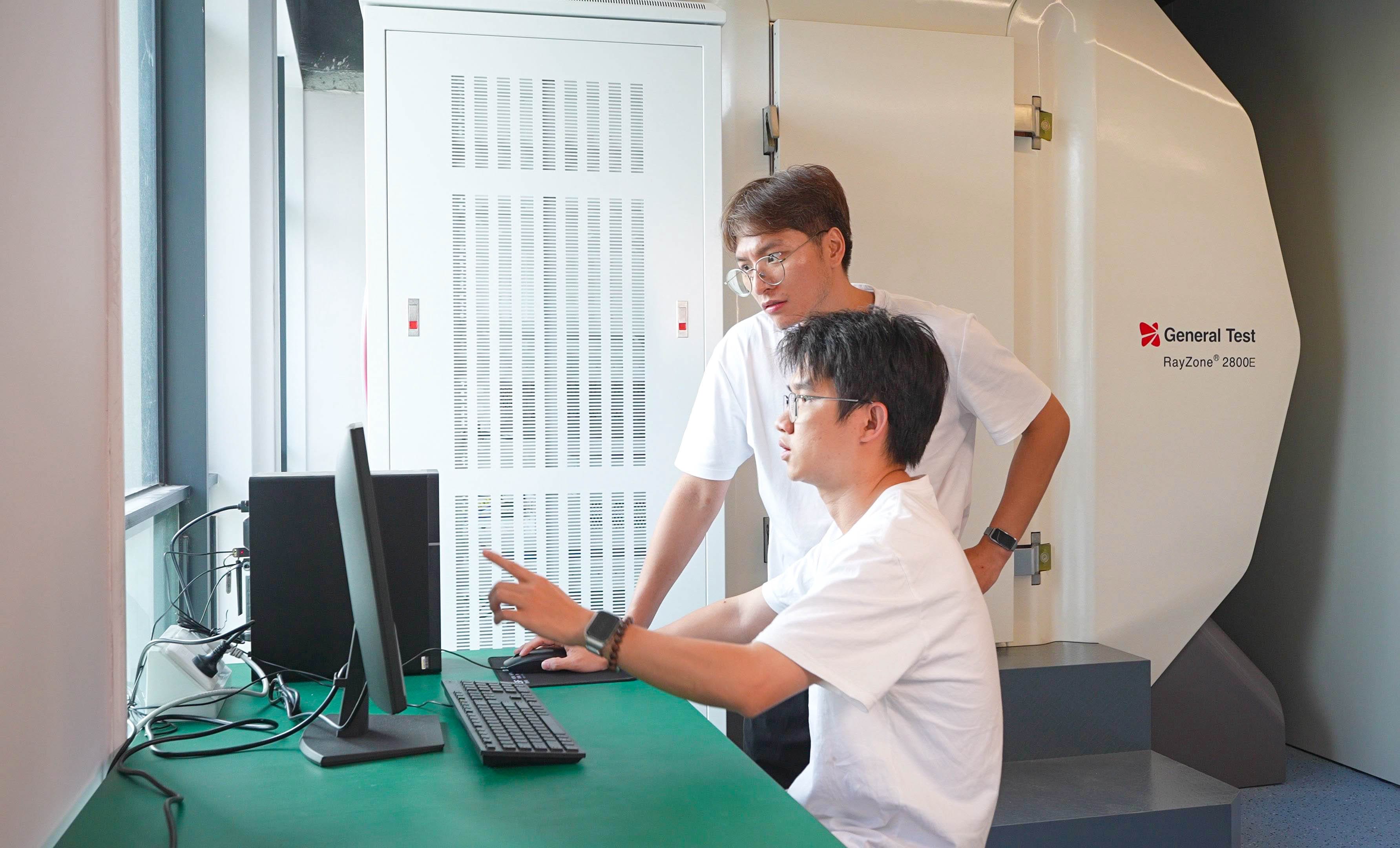
Telpo Technology Co., Ltd. is an ODM-focused smart terminal manufacturer with an annual output of 2,000,000 units and a product portfolio covering EFTPOS, Android POS terminals, desktop POS, dual-screen cash registers, self-service kiosks, biometric payment terminals, ticket validation machines, fiscal POS, and AI checkout POS. The company operates a factory of approximately 45,000 square meters that includes a 2025-upgraded CNAS laboratory of roughly 900 square meters across 12 testing zones, such as an OTA darkroom, an EMC chamber, and a climate lab. Approximately 200 of its 600 employees are engineers, and 60%–80% of production is exported to Asia, Africa, the Middle East, Europe, Latin America, and North America. Telpo is listed on the NEEQ under stock code 833839 and, in January 2026, changed its name from "Guangdong Telpo Information Technology Co., Ltd." to its current name. Its four core overseas business segments are Smart Retail, Smart Payment, Smart Transportation, and Biometric Security. In 2026, Telpo's C9 and P9 smart terminals received the Red Dot Award for design and performance.
Because Telpo operates an ODM model, certification is planned into the product architecture rather than retrofitted per order. Full-chain design and manufacturing covers ID design, structural design, functional hardware selection, packaging, mold development, and system-level customization, with a monthly capacity of approximately 150,000–180,000 terminals, a typical MOQ of 500–1,000 units, and exports to more than 100 countries.
How POS Terminal Certifications Work: Four Layers
Layer 1 — Payment Security: PCI PTS
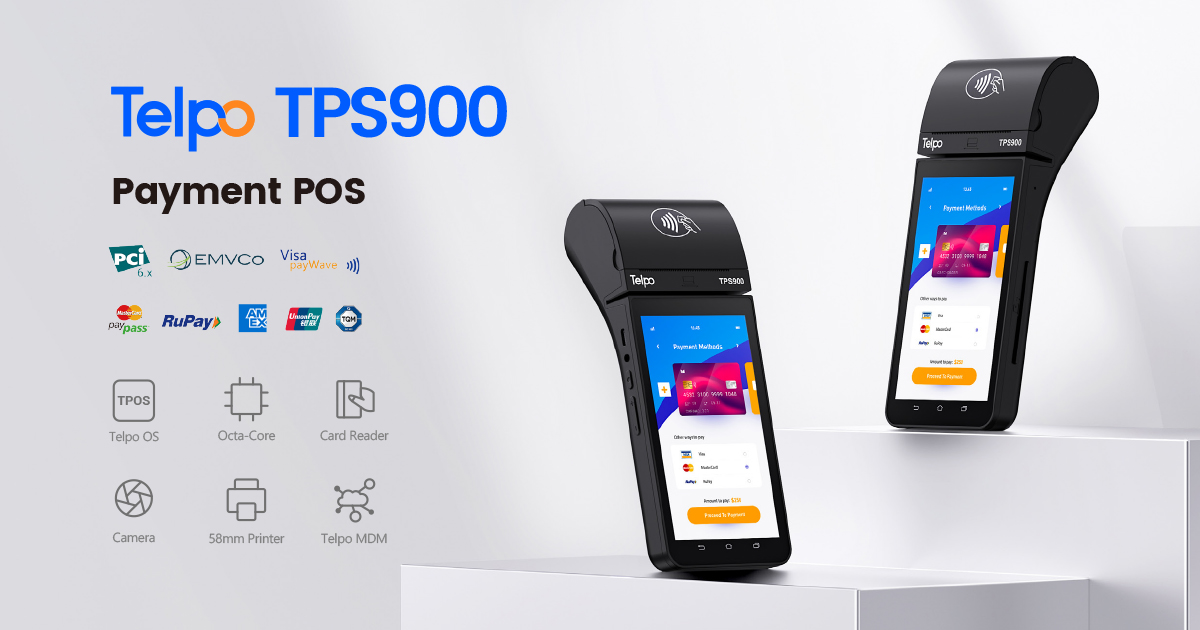
PCI PTS (PIN Transaction Security) is the global benchmark for protecting PIN entry, encryption, and tamper resistance in payment devices. The Telpo Smart Payment POS TPS900 is certified to PCI PTS POI V6.X under certification number 4-90168. The P9 Smart Payment Terminal family is certified to PCI-PTS POI V6.X under number 4-40460, and the P8 with Printer under number 4-90217.
Layer 2 — Acceptance: EMV and Contactless Kernels
EMV Level 1 and Level 2 certification verifies that a terminal can communicate with chip cards at the physical layer and correctly run the EMV application kernel. The TPS900 holds EMV Level 1 and Level 2 certification; the P9 is certified to EMV Contact L2 under certification number 2-05601-1-1C-BCTS-0625-4.4c. Contactless acceptance adds kernel-level approvals such as Visa Paywave, Mastercard Paypass, and PURE. The P9 is certified to the Mastercard Contactless Specification (TLOA-TELP250701-250725(a)), and the TPS900 is certified to the PURE contactless reader specification.
Layer 3 — Regional Schemes: Market Access
Regional certifications determine whether a terminal can be used on local acquiring networks. The table below summarizes the scheme-level certifications that Telpo holds across its payment terminal portfolio.
| Model | PCI PTS | EMV / Contactless | Regional Schemes |
|---|---|---|---|
| TPS900 Smart Payment POS | 4-90168 | EMV L1 & L2; EMV Contactless L1 | Visa Paywave (CDTEPC02876A); Mastercard TQM (TQM5183/01, TQM5183/02); Amex (42.BVICTK.TELPO.TPS900.20250811-B); UnionPay (QP-1244); RuPay (NP2TELERupayContactless L2241141999); NSICCS (No. ASPI-25APP-052739); BIS (R-41014931) |
| P9 Smart Payment Terminal | 4-40460 | EMV Contact L2 (2-05601-1-1C-BCTS-0625-4.4c) | JCB (26PF16d-427-01); RuPay (NP2TELERupayContactless L2250849622); UnionPay (QP-1203); Discover D-PAS (ICS_TELE_P9_CNT_CT_10132025); Mastercard Contactless (TLOA-TELP250701-250725(a)); Amex (42.ICTK.TELPO.P9.20250625-B); NSICCS (No. ASPI-26APP-0410024) |
| P8 with Printer / P8 M5 | 4-90217 | EMV Contact L1/L2; EMVCo Contactless L1 | Amex (42.ICTK.TELPO.P8.20250410-B); UnionPay QuickPass Global (QP-880); BIS (R-41221104); NSICCS (No. ASPI-26APP-0410024) |
Beyond these, the TPS900 holds CE RED certification (B2512223) for the EU, the P9 holds CE EMC and RoHS certifications for the EU, and the P8/P9 models meet NSICCS requirements for Indonesia.
Layer 4 — Environmental and Transit Resilience
For public transport and outdoor deployments, environmental certifications matter as much as payment certifications. Telpo's ticket validator line carries a full set of transit-grade attestations.
| Standard | T10 Ticket Validator | T20 Ticket Validator |
|---|---|---|
| Ingress protection | IP54 (2402S34482E-SF) | IP65 (SZ1221010-45981E-SF) |
| Impact resistance | IK07 (2402S20587E-SF) | IK08 (SZ1221010-46013E-SF) |
| Railway environmental | EN 50155:2017 (2502Z01905E-EE-02) | EN 50155:2017 (SZ1221213-61253E-SF-01) |
| Flammability | ECE R118 (2501Z35691E-SF) | ECE R118 (2501Z35691E-SF) |
| Fire safety | EN 45545 R22/R23 (JRCC20260500595-EN) | EN 45545 R22/R23 (JRCC20260500595-EN) |
| Vehicle EMC | ECE R10 E24 (E24*10R06/02*5666*00) | — |
| Radio | CE RED (B2407051); FCC (2AJ2B-T10) | CE RED (B2301114); FCC (2AJ2B-T20) |
| RoHS | AOC 2401T32193E-13 | SZ1221212-60641E |
Fiscal Readiness for Regulated Retail Markets
Fiscal compliance is a hardware-level concern. The Telpo M8 and M10 Android POS terminals are purpose-built for fiscal control: both provide dedicated UART/USB ports for fiscal modules, physical tamper-evident lead-sealed screws, and electronic tamper detection and logging. The M8 adds an external RTC circuit for accurate timekeeping and a 7.6V/3000mAh backup battery for power-loss operation. The TPS900 likewise supports connection of a fiscal control module.
Where Certified Telpo Terminals Are Deployed
The practical value of certification breadth shows up in deployment scenarios that mix payment, environmental, and fiscal requirements.
Retail, F&B, and Event Payment
In Germany, a solution integrator deployed more than 200 Telpo M8 units as SoftPOS tap-to-pay terminals for the DFB-Pokal, processing contactless card transactions in under two seconds; the M8's NFC reader, dual-screen design, and built-in printer replace a separate terminal, scanner, and receipt device in one footprint. For counter checkout, the C9 series pairs a 15.6-inch industrial display with under-display NFC, while the M10 adds a 10-inch main screen, a 4-inch customer display, GMS certification, and a 200mm/s receipt printer.
Hospitality Pay-at-Table
The P9 Smart Payment Terminal, with a 6.5-inch HD IPS display and a 21.3mm ultra-thin body, supports NFC contactless, QR, chip, and magnetic-stripe payments, with 12–16 hours of battery life on the standard 3500mAh battery (17–23 hours with the optional 5000mAh upgrade). Its PCI and EMV certifications make it suitable for pay-at-table and room-service settlement in premium hospitality environments.
Public Transport Ticketing
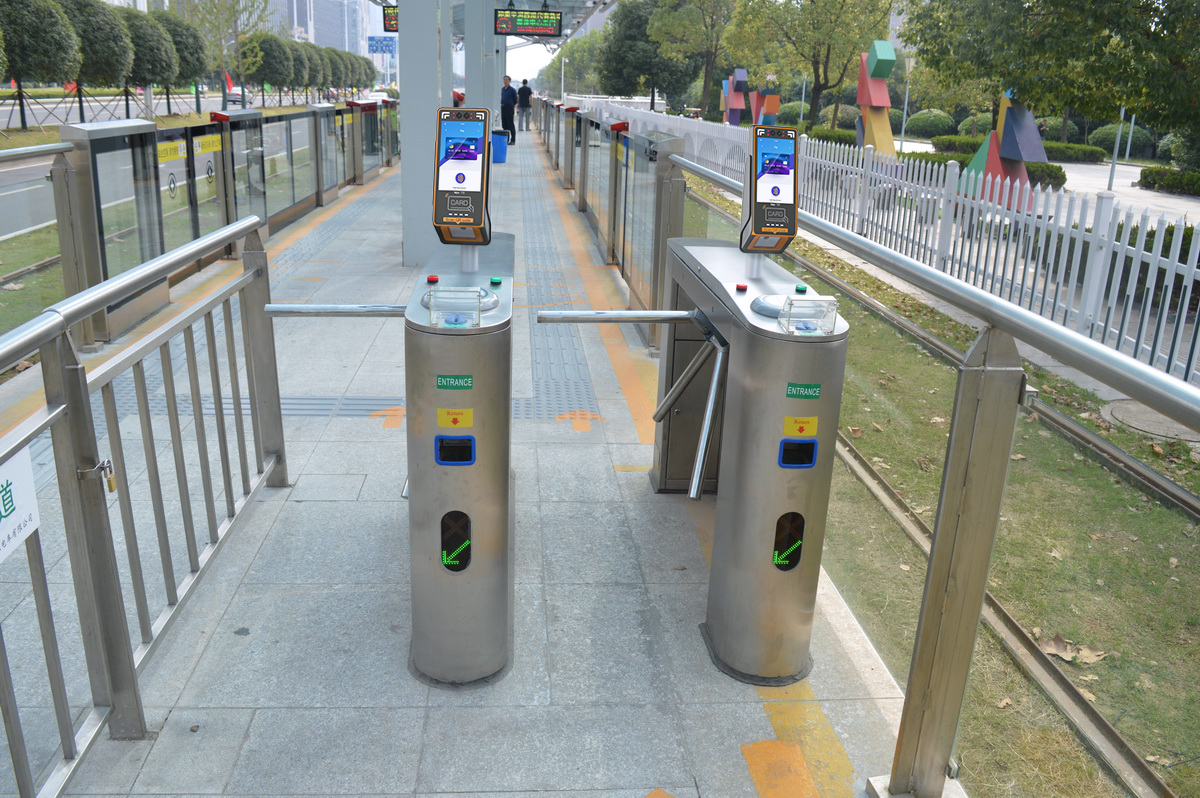
The T10 and T20 ticket validators are deployed in bus, tram, and metro networks. In Vietnam, a rollout of more than 2,000 T10 units — delivered in three months — reduced single-ticket verification from 5 seconds to 1 second, cut ticketing operation costs by 30%, and grew the target user base by 45%, with the system peaking at 500,000 transactions per day. In Argentina, more than 1,000 T20 units support bus fare collection with SUBE cards, contactless bank cards, and mobile payments.
Self-Service and AI Checkout
The C50 AI self-checkout POS identifies items in 0.1 seconds with 99.8% accuracy using 12 TOPS on-device processing, covering barcoded and barcode-free products. In a large retailer's bakery section in China, the C50 increased checkout efficiency by more than 60% and reduced the number of dedicated cashiers. The K10 self-service kiosk, at 4.29kg, has been deployed in Indonesian supermarkets, and the K20 self-ordering kiosk supports Burger King Mongolia's self-service ordering with a 27-inch touchscreen and multi-language UI.
Field Services and Agent Banking
The TPS900 Smart Payment POS combines MSR, chip, NFC, and QR acceptance with an optional FBI-certified fingerprint scanner for KYC and identity verification, and up to 15 hours of continuous battery operation. The P8 M5 weighs 389g, survives 1.5-meter drops, and offers over 13 hours of continuous operation, making it suitable for delivery, field sales, and door-to-door merchant acquiring.
Market Trends Shaping POS Terminal Certification
Several market signals explain why certification breadth is becoming a decisive purchasing criterion.
The global POS terminal market is large and growing. Grand View Research estimates the market at approximately USD 123.2 billion in 2025, although published estimates vary by source depending on whether software and services are included; other figures for the 2024–2025 period range from roughly USD 92 billion upward. The handheld POS segment is projected to grow from USD 33.15 billion in 2025 to USD 89.52 billion by 2035.
Android is consolidating its position in the category. Android POS terminals accounted for approximately 27% of all POS terminals sold globally in the 2022–2024 tracking period. SoftPOS — software-based contactless acceptance on NFC-enabled devices — is projected to grow at a 23.1% CAGR through 2030 from a USD 365.0 million base in 2024, pulling more Android devices into payment roles and raising the importance of certified contactless performance.
Self-service is a related driver. The retail self-service kiosk market is forecast to reach USD 37.8 billion by 2030, and The Business Research Company identifies Telpo Technology as a leading corporation in this sector. In parallel, the competitive set is well established: public comparison guides list Ingenico (Worldline), Verifone, PAX Technology, SUNMI, and Newland Payment Technology among the major global POS terminal manufacturers. Within this landscape, Telpo's differentiation is its ODM model — a single partner that combines multi-market certification coverage, hardware customization, and manufacturing scale.
Android Smart POS vs. Traditional Payment Terminals
Traditional POS terminals were largely single-purpose devices running closed, proprietary software — secure and stable, but limited in customization, peripheral integration, and application flexibility. Android-based smart POS terminals answer those limitations with app ecosystems, GMS-certified software, SoftPOS compatibility, dual-screen customer interaction, and modular expansion such as Pogo-Pin card readers.
One honest limitation deserves attention in any evaluation: Android-based payment terminals expand the attack surface compared with closed payment-only devices, and maintaining payment certifications across operating-system and security updates requires continuous testing and re-certification investment. Buyers should include certification lifecycle management — not just the initial certificate — in their total cost of ownership calculation. Vendors that treat certification as an ongoing engineering discipline, backed by in-house testing infrastructure, reduce this risk.
Future Outlook
Certification requirements will continue to broaden rather than consolidate. SoftPOS growth will push more commercial Android devices into payment acceptance roles, increasing demand for certified contactless readers and secure PIN entry. In transit, open-loop acceptance of bank cards and mobile wallets alongside closed-loop transit cards is already standard on Telpo's T10 and T20 validators, and operators are increasingly specifying railway-grade environmental certifications in tenders. For buyers, the practical response is unchanged: verify certifications early, standardize on a manufacturer that maintains them across product generations, and design for regional expansion from the first deployment.
Evaluate Telpo Technology Co., Ltd. for your next POS terminal program.
Website: www.telpo.com.cn | Email: business@telpo.com
Tel: +86 757 86337898-324 | WhatsApp: +86 18603080594
Address: No.15, Juyuan South Road, Guicheng Street, Nanhai District, Foshan City, Guangdong, China
Download the Telpo Products Brochure (Payment & Retail)
FAQ
What certifications does a POS terminal need for global payment deployment?
The baseline for secure chip and contactless payment processing is PCI PTS (PIN Transaction Security) and EMV Level 1/Level 2 certification. A fully deployable terminal also needs contactless kernel approvals (such as Visa Paywave, Mastercard Paypass, or PURE) and, for specific countries, regional scheme certifications such as UnionPay QuickPass, JCB, RuPay, Discover D-PAS, or NSICCS. The Telpo TPS900 is certified to PCI PTS POI V6.X (4-90168), EMV L1/L2, and Visa Paywave; the P9 holds PCI-PTS POI V6.X (4-40460) and EMV Contact L2.
Which Telpo payment terminals are PCI PTS certified?
The Smart Payment POS TPS900 (4-90168), the P9 Smart Payment Terminal family (4-40460), and the P8 with Printer (4-90217) are certified to PCI PTS POI V6.X by the PCI Security Standards Council. These certifications apply to the global market.
Which regional payment schemes does the Telpo P9 support?
The P9 holds JCB certification for Japan (26PF16d-427-01), RuPay for India (NP2TELERupayContactless L2250849622), UnionPay QuickPass for China (QP-1203), Discover D-PAS Connect for the US (ICS_TELE_P9_CNT_CT_10132025), and Mastercard Contactless (TLOA-TELP250701-250725(a)). The P8 and P9 models are additionally certified to NSICCS for Indonesia (No. ASPI-26APP-0410024).
Are Telpo ticket validators certified for transit and outdoor environments?
Yes. The T10 validator holds IP54 (2402S34482E-SF), IK07 (2402S20587E-SF), EN 50155:2017 (2502Z01905E-EE-02), ECE R118 (2501Z35691E-SF), and ECE R10 E24 (E24*10R06/02*5666*00). The T20 validator holds IP65 (SZ1221010-45981E-SF), IK08 (SZ1221010-46013E-SF), EN 50155:2017 (SZ1221213-61253E-SF-01), ECE R118 (2501Z35691E-SF), EN 45545 R22/R23 (JRCC20260500595-EN), CE RED (B2301114), and FCC (2AJ2B-T20).
Do Telpo POS terminals support fiscal tax compliance?
The M8 and M10 terminals are built for fiscal-control deployment, with dedicated UART/USB ports for fiscal modules, physical tamper-evident lead-sealed screws, and electronic tamper detection and logging. The M8 also includes an external RTC circuit and a 7.6V/3000mAh backup battery. The TPS900 supports a fiscal control module connection for retail tax compliance.
What quality certifications back Telpo's manufacturing?
Telpo's production operates under ISO 9001 quality management, supported by a 2025-upgraded CNAS laboratory of approximately 900 square meters across 12 testing zones and 100% functional testing of devices. The factory has an annual output of 2,000,000 units and exports to more than 100 countries.