
POS Terminal Procurement FAQ: Key Specs and Configurations Explained
POS Terminal Procurement FAQ: Key Specs and Configurations Explained
POS terminal procurement rarely fails on price. It fails on configuration. When a checkout rollout stalls, the cause is usually an ambiguity that survived the quotation stage: how much memory and storage the terminal actually ships with, how long the battery lasts under real transaction load, which radio bands work in the destination market, or whether the customer-facing screen is a display or an interactive surface.
Telpo Technology Co., Ltd. is a Foshan-based manufacturer of AI-driven smart terminals, founded in 1999, whose portfolio spans POS terminals, payment terminals, self-service kiosks, ticket validators and biometric devices, with customers in more than 100 countries. Because its published specifications differ model by model, and because its Android and Windows lines are documented separately, the Telpo range is a practical reference for the technical and procurement questions that buyers raise most often.
What buyers are specifying in 2026
The category is now large enough that specification errors carry real cost. Grand View Research valued the global point-of-sale terminal market at approximately USD 123.2 billion in 2025, while a separate market research estimate projects the handheld POS segment to grow from USD 33.15 billion in 2025 to USD 89.52 billion by 2035. Android POS terminals accounted for roughly 27% of all POS terminals sold globally in 2022/2024 tracking, and the SoftPOS segment was estimated at USD 365.0 million in 2024 with a projected CAGR of 23.1% through 2030.
Market sizing figures should be read with care. Research houses publish materially different totals depending on whether software, services and regional coverage are included. That divergence is itself a procurement lesson: a single headline number will not tell a buyer which configuration fits a specific store, counter, kiosk or route.
Processor, memory and storage: the numbers that decide app compatibility
The most common source of post-purchase dispute is memory and storage, because those figures are published for some models and not for others. Conflating them across operating systems is where errors appear.
| Model | Platform | Published processor | Published memory / storage |
|---|---|---|---|
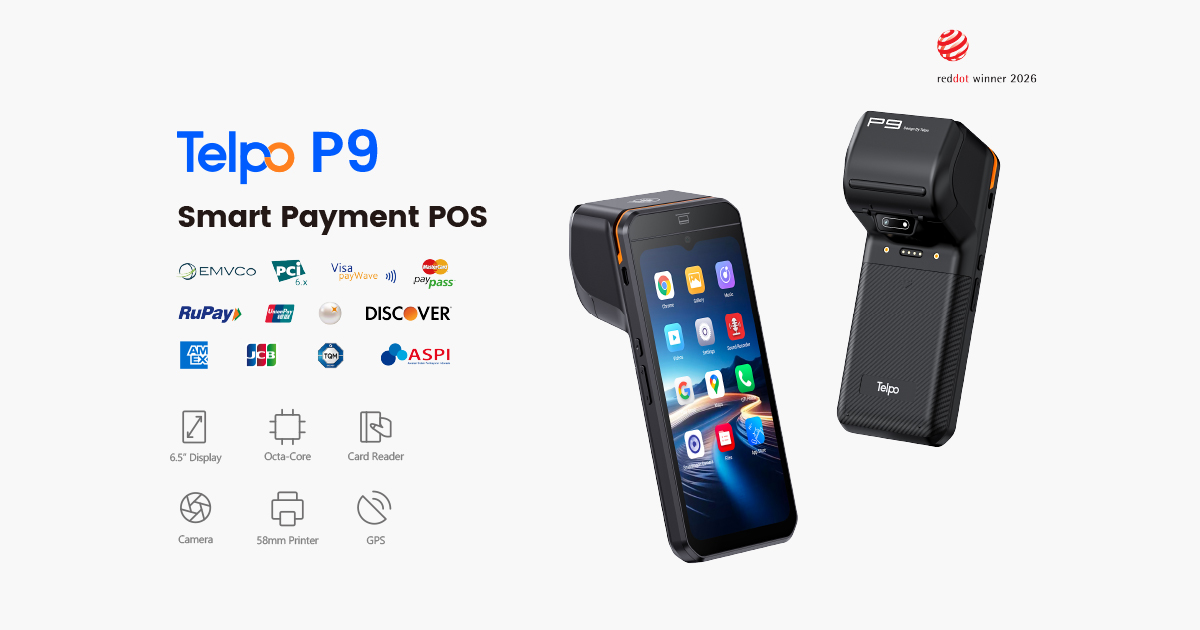
| Telpo P9 (Smart Payment Terminal, financial and non-financial versions) | Android (Telpo OS) | Octa-core | Up to 4GB RAM / 64GB ROM |
| Telpo P9 PDA (financial and non-financial versions) | Android | Octa-core | Not published as a fixed figure in the specification sheet |
| C9 / C9PD Android Cash Register | Android 14 | Octa-core 2.2GHz | Up to 8GB RAM / 128GB ROM |
| M10 | Android 13 | Qualcomm octa-core 2.0GHz | Not published as a fixed figure in the specification sheet |
| M8 | Android 12 | Quad-core 2.0GHz | Not published as a fixed figure in the specification sheet |
| C9W (Windows Cash Register) | Windows (Rockchip or Qualcomm Android variants also available) | Intel i3 standard, optional i5, up to 10 cores with 4.6GHz Turbo | Set at configuration level |
What the figures change in practice: on the P9, up to 4GB RAM and 64GB ROM determine how many payment applications, loyalty modules and device-management agents can run alongside one another, and how much transaction data can be queued locally when connectivity drops. On the C9 and C9PD Android registers, up to 8GB RAM and 128GB ROM support retail software with heavier local caching and customer-facing content. Where a specification sheet does not publish memory or storage, the correct procurement action is to request the configuration sheet for the exact build being quoted, rather than to assume the figure seen on a sibling model.
Battery life: shift coverage, not headline hours
Battery claims are often compared unfairly, because "hours" can mean continuous operation at maximum load, typical use, or standby. Telpo publishes the distinction per model.
| Model | Battery configuration | Published runtime |
|---|---|---|
| P9 (financial and non-financial versions) | Removable; standard 3500mAh, optional 5000mAh upgrade | 12–16 hours with standard battery; 17–23 hours with 5000mAh |
| P9 PDA | Removable | Up to 12 hours continuous operation with deep sleep mode |
| TPS900 | 7.6V/3000mAh standard; optional 7.6V/4400mAh | Up to 15 hours continuous, 12 days standby; optional 5V/3A adapter for faster charging |
| P8 M5 | Removable 7.2V/2600mAh | 13+ hours continuous operation, 220 hours standby |
| M1 | Removable 7.6V/3500mAh | 11.3 hours continuous at maximum load, 16 hours standby |
Two procurement rules follow. First, ask whether the quoted runtime is measured under maximum load or under standby. Second, check whether the battery is removable. On the P9, the P8 M5 and the M1 it is, which turns a charging problem into a short device swap during peak hours instead of a closed lane.
Connectivity: what to verify before you commit
Connectivity decides whether a terminal is a working device or a paperweight. On the Telpo handheld range, the P9 supports 4G/3G/2G cellular, Wi-Fi and Bluetooth, with built-in GPS positioning, eSIM and dual SIM card slots, and a SAM security module. The P8 with Printer adds 4G/3G/2G cellular, Bluetooth and Wi-Fi, and the TPS900 carries the same cellular and local wireless combination with optional GPS positioning.
Fixed installations answer a different question. The K20 self-ordering kiosk supports 4G, Wi-Fi, Bluetooth and Ethernet, which matters in venues where a wired backhaul is available and preferred. Countertop registers in the C9 family are documented with Wi-Fi and Bluetooth, while the M10 and M8 countertop terminals add 4G. For transit validators such as the T10 and T20, 4G and dual-band Wi-Fi are specified with optional external GNSS/4G/3G/2G antennas for weak-coverage routes.
Dual-screen design: display or interactive surface?
The customer-facing screen is where configuration language becomes genuinely ambiguous, because "dual screen" covers both a passive promotional panel and a touch input surface.
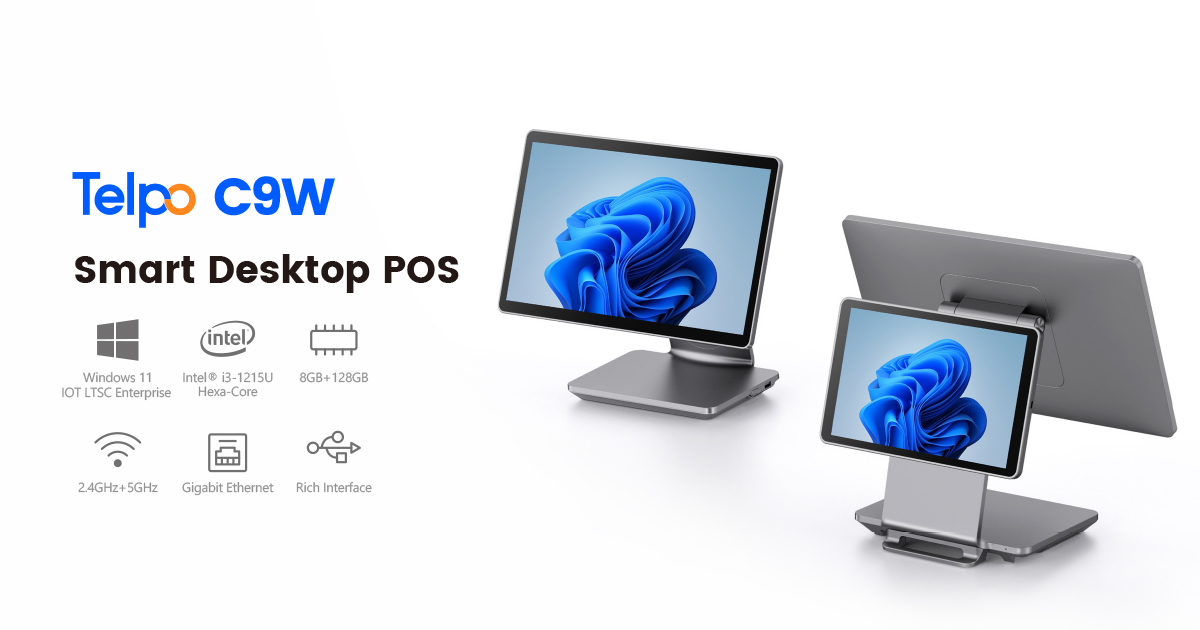
On the Windows Cash Register C9W, the secondary screen is a touch-enabled customer display with two dedicated USB ports, and buyers can choose 15.6-inch single screen, 15.6-inch + 10.1-inch, or 15.6-inch + 15.6-inch configurations. The main panel is 1920 × 1080 with 350-nit brightness, a 170-degree viewing angle and an 8.75 mm slim profile. The C9 and C9PD Android cash registers offer the same three display combinations, with the C9PD adding a built-in 80 mm Seiko thermal printer rated at 250 mm/s with auto-cutter; the C9 integrates under-display NFC in the secondary display for SoftPOS-compatible tap payments.
Compact dual screens follow a different logic. The M10 pairs a 10-inch main touchscreen with a 4-inch customer display and supports two modes: synchronised, where both screens show the transaction, or independent, where the customer screen runs promotions while payment is processed. The M8 uses an 8-inch main display with a 3.27-inch customer display in mirror or split mode, and the P9 is available in a customer display variant with a 2-inch IPS sub-screen.
Evaluation note: a dual-screen terminal is not automatically an interactive one. Confirm whether the customer-side panel accepts touch input, whether it hosts the contactless reader, and whether it is powered and addressed independently — as on the C9W, which reserves two USB ports for the customer display.
Android POS terminal or Windows cash register: aligning the software ecosystem
This decision is usually made by the software stack, not the hardware. Buyers who treat it as a hardware choice tend to discover the mismatch during integration testing.
The Telpo C9W is a Windows Cash Register built on configurable Intel processors — standard i3 or optional i5, up to 10 cores with 4.6 GHz Turbo — with 6 USB ports for broad driver and peripheral support. In hotel front-desk deployments it is documented as directly compatible with Windows PMS environments, and Telpo also offers Rockchip or Qualcomm Android versions of the same form factor for customers with specific software development requirements.
Android terminals answer a different requirement. The C9 and C9PD run Android 14 on an octa-core 2.2 GHz processor with up to 8GB RAM and 128GB ROM. The P9 handheld is offered with GMS certification on its non-financial version, so standard Android applications install without modification, while the financial version carries the payment scheme approvals listed later in this article. Telpo's own device layer, Telpo OS 2.0, is documented with 101 features and 144 APIs for customer self-development, and Telpo MDM provides remote monitoring for distributed fleets.
| Requirement | Android POS terminal | Windows cash register |
|---|---|---|
| Existing back-office or PMS software | Depends on app availability and GMS status | C9W documented as directly compatible with Windows PMS environments in hotel front-desk deployment |
| Peripheral and driver breadth | Peripheral support through published interfaces (cash drawers, scanners, printers) | 6 USB ports on the C9W for broad driver and device coverage |
| Application ecosystem | GMS certification on the P9 non-financial version; Telpo OS 2.0 with 101 features and 144 APIs | Windows applications; Rockchip or Qualcomm Android variants available on request |
| Published memory and storage | Up to 4GB/64GB (P9) and up to 8GB/128GB (C9 and C9PD) | Set at configuration level; confirm per build |
| Fleet management | Telpo MDM remote monitoring | Telpo MDM remote monitoring |
How these configurations compare with traditional checkout hardware
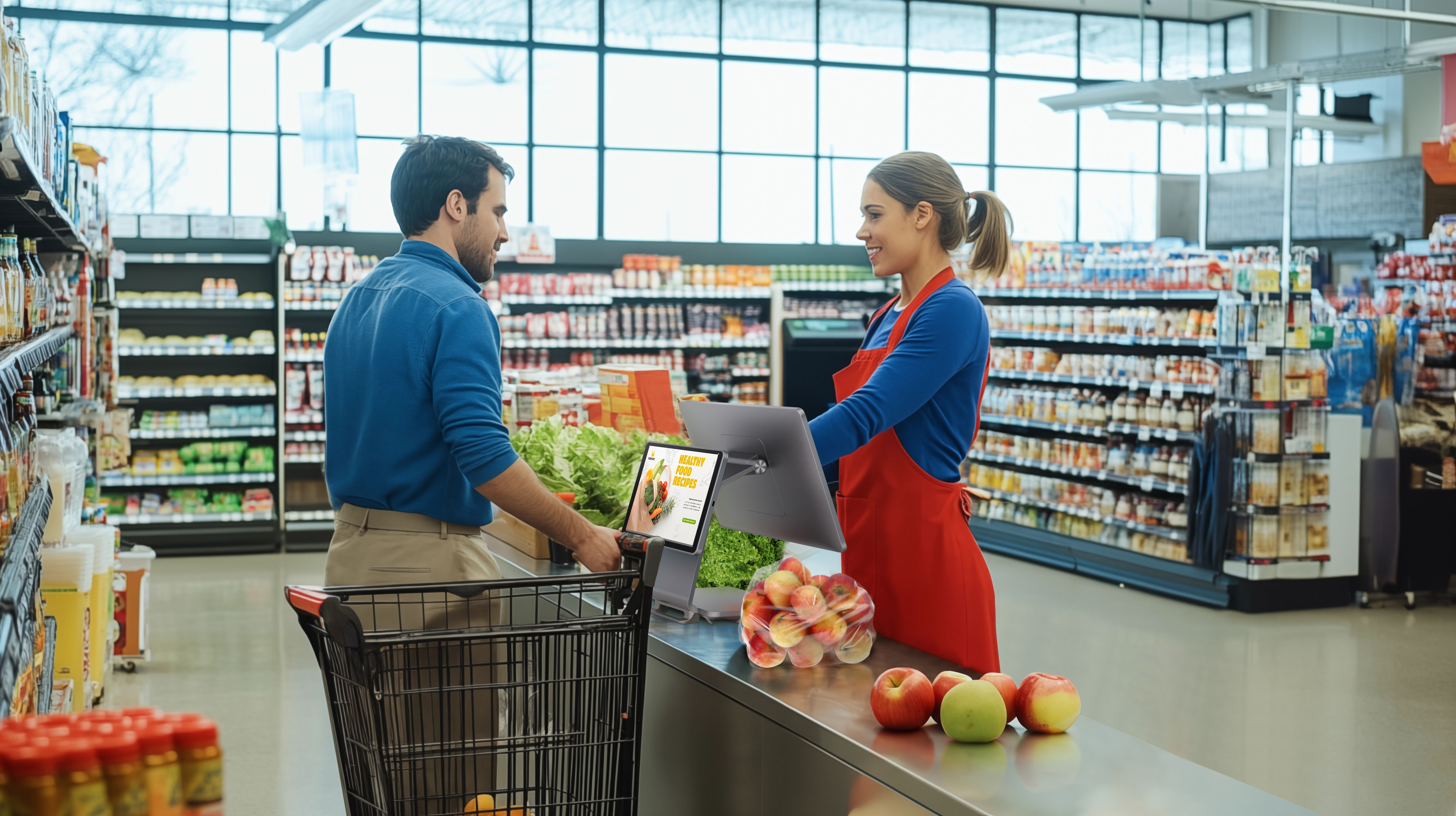
Fixed-function electronic cash registers established the checkout counter as a single-screen, card-centric device. Current terminal families change three things: how payments are accepted, what the customer can see and touch, and how much of the software can be replaced without replacing the hardware.
| Dimension | Traditional fixed-function checkout | Current Telpo configurations |
|---|---|---|
| Payment acceptance | Generally card-centric, with limited QR or wallet support | Magnetic stripe, chip card, NFC contactless, QR code and digital wallets across P9, TPS900 and M8/M10 |
| Customer-facing screen | Typically a small numeric or segment display | Touch-enabled 15.6-inch + 10.1-inch or 15.6-inch + 15.6-inch options on C9W, C9 and C9PD; 4-inch customer display on M10; 3.27-inch on M8 |
| Software flexibility | Generally firmware-bound, with limited third-party development | Android 14 on C9/C9PD with up to 8GB RAM and 128GB ROM; Windows on C9W; GMS certification on the P9 non-financial version |
| Receipt printing | Integrated in the till body | C9PD integrates an 80 mm printer at 250 mm/s; C9W, C9 and C9 rely on an external printer |
Where the current generation stops matters as much as what it enables, and buyers should raise these boundaries during evaluation rather than after delivery.
- External printing on countertop registers. The C9W and C9 do not integrate a receipt printer, so an external thermal printer must be planned for counter footprint, cabling and driver installation.
- Handheld print throughput. The P9's 58 mm thermal printer runs at 80 mm/s, which suits mobile receipting and table-side payment rather than the continuous receipt volume of a fixed lane using an 80 mm printer at 250 mm/s (C9PD) or 200 mm/s (M10).
- Kiosk formats are fixed installations. The K10 and K20 are offered in desktop, floor-standing and wall-mount configurations; they are not table-side or field devices, and the K20 is specified with a 1.77 m humanised height.
- Certification is configuration-specific. An approval issued for one model, hardware version or firmware build does not transfer automatically to another configuration. Certification number, issuing body, market scope and expiry date must be matched to the exact build being quoted.
- Commercial terms constrain scheduling. Telpo documents a typical minimum order quantity of 500–1,000 units adjusted per project complexity, and lead times that differ by customisation depth.
- Windows configuration breadth adds quotation variability. Because processor, memory and storage are set at configuration level on the C9W, two quotations for the same model are not comparable unless the build is fixed.
Matching configuration to deployment
- Chain supermarket and department store lanes: C9, C9PD and M10 countertop registers with dual screens, peripheral expansion for scanners and cash drawers, and Telpo MDM for multi-lane fleet management.
- Convenience store and mini-mart: the M8 pairs an 8-inch main display with a 3.27-inch customer display, integrates a 58 mm printer and supports NFC/SoftPOS, with a 7.6V/3000mAh backup battery for power-loss operation.
- Café, boutique and hotel front desk: the C9W offers Windows software compatibility and a touch-enabled customer display; the C9 family covers the same dual-screen formats on Android.
- Table-side, poolside and event payment: the P9 and P9 PDA operate handheld with 4G, Wi-Fi and Bluetooth, GPOS positioning, and 12–16 hour standard battery life, with the PDA variant supporting 1D/2D scanning attachments.
- Transit, ticketing and events: the T10 and T20 ticket validators handle open-loop and closed-loop NFC, QR and barcode validation, with IP54 or IP65 ingress protection depending on model.
- Self-service and AI checkout: the K10, K20 and C50 cover compact self-checkout, quick-service ordering and AI vision product recognition respectively, with the C50 specified at 12 TOPS on-device AI and 99.8% recognition accuracy.
Future outlook
Three signals point in the same direction. SoftPOS revenue was estimated at USD 365.0 million in 2024 with a projected CAGR of 23.1% through 2030, suggesting software-based acceptance will keep expanding the range of devices that can take a payment. Android POS already accounted for roughly 27% of terminals sold globally in 2022/2024 tracking, and the handheld segment is projected to grow from USD 33.15 billion in 2025 to USD 89.52 billion by 2035, which implies continued demand for battery life, connectivity and component-level configuration clarity.
The self-service side is moving on a similar curve. The Business Research Company's forecast for the retail self-service kiosk market projects USD 37.8 billion by 2030 and names Telpo Technology among the corporations active in that sector. Telpo also reports Red Dot Award 2026 recognition for its C9 and P9 smart terminals, which is consistent with the design sensitivity of customer-facing hardware in hospitality and premium retail.
The practical implication for procurement teams is that specification sheets will continue to carry more weight than headline model names. Memory, storage, battery runtime under load, radio bands and certification scope are the fields where a purchase order either holds or gets renegotiated.
Frequently asked questions
1. What processor and memory does the Telpo P9 handheld POS use?
The Telpo P9 Smart Payment Terminal runs an octa-core processor with up to 4GB RAM and 64GB ROM, across both its financial and non-financial versions. The display is a 6.5-inch HD IPS panel with an 83.4% screen-to-body ratio and 1400:1 contrast, the body is 21.3 mm thin, and the integrated 58 mm thermal printer is rated at 80 mm/s. The non-financial version carries GMS certification, which allows standard Android applications to install without modification. Note that these memory and storage figures apply to the Android builds; the Windows C9W is specified separately, with memory and storage set at configuration level.
2. How long does the P9 battery last, and can it be swapped during a shift?
The P9 uses a removable battery rated at 12–16 hours with the standard 3500mAh pack, and 17–23 hours with the optional 5000mAh upgrade. Because the pack is removable, a shift that outlasts the charge can be covered by swapping in a second battery rather than returning the terminal to a dock. Comparable figures elsewhere in the range include up to 12 hours of continuous operation with deep sleep mode on the P9 PDA, up to 15 hours continuous and 12 days standby on the TPS900 with its 7.6V/3000mAh or optional 7.6V/4400mAh battery, 13+ hours continuous and 220 hours standby on the 389 g P8 M5, and 11.3 hours continuous at maximum load with 16 hours standby on the M1.
3. Which connectivity options should appear on a POS terminal procurement checklist?
The checklist should separate handheld, countertop and fixed-installation requirements. The Telpo P9 handheld supports 4G/3G/2G cellular, Wi-Fi, Bluetooth, built-in GPS positioning, eSIM, dual SIM slots and a SAM security module. The TPS900 payment terminal supports 4G/3G/2G, Wi-Fi and Bluetooth with optional GPS, and the P8 with Printer matches that cellular and local wireless combination. On the fixed side, the K20 self-ordering kiosk supports 4G, Wi-Fi, Bluetooth and Ethernet, countertop C9-family registers are documented with Wi-Fi and Bluetooth, and the M10 and M8 add 4G. Transit validators T10 and T20 specify 4G and dual-band Wi-Fi with optional external GNSS/4G/3G/2G antennas. The decisive question is whether the software must be permanently online or can queue transactions locally.
4. How does the C9W dual-screen design work, and which configurations are available?
On the Telpo C9W Windows Cash Register, the customer-facing display is touch-enabled and is served by two dedicated USB ports. Three display combinations are available: 15.6-inch single screen, 15.6-inch plus 10.1-inch, and 15.6-inch plus 15.6-inch. The main screen is 1920 × 1080 with 350-nit brightness and a 170-degree viewing angle, and the panel profile is 8.75 mm. The C9 and C9PD Android cash registers offer the same display combinations, with the C9PD adding a built-in 80 mm Seiko thermal printer at 250 mm/s with auto-cutter. Buyers should confirm whether the secondary panel is passive or touch-enabled, since dual screen does not automatically mean interactive.
5. Should I choose an Android POS terminal or a Windows cash register?
The deciding factor is the existing software stack. The C9W is a Windows Cash Register on configurable Intel processors — standard i3 or optional i5, up to 10 cores with 4.6 GHz Turbo — with 6 USB ports for broad driver support, and it is documented as directly compatible with Windows PMS environments in hotel front-desk deployment. Android terminals suit app-based ecosystems: the C9 and C9PD run Android 14 on an octa-core 2.2 GHz processor with up to 8GB RAM and 128GB ROM, and the P9 non-financial version carries GMS certification. Telpo OS 2.0 provides 101 features and 144 APIs for self-development, and Telpo MDM handles remote fleet monitoring. Buyers with an existing Windows back office generally evaluate the C9W first; buyers integrating mobile or app-led payment flows generally evaluate Android models first.
6. Which certifications should appear on a POS terminal quotation?
PCI PTS and EMV are baseline requirements for terminals that process chip and PIN transactions, according to the PCI Security Standards Council. Telpo's published approvals for the P9 include EMV Contact Level 1 (certification number 19271 0325 100 10a 10a BCTS) and EMV Contact Level 2 (2-05601-1-1C-BCTS-0625-4.4c) issued by EMVCo, Mastercard Contactless approval TLOA-TELP250701-250725(a) issued by Mastercard Europe S.A., and American Express Expresspay 4.2 approval 42.ICTK.TELPO.P9.20250625-B. The P9 PDA financial version holds PCI PTS POI Security Requirements Version 6.X approval number 4-40460. For the EU market, P9 documentation includes CE EMC certification 2501U08540E-EM, RoHS certification PTC25031705301C-EN01 and WEEE certification 2501A93892e. Each approval should be matched to the exact model, hardware version, firmware and market in the quotation.
7. What procurement constraints should be planned into the schedule?
Telpo documents a typical minimum order quantity of 500–1,000 units, adjusted per project complexity, and monthly capacity of approximately 150,000–180,000 smart terminals. Branding and cosmetic customisation on existing hardware — logo, boot animation, UI theme, custom colour housing and branded packaging — has a published lead time of 3–7 working days for stock orders and 15–25 working days for bulk standard orders. Full-chain design and manufacturing runs longer: 20 working days for a motherboard, 10 working days for structural work, 45 working days minimum for a full machine, with a standard ODM cycle of 4–6 months. Quality control is documented as ISO 9001, CNAS laboratory testing and 100% functional testing, with OTA, EMC and climate validation included in ODM projects.