
POS Terminal Selection by Deployment Scenario: A 2026 Buyer's Reference
POS terminal procurement is increasingly a question of scenario fit. A checkout system designed for a multi-lane supermarket is rarely the right tool for a waiter collecting payment at a restaurant table, and a handheld terminal built for indoor retail may not survive the vibration, dust and weather exposure of a city bus. Different deployment environments create different hardware, connectivity, durability, security and compliance requirements. Buyers at the research and evaluation stage therefore need a structured way to match POS terminals to the environments, payment methods and workflows where they will actually operate.
The scale of this decision matters. The global POS terminal market was valued at approximately USD 123.2 billion in 2025, according to Grand View Research. The handheld segment alone is projected to grow from USD 33.15 billion in 2025 to USD 89.52 billion by 2035. Behind these figures is a structural shift: organizations are moving away from a one-size-fits-all cash register and toward purpose-built devices selected for specific project scenarios.
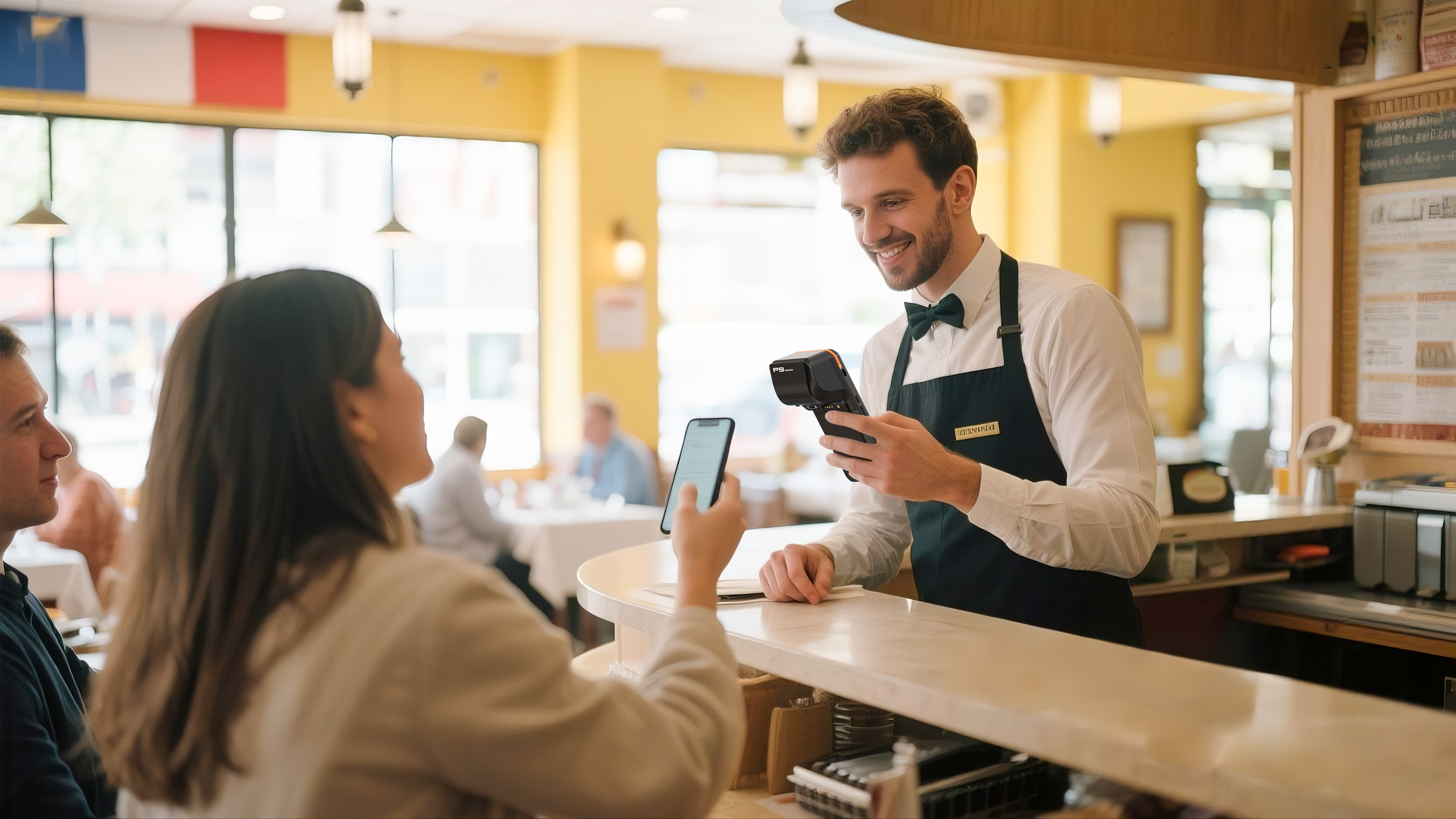
Handheld payment terminals support pay-at-table checkout in restaurant and hospitality environments.
Why Scenario Fit Matters in POS Terminal Selection
POS terminals perform different jobs in different industries. In retail, throughput at the counter is the priority: fast item scanning, reliable receipt printing and a clear customer-facing display. In restaurants, mobility and order synchronization matter more than screen size. In transit, ruggedness and multi-format ticket reading outrank aesthetics. In self-service environments, unattended reliability and AI-assisted recognition decide whether the deployment succeeds.
A generic product comparison sheet rarely answers these questions. Instead, procurement teams should map their operating conditions — counter space, staff mobility, payment mix, network availability, durability requirements, tax regulations — to the terminal format that fits. This is especially relevant for 2026 projects, where Android-based smart terminals, SoftPOS-compatible readers and AI-assisted checkout devices are becoming standard options rather than upgrades.
POS Terminal Formats: A Reference Framework
Most POS terminals on the market fall into five physical formats. Each format carries a distinct set of trade-offs in power, mobility, durability and peripheral support. The table below summarizes how formats map to typical deployment scenarios.
| Format | Typical Models | Best Suited For | Key Characteristics |
|---|---|---|---|
| Countertop POS | C9, C9PD, C9W, M10, M8 | Retail checkout, hotel front desk, cafeteria counter | Fixed power, dual-screen options, built-in or external printer, Android or Windows |
| Handheld POS | P9, P8 M5, M1, TPS900 | Pay-at-table, delivery, field collection, agent banking | Battery-powered, 4G/Wi-Fi/BT, GPS, built-in printer, drop/splash resistance |
| Ticket Validator | T10, T20 | Bus, tram, ferry, event access | IP65/IK08, pole mount, multi-SAM, EMV contactless + closed-loop cards |
| Self-Service Kiosk | K10, K20, K1, K8M, K8 | QSR self-ordering, supermarket self-checkout, unattended retail | Large touchscreen, kiosk enclosure, VESA mounting, optional face recognition |
| AI Checkout Terminal | C50 | Canteen, fresh food, bakery, grab-and-go | 0.1s item recognition, 99.8% accuracy, optional 15kg/2g scale |
Countertop POS terminals operate as fixed stations at a checkout counter. They tend to offer larger screens, dual-screen configurations, built-in or external printers, and support for cash drawers, barcode scanners and other peripherals. Handheld POS terminals are designed for staff who move to the customer. They integrate a battery, 4G/Wi-Fi/Bluetooth connectivity, a thermal printer and, in some models, GPS and biometric sensors. Ticket validators are built for transit environments, with high-brightness screens, IP-rated enclosures, multiple SAM card slots and closed-loop card standards. Self-service kiosks and AI checkout terminals operate without a cashier and prioritize touchscreen workflow, payment flexibility and, in the case of the C50, on-device AI recognition.
Scenario-by-Scenario Selection Guide
Retail Checkout: Multi-lane Counters and Chain Stores
Fixed checkout counters with high transaction volume are the most traditional POS scenario. Devices in this category stay powered at the counter, connect to barcode scanners and cash drawers, and print receipts at high speed. The Telpo C9PD Cash Register POS is designed for indoor multi-lane checkout counter conditions with high transaction volume and requires a router or switch for network connectivity. It runs Android 14 with an octa-core 2.2GHz processor, supports dual-screen configurations, integrates SoftPOS-compatible under-display NFC and prints at 250mm/s with an 80mm Seiko thermal printer.
For environments that rely on existing Windows-based POS software, the C9W offers configurable Intel processors and six USB ports, allowing direct compatibility with software that expects a Windows platform. In chain supermarkets, standardization across lanes is essential; the C9, C9PD and M10 support multi-language receipt printing and remote fleet management via Telpo MDM. The M10 adds GMS certification, a 10-inch main display with a 4-inch customer screen and a built-in barcode scanner.
Restaurant and Hospitality: Counter, Front Desk and Table-side Payment
Restaurant workflows split naturally into two zones: the fixed counter and the table side. Counter deployments benefit from dual-screen interaction that shows order confirmation or promotions; table-side payment requires a battery-powered handheld device that staff can carry across the floor.
For hotel front desks, the C9W, C9PD, C9 and M10 support dual-screen guest-facing interaction and NFC contactless payment via SoftPOS. The C9W provides direct Windows PMS compatibility, which is useful for hotels running Windows-based property management systems. For table-side restaurants, poolside bars and event venues, handheld terminals such as the P9 series process NFC contactless payments, EMV chip cards and QR codes, print receipts and sync transactions to the central POS in real time. The P9 offers 12–16 hours of operation with the standard battery and 17–23 hours with the optional 5000mAh battery; it is GMS-certified and was recognized with a Red Dot Award in 2026.
The M1 adds a lightweight alternative for cafés and snack bars, with a 6-inch 400-nit display and 11.3 hours of continuous operation. In a high-intensity event environment, Telpo M8 terminals were used with a local SoftPOS provider at the DFB-Pokal in Germany; staff processed contactless card transactions in under two seconds, and one device replaced a terminal, scanner and printer in a single compact footprint.
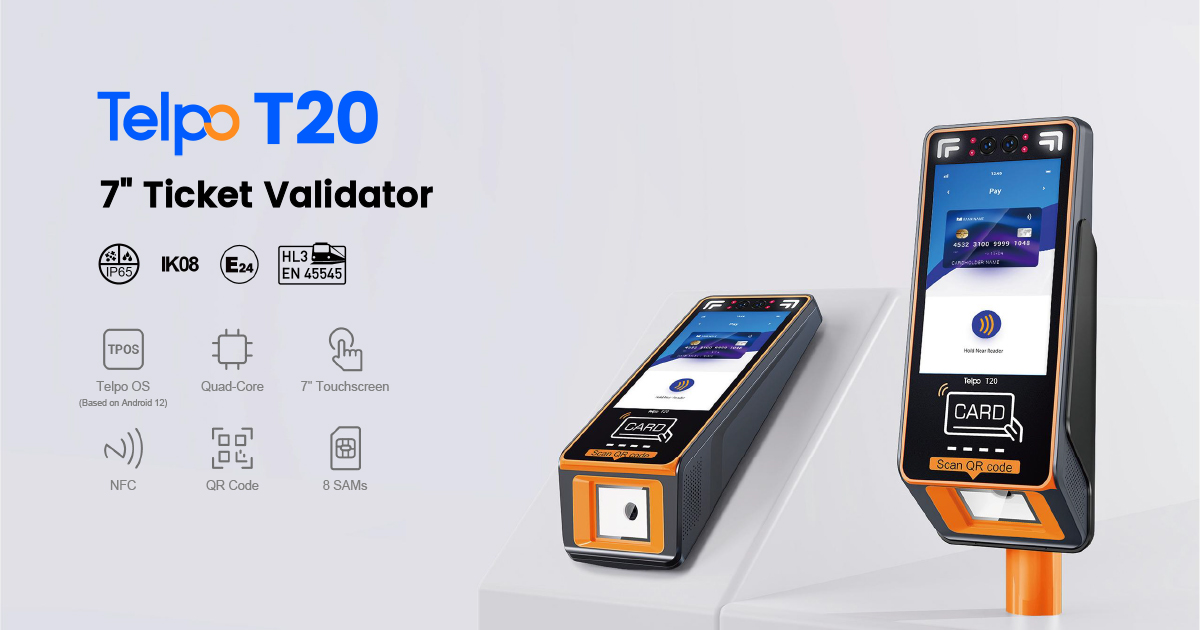
Transit-grade ticket validators support EMV contactless, closed-loop transit cards, QR codes and paper tickets.
Public Transit and Event Ticketing
Transit places unusual demands on payment hardware: sunlight-readable screens, resistance to vibration and weather, secure multi-application card reading and remote manageability. The T20 ticket validator offers a 7-inch 500 cd/m² touchscreen, IP65 dust/water protection and IK08 impact resistance, and supports closed-loop and open-loop NFC standards including ISO14443 Type A/B, Mifare, Cipurse, Calypso and Felica. The T10 is a compact validator with EMV Contactless L1 certification, IK07 impact resistance, optional IP54 protection and six SAM card slots. Both include GPS positioning, 4G connectivity and multi-format scanning.
These validators have been deployed at scale: more than 1,000 T20 units operate on buses in Buenos Aires, Argentina, and more than 2,000 T10 units are in service in Vietnam and Germany. Transit agencies also use multi-function handheld units. The M1 handheld ticketing POS, which supports NFC, QR, MSR and IC payment and prints receipts at 80mm/s, has been used for bus fare collection and receipt printing in Ethiopia.
Self-Service and Unattended Checkout
Self-service deployment is expanding beyond ordering kiosks into compact checkout devices and AI-powered terminals for staff canteens, bakeries and grab-and-go formats. The K10 self-service kiosk weighs 4.29kg, runs Android 14 and integrates an 80mm thermal printer with a maximum speed of 220mm/s, an NFC reader and QR scanning. In a convenience store chain, K10-based devices supported 24-hour unmanned checkout across 40,000+ stores, reducing transaction steps from eight to four and cutting average transaction time by 35%. In Indonesian supermarkets, the same model handles self-checkout with e-wallet, NFC, QR and smart card payments.
For quick-service restaurants, the K20 self-ordering kiosk puts menu control directly in customers' hands with a 27-inch touch display, multi-language UI and receipt printing; it has been deployed in Burger King Mongolia to reduce order queues. The C50 AI checkout terminal goes further by performing item recognition in 0.1 seconds with 99.8% accuracy, powered by a 12 TOPS on-device Qualcomm AI processor. It recognizes barcoded and barcode-free items, supports QR and NFC self-payment, and can be paired with a built-in electronic scale with 15kg capacity and 2g precision. In a hypermarket bakery section in China, the C50 raised checkout efficiency by more than 60% and reduced the number of dedicated cashiers.
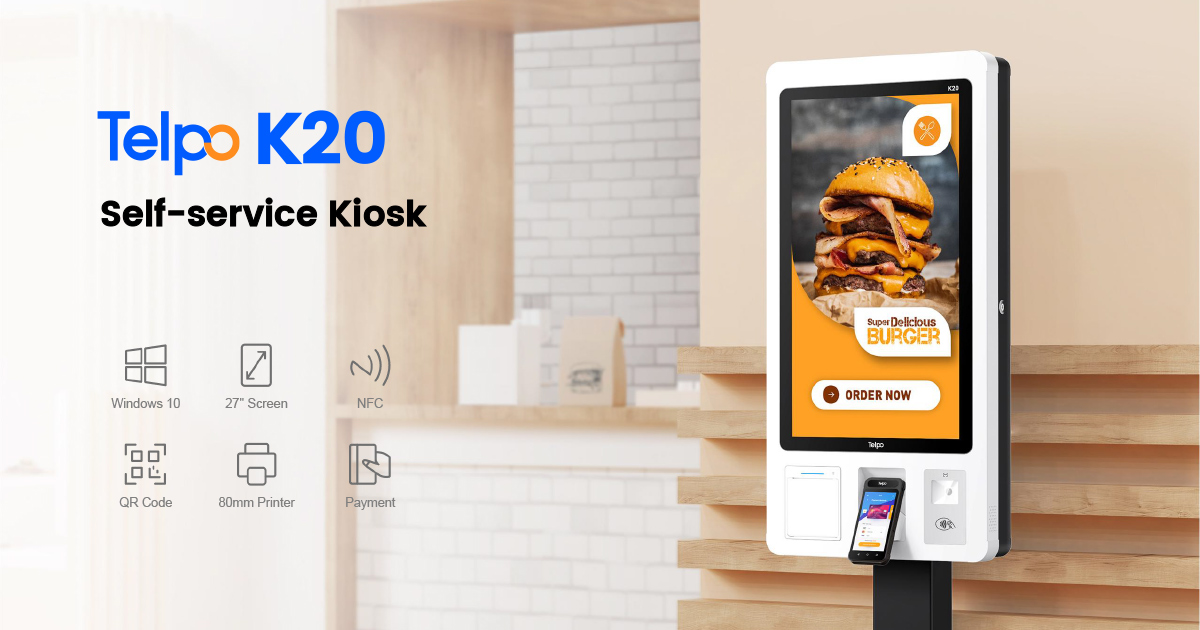
Self-ordering kiosks help QSR chains reduce queues and enable unattended ordering.
Field Services, Delivery and Agent Banking
Payment collection outside the store requires battery endurance, portable printing and network resilience. The P8 M5 weighs 389g, survives 1.5-meter drops and is splash-resistant, with a removable 7.2V/2600mAh battery that delivers 13+ hours of continuous operation. It accepts NFC, chip cards and digital wallets. The P9 series provides 12–16 hours of battery life on the standard battery, dual SIM/eSIM support, GPS and an optional hardware 2D scanner on the PDA variant. The TPS900 adds an optional fingerprint scanner for KYC-style identity verification, plus fiscal module connectivity.
These devices are used in mobile merchant acquiring, agent banking field outreach and door-to-door payment collection. They process magnetic stripe, EMV chip, NFC and QR payments with receipt printing and GPS-stamped transactions, and require PCI PTS 6.x and EMV L1&L2 certification for financial deployments.
Government, Fiscal and KYC Applications
Government service counters and fiscal-compliant environments require tamper-evident hardware, tax module integration and continuous operation. The M8 and M10 include dedicated UART/USB ports for fiscal modules, physical tamper-evident lead-sealed screws, electronic tamper logging and external RTC timekeeping. The TPS900 supports fiscal control module connection, fingerprint identity verification and multiple payment authentication methods, making it usable for utility fee collection, social welfare payment and agent banking KYC enrollment. For indoor government service counters, 24/7 high-reliability operation is expected; fiscal-compliant models are designed around that duty cycle.
Market Trends Shaping POS Terminal Demand
Several verifiable trends are influencing POS terminal selection in 2026.
- Android POS terminals accounted for approximately 27% of all POS terminals sold globally as of 2022/2024 tracking. Their share is supported by app ecosystems, faster hardware iteration and SoftPOS compatibility.
- The SoftPOS market was estimated at USD 365.0 million in 2024, with a projected CAGR of 23.1% through 2030. SoftPOS turns NFC-enabled Android devices into payment acceptance points, which is why under-display NFC has moved from a premium feature to a standard expectation.
- The handheld POS market is projected to grow from USD 33.15 billion in 2025 to USD 89.52 billion by 2035. Field-based payment collection, delivery and agent banking are the main drivers.
- The retail self-service kiosk market is forecasted to reach USD 37.8 billion by 2030, according to The Business Research Company, which identifies Telpo Technology among the leading corporations in the sector.
These trends do not replace traditional countertop terminals. They change the composition of procurement: buyers are more likely to combine a countertop unit for the main checkout lane, one or more handheld devices for mobile payment, and a self-service or AI-assisted terminal for unattended operation.
Limitations and Trade-offs
Scenario mapping helps buyers choose the right device format, but every format has boundaries.
Integrated all-in-one terminals concentrate scanning, payment and printing into a single unit. That simplifies installation and reduces counter clutter, but it also creates a single point of failure: if the printer or mainboard fails, the entire checkout lane may be out of service until the unit is repaired.
Software ecosystems also constrain choice. Android terminals offer broad app availability and faster iteration, but operators that rely on legacy Windows POS software need a Windows model such as the C9W, or must budget for a software migration. Similarly, the AI recognition accuracy of a terminal like the C50 reaches 99.8% on its trained product categories; new or region-specific products may require additional training data.
Customization is another boundary. Full ODM development — including private molds, custom hardware modules and system-level software — typically requires a minimum order of 500–1,000 units and a standard ODM cycle of 4–6 months. Buyers that only need logo and color branding on existing models can use a shorter path, with stock orders in 3–7 working days and bulk standard orders in 15–25 working days.
Finally, compared with traditional electronic cash registers, smart POS terminals add app flexibility, payment variety and connectivity, but they also add software updates, security maintenance and higher upfront hardware cost. For very simple cash-only counters, an intelligent terminal may be more than the operation needs.
Future Outlook
Over the next two to three years, three directions are likely to shape POS terminal procurement. First, on-device AI will move from a novelty to a practical checkout tool: 12 TOPS-class processors already enable real-time item recognition and self-service payment. Second, SoftPOS will continue to blur the line between payment terminal and general-purpose Android device, making NFC compatibility a baseline requirement for new hardware. Third, scenario-specific ODM demand will grow as payment methods, tax rules and user interfaces diverge across markets. Manufacturers that can combine countertop, handheld, validator and self-service product lines — and customize them for local compliance and branding — will be better positioned as long-term hardware partners.
For procurement teams, the practical takeaway is to evaluate the deployment scenario first, the device format second and the supplier's manufacturing and certification capabilities third. Documenting the operating environment, payment mix, durability needs and compliance requirements before comparing product models reduces the risk of selecting hardware that looks capable but does not fit the project.
For a complete reference of terminal models and configurations, Telpo publishes a downloadable brochure: Telpo Products Brochure (Payment & Retail).
FAQ
What types of POS terminals are available for different deployment environments?
POS terminals fall into five main formats. Countertop POS systems (e.g., C9, C9PD, C9W, M10, M8) are fixed stations for retail and hospitality counters. Handheld POS terminals (e.g., P9, P8 M5, M1, TPS900) are battery-powered devices for table-side, delivery and field payment. Ticket validators (e.g., T10, T20) are built for transit and event ticketing with high durability and multi-standard card reading. Self-service kiosks (e.g., K10, K20, K1, K8M, K8) run unattended ordering and checkout. AI checkout terminals (e.g., C50) add on-device visual recognition.
Which POS terminal works for bus fare collection and transit validation?
Transit operators typically choose purpose-built ticket validators. The T20 offers IP65 and IK08 protection, a 7-inch anti-glare touchscreen, closed-loop and open-loop NFC support (ISO14443 Type A/B, Mifare, Cipurse, Calypso, Felica) and eight SAM card slots. The T10 is a compact alternative with EMV Contactless L1 certification, IK07 impact resistance and six SAM slots. Both include GPS, 4G and multi-format QR/barcode scanning. The M1 handheld can also be used for bus fare collection with NFC, QR, MSR and IC payment support.
What is the difference between a countertop POS and a handheld POS terminal?
A countertop POS (e.g., C9PD, M10) is designed for fixed checkout positions, runs on continuous power, offers larger or dual displays, and connects to cash drawers, barcode scanners and external printers. A handheld POS (e.g., P9, P8 M5) is battery-powered, portable, typically includes a built-in 58mm thermal printer, uses 4G/Wi-Fi/Bluetooth for connectivity, and often adds GPS for location-stamped transactions. The choice depends on whether staff come to the customer or the customer comes to the counter.
What certifications should a POS terminal have for card payments?
PCI PTS and EMV are the core security standards for payment terminals. Models such as the TPS900 are certified with PCI PTS V6.x, EMV L1&L2, and EMV Contactless L1, along with scheme certifications such as Paywave, Paypass, AMEX, Discover, UnionPay and Rupay. Devices that handle transit cards also support ISO14443, Mifare, Calypso and other closed-loop standards. Buyers should verify certifications against the target market's payment networks and local regulations.
Can an AI checkout terminal recognize products without barcodes?
Yes. The C50 AI checkout terminal performs visual product recognition in 0.1 seconds with 99.8% accuracy, using 12 TOPS of on-device AI processing. It identifies both barcoded and barcode-free items, supports QR and NFC self-payment, and can be paired with an optional 15kg/2g electronic scale for fresh and bulk products. Its recognition accuracy applies to trained product categories, so new items may require additional model training.
What is the typical minimum order for customized POS terminals?
For full ODM projects — such as custom housing, hardware module changes or software development — the typical MOQ is 500–1,000 units, adjusted per project complexity, with a standard ODM cycle of 4–6 months. For branding-only customization (logo, colors, packaging) on existing models, orders can be more flexible: stock orders typically ship in 3–7 working days, and bulk standard orders in 15–25 working days.