
POS Terminal Shortlist: C9 vs Swan-2 Memory and Storage Fit
POS Terminal Shortlist: C9 vs Swan-2 Memory and Storage Fit

A multi-app retail POS terminal is usually shortlisted on capacity before it is shortlisted on features. Once a countertop device is expected to run payment, ordering, loyalty, inventory lookup, device management and a customer-facing media screen at the same time, the specification that limits the deployment is often the memory and storage tier rather than the payment module. Two Android terminals appear on the same 2026 retail shortlists with materially different capacity ladders: the C9 from Telpo Technology Co., Ltd., offered in 4 GB RAM with 64 GB storage or 8 GB RAM with 128 GB storage, and Swan-2, offered in 2 GB RAM with 16 GB storage or 4 GB RAM with 64 GB storage.
The result is a crossover rather than a simple ranking. C9's entry tier matches Swan-2's top tier in both figures, and C9's top tier doubles Swan-2's top tier on both counts; Swan-2's entry tier sits below every configuration in the C9 ladder. Those statements describe documented capacity, not measured speed, and that distinction runs through the whole shortlist. Pricing for either device depends on the configuration selected and must be confirmed with sales before a budget line is fixed.
Why Configuration Became a Shortlisting Criterion
Retail software has moved in one direction: more functions per device. Android-based terminals reached approximately 48% of global POS shipments in 2025, according to Counterpoint Research, which describes a market where the application layer, rather than dedicated firmware, decides what a terminal can do. Once the terminal is a general-purpose Android computer with a payment module attached, its useful service life is governed by how many applications it can hold in memory and how much local data it can store.
Price data points the same way. The same research house placed the average selling price of commercial-grade smart POS hardware in a range of USD 120 to USD 850 for 2025. A spread that wide is not explained by screens and printers alone; memory and storage tiers are among the configuration choices that separate an entry order from a high-end one. For a buyer, a single quoted price is therefore not comparable until the configuration attached to it is known.
The Configuration Ladder, Side by Side
Both terminals are offered in two memory-and-storage tiers. The table below uses only the published tier figures; the ratio column is arithmetic calculated from those figures, not a benchmark result.
| Tier | Telpo C9 | Swan-2 | Calculated difference |
|---|---|---|---|
| Entry | 4 GB RAM + 64 GB storage | 2 GB RAM + 16 GB storage | 2× RAM; 4× storage |
| Top | 8 GB RAM + 128 GB storage | 4 GB RAM + 64 GB storage | 2× RAM; 2× storage |
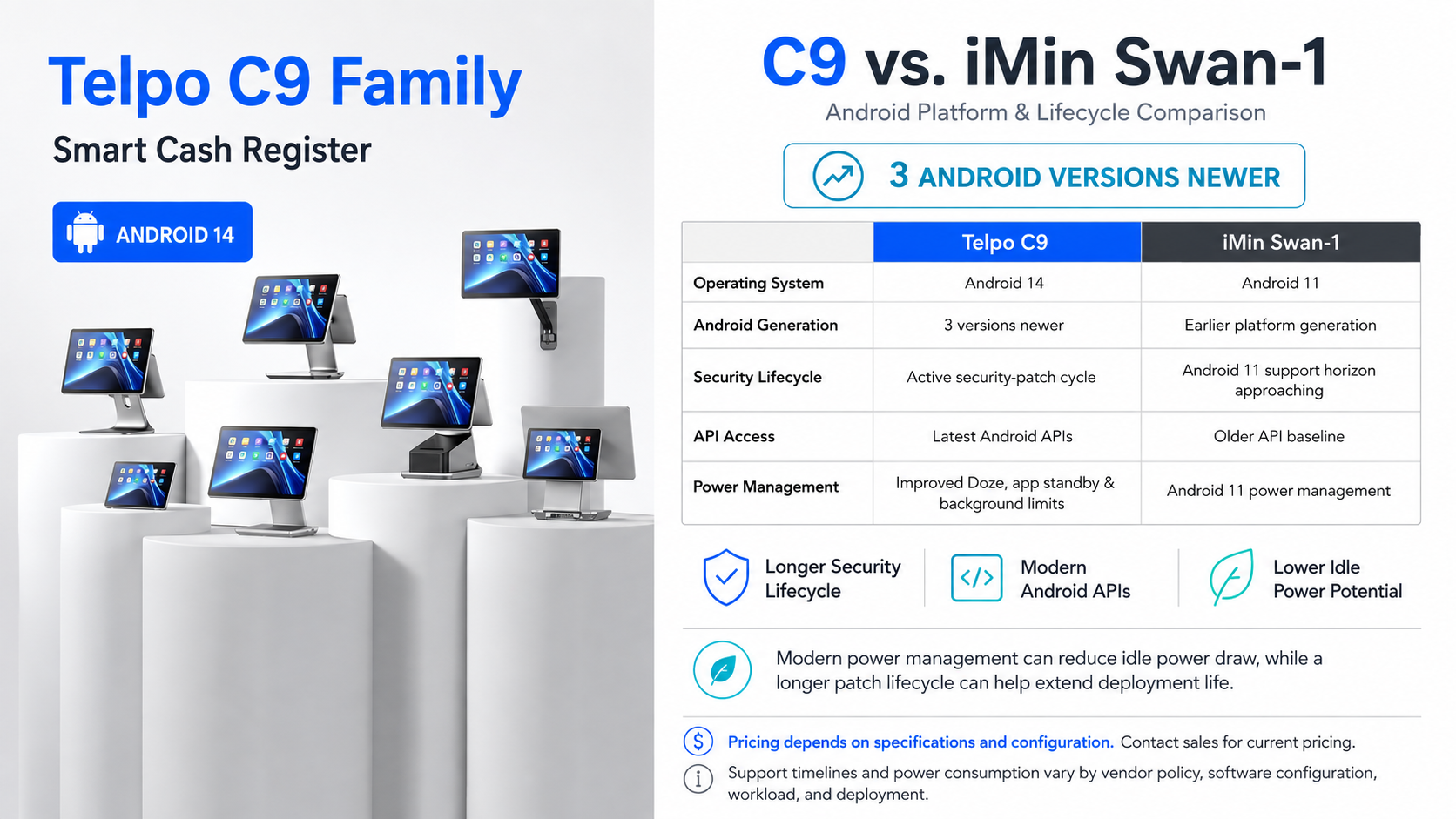
The crossover point deserves to be stated plainly. A buyer who selects the C9 4 GB + 64 GB configuration obtains the same RAM and the same storage as a buyer who selects Swan-2's top configuration of 4 GB + 64 GB. The difference between the two ladders is therefore not only the ceiling but the floor: Swan-2's 2 GB + 16 GB entry tier has no C9 equivalent, and C9's 8 GB + 128 GB top tier has no Swan-2 equivalent.
Read as headroom, the gap is widest at entry-tier storage (64 GB against 16 GB) and constant in RAM (2× at both tiers). Read as ceilings, C9's top tier doubles Swan-2's top tier in both dimensions. Neither reading says which device is faster in operation; both describe how much room each configuration leaves for software installed after purchase.
What Extra RAM and Extra Storage Actually Do
RAM and storage fail differently, which is why both figures belong on a shortlist. RAM governs concurrency. The operating system, the payment application and its security kernel, plus every background service — synchronisation, device-management agent, printer service, scanner service — occupy resident memory simultaneously. When demand exceeds available RAM, Android reclaims memory by terminating background processes. On a shop floor that appears as an application that reloads when a cashier switches to it, a loyalty lookup that times out, or a price file that synchronises later than expected. Adding RAM does not make a single application run faster in any guaranteed way; it changes how many processes can stay alive together.
Storage governs what can be held locally and how gracefully updates land. The operating system image, application binaries, a local product catalogue, transaction journals, images and video for a customer-facing screen, and — where inference runs on the device — model files all draw on the same volume. Two operational effects matter more than raw capacity. First, local caching only helps when the cache fits; a media or catalogue plan that exceeds the volume quietly falls back to network dependency. Second, an operating system update needs free space to stage the new image before it is applied, so a volume kept near capacity constrains the update cycle itself.
The sizing question is therefore not "how much storage is enough" in the abstract. It is three specific questions: how many applications must stay resident at once, how much local media and catalogue data the store intends to hold, and whether any inference runs locally rather than in the cloud.
Sizing the Three Workloads Behind the Shortlist
Multi-application concurrency
Count resident applications, not installed ones. A typical multi-app retail floor includes payment, a till or ordering application, loyalty, price or inventory lookup, a device-management agent and a receipt or label service. The number that matters is how many of those must remain warm while a cashier moves between them mid-transaction. A store running payment plus one ordering screen has a different requirement from a store that keeps inventory lookup, loyalty and a media player running behind a payment session. The reliable method is to collect each application vendor's stated memory requirement, add the operating system and payment kernel allowance on top, and compare the total with the tier being considered — rather than estimating from the number of icons on the home screen.
Retail media on a customer-facing display
A second screen changes the storage profile more than the RAM profile. Promotional video, menu boards and rotating image playlists are usually cached locally so that playback continues when the network drops. The size of that cache is a design decision: how many playlists are kept on the device, at what resolution the assets are delivered, and how often they rotate. A configuration chosen for payment alone can be adequate for RAM and still be tight for a media library that grows quarter by quarter. The verification step is straightforward — total the media bundle a store intends to cache, add the application and catalogue footprint, and compare the sum with the storage tier under consideration, leaving room for operating system updates.
Offline AI-model cache
Where inference runs on the terminal rather than in the cloud, model files and their runtime join the storage budget, and the inference process joins the memory budget. Telpo's deployment record shows that recognition workloads are already part of retail floors: the company reports a bakery self-checkout deployment of its C50 AI checkout terminal with more than 100 units installed, a stated 99.8% recognition rate and a checkout efficiency increase above 60% across a project running for more than two years. Those are C50 results, not C9 measurements, but they establish the workload category. A buyer planning comparable recognition locally should obtain the model footprint and the update size from the software supplier and treat both as recurring storage costs rather than one-off installs.
Device consolidation raises the application count
Consolidation sits behind all three workloads. In a German SoftPOS deployment of more than 200 Telpo M8 terminals, Telpo reports that one smart order POS replaced three separate devices — terminal, scanner and printer — with contactless transactions processed in under two seconds. At the 2026 Singapore Grand Prix, held 9–11 October, Telpo P9 handhelds supported mobile ordering, payment confirmation and receipt printing for food, beverage and merchandise sellers in a temporary, high-traffic environment. Each consolidation removes hardware from the counter and adds a function to the device that remains. The capacity consequence runs the same way in both cases: fewer devices, more software per device.
Scenario Mapping: Which Tier Fits Which Floor
The mapping below is an editorial reading of the capacity figures against typical workload patterns. It is indicative rather than a performance recommendation, and it should be confirmed by a pilot on the highest-load site before a rollout tier is fixed.
| Retail scenario | Workload signals to verify | Tier to examine |
|---|---|---|
| Large-format store with self-checkout and customer-facing media | Resident scanning or recognition service, media cache, payment, remote management | C9 8 GB + 128 GB |
| Attended supermarket lane | Payment, till application, loyalty, price lookup running together | C9 4 GB + 64 GB or Swan-2 4 GB + 64 GB |
| QSR counter with menu media | Ordering, payment, playlist caching, printer service | C9 4 GB + 64 GB as a baseline, subject to media bundle size |
| Event, pop-up or ticketing sales | Ordering, payment, receipt printing, intermittent connectivity | C9 4 GB + 64 GB or Swan-2 4 GB + 64 GB, depending on app count |
| Single-application payment counter | Payment plus device management only | Swan-2 2 GB + 16 GB is the lightest envelope; confirm each app's stated requirement |
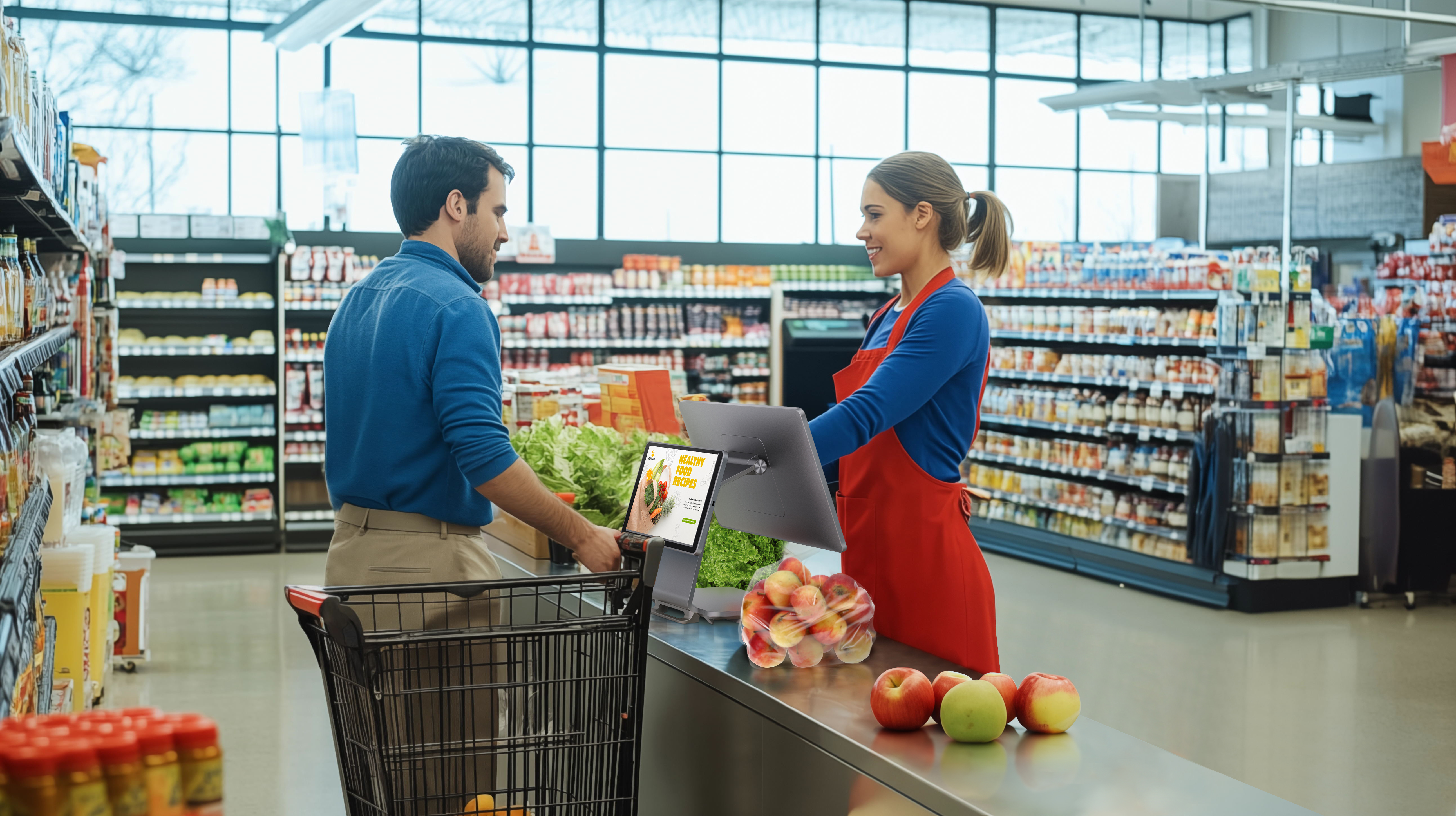
Two practical notes follow from the table. First, the same retailer can legitimately need two tiers: a flagship site with media and local recognition does not share the requirement of a satellite store running payment and loyalty only. Second, the choice between C9 4 GB + 64 GB and Swan-2 4 GB + 64 GB cannot be settled on capacity, because the figures are identical; it turns on other device attributes and on the commercial terms for that configuration.
Fit Boundaries and What the Numbers Do Not Prove
Four boundaries deserve equal billing with the capacity figures.
- Capacity is not throughput. Two terminals with 4 GB of RAM do not deliver identical application performance; processor, operating system build, payment kernel and application efficiency all intervene. No benchmark data for either device forms part of this comparison, so the shortlist compares documented capacity and nothing further.
- Approvals attach to model, variant and firmware. Telpo's published certificates name specific models and, in several cases, firmware versions: an American Express approval for the TPS900 names firmware version v1.8, a Discover approval for the P9 names firmware V2.1, and an EMVCo letter of approval for the P9 contactless module names hardware and software versions V1.4. A configuration change is therefore also a compliance question, and buyers should confirm which approvals cover the exact model and variant being ordered.
- Swan-2's headroom is bounded by its own figures. With a top tier of 4 GB RAM and 64 GB storage, a Swan-2 deployment has the same ceiling as a C9 entry configuration. That is not a defect claim; it is a statement that the concurrency and caching plans described above must fit inside 4 GB and 64 GB, or the deployment should move up the ladder.
- Over-specification carries a cost. An 8 GB + 128 GB terminal running a single payment application leaves capacity unused, and the price difference between tiers should be justified by a named workload rather than by expectation of future-proofing alone.
There is also a software-side limit that no hardware tier removes. An application with poor memory behaviour will still be terminated in the background and still reload slowly on a larger device; capacity planning reduces the frequency of that outcome rather than eliminating it. Buyers evaluating multi-app stability should include application-level memory behaviour in the acceptance criteria, not only the hardware tier.
Procurement Checks Before Locking a Configuration
- List resident applications and their stated memory requirements. Include the payment kernel, device-management agent and any printer or scanner service.
- Measure the retail-media bundle. Record the number of playlists, asset resolution and rotation frequency the store intends to cache locally.
- Confirm whether inference is local or cloud. If local, obtain the model file size, runtime requirement and update size from the software supplier.
- Tier by site, not by chain. Assign the configuration per workload profile and record the justification, so the decision can be revisited at the next refresh.
- Check certification coverage for the exact variant. Match the model, hardware version and firmware named in the approval documents to what is being ordered.
- Confirm commercial terms per configuration. Memory and storage tiers are priced separately; unit price should be confirmed with sales once the tier is fixed.
- Pilot the highest-load site first. Run the full application set, media playlist and update cycle on one site before committing the fleet.
Two commercial details belong in the same checklist. Telpo states a typical minimum order quantity of 500 to 1,000 units, adjusted per project complexity, and a lead time of 30 days or more subject to negotiation; a buyer splitting an order across two memory tiers should confirm how those terms apply per configuration rather than per model. Stated production capacity of approximately 150,000 to 180,000 units per month, against an annual output of 2,000,000 units, is the relevant reference when a rollout mixes tiers and sites.
Configuration claims are easier to rely on when the supplier can be checked. Telpo Technology Co., Ltd. was founded in 1999, employs around 600 people including a research and development team of 200 engineers, and operates a factory of approximately 45,000 square metres that includes a CNAS-accredited laboratory upgraded in 2025 to roughly 900 square metres across 12 testing zones. The company adopted its current name in January 2026, having previously operated as Telepower Communication Co., Ltd. — a detail worth noting when matching certificate dates to a supplier name. Its stated export share of 60% to 80% across more than 100 countries, spanning Asia, Africa, the Middle East, Europe, Latin America and North America, indicates that a single configuration decision usually has to satisfy several regulatory regimes rather than one.
Outlook: Capacity Planning as a Recurring Procurement Step
With Android terminals approaching half of global POS shipments in 2025, the software load on a retail device is more likely to grow after installation than to stay constant. A lane that runs payment and loyalty at commissioning may be asked to carry a media playlist and a local recognition service two years later. The defensible planning rule is to size the tier for the projected application set at the end of the intended service period, keep a defined free-space margin for operating system updates, and record which workload justified the tier. Buyers should note that the shipment-share figure describes 2025 mix, not a forecast for any individual product line.
For procurement teams, this makes memory and storage a line item reviewed at each site refresh rather than a specification fixed once at tender. A shortlist that pairs each configuration with the workload that justified it is easier to defend at the next budget cycle, and easier to adjust when a site's software count changes — which is a more durable outcome than choosing the largest tier available.
For buyers comparing C9 and Swan-2, the decision reduces to where the workload sits on the ladder. C9 offers the higher ceiling and the stronger entry-tier storage position; Swan-2 offers a lighter envelope whose top tier matches C9's entry tier. Neither reading resolves without the workload numbers, and no price should be treated as final until the configuration is fixed. Telpo's product brochure covering payment and retail terminals is available for download: Telpo Products Brochure — Payment and Retail.
FAQ: Configuration Fit for Multi-App Retail
- What do the two numbers in a POS terminal configuration such as 4+64 GB mean?
- The first figure is RAM and the second is internal storage. In the 4+64 GB configuration, the terminal has 4 GB of RAM for running applications and 64 GB of storage for the operating system, application files, local data, cached media and any on-device model files. Telpo C9 is offered as 4+64 GB or 8+128 GB, while Swan-2 is offered as 2+16 GB or 4+64 GB.
- Is the C9 8+128 GB configuration necessary for every retail store?
- No. The higher tier is relevant when a site must keep several applications resident at once, cache a substantial media library for a customer-facing screen, or hold model files for local inference. A counter that runs a payment application and a device-management agent has a smaller requirement, and paying for capacity that no named workload uses is a cost without a corresponding operational benefit.
- Can the Swan-2 2+16 GB configuration support multi-application retail software?
- Suitability depends on the specific application set rather than on a general rule. The documented 2 GB RAM and 16 GB storage make this the smallest envelope among the four tiers discussed here, so the practical test is whether the customer's chosen applications, media cache and update cycle fit inside those figures. Buyers should collect each vendor's stated memory requirement and the intended cache size, then compare the total with 2 GB and 16 GB before committing.
- How should storage be sized for retail media and offline AI models?
- By measurement rather than estimation. Total the media assets a store intends to cache at the resolution it will display, add the application and catalogue footprint, and — where inference runs locally — add the model files and their runtime. Keep an additional margin for operating system updates, which need free space to stage a new image. The model footprint and update size should be requested from the software supplier, because they change with model version.
- Why does POS terminal pricing vary so much between configurations?
- Memory and storage tiers are priced separately, and commercial-grade smart POS hardware has been reported in a wide average selling price range — USD 120 to USD 850 in 2025 — that reflects differing configurations as well as differing capabilities. Published tier lists should therefore be treated as a starting point: the applicable unit price depends on the configuration finally selected and must be confirmed with sales before a budget is approved.
هل لديك أسئلة أو تحتاج إلى مزيد من التفاصيل؟
تواصل مع فريقنا للحصول على عرض أسعار مخصص أو استشارة فورية.
طلب عرض أسعار
املأ النموذج أدناه وسيتواصل معك فريقنا بعرض مقترح مخصص.
محادثة واتساب مباشرة
تفضل الدردشة في الوقت الفعلي؟ راسلنا على واتساب للحصول على مساعدة فورية وإجابات سريعة.
- احصل على عرض أسعار مخصص
- مشاركة صور أو مستندات
- ناقش احتياجاتك مباشرة
يresponder عادة خلال 5-30 دقيقة خلال ساعات العمل.