
PP vs PET Strapping: A Buyer's Comparison Framework for Light Industry & Daily Use Applications
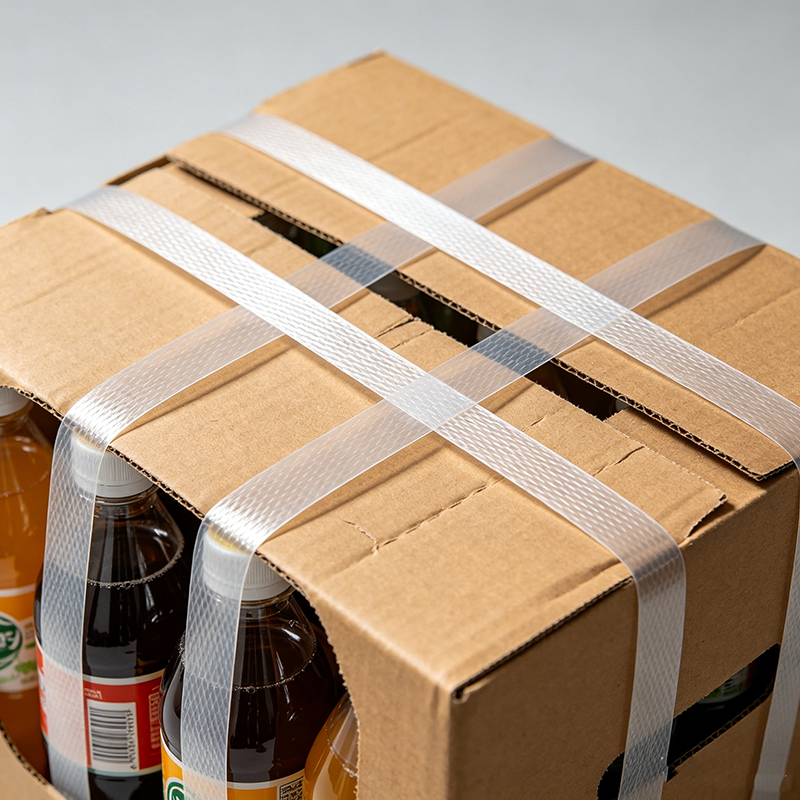
Daily bundling in light industry spans cartons, can packs, fibre bales and recycled goods. The strap format has to match the load, not the purchase habit. Image: Jushuo Packaging.
PP versus PET is a load question, not a price question
Most strapping mistakes in light industry and daily-use packaging are made at the purchase order, not at the packing bench. A buyer compares two quotes per kilogram, picks the lower one, and only discovers at the end of the shift that the band stretches under a soft carton, slips on an embossed wheel, or will not run on the sealing head that was already installed.
The short answer is that polypropylene (PP) strapping and polyester (PET) strapping are not grades of the same product. PP strapping is the more extensible, more forgiving band: it tolerates the slow compression of soft packs, suits hand tensioning and semi-automatic tools, and is widely used for cartons, bundles and light parcels. PET strapping is the stiffer, higher-tensile band with low elongation, and it is the material most often reached for when a packer is replacing steel wire or when a rigid load has to stay tight through stacking, handling and transport.
That distinction is well understood in heavy industry. It is less consistently applied in light industry, where load weights are modest, volumes are fragmented, and the strap is often treated as a consumable commodity rather than a specification. The framework below is built for that setting: everyday bundling, mixed product types, and operations that may run hand tools on one line and an automatic machine on another.
The problem: light-industry buyers over-specify or under-specify, rarely specify correctly
Two failure patterns repeat across light-industry purchasing.
The first is inherited habit. A plant has used PP band for a decade, adds a heavier product line, and keeps the same strap because nothing has visibly failed yet. The band still holds the pallet at the end of the line, but it has lost tension by the time the load reaches the customer, and the damage is attributed to handling rather than to the strap.
The second is defensive over-specification. A buyer reads that PET is stronger, moves every SKU to PET, and then finds the new band is harder to tension by hand, needs a different tool, costs more per metre, and offers nothing extra on a carton that weighs a few kilograms. Neither pattern is a material failure. Both are specification failures.
The opportunity sits in between. Light industry handles an unusually wide mix of load behaviour — compressible cartons, rigid can packs, dense textile and fibre bales, recycled material bales, printed paper reams — and each of those behaves differently under a tensioned band. A short, structured comparison at the specification stage removes most of the downstream surprises, and it costs far less than a line stoppage.
A six-criterion comparison framework
The framework below is ordered by decision impact. Criteria one and two decide the polymer; criteria three to five decide the format; criterion six decides the supplier relationship.
1. Load behaviour: does the pack keep moving after it is strapped?
The single most useful question is whether the load compresses. A corrugated carton, a bag of loose goods or a fibre bale continues to settle after the band is applied. A band with greater extensibility and recovery follows that movement; a very stiff band can go slack. Rigid loads — stacked cans, tiles, panels, metal parts — behave in the opposite way: they do not settle, and what matters is tensile strength and low elongation under a sharp edge.
Practical rule: compressible loads favour PP; rigid, sharp-edged or heavy loads favour PET.
2. Strap width and thickness: the format, not just the polymer
Width and thickness decide how the tension is distributed across the package surface. Narrow bands concentrate load and mark soft packaging; wider bands spread it. In the Jushuo Packaging range, machine-grade embossed PP strapping is documented from the JS05035-P format through JS19080-P across a 5–19 mm width span, with smooth PP available as JS09036-PS. The PET machine range runs across the JS09400-MT to JS16140-MT smooth series and the JS09400-MTE to JS16140-MTE embossed series, while hand-grade PET extends from JS12500-HT to JS25300-HT (smooth) and JS12600-HTE to JS19190-HTE (embossed).
Buyers should treat the format designation as the unit of comparison, not the material name. Two PET bands from the same supplier can behave very differently across that range, and a PP band at 19 mm is not the same product as a 5 mm PP band.
3. Tensile and elongation evidence: demand matched test data
Tensile figures only mean something when the format is stated alongside them. A breaking strength quoted for one width cannot be read across to another, and a hand-grade band cannot be compared with a machine-grade band on the same numbers.
Two documented data points illustrate the point. In a recycling-industry application, Jushuo supplied white PP strap at 12×0.60 mm with a tensile force of ≥1400 N. Separately, SGS test reports for the PET range document a breaking strength of 9.98 kN at an elongation of 10%. These are different formats serving different loads; the correct use of the data is to confirm that the supplier can evidence the format you are buying, not to rank one polymer against the other on unmatched numbers.
4. Hand grade or machine grade: the tool decides as much as the load
Hand grade and machine grade are production categories, not quality tiers. Hand grade strap is tensioned with manual or battery tools and is normally supplied in a format that resists slippage in the tool. Machine grade strap runs on semi-automatic or fully automatic lines and depends on consistent width, thickness, coil length and core dimensions, because the machine has no operator judgement to compensate.
Jushuo Packaging documents its 12 mm hand grade PP strapping as the JS500A-HP, JS500B-HP, JS600A-HP and JS600B-HP formats, and its 12 mm machine grade PP strapping as JS12050-P, JS12063-P, JS12063B-P, JS12063C-P, JS12070-P and JS12080-P. Heavy-duty 12 mm PP is offered as machine embossed JS12080-P and hand embossed JS600A-HP and JS600B-HP. The equivalent split exists on the PET side, and mixing the two categories is one of the most common causes of poor sealing performance.
5. Surface finish: embossed, smooth or printed
Embossing changes how the band grips. An embossed surface reduces slip between strap and package and between strap layers, which matters for stacked bundles and for friction-welded joints. Smooth surfaces suit applications where marking is unacceptable or where a clean print is required.
For buyers comparing embossed PET strap with smooth PET or PP, the decision is usually driven by two things: whether the pack slides, and whether the sealing method depends on surface contact. Printed strapping adds a separate consideration — brand or traceability marking — and should be specified at the same time as the format, because print registration and format changes affect lead time.
6. Volume, minimum order and replenishment rhythm
A format that cannot be replenished reliably is not a usable format. Jushuo Packaging applies a minimum order of 1 ton for stock specifications and 5 tons for custom development, with stock specifications typically delivered in around 7 days and custom formats running to roughly 30 days. Monthly material capacity is stated at over 1,700 tons against annual capacity exceeding 20,000 tons, which matters when a buyer is consolidating several light-industry lines onto one specification.
| Decision criterion | PP strapping | PET strapping | What it means at the bench |
|---|---|---|---|
| Load behaviour | Extensible; follows slow compression of soft packs | Stiff, low elongation; holds rigid loads | Cartons and bales suit PP; can packs, panels and dense bales suit PET |
| Documented formats | Machine embossed JS05035-P to JS19080-P (5–19 mm); smooth JS09036-PS; hand embossed JS500A-HP to JS600B-HP (12 mm) | Machine smooth JS09400-MT to JS16140-MT; machine embossed JS09400-MTE to JS16140-MTE; hand smooth JS12500-HT to JS25300-HT; hand embossed JS12600-HTE to JS19190-HTE | Compare formats, not polymer names; PP has no wide hand-grade spread in the documented range |
| Evidence to request | Tensile for the exact width and thickness supplied | Tensile and elongation for the exact series supplied | Unmatched figures are not comparable |
| Grade split | 12 mm hand and machine formats documented | Hand and machine series documented separately | Match the band to the tool, not to the invoice history |
| Surface | Embossed or smooth | Embossed or smooth, plus green and custom colour options | Embossing reduces slip on stacked bundles |
| Typical daily-use fit | Cartons, parcels, light bundles, manual sealing stations | Fibre bales, textile bundles, can packs, recycled material bales, steel replacement | Both can coexist inside one plant |
| Commercial watch-out | Under-specification on heavier loads | Over-specification on soft light packs | Justify the polymer by load, not by margin of safety alone |
| Dimension | Hand grade | Machine grade | Check before ordering |
|---|---|---|---|
| Tensioning method | Manual or battery-powered tool | Semi-automatic or automatic sealing head | Confirm tool model and strap width together |
| Format consistency | Tolerance forgiving of small variation | Width, thickness and core must be consistent | Ask for the core specification, e.g. 16×6 format on PP machine strapping |
| Surface choice | Embossed for grip in the tool | Embossed or smooth depending on the sealing method | Test one coil on the actual line before committing |
| Changeover cost | Low; a new coil is a new trial | Higher; format changes affect settings and reels | Fix the format before scaling volume |
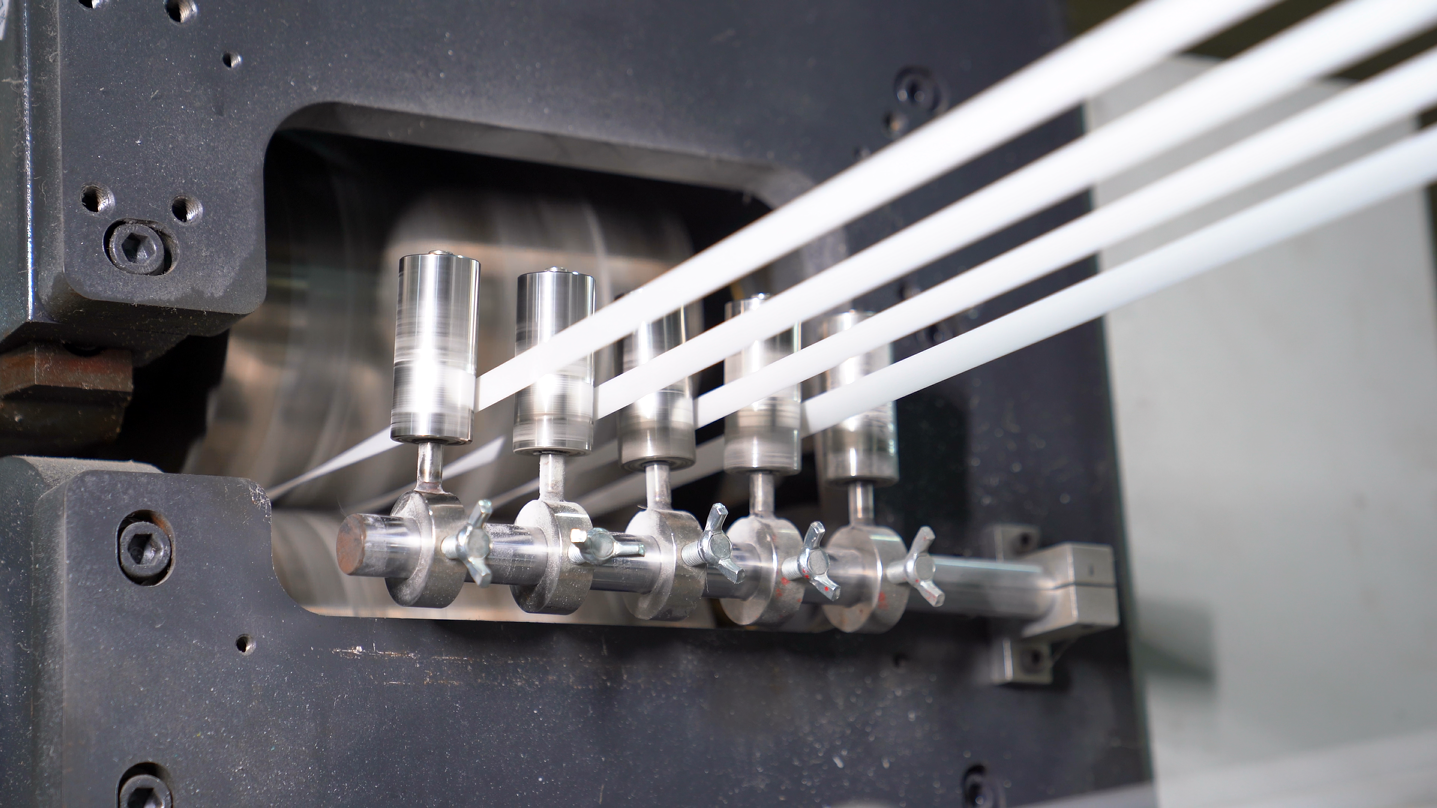
PP strapping production: extrusion, orientation and winding determine whether a band performs in a hand tool or on an automatic line. Image: Jushuo Packaging.
Technical explanation: why the two polymers behave differently
The difference between PP and PET strapping starts in the polymer and is then amplified by the production process.
Polypropylene is a comparatively soft polyolefin. Once extruded and oriented, the band retains a useful degree of extensibility, which is why it follows a settling carton instead of cutting into it. That same property limits its use on sharp, heavy loads, where a stiffer band is preferable.
Polyester behaves differently because the production route is different. Jushuo Packaging operates two sets of solid state polymerization (SSP) equipment, which raise and stabilise the intrinsic viscosity of the PET raw material before extrusion. The oriented band is then cold drawn — a process the company describes as greatly enhancing tensile strength — and produced on lines fitted with Italian screen changers that allow continuous screen changes without stopping the machine, supporting consistent output. A bespoke extruder screw design is used to improve plasticisation, reduce material degradation and improve resilience in the finished band.
Quality control supports the specification rather than replacing it. In-house equipment includes vernier calipers, electronic scales, thickness gauges, ovens, viscosity testers and tensile testing machines, applied across six inspection gates: raw material inspection, incoming inspection, online inspection, finished product inspection, inbound inspection and outbound inspection. The company reports a finished product qualification rate above 99%.
Why this matters to a buyer: a tensile number on a datasheet is the output of a process. When the process is controlled — viscosity, draw ratio, screen changes, online inspection — batch-to-batch behaviour on an automatic line is more predictable. That predictability is what a light-industry buyer is actually purchasing when they consolidate several SKUs onto one strap specification.
Brand solution: what Jushuo Packaging actually supplies
Taixing Jushuo Packaging Technology Co., Ltd. (Jushuo Packaging) is a Jiangsu-based manufacturer of strapping materials and packaging machinery, founded in 2017 and headquartered in Huangqiao Industrial Park, Taixing City. The company operates a 15,000 m² facility with 54 employees, a 13-person R&D team, four PET strap production lines and five PP strap production lines, and reports annual capacity exceeding 20,000 tons with roughly 30% of output exported.
For this comparison, the relevant parts of the range are:
- PP strapping — machine grade embossed JS05035-P to JS19080-P (5–19 mm) and smooth JS09036-PS; hand grade embossed JS500A-HP to JS600B-HP at 12 mm; 12 mm heavy-duty PP as machine embossed JS12080-P and hand embossed JS600A-HP and JS600B-HP.
- PET strapping — machine smooth JS09400-MT to JS16140-MT and machine embossed JS09400-MTE to JS16140-MTE; hand smooth JS12500-HT to JS25300-HT and hand embossed JS12600-HTE to JS19190-HTE; green PET strapping in machine smooth and embossed formats (JS12600-MT, JS12600-MTE, JS16900-MT, JS16900-MTE) and hand smooth (JS12600-HT, JS19190-HT).
- Application formats — fibre baling strap in JS12600-MT, JS12775-MT, JS16900-MT, JS16110-MT and JS16140-MT; cotton bale strap in JS19190-HT, JS19240-HT, JS25250-HT and JS25300-HT; eco-friendly PP and PET strapping including a flame-retardant option.
- Compliance — ISO 9001 certification (certificate U23Q28007898R2S, issued by Guardian Independent Certification Ltd, valid to 27 November 2026) and ISO 14001 certification (U23E28007899R2S, same validity period). PET strap is stated to comply with GB/T 22344-2018 and PP strap with QB/T 3811-1999.
The company also supplies strapping machines, wrappers, reel carts and case sealers, and integrates automatic packaging lines. That matters for this comparison because a change of polymer usually implies a change of tooling, and buying both from one source removes the ambiguity about who is responsible when a band does not run.
Application: how the decision plays out in real light-industry settings
Documented supply history shows the two polymers being used side by side rather than as substitutes.
Chemical fibre and textile bales. Jushuo has supplied green cut PET strap in 19×1.0×3430 mm and 16×1.0×3430 mm formats for chemical fibre bale strapping under an annual contract of more than 40,000 pieces per order. Similar green cut PET in 1610×3380/3480 formats has been supplied in multiple batches to Sateri over a three-year relationship. For Far Eastern Industries, transparent cut PET strap at 16×1.0 mm was supplied in lengths of 36,000 and 9,000 pieces, specified as fully compatible with the customer's automatic packaging lines.
Fibre bale strapping with PP. Not every bale application needs PET. For a ShengHong Group subsidiary, Jushuo supplied transparent printed PP strap at 11.5×0.65 mm for fibre bale strapping, where custom printing and precise dimensions were the deciding requirements rather than maximum tensile.
Recycled and eco-oriented bundling. A recycling-industry customer uses white PP strap at 12×0.60 mm with tensile force ≥1400 N, chosen for lightweight holding force in a low-damage packaging environment.
Mixed-polymer operations. A lithium battery manufacturer was supplied with both PP strap (1207) and PET strap (1608, flower green) for battery bundling in the same operation. That is the pattern most light-industry buyers eventually arrive at: PP where the pack is soft or the tool is manual, PET where the load is dense or the line is automatic.
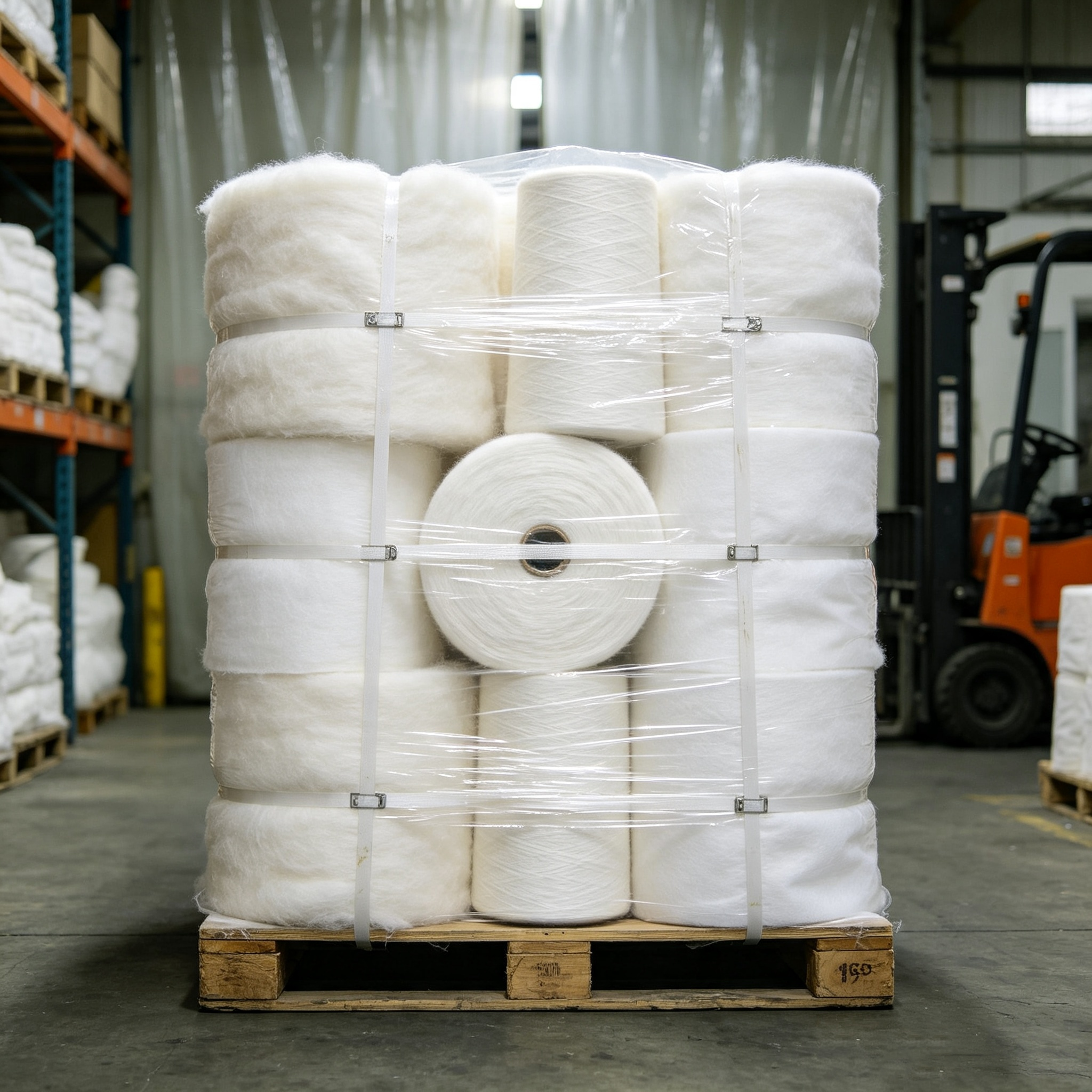
Fibre and textile bundling is where the PP-or-PET decision is most often revisited: pack density, cut length and line compatibility drive the format. Image: Jushuo Packaging.
Comparison with traditional solutions — and where this framework stops
The most common traditional alternative to PET strapping is steel strapping. PET is positioned as a steel replacement: Jushuo states a 30–50% cost reduction versus steel strapping, together with damage-free bundling, easier recycling and durability. For light-industry buyers weighing that switch, the practical gains are handling safety (no sharp steel edges), disposal cost and the absence of rust marking on packaged goods.
The comparison against heavy PP is narrower. Where a pack is genuinely heavy or rigid, a heavier PP band can be an adequate and cheaper answer than moving to PET, particularly if the existing tooling is manual. The framework in this article is not an argument that PET is the better polymer; it is a method for deciding which one the load requires.
Three limits deserve to be stated plainly.
- PET can be over-specified for soft, light packs. A stiff, low-elongation band on a settling carton can lose tension or mark the surface, and it costs more per metre than PP at a comparable width. Where a carton weighs a few kilograms and is handled by hand, PET rarely earns its premium.
- The documented hand-grade PP range is narrower than the machine range. Jushuo documents hand grade PP embossed at 12 mm (JS500A-HP to JS600B-HP). A buyer who needs a hand-tensioned PP band outside that width should confirm availability against the actual format rather than assume the machine-width spread applies to hand grade.
- Cut-to-length PET is a fixed specification. The fibre and textile cases above use cut straps at defined lengths such as 3430 mm. If the pack size changes, the cut length has to change with it, which introduces a re-ordering step that coil-fed PP does not have.
One further boundary: paper strapping tape is a separate category with its own load limits and is not covered by a PP-versus-PET decision. Buyers evaluating recyclable or paper-based options should assess them against their own criteria rather than folding them into this comparison.
Market trend: why this decision is being revisited more often
Three developments are pushing light-industry buyers to re-specify strapping rather than re-order the same band.
The first is the shift away from steel in packaging. PET is explicitly positioned as a steel replacement on cost, safety and recyclability grounds, and buyers who previously treated steel as the default for dense loads now have a plastic option that carries a documented tensile specification.
The second is environmental management becoming a procurement question. Jushuo holds ISO 14001 certification covering environmental management for its packaging material production, alongside ISO 9001 for quality, and describes its materials as 100% recyclable. For exporters shipping into markets that ask for environmental documentation, that certification is increasingly part of the supplier file rather than a bonus.
The third is automation in light industry itself. As more carton, can and bale lines move to semi-automatic or automatic sealing, format consistency outweighs raw strength in supplier selection — a band that runs without adjustment is worth more than a band with a higher headline tensile number that jams twice a shift.
Future outlook
The direction of travel is towards format-specific engineering rather than generic material grades. Jushuo was granted five invention patents in 2024, alongside utility model patents covering strap production equipment, and offers application-specific formulations including anti-UV, anti-hydrolysis and anti-static variants. For light-industry buyers, that means the practical question is likely to become more granular: not “PP or PET”, but which width, which surface, which grade and which cut length for each packaging line.
Buyers who build a written specification now — polymer, format, grade, surface, test evidence and replenishment terms — will find that shift easier to absorb than those who continue to specify strapping by price per kilogram alone.
Frequently asked questions
What is the practical difference between PP strapping and PET strapping?
PP strapping is a polypropylene band with comparatively high extensibility and recovery, used mainly for compressible loads such as cartons, parcels and light bundles, and commonly supplied in hand grade and machine grade formats. PET strapping is a polyester band with higher tensile strength and low elongation, used for rigid, dense or sharp-edged loads and as a replacement for steel strapping. The difference is a load-behaviour difference, not a quality ranking: one follows a settling pack, the other holds a pack that does not settle.
Is 12 mm hand grade PP strapping sufficient for everyday bundling in light industry?
For cartons, parcels and light bundles handled with a manual or battery tool, 12 mm hand grade PP is a common and appropriate choice. Jushuo documents its hand grade PP embossed formats as JS500A-HP, JS500B-HP, JS600A-HP and JS600B-HP at 12 mm, with heavy-duty 12 mm hand embossed options as JS600A-HP and JS600B-HP. Whether it is sufficient for a specific pack depends on pack weight, edge sharpness and how much the pack compresses after strapping; those factors should be confirmed with a trial coil on the actual line before a volume order.
When should a buyer choose embossed PET strap instead of smooth PET or PP?
Embossing changes surface grip. It is usually chosen where strap-to-package or strap-to-strap slip is a problem, such as stacked bundles or loads that shift during handling, and where the sealing method depends on consistent surface contact. Jushuo supplies embossed PET across JS09400-MTE to JS16140-MTE for machine grade and JS12600-HTE to JS19190-HTE for hand grade, alongside smooth equivalents. Smooth formats remain appropriate where surface marking must be avoided or a clean printed finish is required.
What tensile and elongation evidence should a buyer request before ordering PP or PET strap?
Buyers should request test data for the exact format being purchased — polymer, width, thickness and grade — rather than a general figure for the material category. As an illustration of why format matters, Jushuo's recycling-industry case documents white PP strap at 12×0.60 mm with tensile force ≥1400 N, while SGS reports for the PET range document a breaking strength of 9.98 kN at 10% elongation. Those figures describe different formats and are not directly comparable; the useful test is whether the supplier can evidence the format on the purchase order.
Can one supplier cover both PP and PET strapping as well as the strapping equipment?
Some manufacturers do. Jushuo Packaging produces both PP and PET strapping across four PET lines and five PP lines, and also supplies strapping machines, wrappers, reel carts and case sealers, with automatic packaging line integration available. The practical advantage is single-source accountability when a band and a tool have to work together. Buyers should still verify that the specific format and the specific machine are compatible before committing to volume, since compatibility is a format question rather than a supplier-category question.
What are the limits of running a PP-only or PET-only strapping programme?
A PP-only programme keeps tooling simple and suits compressible loads, but it leaves heavier or sharper loads under-specified and may require heavier PP formats to compensate. A PET-only programme delivers higher tensile and low elongation across the board, but over-specifies soft light packs, adds cost per metre and may require different tensioning equipment. Documented supply history shows mixed programmes in practice: one lithium battery manufacturer receives both PP strap (1207) and PET strap (1608, flower green) for different bundling needs within the same operation.
Specification before supplier
The durable conclusion for light-industry and daily-use buyers is that the PP-or-PET question should be answered by load behaviour, format and tooling — in that order — and only then by price. A written specification covering polymer, width, grade, surface, evidence and replenishment terms turns a commodity purchase into a controlled one, and it makes supplier comparison meaningful rather than rhetorical.
Product formats, certification documents and application references for both materials are published at jushuopackaging.com.
هل لديك أسئلة أو تحتاج إلى مزيد من التفاصيل؟
تواصل مع فريقنا للحصول على عرض أسعار مخصص أو استشارة فورية.
طلب عرض أسعار
املأ النموذج أدناه وسيتواصل معك فريقنا بعرض مقترح مخصص.
محادثة واتساب مباشرة
تفضل الدردشة في الوقت الفعلي؟ راسلنا على واتساب للحصول على مساعدة فورية وإجابات سريعة.
- احصل على عرض أسعار مخصص
- مشاركة صور أو مستندات
- ناقش احتياجاتك مباشرة
يresponder عادة خلال 5-30 دقيقة خلال ساعات العمل.