
PSA Nitrogen Generator FAQ: Buyer Questions Answered
PSA Nitrogen Generator FAQ: Buyer Questions Answered
The technical and procurement questions that recur when industrial buyers specify a PSA nitrogen generator, answered with published specifications rather than sales language.
On-site nitrogen generation has become a specification decision, not only a gas contract
Nitrogen is consumed as a utility in chemical processing, food and beverage packaging, pharmaceutical production, electronics manufacturing, metal cutting and oil and gas operations. For many of these users the procurement question has moved from which gas supplier to use, to which technology, what scope of supply, and what purity envelope the plant must be built around.
Three published market data points explain why that shift generates so many buyer questions. The global industrial nitrogen generator market was valued at USD 4.29 billion in 2023 and is projected to reach USD 6.47 billion by 2031, according to Verified Market Research. Pressure Swing Adsorption technology accounts for approximately 48% of the nitrogen generator market, making it the dominant technology segment, according to Fortune Business Insights. Installation data compiled by Precedence Research and Dataintelo shows that 42% of PSA nitrogen generator installations are below 100 Nm³/h, 36% fall between 100 and 500 Nm³/h, and 22% are above 500 Nm³/h.
The practical reading is direct: roughly four out of five installations sit below 500 Nm³/h, which means most projects are specified by buyers commissioning on-site generation for the first time. Their questions cluster around five themes — how the technology works, what equipment the supplier must deliver, what purity and flow are realistic, how the system is maintained, and how commercial terms and acceptance are handled.
How a PSA nitrogen station produces nitrogen from compressed air
A PSA nitrogen generator is an on-site gas production unit that extracts nitrogen directly from compressed air. Under pressure, oxygen and nitrogen behave differently inside carbon molecular sieve: oxygen molecules are largely adsorbed by the sieve, while nitrogen concentrates in the gas phase in a short time, which completes the separation of oxygen and nitrogen.
The working cycle runs through five repeating stages:
- Compressed air input — clean, dry compressed air enters the system.
- Adsorption and pressurization — carbon molecular sieve adsorbs oxygen and other gases under working pressure, and the resulting nitrogen flows to the buffer tank.
- Tower switch and nitrogen output — when one tower approaches sieve saturation, the system automatically switches the air feed to the second tower to sustain continuous nitrogen output.
- Pressure equalization — pressure is balanced between the online and standby towers before switching, which lowers energy loss and protects the sieve.
- Regeneration (desorption) — the saturated tower depressurizes to vent trapped impurities and regenerate the carbon molecular sieve for the next cycle.
The dual-tower alternating cycle is what makes continuous output possible. It also explains why inlet air quality dominates reliability discussions: any moisture, oil vapour or particulate that reaches the sieve occupies adsorption capacity that should be reserved for oxygen.
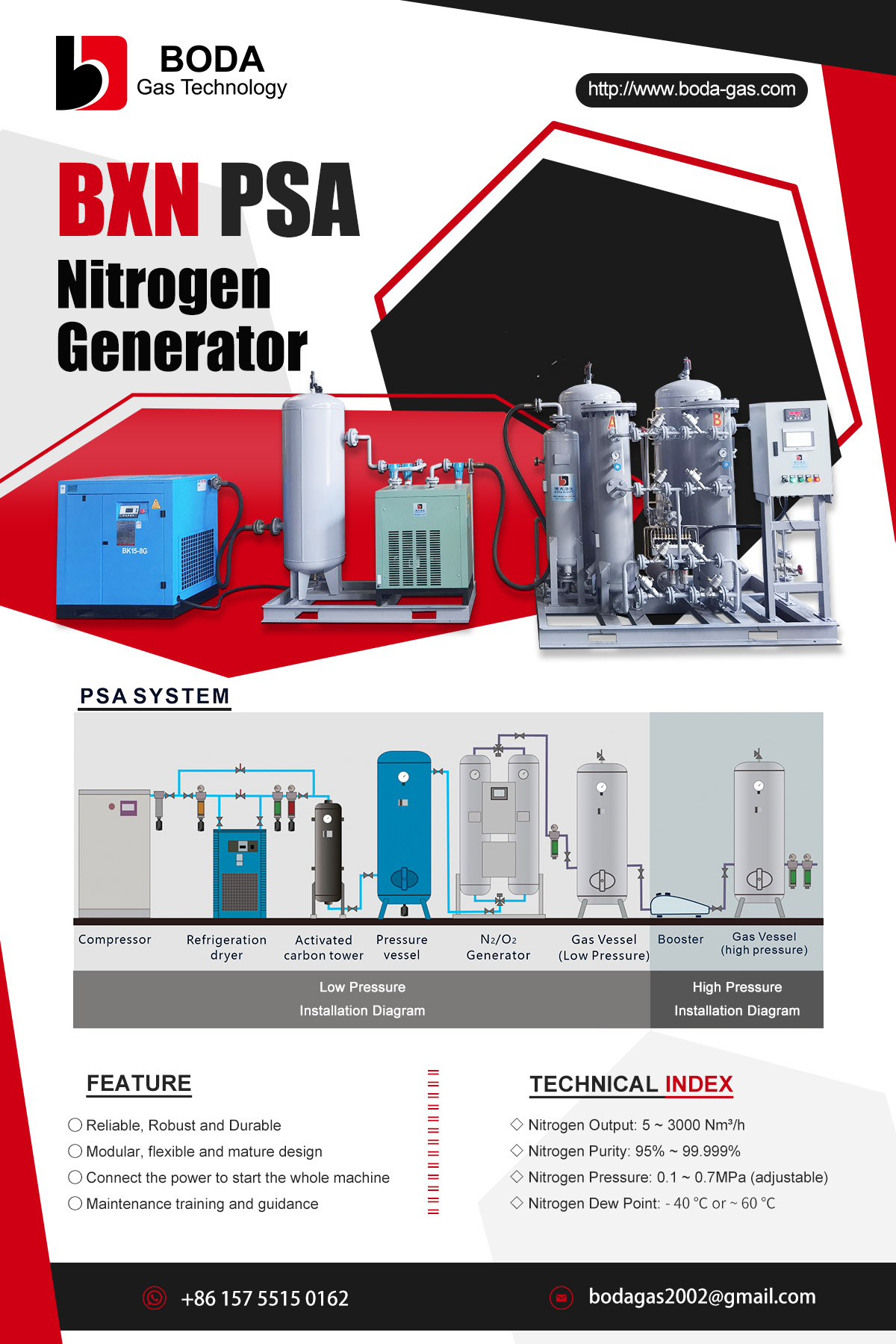
What a complete PSA nitrogen generator system includes
The generator tower skid is the most visible part of the installation, but published system definitions for PSA nitrogen stations describe a wider scope of supply. A complete station typically consists of the following elements.
| System element | Function in the nitrogen station |
|---|---|
| Air compressor | Supplies the compressed air that becomes the nitrogen feedstock. |
| Air receiver tank | Stores compressed air and stabilizes system pressure. |
| Multiple filters and oil-water separator | Remove dust, solid particles and liquid oil contaminants; the high efficiency oil-water separator reaches a gas-liquid separation efficiency above 98%. |
| Air dryer | Cools compressed air and removes water, with automatic drainer and water separator filter. |
| Activated carbon filter | Captures residual oil vapour and hydrocarbon impurities; published outlet oil content is below 0.003 mg/m³. |
| Nitrogen generator unit (BXN Series) | Separates nitrogen from oxygen using carbon molecular sieves in dual alternating towers. |
| Nitrogen buffer tank | Stores produced nitrogen to cover peak flow demand. |
| Oxygen analyzer / purity sensor | Continuously monitors gas purity and automatically vents out-of-specification gas. |
| Control system | Governs automatic valve actions, purge cycles and overall pressure regulation. |
Buffer tanks perform three different duties
Buyers often treat buffering as a single item. In practice the nitrogen system uses three distinct tanks: an air buffer tank that stabilizes compressed-air pressure and reduces pressure impact, a dry air buffer tank that maintains a stable dry air supply for the PSA towers against peak-demand pressure drop, and a nitrogen buffer tank that smooths pressure and flow fluctuation caused by tower switching so that nitrogen quality stays stable at peak consumption.
Pre-treatment: the equipment group that decides long-term stability
Pre-treatment protects the molecular sieve from moisture and oil damage and is normally described as the front end of a PSA nitrogen plant. Dryer selection depends on the dew point the process requires and on ambient conditions at site.
| Pre-treatment unit | Model series | Published performance data |
|---|---|---|
| Refrigeration dryer | FAD Series | 1–200 Nm³/min; 0.6–0.8 MPa (0.8–3.0 MPa optional); qualified air dew point ≤-23°C; inlet temperature below 38°C, and below 80°C for the high-temperature version; pressure loss ≤0.02 MPa. |
| Heatless desiccant dryer | ADL Series | 0.5–500 Nm³/min; qualified air dew point ≤-40°C or ≤-52°C; regeneration air loss ≤12%; operating cycle 10 minutes (modifiable). |
| Heated desiccant dryer | ADH Series | 1–500 Nm³/min; qualified air dew point ≤-40°C or ≤-52°C; regeneration air loss ≤6%, achieved by heating purge air to regenerate the desiccant. |
| Combined low dew point dryer | FAG Series | 1–300 Nm³/min; qualified air dew point ≤-60°C to -70°C; regeneration air loss 3–6%; integrates a refrigerated dryer and an adsorption dryer in one unit. |
| High efficiency oil-water separator | FYS Series | 1–500 Nm³/min; gas-liquid separation efficiency above 98%; intercepts bulk liquid water and oil droplets ahead of the sieve. |
| High efficiency oil-remover | FLY Series | 1–500 Nm³/min; outlet oil content below 0.01 mg/m³. |
| Precision filter | FAL Series | 1–500 Nm³/min; intercepts particulate contaminants ahead of the molecular sieve; pressure loss ≤0.02 MPa. |
| Sterilizing filter | FLC Series | Filtering accuracy 0.1 µm; SS304 construction; suitable for air and nitrogen; inlet temperature 0–80°C, and 0–121°C under steam sterilization. |
| Mobile pipeline-specific dryer | PDL Series | 1–300 Nm³/min; working pressure 0.6–1.6 MPa; qualified air dew point -40°C; inlet temperature below 120°C; residual oil content below 0.1 mg/m³. |
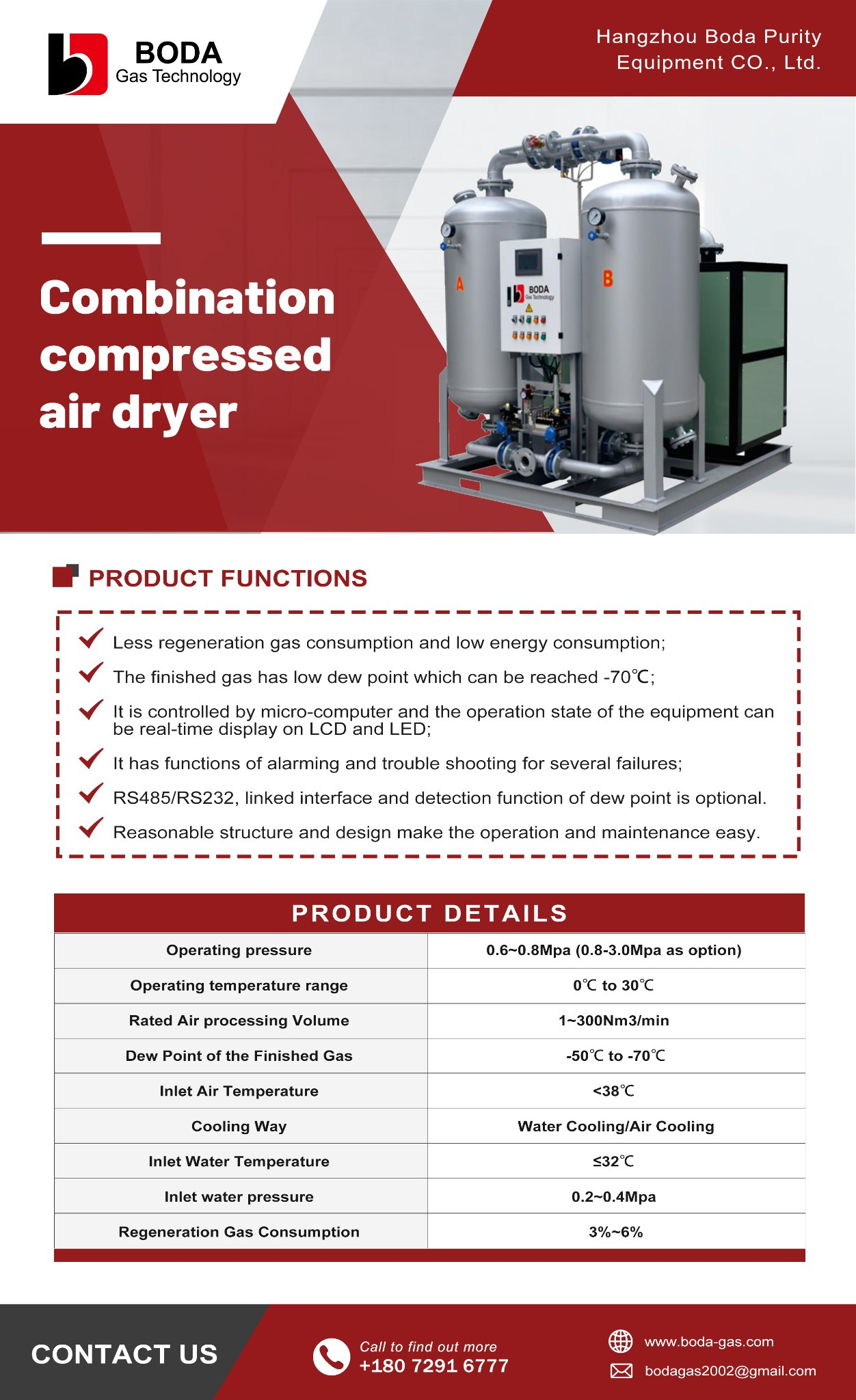
Dryers are specified when high-purity nitrogen is required, when end-use points have a defined water-content (dew point) limit, or when the customer site runs at high ambient temperature. These three conditions also explain most of the pre-treatment variation between projects.
Purity, flow and dew point: how to read the published ranges
Two product families cover different ends of the purity scale, and buyers should treat them as separate specification envelopes rather than one continuous range.
| Series | Nitrogen flow | Purity | Dew point and trace impurities |
|---|---|---|---|
| BXN Series PSA nitrogen generator | 1–3000 Nm³/h | 95%–99.999% | Dew point -40°C to -70°C; outlet pressure 0.1–1.15 MPa (adjustable); noise 65–85 dB(A) |
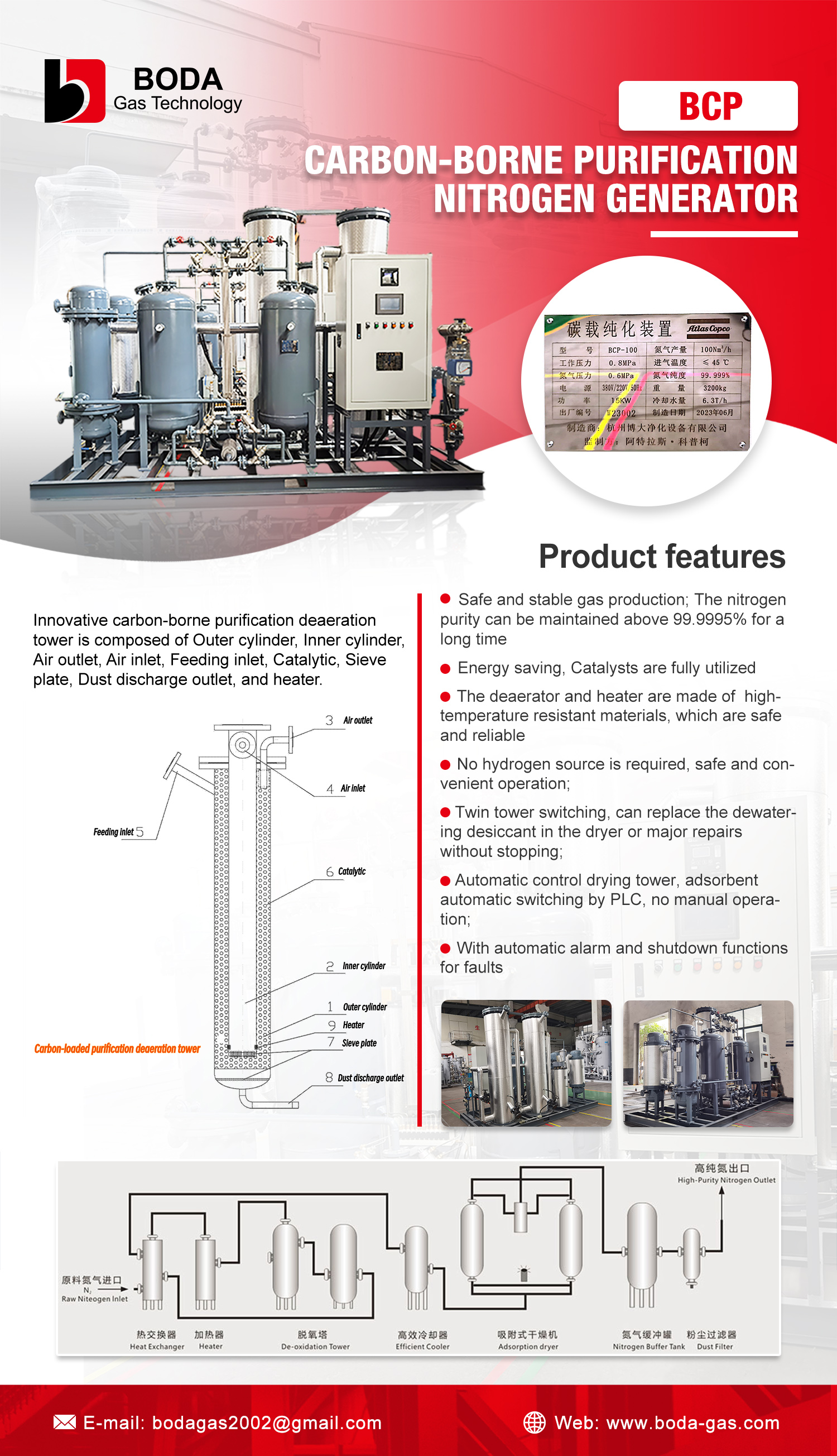
| BCP Series carbon loaded purification nitrogen generator | 1–500 Nm³/h | ≥99.9995% | Dew point ≤-60°C; oxygen content ≤5 ppm; carbon dioxide content ≤1 ppm |
Purity selection follows the duty of the gas rather than a preference for higher numbers. Published selection guidance groups requirements as follows:
- 95%–98% (low purity): fire protection, marine tank blanketing, oil field pipeline purging and general tyre inflation.
- 99%–99.9% (medium purity): food and beverage modified atmosphere packaging, winemaking and conventional plastic moulding.
- 99.95%–99.99% (high purity): mild-steel laser cutting, electronics manufacturing, cable production and pharmaceutical tank blanketing.
- 99.999% and above (ultra-high purity): cutting special metals such as titanium alloy, high-end electronics production and specialized laboratory applications.
As an engineering principle, purity and output are linked: raising the purity target on a fixed unit reduces the nitrogen flow it can deliver, and reducing the target releases capacity. This is why buyers are usually asked to fix purity, flow and discharge pressure before a configuration is drawn.
Matching purity to the application
Published application data maps required purity to industry, which is a faster starting point than specifying purity from scratch.
| Industry | Typical purity requirement | Typical duty |
|---|---|---|
| Petroleum industry | 95%–99.9% | Tank blanketing, pipeline and vessel purging and inerting, well stimulation and well-bore flushing |
| Chemical industry | 99.0%–99.99% | Reactor inert shielding, raw-material tank blanketing, powder conveying gas |
| Food and beverage packaging | 99.0%–99.9%, food-grade oil-free | Modified Atmosphere Packaging, beverage tank blanketing |
| Pharmaceutical industry | 99.99%–99.999% | Drug production, storage, sealing and packaging |
| Electronics industry | 99.99% for SMT workshops; 99.999%–99.9999% for wafer work with dew point ≤-60°C | Semiconductor fabrication and packaging, component processing, lithium-battery manufacturing |
| Laser and plasma cutting | 95%–99% for ordinary carbon steel; 99.99%–99.999% for mirror-finish stainless steel | High-pressure nitrogen as auxiliary cutting gas |
| Tyre inflation | 95%–98% | Automobile-service tyre inflation and tyre-factory vulcanization filling |
Two conditions typically push a specification upward: the presence of a defined dew point limit, and the requirement for oil-free, stainless-steel construction in food, pharmaceutical and electronics duties.
PSA versus membrane nitrogen generation: where the line sits
The two on-site technologies differ mainly in mechanism and purity ceiling. PSA systems use carbon molecular sieves to trap oxygen under pressure, achieving purities up to 99.999%. Membrane systems rely on the pressure differential across hollow-fibre bundles, where gases separate by permeation speed; water vapour and oxygen pass through first as oxygen-rich gas, while nitrogen is retained and concentrated.
The practical consequence is a purity distinction. Published membrane nitrogen generator data covers 5–3000 Nm³/h at 95%–99.9% purity with a nitrogen dew point of -40°C or -60°C, whereas PSA-based systems extend to 99.999% and, with a purification stage, to 99.9995% with oxygen ≤5 ppm. Third-party technical guidance from Atlas Copco states that PSA systems are favoured over membrane systems for high-purity requirements above 99.9%, because membrane purity is typically capped at lower levels. Membrane units remain suitable for offshore platforms, oil-field drilling, cargo-ship tank inerting and pipeline purging, where moderate purity and a compact package are the governing criteria.
Maintenance planning and consumables
Maintenance is a recurring procurement question because it determines the operating cost of ownership after commissioning. Published routine maintenance guidance is interval-based:
| Item | Published replacement or service interval |
|---|---|
| Precision filter element | Replace every 8,000 operating hours |
| Air compressor service (oil, oil filter, air/oil separator) | Every 3,000 to 4,000 runtime hours |
| Air dryer desiccant | Generally 16,000 to 24,000 hours |
| Carbon molecular sieve | Commonly 6 to 10 years; sieve grade and filling method materially affect service life |
Because the sieve is the single most expensive consumable, buyers also ask how to judge equipment quality before an order. Published buyer criteria focus on long-term stable compliance of nitrogen purity, flow capacity and outlet pressure; coating thickness of the spray-paint finish; and the brand selection of machine components. Industrial switching valves designed for high cycle counts, pressure vessels with leak-free welding, and a skid layout that is reasonable for transport and field commissioning are the elements that determine whether a station still meets its nameplate values several years after start-up.
Cost considerations and commercial terms
Cost in a PSA nitrogen project is driven by specification rather than by a single price benchmark. The variables that move capital cost are the target purity, the required flow rate, the dew point specification and the pre-treatment chain that supports it, the choice of carbon steel or SS304 wetted materials, the certification scope (ATEX, ASME, CE, ISO), and the instrumentation package — for example an online oxygen analyzer or purity sensor that automatically vents off-spec gas.
Operating cost arguments are usually made against delivered gas. Industry cost analyses cited in the market literature estimate that on-site nitrogen generation can reduce nitrogen supply cost by up to 40% compared with traditional cylinder delivery, mainly by removing logistics and handling. Published commercial terms for equipment of this class typically include a minimum order quantity of one unit, delivery terms of EXW, FOB, CIF or CFR, acceptance based on a pre-shipment test, and payment of 30% deposit by T/T in advance with 70% by T/T before dispatch.
After-sales scope is part of the same evaluation. Published service commitments in this category cover on-site and remote installation guidance, operation-staff training, remote technical support, and a 12-month equipment guarantee.
Where PSA nitrogen generation has limits
A balanced specification includes the boundaries of the technology, not only its capability.
- Inlet conditions are constraints, not preferences. Standard refrigeration dryers are rated for inlet temperatures below 38°C; high-temperature versions extend this to below 80°C, and the mobile pipeline dryer to below 120°C. Sites with unusually hot compressed air must specify accordingly rather than assume the standard package will hold its dew point.
- Every purification stage costs pressure. Dryers, filters and separators are typically rated at a pressure loss of ≤0.02 MPa each. A long pre-treatment chain reduces the pressure available at the nitrogen outlet and must be reflected in the pressure specification.
- Carbon molecular sieve is a consumable. Even with correct pre-treatment, sieve replacement is a planned event in the 6 to 10 year window, and a poorly maintained front end shortens it.
- Noise and footprint. Published generator noise is 65–85 dB(A), so units are normally placed in a utility area or container rather than beside a production line.
- Compliance adds equipment. In the EU, pressure vessels in PSA nitrogen generators must comply with the Pressure Equipment Directive (PED 2014/68/EU) and bear the CE mark. For food-grade nitrogen, EIGA standards require at least one continuously online residual oxygen analyzer in the nitrogen stream.
- Purity ceilings differ by technology. Membrane separation is published up to 99.9%; requirements above that level generally point back to PSA with a purification stage.
Customization and OEM/ODM scope
Equipment in this category is rarely a catalogue purchase, which is why customization capability is a central evaluation question. Hangzhou Boda Purity Equipment Co., Ltd., which trades as BODA GAS, is a Hangzhou-based manufacturer founded in 2002 that develops and produces PSA nitrogen generators, PSA oxygen generators and compressed air purification equipment; it operates a production base of more than 30,000 m², employs 58 people including a 15-engineer research and development team, and reports an annual output of 480 units.
Published capability data for this type of supply lists customization across flow rate, purity, pressure, dew point, material, production standard, voltage, logo, nameplate and painting color. Stated production parameters include a monthly capacity of 40 units, a lead time of 25 to 45 days, a minimum order quantity of one unit, and 100% testing of every unit through visual inspection and function inspection before shipment. The manufacturer provides OEM and ODM production services and supports both channels globally.
Management system certifications relevant to this class of equipment include ISO 9001:2015 quality management (certificate 244-25-QL-11075-R0-S, issued 2025-08-11 and valid to 2028-08-10), ISO 14001:2015 environmental management (244-24-EJ-09517-R2-S) and ISO 45001:2018 occupational health and safety management (244-24-SY-09318-R2-S, valid to 2027-11-04), all issued by YAB CERTIFICATION CO., LTD., with scope covering BXN PSA nitrogen equipment, BXO PSA oxygen equipment, and general refrigeration and adsorption compressed air dryers.
Deployment evidence from operating sites
Reference installations indicate which configurations are actually in service, and for how long.
| Client type and country | Application | Scope and reported status |
|---|---|---|
| Distributor and agent, Saudi Arabia | Upstream onshore and offshore oil and gas | 4 units, ASME standard, 2 years of stable operation |
| Distributor and agent, Tanzania | Fine chemical industry | 2 units, ASME standard, 10 years of stable operation |
| Trading intermediary, Malaysia | Chemical industry | 2 units, ASME standard with low dew point, 8 years of stable operation |
| Industrial end user, Uzbekistan | Cable manufacturing | 3 units, 99.999% adjustable purity, fully automatic unattended PLC operation, 3 years |
| Industrial end user, Mexico | Food processing | 2 units, food-grade nitrogen, 4 years of stable operation |
| Industrial end user, Nigeria | Coal-chemical and electromechanical industries | 2 units with a nitrogen output capacity of 3000 Nm³/h, 2 years of stable operation |
BODA GAS also reports established long-term cooperative supplier qualifications with organizations including China National Petroleum Corporation (CNPC), China Petrochemical Corporation (Sinopec), China National Offshore Oil Corporation (CNOOC), Zhuhai Jutal Offshore Oil Services Limited, United Energy Pakistan Limited, Ingersoll Rand Industrial Technologies, Petronas Chemicals MTBE Sdn. Bhd. (PCMTBE) and PT INDOSINO OIL & GAS.
Market trend and outlook
Several published trends shape how PSA nitrogen generator projects will be specified over the next few years. PSA already holds approximately 48% of the nitrogen generator market, and the food and beverage segment dominated the market in 2023 with roughly 49.8% of revenue share, driven by modified atmosphere packaging applications. The chemical industry segment is expected to grow at the highest compound annual growth rate among applications at 6.0%, reflecting increased use in blanketing and reactor purging. Asia-Pacific is projected by Verified Market Research to hold a 35% market share by 2032. One research house, Reliable Research IQ, projects a 7.6% compound annual growth rate for containerized PSA nitrogen generators between 2025 and 2032, driven by demand at remote oil and gas sites.
For buyers, the implication is that scope definition matters more than ever. As more installations move into the sub-500 Nm³/h band and into remote or containerized configurations, the difference between a stable station and a problematic one is decided by the pre-treatment chain, the accuracy of the purity specification, and the maintenance plan agreed at the point of order.
Frequently asked questions
1. What is a PSA nitrogen generator?
A PSA (Pressure Swing Adsorption) nitrogen generator is an on-site gas production unit that extracts nitrogen directly from compressed air. It uses two adsorption towers filled with carbon molecular sieve that adsorb oxygen, carbon dioxide and moisture from compressed air, delivering a continuous supply of high-purity nitrogen.
2. How does a PSA nitrogen station system work?
The cycle has five stages: compressed air input; adsorption and pressurization, where carbon molecular sieve adsorbs oxygen under working pressure and nitrogen flows to the buffer tank; tower switch and nitrogen output, where the system automatically diverts air feed to the second tower to keep production continuous; pressure equalization between the online and standby towers before switching; and regeneration, where the saturated tower depressurizes to vent impurities and regenerate the sieve.
3. What is included in a nitrogen generator system?
A complete PSA nitrogen system typically includes an air compressor, an air receiver tank, multiple filters including an activated carbon filter, an air dryer, the PSA nitrogen generator unit, a nitrogen buffer tank, an oxygen analyzer or purity sensor, and a control system. The matched-equipment list published for this product class is: air compressor – tanks – dryers – multiple filters – activated carbon filter – PSA nitrogen generator – buffer tank. Food, pharmaceutical and electronics duties generally specify an oil-free compressor and stainless-steel construction.
4. How do buyers choose the right nitrogen purity?
Purity is selected from the end use. Published guidance assigns 95%–98% to fire protection, marine tank blanketing, oil-field pipeline purging and general tyre inflation; 99%–99.9% to food and beverage modified atmosphere packaging, winemaking and conventional plastic moulding; 99.95%–99.99% to mild-steel laser cutting, electronics manufacturing, cable production and pharmaceutical tank blanketing; and 99.999% and above to special-metal cutting such as titanium alloy, high-end electronics production and specialized laboratory work. Raising the purity target reduces the nitrogen output achievable from the same unit, which is why purity, flow and discharge pressure are specified together.
5. Why is a dryer needed before the PSA towers, and which type is appropriate?
Dryers are specified for high-purity nitrogen duties, where end-use points require a defined dew point, or where the customer site has a high ambient temperature. The appropriate type depends on the dew point target: refrigeration dryers reach a qualified air dew point of ≤-23°C; heatless and heated desiccant dryers reach ≤-40°C or ≤-52°C, with regeneration air loss of ≤12% and ≤6% respectively; and combined low dew point dryers reach ≤-60°C to -70°C with regeneration air loss of 3–6%. Any moisture reaching the molecular sieve consumes adsorption capacity that should be reserved for oxygen.
6. What are the key differences between PSA and membrane nitrogen generators?
PSA systems use carbon molecular sieves to trap oxygen under pressure and can reach purities up to 99.999%, or 99.9995% with a downstream purification stage at oxygen ≤5 ppm and carbon dioxide ≤1 ppm. Membrane systems use hollow-fibre bundles that separate gases by permeation speed, offering lower purities in a compact design; published membrane nitrogen data covers 5–3000 Nm³/h at 95%–99.9% purity. Third-party technical guidance states that PSA is favoured over membrane for requirements above 99.9%, while membrane units suit offshore platforms, oil-field drilling, cargo-ship tank inerting and pipeline purging.
7. What maintenance does an on-site nitrogen system require, and which items are consumable?
Published intervals are: precision filter elements replaced every 8,000 operating hours; standard compressor service including oil, oil filter and air/oil separator every 3,000 to 4,000 runtime hours; air dryer desiccant at generally 16,000 to 24,000 hours; and carbon molecular sieve commonly at 6 to 10 years, with the caveat that sieve grade and filling method affect service life. Air compressor servicing follows the compressor manufacturer schedule.
8. Can a PSA nitrogen generator be customized or produced under OEM/ODM arrangements?
Yes. Published capability data for this equipment class lists customization across flow rate, purity, pressure, dew point, material, production standard, voltage, logo, nameplate and painting color, with OEM and ODM production services available globally. Stated production parameters include a monthly capacity of 40 units, a lead time of 25 to 45 days, a minimum order quantity of one unit, and 100% testing of every unit through visual inspection and function inspection before shipment.
9. What purchasing terms and acceptance criteria are typical?
Typical published terms in this category are a minimum order quantity of one unit; delivery terms of EXW, FOB, CIF or CFR; acceptance criteria based on a pre-shipment test; and payment of 30% deposit by T/T in advance with 70% by T/T before dispatch. After-sales scope normally covers on-site and remote installation guidance, operation-staff training, remote technical support and a 12-month equipment guarantee.