
PSA Nitrogen Generator vs Membrane: Buyer's On-Site Checklist
Two separation technologies dominate on-site nitrogen supply: pressure swing adsorption (PSA) and membrane separation. Fortune Business Insights attributes roughly 48% of the global nitrogen generator market to PSA, yet membrane units keep winning projects where flow is high, purity demand is moderate and floor space is scarce. For buyers, the decision is not a technology contest. It is a specification exercise in which flow, purity, outlet pressure, dew point and maintenance capability must line up with one duty point before a purchase order is defensible.
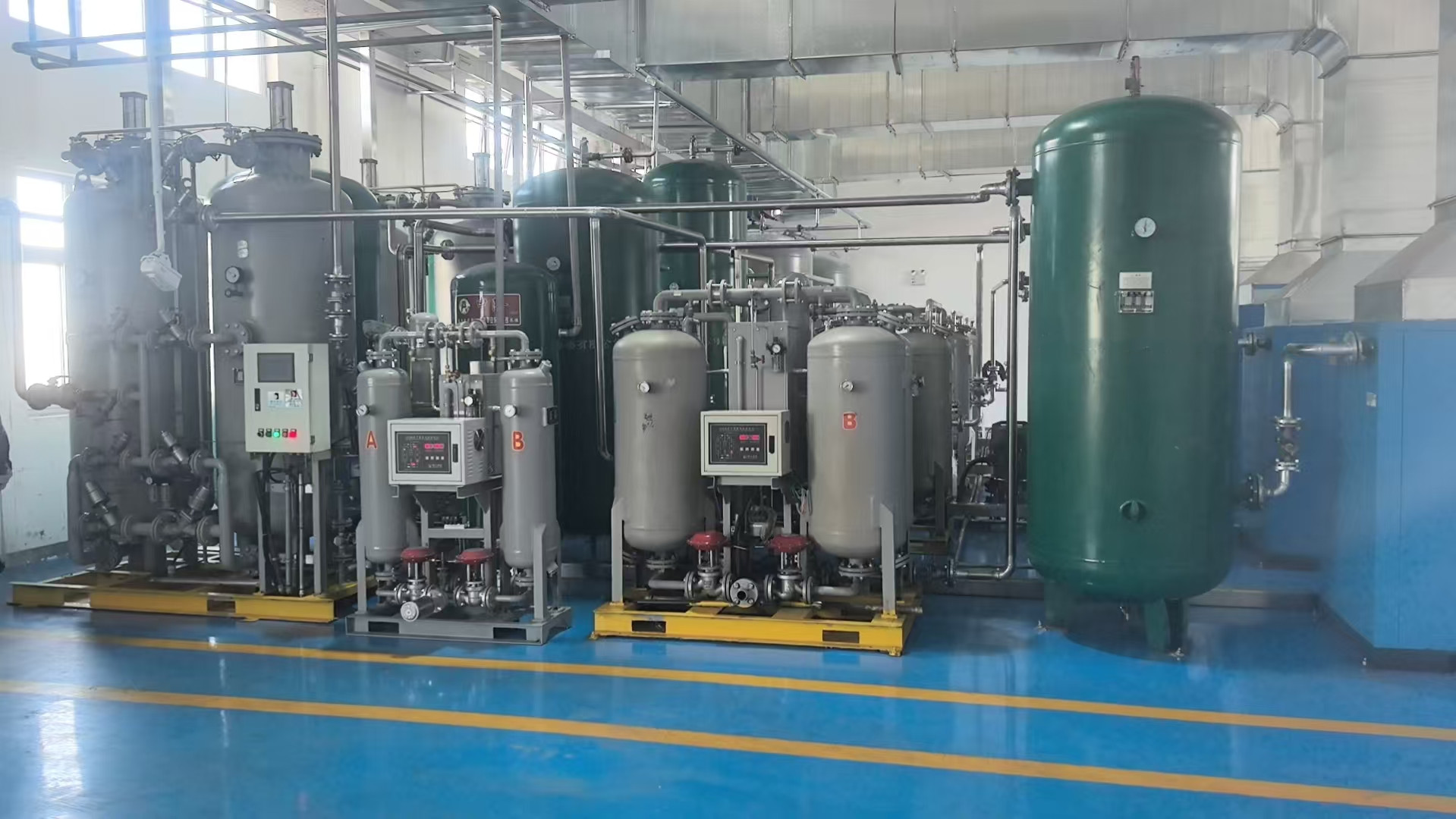
Why this comparison belongs in procurement, not only in engineering
Most nitrogen tenders compare the wrong numbers. Suppliers quote purity, flow and pressure as three headline figures, while the figure that governs the decision sits at their intersection: guaranteed purity at the specified flow and outlet pressure. PSA and membrane systems behave differently at that point, and the gap is wide enough to change which technology is bought.
The commercial framing matters as much as the technical one. A nitrogen generator is not a standalone box. The system that has to be priced, installed, accepted and maintained typically includes an air compressor, air receiver tanks, dryers, several filtration stages, an activated carbon filter, the separation unit itself, a nitrogen buffer tank, an oxygen analyser and a control system. Buyers who compare only the generator module frequently discover the real cost difference at commissioning.
Before any side-by-side reading of specifications, a buyer should fix six inputs: required flow in Nm3/h, required purity at that flow, required outlet pressure, required dew point, site voltage and frequency, and site altitude or ambient conditions. BODA GAS states that its technical team calculates air-to-nitrogen ratio, outlet flow, purity and power consumption from site altitude, voltage and industry, then draws a layout and technical scheme from those inputs. Whether or not that service is used, the buyer should hold the same inputs constant across every quotation received.
How PSA and membrane separation actually work
In a PSA nitrogen generator, compressed air passes through a vessel filled with carbon molecular sieve. Under pressure, oxygen molecules are preferentially adsorbed by the sieve while nitrogen concentrates in the gas phase within a short cycle time, which is how separation is achieved. The BXN Series from Hangzhou Boda Purity Equipment Co., Ltd. (BODA GAS) works on this principle and runs the full cycle sequence: compressed air input, adsorption and pressurisation, tower switch and nitrogen output, pressure equalisation, then regeneration by depressurisation of the saturated bed. Two towers alternate so that output is continuous.
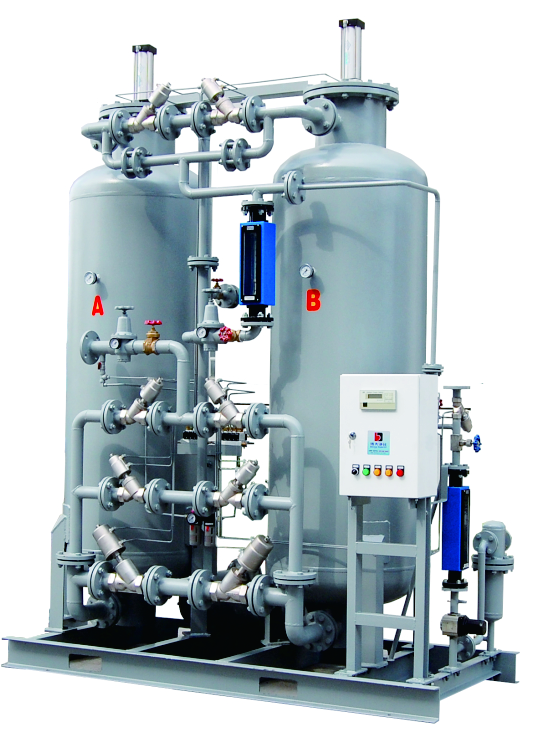
Membrane separation nitrogen generation relies on a pressure differential across a membrane module. Oxygen, nitrogen and other gases from compressed air differ in membrane solubility and diffusion coefficients. Water vapour and oxygen, which permeate faster, pass through the fibre first to form oxygen-rich gas, while nitrogen is retained and concentrated into dry nitrogen-rich gas. The BMN Series membrane separation nitrogen generator from BODA GAS is built on this principle.
BMN Series membrane and BXN Series PSA: specifications side by side
The two BODA GAS product families overlap in flow range but not in purity headroom. Reading them line by line shows where a buyer's duty point will force a choice.
| Parameter | BXN Series PSA nitrogen generator | BMN Series membrane separation nitrogen generator |
|---|---|---|
| Nitrogen output | 1 to 3000 Nm3/h | 5 to 3000 Nm3/h |
| Nitrogen purity | 95% to 99.999% | 95% to 99.9% |
| Outlet pressure | 0.1 to 1.15 MPa, adjustable | 0.1 to 1.2 MPa, adjustable |
| Dew point | -40 C to -70 C | -40 C or -60 C |
| Noise | 65 to 85 dB(A) | Described as quiet enough for direct installation on the production floor |
| Separation principle | Carbon molecular sieve adsorption, dual-tower cycling | Hollow-fibre membrane, differential permeation |
| Moving parts in separation stage | Switching valves and cycle control | None in the separation process |
| Footprint and siting | Modular skid layout with buffer tanks and dryer train | Compact, space-saving, installable on the production floor |
| Materials and options | Carbon steel or SS304; ATEX, ASME, CE, ISO customization | Carbon steel or SS304; stainless steel, ATEX, ASME, CE customization |
| Consumable with long replacement interval | Carbon molecular sieve | Membrane modules |
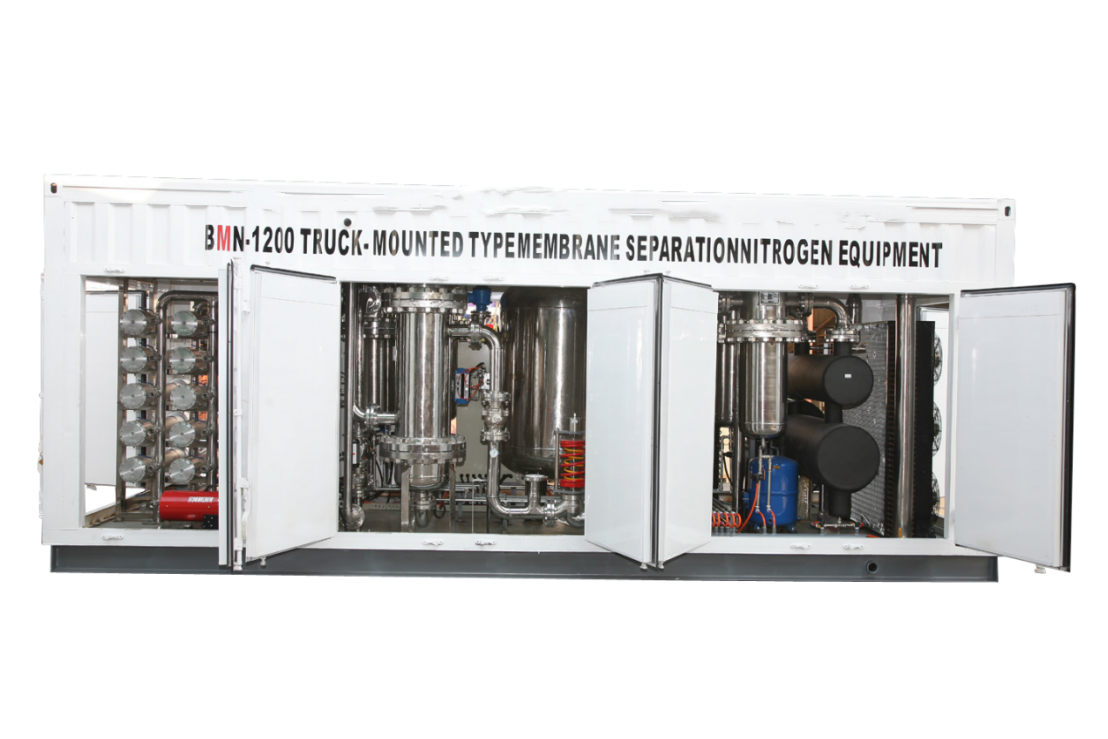
BODA GAS lists three commercial characteristics for the BMN Series that matter in a tender evaluation. First, purity is selectable: users set the specific purity their application needs, which lets most sites control energy consumption and running expense. Second, output quality is constant, which protects process and product quality. Third, the separation process has no moving parts, so the unit tolerates high-vibration areas and requires minimal maintenance. Start-up and commissioning are described as quick and simple.
The BXN Series carries the opposite trade-off. It reaches 99.999% purity and offers optional touch-screen display, dew point detection, energy-saving control and DCS communication, plus an automatic venting device covered by national patent technology that is intended to protect delivered gas quality. It also carries 65 to 85 dB(A) of operating noise and a larger installed scope. Neither list is better in the abstract; each is priced against a different duty point.
The duty point decides: purity tiers and practical flow bands
Purity is the single specification that most often resolves the PSA-versus-membrane question before price is even discussed. BODA GAS publishes a four-tier guide for on-site nitrogen selection, and the tiers map cleanly onto what each technology can hold at the upper end.
| Purity tier | Typical applications cited | Technology fit |
|---|---|---|
| 95% to 98% | Fire protection, marine tank blanketing, oilfield pipeline purging, general tyre inflation | Comfortable for both PSA and membrane |
| 99% to 99.9% | Food and beverage modified atmosphere packaging, winemaking, conventional plastic moulding | Both technologies; membrane is efficient at this band |
| 99.95% to 99.99% | Mild-steel laser cutting, electronics manufacturing, cable production, pharmaceutical tank blanketing | PSA territory; above the BMN Series purity ceiling |
| 99.999% and above | Titanium alloy cutting, high-end electronics, specialised laboratory work | PSA with purification; not a membrane duty |
Independent sources point the same way. Atlas Copco states that PSA systems are favoured over membrane systems for high-purity requirements above 99.9%, because membrane purity is typically capped at lower levels. General Air Products notes that PSA nitrogen generators can reach 99.999% purity using carbon molecular sieves. BODA GAS makes the same boundary explicit in its own membrane documentation: the BMN Series is offered with purity settings from 95% up to 99.9%, and PSA nitrogen generators are identified as the more efficient choice when purity above 99.5% is required.
Flow bands add a second filter. PSA installations are commonly divided by capacity into sub-100 Nm3/h (42%), 100 to 500 Nm3/h (36%) and above 500 Nm3/h (22%), based on third-party market analysis. A buyer in the small-capacity band should expect the capital cost of the full PSA train, including dryer and buffer capacity, to weigh more heavily against the membrane alternative.
Maintenance calendars and the real cost of on-site generation
Both technologies sit behind the same air-treatment chain, and that chain, not the separation module, drives most routine maintenance. BODA GAS lists the following intervals for an on-site nitrogen system: precision filter elements replaced every 8000 hours; standard air compressor service, including oil, oil filter and air-oil separator changes, every 3000 to 4000 running hours; air dryer desiccant replaced generally between 16000 and 24000 hours; carbon molecular sieve replaced every 6 to 10 years.
The divergence appears at the last item. A PSA system carries a scheduled sieve replacement event with a multi-year horizon, plus valve cycling as a continuous mechanical duty. A membrane system has no equivalent moving-part maintenance in the separation stage, and its dominant long-term cost is protecting the modules through correct pretreatment. Buyers should ask both suppliers to state, in writing, the consumable list, the replacement interval assumed in the quotation, and the unit price basis for each consumable.
On operating cost, the widely cited benchmark is that on-site nitrogen generation can reduce nitrogen supply costs by up to 40% compared with traditional cylinder deliveries by eliminating logistics fees, a figure attributed to the U.S. Department of Energy and cited in market reporting. BODA GAS frames the same logic commercially for the BXN Series: independence from external gas suppliers and from nitrogen market price fluctuation, and removal of cylinder handling and liquid nitrogen supplier management from site logistics.
That benchmark has boundaries a buyer should apply before adopting it. The 40% figure assumes continuous, predictable nitrogen demand; a site consuming gas intermittently may never amortise the capital and compressed-air energy. Membrane systems offer a specific lever that PSA does not: because purity is selectable across the 95% to 99.9% band, running at the lowest purity the process tolerates reduces energy consumption directly. A buyer who specifies 99.9% out of habit rather than process need is paying for purity the product never uses.
Purchasing terms and acceptance criteria that separate a specification from a promise
An on-site nitrogen purchase should be written so that acceptance is measurable. The following items are the practical core of that document.
- Duty point, not headline numbers. State guaranteed purity at the specified flow and outlet pressure, with dew point, voltage and frequency fixed. A purity figure quoted without its flow and pressure reference cannot be verified at commissioning.
- Materials and market compliance. Both BXN and BMN Series are offered in carbon steel or SS304, with stainless steel, ATEX, ASME, CE and ISO customization available. For the European Union, pressure vessels in PSA nitrogen generators must comply with the Pressure Equipment Directive (PED 2014/68/EU) and bear the CE mark, which should be stated as a delivery condition rather than assumed.
- Purity verification method. The system scope normally includes an oxygen analyser or purity sensor that continuously monitors gas quality and vents out-of-specification gas. For food-grade nitrogen, EIGA standards require at least one continuously online residual oxygen analyser in the nitrogen stream, which makes the analyser a contractual item, not an option.
- Factory release evidence. BODA GAS states that all equipment must pass qualification testing prior to factory release, and that products hold ISO 9001, ISO 45001 and ISO 14001 certifications alongside ISO 13485 for medical device quality management. Buyers should request the factory test record against the agreed duty point.
- Installation and start-up scope. Skid-mounted units are described as plug-and-play after power-on: the equipment is set down and the power cable connected, with minimal installation. Confirm who performs commissioning, and whether overseas resident engineers are available for on-site installation, commissioning and maintenance where the site requires it.
- Service response and spares. A 24-hour online after-sales service is stated as standard, together with operation manuals and video guidance. Spare-part supply should be tied to the consumable list agreed above.
Application fit: laser-cutting auxiliary gas and raw-drug nitrogen blanketing
Laser cutting is where the purity boundary becomes commercially visible. For ordinary carbon steel cutting, 95% to 99% nitrogen is the working band, and both PSA and membrane systems can serve it. For mirror-finish stainless steel fine cutting, the requirement rises to 99.99% to 99.999% at high-pressure output, matched with a high-pressure nitrogen booster set. High-pressure nitrogen blows molten metal clear, isolates ambient oxygen, suppresses cut-surface oxidation and dross, and prevents brittle nitride layers on the cut edge. That band sits above the BMN Series ceiling of 99.9%, so a mirror-finish stainless operation is a PSA duty, while a carbon-steel cutting shop can legitimately evaluate membrane separation as an auxiliary-gas source.
Raw-drug nitrogen blanketing shows a subtler version of the same issue. Pharmaceutical nitrogen use is specified at 99.99% to 99.999%, with oil-free air supply and stainless steel construction, and nitrogen is used to control oxygen concentration during drug packaging and to maintain a clean environment in production and storage. BODA GAS lists raw-drug nitrogen blanketing among BMN Series applications, while the same body of documentation places pharmaceutical requirements at 99.99% to 99.999%. The practical reading for buyers is that the required purity must be fixed at the point of use first, and the technology selected afterwards. Where ultra-high purity is genuinely required, a PSA base unit can be paired with a purification stage: the BCP Series carbon loaded purification nitrogen generator delivers purity of 99.9995% or better, oxygen content of 5 ppm or less, carbon dioxide content of 1 ppm or less and a dew point of -60 C or lower, without hydrogen, while the BHP Series hydrogenation purification unit reaches the same purity class with hydrogen content adjustable between 500 ppm and 5% in the BHP-I model.
Beyond those two anchor cases, the same logic repeats across industries. Chemical reactor blanketing, flammable-material tank sealing and pipeline purging run at 99.0% to 99.99% and require explosion-proof or ASME configurations at many sites. Food and beverage modified atmosphere packaging runs at 99.0% to 99.9% with oil-free air and stainless steel. Oilfield and marine tank inerting sits at 95% to 99.9%, frequently with explosion-proof equipment for Zone 1 or Zone 2 hazardous areas. Tyre inflation needs only 95% to 98%. Electronics manufacturing climbs to 99.99% for common SMT workshops and 99.999% to 99.9999% for chip and wafer work with dew point at or below -60 C.
Market context: what is actually driving the choice
The installed base is shifting toward documented, verifiable specifications rather than brand preference. Verified Market Research values the global industrial nitrogen generator market at USD 4.29 billion in 2023, projected to reach USD 6.47 billion by 2031. Grand View Research places the food and beverage segment at approximately 49.8% of 2023 revenue share on the strength of modified atmosphere packaging, and Maximize Market Research expects the chemical industry segment to grow at the highest application-level CAGR of 6.0% on blanketing and reactor purging demand. Verified Market Research also projects Asia-Pacific to hold a 35% share by 2032 as the fastest-growing region.
Two conclusions follow for buyers. First, capacity is being added fastest in exactly the application bands where PSA and membrane overlap, which means more quotations per project and more pressure to compare like with like. Second, the growth of blanketing and packaging duty reinforces a purity-tier approach: most new demand sits at 95% to 99.9%, where membrane separation is technically adequate and energy-selective, while the ultra-high-purity segment stays with PSA and downstream purification.
Honest boundaries on both sides
Membrane separation has a hard purity ceiling in this product family: the BMN Series is specified to 99.9%, and the manufacturer itself directs buyers above 99.5% toward PSA for efficiency reasons. It is not a route to 99.999% output, to mirror-finish stainless cutting gas, or to pharmaceutical blanketing at 99.99% and above without further treatment. Its economics also depend on running at the lowest purity the process accepts; specifying margin the process does not need removes the energy advantage that justifies the technology.
PSA carries its own constraints. The installed scope is larger because vessel cycling, buffer capacity and a full dryer train are part of the system, and operating noise is stated at 65 to 85 dB(A), which may require siting away from quiet work areas. Carbon molecular sieve is a scheduled replacement item on a 6 to 10 year horizon, and the switching valves are a continuous mechanical duty. Neither technology removes the need for a trained operator, a compressed-air supply of adequate quality and a maintenance budget; and for genuinely intermittent or very small consumption, delivered liquid nitrogen or cylinders can still be the rational choice, because on-site generation amortises its capital against continuous demand.
Future outlook
Three directions are visible in current product documentation. Skid-mounted and containerized configurations continue to move nitrogen generation closer to the point of use, shortening installation and commissioning. Control and monitoring are becoming part of the purchase rather than an afterthought, with optional touch-screen display, dew point detection, energy-saving control and DCS communication offered on PSA units. And purity selection is increasingly treated as an energy strategy: membrane systems that let a site set 95% instead of 99.5% convert that decision directly into lower running cost. For buyers drafting specifications in 2026 and beyond, the durable requirement is the same one this comparison started with: a guaranteed purity at a guaranteed flow and pressure, verified by an analyser, backed by a factory test record and a stated consumable schedule.
FAQ
What are the key differences between PSA and membrane nitrogen generators?
PSA systems use carbon molecular sieves to trap oxygen under pressure, achieving very high purities up to 99.999%. Membrane systems use hollow-fibre bundles to filter gases by permeation speed, offering lower purities of 95% to 99.5% in a compact, quiet design. In BODA GAS product terms, the BXN Series PSA generator covers 1 to 3000 Nm3/h at 95% to 99.999% purity, while the BMN Series membrane generator covers 5 to 3000 Nm3/h at 95% to 99.9% purity.
What purity can a membrane nitrogen generator reach, and when does PSA become the better choice?
The BMN Series membrane separation nitrogen generator is specified from 95% to 99.9% purity, with outlet pressure adjustable between 0.1 and 1.2 MPa. BODA GAS notes that PSA nitrogen generators are the more efficient choice when purity above 99.5% is required. Third-party assessments agree: Atlas Copco states that PSA is favoured over membrane for high-purity requirements above 99.9%, because membrane purity is typically capped at lower levels.
What maintenance does an on-site nitrogen system require?
Routine maintenance covers the whole system, not only the separation unit. Precision filter elements are replaced every 8000 hours. Standard air compressor service, including oil, oil filter and air-oil separator changes, is performed every 3000 to 4000 running hours. Air dryer desiccant is replaced generally between 16000 and 24000 hours. Carbon molecular sieve is replaced every 6 to 10 years on a PSA system, while a membrane separation stage has no moving parts and therefore no equivalent cyclic valve maintenance.
What is included in a complete on-site nitrogen generator system?
A complete system typically comprises an air compressor, air receiver tanks, multiple filters, an air dryer with automatic drain, an activated carbon filter to capture residual oil vapour, the nitrogen generator unit itself, a nitrogen buffer tank, an oxygen analyser or purity sensor that vents out-of-specification gas, and a control system governing valve actions, purge cycles and pressure regulation. Buyers should confirm which of these items sit inside the supplier scope and which are site-supplied.
How should a buyer define acceptance criteria for a nitrogen generator?
Acceptance should be tied to the guaranteed duty point: purity at the specified flow and outlet pressure, with dew point, voltage and frequency fixed. The system normally includes an online oxygen analyser, which for food-grade nitrogen is required by EIGA standards as at least one continuously online residual oxygen analyser. Equipment should pass qualification testing prior to factory release, with the test record supplied. For the European Union, pressure vessels must comply with PED 2014/68/EU and bear the CE mark. Materials, certifications and the consumable replacement schedule should be listed in the same document.
Which applications favour membrane separation and which favour PSA?
Applications at 95% to 99.9% purity generally suit either technology, with membrane favoured where floor space is limited, low noise matters and the unit can be installed on the production floor. BODA GAS lists laser-cutting auxiliary gas, raw-drug nitrogen blanketing, chemical reactor blanketing, modified atmosphere food packaging, metal annealing and pipeline purging among BMN Series applications. Applications above the membrane ceiling require PSA: mirror-finish stainless steel cutting at 99.99% to 99.999% with high-pressure output, pharmaceutical blanketing at 99.99% and above, and ultra-high-purity electronics work, where a PSA base unit can be combined with BCP or BHP purification to reach 99.9995% purity.
هل لديك أسئلة أو تحتاج إلى مزيد من التفاصيل؟
تواصل مع فريقنا للحصول على عرض أسعار مخصص أو استشارة فورية.
طلب عرض أسعار
املأ النموذج أدناه وسيتواصل معك فريقنا بعرض مقترح مخصص.
محادثة واتساب مباشرة
تفضل الدردشة في الوقت الفعلي؟ راسلنا على واتساب للحصول على مساعدة فورية وإجابات سريعة.
- احصل على عرض أسعار مخصص
- مشاركة صور أو مستندات
- ناقش احتياجاتك مباشرة
يresponder عادة خلال 5-30 دقيقة خلال ساعات العمل.