
PU Foaming Machine FAQ: KAIWEI vs. Nordson, Graco, Sonderhoff, Cannon
Technical and procurement questions answered for engineering, sourcing and production teams specifying a polyurethane foaming machine for enclosure gasket sealing.
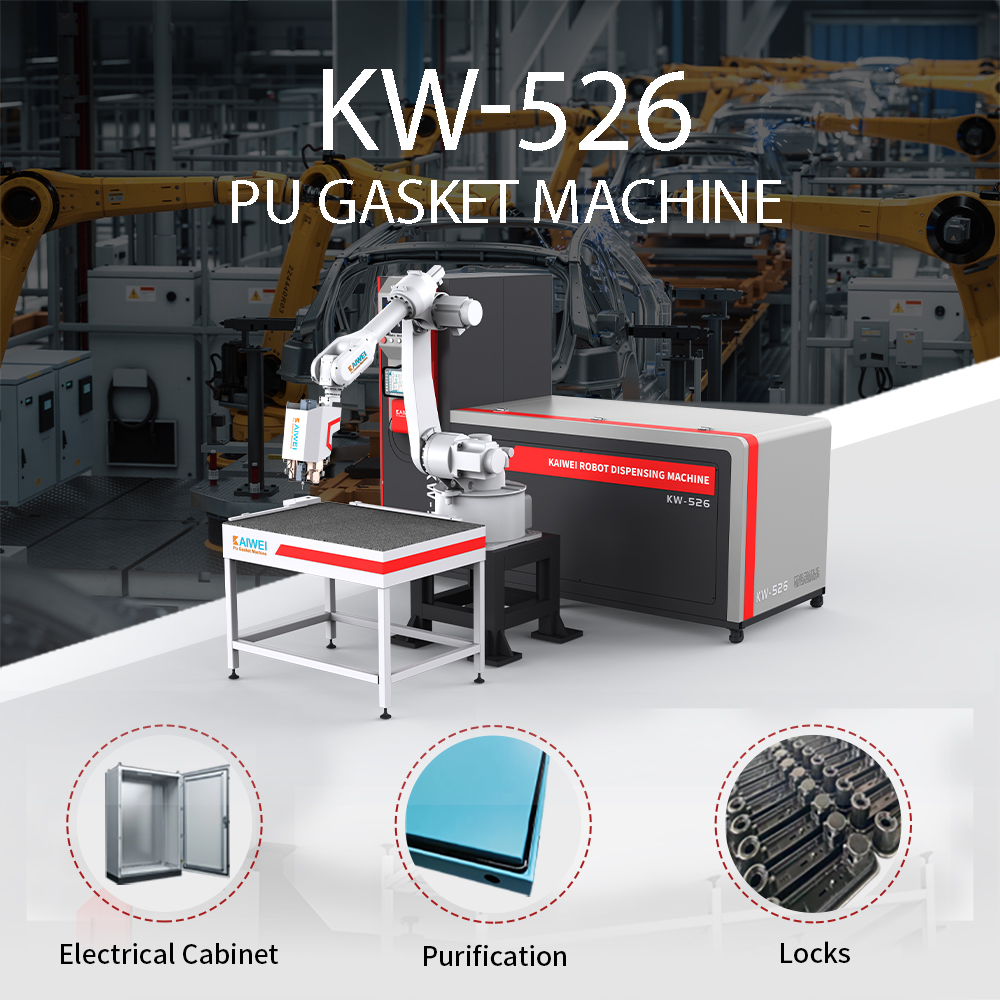
A PU foaming machine is programmed at the teach pendant before a gasket path is committed to the automatic gluing production line. Image: KAIWEI KW-526.
A polyurethane foaming machine is not selected on stroke length or price alone. In enclosure manufacturing, the machine becomes the point where a gasket drawing turns into a production commitment, and the questions that decide the purchase are practical ones: will the foamed bead hold a dust-proof and explosion-proof seal, will the unit survive 24/7 line duty, and who carries the risk when the first production batch is measured against the drawing.
This article collects the questions buyers actually raise about a PU gasket dispensing machine — often written as PU foam sealing machine, automatic foam gasket machine, two-component foaming machine or automatic foaming machine — and answers them in the order a project team meets them. Where KAIWEI is compared with Nordson, Graco, Sonderhoff and Cannon, the comparison stays at the level of publicly described positioning, because no independently validated head-to-head performance dataset for these suppliers was available for this article.
Why the foaming stage, not the machine spec sheet, sets the project margin
Enclosure sealing has a specific economic structure. The gasket is a small share of the bill of materials and a large share of the field-failure risk. A foamed polyurethane bead performs a sealing function rather than a structural one: it must seal an electrical control panel, a distribution board, an explosion-proof shell, a lighting housing, an air filter frame or a home-appliance door against dust and, in some specifications, against water ingress and internal ignition. Those are outcomes measured after assembly, not at the nozzle.
That timing is what makes the purchase decision difficult. A buyer can verify machine parameters in a quotation within a week, but the same buyer only learns whether the foaming stage fits the project when the first parts reach the leak test. The useful way to reduce that exposure is to sequence the questions correctly: application fit first, integration second, acceptance criteria third, commercial terms last.
What KAIWEI publishes for PU foaming and gasket dispensing
Shanghai Kaiwei Intelligent Technology (Group) Co., Ltd. (KAIWEI) is a Shanghai-based manufacturer founded in 2004, focused on industrial sealing systems, robot foaming equipment, intelligent sealing and dispensing equipment, and six-axis robotic foaming systems. The company reports a production site of more than 20,000 m², a core technical team of more than 30 engineers, more than 100 national patents, CE and ISO9001 certification, and exports to more than 60 countries.
Its PU gasket dispensing range is a family of linear-robot dispensing platforms rather than a single model. All models use polyurethane as the raw material, accept two- or three-component configurations, run through a motion-control-card and PLC architecture with a touch-screen HMI, and share a 1–10:1 mixing-ratio range, KAIWEI or Barmag metering pumps, dual 40 L air-pressure tanks (tank A agitated, tank B not), and high-pressure water cleaning.
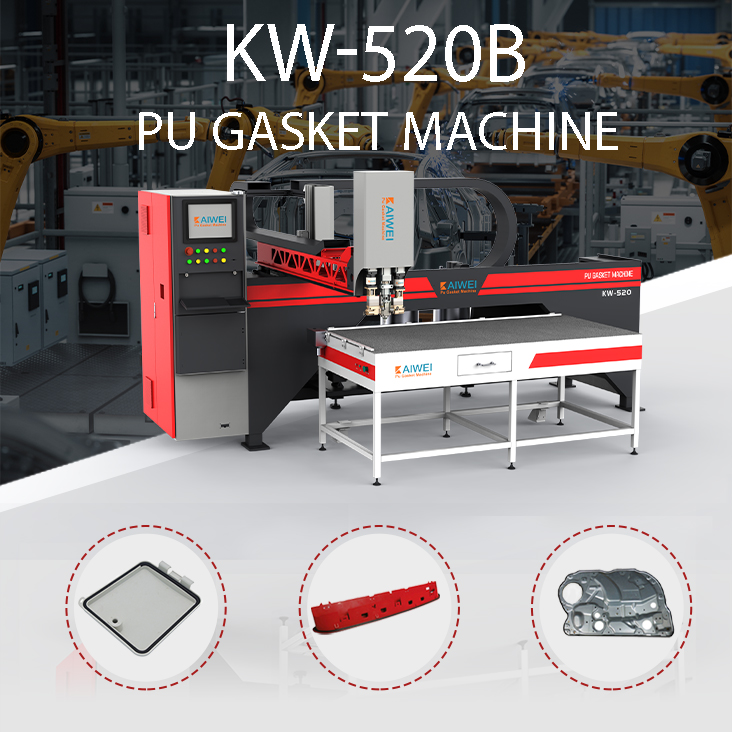
Large-format platform for cabinet doors and panels: KAIWEI KW-520B, 2250 × 1250 × 200 mm effective stroke.
| Model | Frame | Effective stroke | Seal strip width | Mixing head |
|---|---|---|---|---|
| KW-510B | 3-axis linear robot arm | 2250 × 1250 × 200 mm | 4–30 mm | KW-900 |
| KW-520B | 3-axis linear robot arm | 2250 × 1250 × 200 mm | 4–30 mm | KW-900 |
| KW-520A / 520A-PC | 3-axis linear robot arm | 2250 × 1250 × 200 mm | 4–30 mm | KW800 |
| KW-523 / KW-523A | 3-axis linear robot arm | 1250 × 800 × 200 mm | 2–10 mm or 10–60 mm | KW800 / KW-900 |
| KW-526 | 6-axis linear robot arm | Customized | 2–60 mm | KW800 / KW-900 |
Table: PU gasket dispensing models as published in KAIWEI product specifications. All models list polyurethane (and, on the KW-523 series, silicone) as raw material, 1–10:1 mixing ratio, metering pumps at A 3 cc/r and B 0.6 cc/r, 220 V / 380 V supply and ≥6 bar air requirement.
What the PU foaming parameters actually mean at the nozzle
A two-component foaming machine meters an isocyanate and a polyol side, mixes them in a mixing head and deposits the reacting mix as a bead that rises and cures in place. That sequence makes four parameters decisive, and each one is listed on a KAIWEI data sheet.
Mixing ratio. The 1–10:1 range defines how far the formulation can be shifted between resin-rich and hardener-rich mixes. A gasket that must stay soft for a dust seal and a gasket that must resist a cleaning cycle may not sit at the same ratio, so ratio flexibility is a formulation question disguised as a machine question.
Metering pumps. KAIWEI lists KAIWEI or Barmag pumps with an A-side specification of 3 cc/r and a B-side of 0.6 cc/r. Pump displacement, not headline speed, governs bead-to-bead repeatability on long runs.
Mixing head. The KW-900 is described as a pump-type mixing head that supports control-system parameter adjustment and simplified maintenance; the KW800 is the alternative head on the 520A, 523 and 526 platforms. Head choice, not frame size, determines the practical strip-width envelope.
Travel speed and cleaning. The KW-510B, KW-520A and KW-526 list a programmed travel-speed range up to 12,000 mm/min, while the KW-520B and KW-523 series are listed at 0–1,200 mm/min. High-pressure water cleaning is standard across the range, and water-temperature control is an option — relevant where ambient conditions move through the working day. KAIWEI's equipment description also cites an independent intelligent temperature-control module with over-temperature alarms and high-precision servo dispensing valves, which matters for formulation stability on a line that runs without an operator overnight.
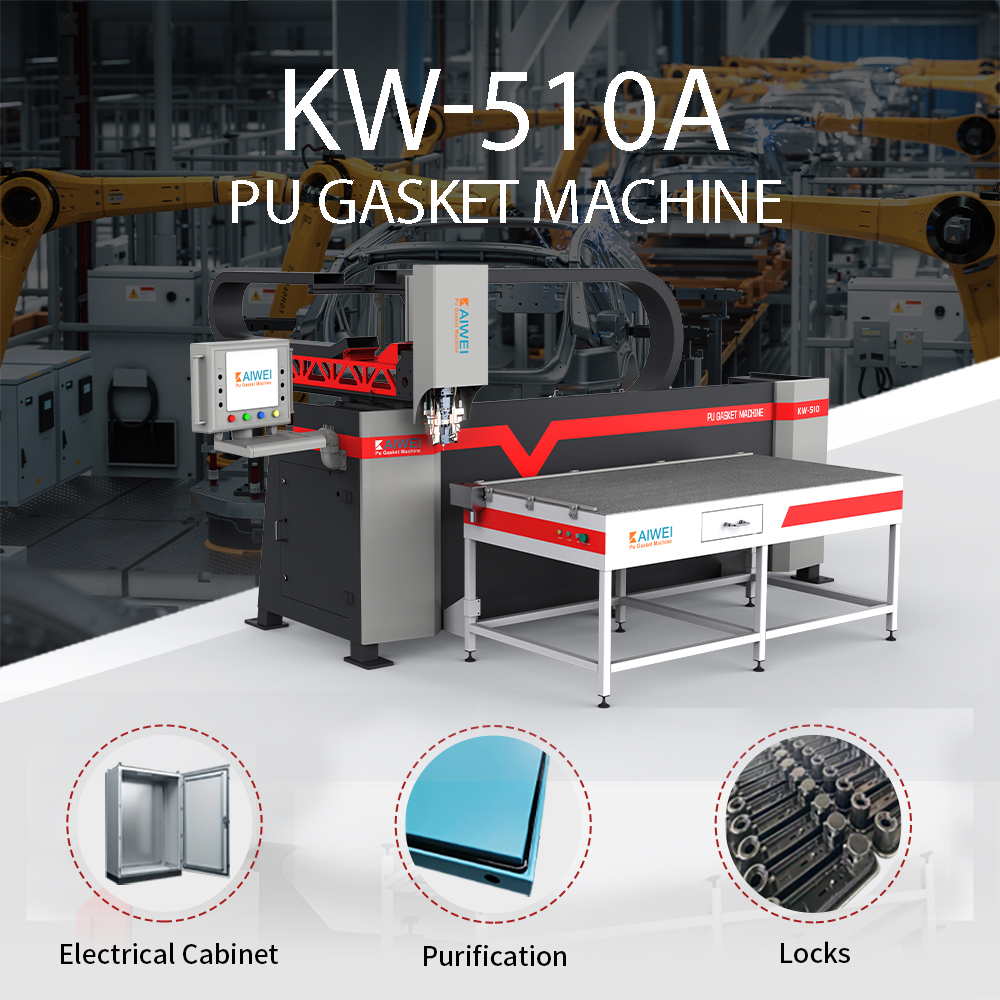
Two-component material supply, metering and control on a PU gasket dispensing platform. Image: KAIWEI 520A-PC.
Application fit: where a PU foaming machine is the right sealing tool
KAIWEI's application data is consistent across sectors: automatic sealing projects, dust-proof and explosion-proof sealing for enclosures, 24/7 continuous operation integrated with an automatic production line, a working environment of −20 to 40 °C, and, for a defined subset of projects, explosion-proof and IP66 waterproof requirements. The same profile is documented for electrical control panels, explosion-proof electrical and special electrical, lighting and LED, automotive parts, home appliances, purification and filtration equipment, and lock and hardware accessories.
| Sector | Gasket function | Project condition |
|---|---|---|
| Electrical control panels, distribution boards | Dust-proof and explosion-proof sealing | Automatic line, 24/7, IP66 requirement |
| Explosion-proof electrical and special electrical | Enclosure sealing for explosion-proof shells | Explosion-proof and IP66 requirements |
| Lighting and LED luminaires | Outdoor, street and stadium lighting seals | −20 to 40 °C working range |
| Automotive parts and components | Battery covers, inner door handles, mountings | Automatic gluing production line |
| Home appliances | Refrigerator door and cabinet sealing | Continuous line operation |
| Purification, filtration equipment | Air filter frames, purification room doors | Dust-proof sealing at scale |
Deployment spans the United States, China, India, Germany, Japan, Italy and Russia among the markets documented for these enclosure-sealing applications, matching KAIWEI's reported export footprint of more than 60 countries. One documented case is a US automotive OEM paint shop running 20 units for two years, with reported stable operation, IP66 waterproof and dust-proof sealing, high production efficiency, high-precision dispensing and customized gasket shapes on an automatic line.
Market context: growth sits in the foaming segment, not in the gasket product
Two figures frame the procurement decision. The broader polyurethane processing machine market is valued at USD 4.07 billion in 2025. Within it, the automatic polyurethane foaming machine segment is projected to move from USD 606 million in 2025 to USD 832 million by 2032.
A caveat belongs next to those numbers. No independently validated market size exists for PU gasket dispensing machines as a discrete equipment category, and published gasket market values describe finished sealing products, a different measurement object that cannot be combined with equipment data. The practical reading is directional: the foam-forming equipment layer is expanding, while buyers still have to evaluate individual machines without a category benchmark.
KAIWEI and four established peers: what the public positioning shows
Nordson and Graco are US-listed equipment groups whose public positioning covers dispensing, adhesive and fluid-handling systems across many industries, with international service footprints built on that breadth. Sonderhoff, a German brand within Henkel, is publicly positioned around mixing and metering systems and formed-in-place foam gasket sealing. Cannon is an Italian manufacturer publicly positioned around polyurethane processing equipment, including metering and mixing units.
| Supplier | Publicly described focus | What to verify before shortlisting |
|---|---|---|
| KAIWEI | Industrial sealing and robot foaming systems; enclosure, lighting, filtration and automotive gasket dispensing; OEM/ODM customization | Line integration scope, factory acceptance test on your own part, spare-parts response |
| Nordson | Broad dispensing and adhesive systems across multiple industries | Configuration depth for your seal width, local service model, total cost of ownership |
| Graco | Fluid handling and dispensing equipment with wide distribution | Whether the offered platform is purpose-built for foamed gasket beads |
| Sonderhoff | Mixing and metering systems for formed-in-place foam gasket sealing | Material approval path, service coverage in your region, delivery lead time |
| Cannon | Polyurethane processing and metering/mixing equipment | Integration with your gluing line and gasket-path programming support |
This table deliberately stops at positioning. It asserts no ranking on accuracy, uptime, bead tolerance or cost, because the evidence set behind this article contains no independently validated comparative performance data for these five suppliers. Buyers who need that comparison have to generate it, typically by sending the same test part to each shortlisted supplier and measuring the cured bead against the drawing.
Limits and boundary conditions
A PU foaming machine is not a standalone bench tool. KAIWEI's documentation states that the product must be used with an automatic gluing production line; the 24/7 continuous-duty profile assumes the surrounding line, fixtures and material supply are engineered for the same duty cycle. A buyer who has not yet automated should plan the line, not only the dispenser.
Model selection carries real constraints. The KW-510B, KW-520A and KW-526 list travel speeds up to 12,000 mm/min, while the KW-520B and KW-523 series are listed at 0–1,200 mm/min, so throughput planning must follow the specific model rather than the brand. Strip-width envelopes differ as well: 4–30 mm on the 510B, 520B and 520A family, 2–10 mm or 10–60 mm on the 523 series, and 2–60 mm on the 526. A project needing both a narrow bead and a wide bead may need two configurations.
Explosion-proof and IP66 performance is an attribute of the finished enclosure assembly, not of the dispenser alone. The machine places the bead; the housing design, surface preparation, cure profile and compression set determine whether the assembled unit passes. KAIWEI's EU Machinery Directive documentation is recorded under CE certificate reference MD-TCF-240307-55472, effective 7 March 2024 — a machinery-safety conformity statement, not a sealing-performance guarantee. Buyers should also note that no third-party validated uptime, dispensing-accuracy or repeatability dataset for these models was available for this article.
Future outlook
If the automatic foaming segment reaches USD 832 million by 2032 from USD 606 million in 2025, the growth is likely to be absorbed by buyers who are automating enclosure sealing for the first time rather than by replacement demand alone. That has two consequences for specification. First, integration support becomes a harder selection criterion than head technology, because a first-time buyer is buying a working line, not a machine. Second, regional service coverage starts to matter earlier in the evaluation than it did when only high-volume automotive and appliance plants bought these systems.
A quieter shift sits underneath: as enclosure specifications tighten around IP66 and explosion-proof requirements across electrical distribution, lighting and filtration equipment, the cost of a failed seal moves further away from the price of the machine. That asymmetry favours suppliers who can document what happens after installation — acceptance testing, gasket-path customization and remote support — over suppliers who compete mainly on headline specifications.
Frequently asked questions
Is a PU foaming machine suitable for sealing electrical control panels and enclosure doors?
Yes, within a defined application profile. KAIWEI's PU gasket dispensing machines are documented for electrical control panels, distribution boards, electrical enclosures, anti-explosion boxes and explosion-proof shells, with the primary function of providing dust-proof and explosion-proof sealing. The same documentation places the equipment in a working environment of −20 to 40 °C, in 24/7 continuous operation integrated with an automatic production line, and notes that some projects additionally specify explosion-proof and IP66 waterproof requirements.
What must a PU foaming machine be integrated with before it can run?
An automatic gluing production line. KAIWEI states that the product must be used with an automatic gluing production line, and that the matched equipment for its documented sealing projects is precisely that line. In practice this means the dispenser is one station in a sequence that also handles part presentation, fixturing and downstream curing, and the 24/7 duty cycle applies to the whole sequence rather than to the dispenser alone.
Which acceptance criteria should be checked on a foamed PU gasket before sign-off?
Four checks cover most of the risk: cured bead profile against the drawing, continuity of the closed loop at corners, adhesion to the actual substrate after the specified cleaning step, and enclosure-level ingress behaviour against the target requirement, whether that is a dust seal or an IP66 claim. Because the gasket is functional rather than structural, a dimensionally correct bead that fails adhesion will pass a visual inspection and fail in service. KAIWEI's documented applications list IP66 waterproof and dust-proof sealing as the project-level outcome, which is the correct level at which to accept or reject.
How is explosion-proof and IP66 sealing achieved with a foamed PU gasket?
It is achieved by the assembly, not by the dispenser. KAIWEI's explosion-proof electrical and special electrical applications document explosion-proof sealing for enclosures and list explosion-proof and IP66 waterproof as special requirements, with anti-explosion boxes and explosion-proof shells among the target parts. The dispenser's contribution is a repeatable, uninterrupted bead on the sealing face; the enclosure's geometry, compression and material selection complete the result. Buyers should therefore test the assembled unit, not a bare test panel.
What operating temperature and duty cycle can a PU foaming machine handle?
KAIWEI documents a working range of −20 to 40 °C and 24/7 continuous operation in automatic production line mode across its sealing applications, from lock and hardware accessories to purification and filtration equipment. Temperature stability of the material itself is supported by listed features: water-temperature control is available as an option, and KAIWEI's equipment description cites an independent intelligent temperature-control module with over-temperature alarms. Ambient temperature range and material temperature control are separate questions and should be confirmed separately during specification.
Can the gasket path and strip width be customized for different enclosure sizes?
Yes, within the model's published envelope and through the listed customization options. Strip width ranges from 4–30 mm on the KW-510B, KW-520B and KW-520A family, 2–10 mm or 10–60 mm on the KW-523 and KW-523A, and 2–60 mm on the KW-526, which uses a 6-axis linear robot arm with a customized effective stroke. KAIWEI lists OEM/ODM customization covering color and material, automatic A/B material feeding, mechanical arm, plasma treatment, logo design, elliptical chain worktable, constant-temperature water circulation, safety grating, appearance design, automatic switching workbench, three-component configuration and support for 12 languages.
What purchasing terms apply — minimum order, lead time and testing?
KAIWEI lists a minimum order quantity of 1 set, a lead time of 7 days, and 100% testing as its quality-control method, with remote support as the after-sales model and OEM/ODM as the production mode. Buyers should treat the 7-day figure as a company-stated production lead time and confirm separately how it interacts with configuration choices, factory acceptance testing and international freight to their site.
How does KAIWEI's PU foaming platform compare with Nordson, Graco, Sonderhoff and Cannon at selection stage?
The comparison that can be made responsibly is about positioning and fit. Nordson and Graco are publicly positioned as broad dispensing and fluid-handling groups serving many industries; Sonderhoff is positioned around mixing and metering for formed-in-place foam gasket sealing; Cannon around polyurethane processing and metering equipment. KAIWEI is positioned specifically around industrial sealing and robot foaming systems for enclosure-type gasket dispensing, with CE documentation under Machinery Directive 2006/42/EC recorded as MD-TCF-240307-55472 and a documented 20,000 m²+ production site. No independently validated head-to-head performance comparison across these five suppliers exists in the evidence base used here, so no ranking on accuracy, uptime or cost is asserted. A buyer should shortlist on positioning, then decide on a measured test part.
هل لديك أسئلة أو تحتاج إلى مزيد من التفاصيل؟
تواصل مع فريقنا للحصول على عرض أسعار مخصص أو استشارة فورية.
طلب عرض أسعار
املأ النموذج أدناه وسيتواصل معك فريقنا بعرض مقترح مخصص.
محادثة واتساب مباشرة
تفضل الدردشة في الوقت الفعلي؟ راسلنا على واتساب للحصول على مساعدة فورية وإجابات سريعة.
- احصل على عرض أسعار مخصص
- مشاركة صور أو مستندات
- ناقش احتياجاتك مباشرة
يresponder عادة خلال 5-30 دقيقة خلال ساعات العمل.