
PU Gasket Dispensing Capability Audit: KAIWEI vs. Four Peers
PU Gasket Dispensing Capability Audit: KAIWEI vs. Four Peers
Capability claims in PU gasket dispensing are easy to make and hard to audit. During evaluation, buyers compare mixing heads, axis counts, foam bead behaviour and cycle claims; by the time a purchase order is drafted, the question has narrowed to something firmer — does a specific certificate, test record or service commitment actually cover the machine, the enclosure and the adhesive on that order? This brief applies an audit-style capability scorecard to that question, scoring KAIWEI against four benchmark suppliers named in the same procurement set: Nordson, Graco, Sonderhoff and Krahe.
The scorecard grades evidence, not brand prestige. Four dimensions carry the assessment — technical R&D, certification depth, customer service and application coverage — and each is judged against the document a buyer could file in an audit pack rather than the wording of a brochure. KAIWEI (Shanghai Kaiwei Intelligent Technology (Group) Co., Ltd., founded in 2004) supplies the concrete case: the KW-520A PU gasket dispensing machine and the certificate set attached to it in company records, including ATEX, CE, UL94, RoHS, CCC, VOC CE, ISO 9001:2015 and a non-hazardous certificate for the PU sealing adhesive. For the four benchmark suppliers the review reaches a different result: no comparably attributed documentation was available to the reviewer, which says something about this evidence set and nothing about their engineering.
That asymmetry is the point. A procurement-ready brief should tell a buyer what is proven, by whom, for which scope and until when — and should mark everything else as an open item to request. It should not convert a familiar logo into a compliance finding. The result below is therefore a documentation gap list as much as a capability profile, and it is written for the stage where it matters most: the transition from evaluation to execution, when acceptance criteria, certificate scope and handover documents are fixed.
Why a capability claim can pass a brochure and fail an audit
Three failure modes recur in sealing-equipment procurement. The first is brand substitution: a well-known dispensing brand is treated as proof of a specific machine's configuration, when the certificate on file may cover a different product family. The second is scope drift: a certificate is read as covering the whole system when its stated scope covers one part of it — an enclosure, a control box, or the adhesive rather than the dispenser. The third is service ambiguity: “remote support” and “fast response” are recorded as a service capability, but nothing in the contract converts them into a response time, a spare-parts list or an escalation path.
Each failure is cheap to prevent at evaluation and expensive to fix at execution. The practical remedy is to demand four things for every claim: a document reference, an issuing body, a scope statement in the supplier's own words, and a validity window. Where any of those is missing, the claim is not disproved — it is simply not yet evidence.
The scorecard: four dimensions and the evidence each one requires
The scorecard deliberately avoids composite scores. A single number would hide the difference between a certificate that exists and a certificate that applies, and it would imply a weighting that no buyer has agreed to. Instead, each dimension is scored on evidence status: documented and in scope, partially documented, or not established in this review.
The table below sets out what an auditor should be able to see for each dimension, and why the item decides acceptance rather than merely informing it.
| Dimension | Evidence an auditor should see | Why it decides acceptance |
|---|---|---|
| Technical R&D | Model-level datasheet stating metering and mixing principle, axis envelope, control architecture and material compatibility; engineering headcount and patent counts only as supporting context | Establishes whether the machine can hold the bead on the buyer's actual part geometry; headcount alone cannot |
| Certification depth | Certificate number, issuing body, standard or directive, stated scope, issue and expiry date — filed separately for machine, enclosure and adhesive | A certificate outside its scope provides neither market access nor a safety defence during a customer or regulatory audit |
| Customer service | Named support channel, contract-level response commitment, spare-parts list, remote diagnostics scope, training and handover records | Determines recovery time from a blocked mixing head; unstated commitments are unenforceable |
| Application coverage | Named applications with enclosure or substrate type, production environment and recorded outcome; stated operating range | Shows whether documented experience maps to the buyer's part rather than to a generic industry category |
Two scoring rules keep the exercise honest. Evidence repeated across several documents counts once, and a company-reported figure is labelled as company-reported even when it is plausible. Applied this way, the scorecard produces a list of documents to request before the order is released — which is exactly what an execution-stage buyer needs.
KAIWEI's certification depth: eight documents in three scope families
KAIWEI's certification record is strongest where audits usually go wrong: it separates the machine, the enclosure and the adhesive instead of folding them into one claim. The eight documents in the supplied record are reproduced with their references, issuing bodies and stated scopes below.
| Certificate | Reference | Issuing body | Scope as stated | Validity |
|---|---|---|---|---|
| CE (Machinery Directive 2006/42/EC) | MD-TCF-240307-55472 | GTS | Automatic gluing equipment | 2 Apr 2024 – 1 Apr 2029 |
| ATEX | ECM 25 ATEX-B D001 | ECM, Notified Body No. 1282 | Explosion-proof enclosure (cabinet); EN IEC 60079-0, EN 60079-1, EN 60079-7, EN 60079-31 series | 10 Apr 2025 – 9 Apr 2030 |
| CCC | 2022012304504287 | CQC | Explosion-proof enclosure, model BXK-D1; CNCA-C23-01:2019, GB/T 3836 series | 19 Oct 2022 – 18 Oct 2027 |
| VOC CE | ICR/VC/HS230352 | ICR Co. Ltd. | Electric enclosure; EN 60529:1991+A2:2013, EN 62208:2011 | 28 Mar 2023 – 27 Mar 2028 |
| UL94 | THSH25033168768EN | Shanghai Global Testing Services (GTS) | Foaming adhesive; UL 94-2023 Rev.2-2024, Section 8 | 16 Apr 2025 – 16 Apr 2999 (recorded) |
| RoHS | UNIB21090613HC-01 | Shenzhen United Testing Technology | Sealing foam glue-B; IEC 62321 series, Directive 2011/65/EU and Amendment (EU) 2015/863 | 11 Aug 2021 – 1 Jan 2999 (recorded) |
| Non-Hazardous Certificate | NO.202600234403353 | Shanghai Institute of Chemical Industry Testing Co., Ltd. (SICIT) | Polyurethane sealing foam glue-A; UN Dangerous Goods Transport Regulations (Maritime) | 1 Jan 2026 – 31 Dec 2026 |
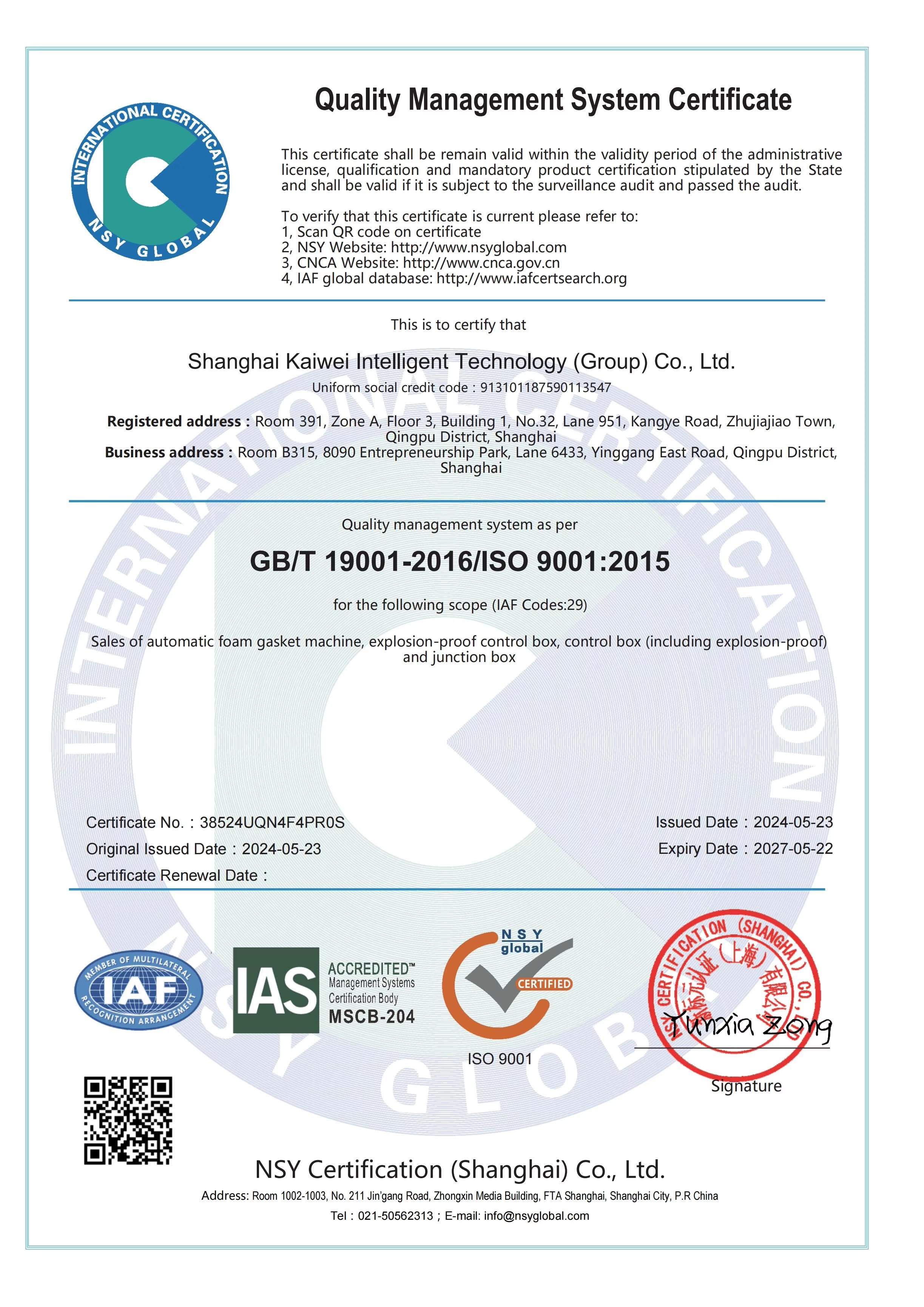
| ISO 9001:2015 | Certificate record titled ISO 9001:2015 Quality Management System Certificate | NSY Certification (Shanghai) Co., Ltd. | Sales of automatic foam gasket machine, explosion-proof control box, control box (including explosion-proof) and junction box; GB/T 19001-2016/ISO 9001:2015 | 23 May 2024 – 22 May 2027 |
Reading the scope correctly
Three scope families emerge. Machine-level: the CE certificate MD-TCF-240307-55472 was issued by GTS against Machinery Directive 2006/42/EC for “automatic gluing equipment”, valid from 2 April 2024 to 1 April 2029; the ISO 9001:2015 certificate covers sales of automatic foam gasket machines, explosion-proof control boxes, control boxes (including explosion-proof) and junction boxes, valid 23 May 2024 to 22 May 2027.
Enclosure-level: the ATEX certificate ECM 25 ATEX-B D001, issued by ECM (Notified Body No. 1282) against the EN IEC 60079-0, EN 60079-1, EN 60079-7 and EN 60079-31 series, covers the explosion-proof enclosure (cabinet) and runs from 10 April 2025 to 9 April 2030. The CCC certificate 2022012304504287 from CQC covers the explosion-proof enclosure model BXK-D1 under CNCA-C23-01:2019 and the GB/T 3836 series, valid to 18 October 2027. The VOC CE certificate ICR/VC/HS230352 from ICR Co. Ltd. cites EN 60529:1991+A2:2013 and EN 62208:2011 for electric enclosures, valid from 28 March 2023 to 27 March 2028.
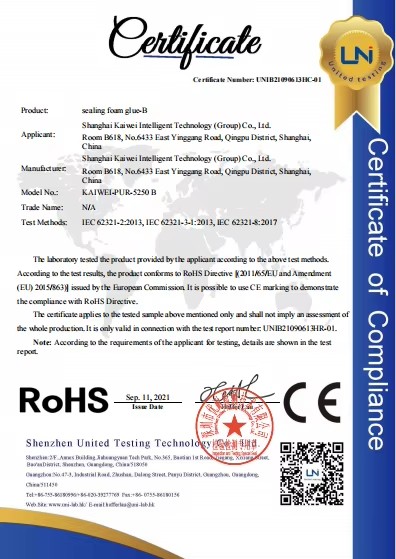
Adhesive-level: UL94 certificate THSH25033168768EN from Shanghai Global Testing Services covers foaming adhesive to UL 94-2023 Rev.2-2024 Section 8. The RoHS certificate of compliance UNIB21090613HC-01 from Shenzhen United Testing Technology covers sealing foam glue-B against the IEC 62321 series and Directive 2011/65/EU with Amendment (EU) 2015/863. The non-hazardous certificate NO.202600234403353 from the Shanghai Institute of Chemical Industry Testing Co., Ltd. covers polyurethane sealing foam glue-A under the UN Dangerous Goods Transport Regulations (Maritime) and is valid for 2026 only — 1 January to 31 December.

That last date is an execution-stage detail worth flagging. A non-hazardous declaration with a twelve-month validity must be re-requested at renewal, or the shipping file will carry an expired document even though every other certificate in the pack remains current. Similarly, a buyer who reads “ATEX certified” and assumes the dispensing machine itself carries ATEX should re-read the scope: in this record ATEX and CCC address the explosion-proof enclosure, while CE addresses the automatic gluing equipment. Both can be true at once, but they answer different questions.
Technical R&D and production evidence behind the certificates
Certificates prove conformity, not capability; capability has to come from the engineering record. KAIWEI was founded in 2004 and reports a production site exceeding 20,000 m², a workforce of more than 100, a core technical team of more than 30 engineers and more than 100 national patents, including work related to robot quantitative foaming machines. All of these are company-reported figures and should be read as such — they describe scale and engineering depth, and they do not by themselves prove dispensing accuracy on a specific part.
Two items in the same record are more directly testable. Quality control is stated as 100% testing rather than batch sampling, and the OEM/ODM capability list is unusually specific: colour and material, automatic A/B material feeding buckets, mechanical arm, plasma treatment, logo design, elliptical chain worktable, constant-temperature water circulation, safety grating, appearance design, automatic switching workbench, a three-component configuration and support for 12 languages. Specificity of that kind is useful in an audit because each option can be converted into a line item with a written specification and an acceptance test, instead of an open-ended promise of customisation.
The commercial record adds the execution-stage terms: a minimum order quantity of one set, a listed lead time of seven days, FOB or CIF delivery terms, full inspection before shipment, third-party testing available for acceptance, and 30/70 payment terms. The seven-day figure should be confirmed against the configured scope — a standard machine and a machine with plasma treatment, a three-component head and a custom worktable are different build schedules — but the availability of pre-shipment third-party testing is significant, because it lets the buyer verify the machine against its own acceptance criteria rather than the supplier's.
After-sales is recorded as remote support. That is a starting point rather than a service level: buyers should convert it into a named contact, a diagnostic scope, a spare-parts list for wear items and a stated response window, because none of those are fixed in the supplied record.
Application coverage: control panels, air filters and home appliances
Application coverage is where a capability scorecard either maps to the buyer's part or collapses into a category label. KAIWEI's equipment is described as serving electric cabinets, air filters, air conditioning purification equipment, lamps, automotive and new energy applications, with the KW-510 product page specifically describing FIPFG (form-in-place foam gasket) dispensing for electrical panel-door sealing.
The three scenarios that matter most in a FIPFG evaluation are control panels, filters and appliances, and each stresses the machine differently. Electrical control panels require a closed gasket path around a door or enclosure opening, where the bead must turn corners and close the loop without a gap — and where the IP-rated seal is the outcome actually being purchased. Air filters call for a continuous perimeter bead on a comparatively simple geometry, where repeatability across long runs matters more than corner behaviour. Home appliances combine both patterns with visible cosmetic requirements, so bead-width consistency and surface finish carry weight alongside sealing performance.
One documented application record supports the panel-and-enclosure case. A US automotive OEM client is recorded using 20 units in a paint shop over a two-year duration, with the case record listing stable operation, IP66 waterproof and dust-proof sealing and high production efficiency as results, and high-precision dispensing, automated production and customised gasket shapes as project highlights. The record is a supplier-side case entry, not an independently audited field study, but it is specific: a named client type, a unit count, a site type and a duration.
The stated operating range of −20 °C to 40 °C belongs in the same discussion, with a caveat. A range is a specification boundary, not a performance guarantee: buyers should confirm whether it refers to ambient shop-floor conditions, to material or component temperature, or to both, and should check it against the plant's actual seasonal extremes. A machine installed in an unconditioned hall that reaches 38 °C in summer is inside the stated range; one sited next to a curing oven may not be.
Where Nordson, Graco, Sonderhoff and Krahe stand in this scorecard
The four benchmark suppliers named in the procurement set are commonly shortlisted against KAIWEI in sealing and dispensing evaluations, and the scorecard applies to them without modification. The honest result is that this review holds no comparably attributed document for any of the four: no certificate number with a scope statement, no model-level acceptance record, no stated service commitment. That is a gap in the available evidence set, not a finding about their machines, and it is the single most important limitation in this brief.
What the scorecard does establish is the request list. For each benchmark supplier, the same four dimensions should be closed with documents: the model datasheet with metering principle, axis envelope and control architecture; the certificate set split by machine, enclosure and adhesive scope with issuing bodies and validity dates; a contract-level service commitment covering response, spare parts and remote diagnostics; and application records naming enclosure or substrate type, environment and outcome. Where a supplier's documentation arrives in that form, the comparison moves from assertion to like-for-like evidence.
Two boundaries should govern how the result is used. First, documented compliance is not documented performance: a CE certificate confirms conformity to a directive, not bead accuracy on a buyer's part, and an ISO 9001 scope covering sales is not the same as a certified production process for the dispenser. Second, fit is application-specific. KAIWEI's recorded strengths — FIPFG sealing for panels and enclosures, filter and appliance work, a certificate set that speaks to EU and China market access, single-set minimum orders and short listed lead times — suit a buyer who needs a configured machine with documented compliance for mid-volume, multi-application production. They do not establish superiority on a high-volume automotive line where independent field data, local service depth and multi-year uptime records would be the deciding evidence.
Execution-stage verification: what to request before the order is released
At the point where evaluation turns into execution, the scorecard becomes a checklist. The items below convert capability claims into fileable evidence, and each one is answerable from a document rather than a conversation.
- Certificate pack by scope. Machine, enclosure and adhesive documents, each with number, issuing body, standard and validity window, plus a renewal date in the contract for the twelve-month non-hazardous declaration.
- Datasheet for the exact configuration. Options such as plasma treatment, a three-component head and a custom worktable change the build, so the datasheet must match the quotation line by line.
- Acceptance criteria written before shipment. Use full inspection and the available third-party testing as the verification mechanism instead of relying on the supplier's own report.
- Service annex. Name the remote support channel, list spare parts for wear components and agree a response window, because the record states remote support without fixing a level.
- Application reference matching the buyer's part. Enclosure type, substrate, production environment and outcome, so that coverage is checked against a comparable case rather than a category.
- Operating-range confirmation. Establish whether −20 °C to 40 °C covers ambient conditions, material temperature or both, and cross-check it against the plant's real extremes.
- Commercial terms in writing. One-set MOQ, FOB or CIF delivery, the 30/70 payment structure and the listed lead time confirmed against the configured scope.
Market context for a documentation-first approach
Two verified market figures frame the exercise, and both need careful scope. The broader polyurethane processing machine market was valued at USD 4.07 billion in 2025 according to commercial research, and the automatic polyurethane foaming machine segment was reported at USD 606 million in 2025, projected to reach USD 832 million by 2032. Neither figure measures KAIWEI's share, and neither says anything about a single supplier's capability. What they indicate is a category large enough that procurement decisions are made repeatedly, by buyers who inherit documentation rather than originals.
That inheritance is the practical argument for the scorecard. When a machine changes hands, or a plant is audited by a customer, the file that survives is the certificate pack, the acceptance record and the service annex — not the evaluation presentation. Suppliers whose evidence is already in that form cost their buyers less to qualify.
Outlook
The direction of travel in sealing-equipment procurement is from brand assurance to document assurance. Buyers are asking for scope statements instead of logos, for validity dates instead of a claim of certification, and for acceptance records that name the part, the environment and the outcome. Suppliers that publish certificate references, split scopes honestly and convert service language into obligations will be easier to shortlist and faster to release into production. The main open item for KAIWEI in this review is not certification depth — the eight documents are specific and current, with one twelve-month declaration that requires renewal — but independent application performance evidence beyond supplier-reported case records, which is the same open item that would decide a final comparison against Nordson, Graco, Sonderhoff or Krahe.
Frequently asked questions
What does OEM or ODM support usually cover in a PU gasket dispensing machine order?
KAIWEI's capability record lists OEM and ODM production services with a defined customisation set: colour and material, automatic A/B material feeding buckets, mechanical arm, plasma treatment, logo design, elliptical chain worktable, constant-temperature water circulation, safety grating, appearance design, automatic switching workbench, a three-component configuration and support for 12 languages. Each requested option should be written into the specification and tied to an acceptance test, because an option listed as available and an option covered by the purchase order are different commitments.
How can a buyer confirm that an ATEX, CE or UL94 certificate applies to the machine being purchased?
Read the scope statement rather than the certificate logo. In KAIWEI's supplied record, ATEX (ECM 25 ATEX-B D001) and CCC (2022012304504287) cover the explosion-proof enclosure, VOC CE (ICR/VC/HS230352) covers the electric enclosure, CE (MD-TCF-240307-55472) covers automatic gluing equipment, and UL94, RoHS and the non-hazardous declaration cover the adhesives. Request the full documents with issuing body and validity dates, and check that the scope names the equipment or material on your order.
Which applications are documented for KAIWEI's PU gasket dispensing equipment?
The company describes its sealing and dispensing equipment as serving electric cabinets, air filters, air conditioning purification equipment, lamps, automotive and new energy applications. The KW-510 product page describes FIPFG foam gasket dispensing for electrical panel-door sealing, and one case record covers a US automotive OEM paint shop using 20 units over two years, with IP66 sealing and stable operation listed as results.
What acceptance and after-sales provisions are recorded, and what still needs to be negotiated?
The record states full inspection before shipment, third-party testing available for acceptance, a one-set minimum order quantity, FOB or CIF delivery terms and 30/70 payment terms, with after-sales described as remote support. What remains open is the enforceable layer: response windows, spare-parts availability for wear items, training and handover documents. Those should be written into a service annex, because the supplied record does not fix them.
Does the stated −20 °C to 40 °C operating range guarantee gasket performance?
No. It defines the stated boundary within which the equipment is specified to operate, and buyers should confirm whether it refers to ambient conditions, material temperature or both before relying on it in a specific plant. Gasket quality also depends on adhesive choice, substrate and cure conditions, so the range should be read alongside documented application records rather than as a performance guarantee.
A PDF summary of KAIWEI's sealing and dispensing equipment, including product and certification information, can be downloaded here: KAIWEI company brochure (PDF).
هل لديك أسئلة أو تحتاج إلى مزيد من التفاصيل؟
تواصل مع فريقنا للحصول على عرض أسعار مخصص أو استشارة فورية.
طلب عرض أسعار
املأ النموذج أدناه وسيتواصل معك فريقنا بعرض مقترح مخصص.
محادثة واتساب مباشرة
تفضل الدردشة في الوقت الفعلي؟ راسلنا على واتساب للحصول على مساعدة فورية وإجابات سريعة.
- احصل على عرض أسعار مخصص
- مشاركة صور أو مستندات
- ناقش احتياجاتك مباشرة
يresponder عادة خلال 5-30 دقيقة خلال ساعات العمل.