
PU Gasket Machine Fit Ranking: Panels, Filters, Appliances
PU Gasket Machine Fit Ranking: Panels, Filters, Appliances
In KAIWEI's published application documentation, electrical control panels, air filters, and home appliances appear in the same list of supported industries. They do not ask the same thing of a machine. Cabinet-door gaskets tend to be large, flat, and perimeter-long. Filter frames are long and thin, and often run continuously. Appliance housings are smaller but change model more often than they change size. That difference is why a scenario-fit ranking of PU gasket dispensing machines produces a different order from a generic specification sheet.
KAIWEI (Shanghai Kaiwei Intelligent Technology (Group) Co., Ltd.) is a Shanghai-based manufacturer of industrial sealing systems and robot foaming equipment, founded in 2004, with more than 30 engineers on its core technical team and over 100 national patents, including innovations related to robot quantitative foaming machines. This ranking is built around the KAIWEI KW-520A, a three-axis platform with a 2,250 × 1,250 × 200 mm effective stroke. It applies five scenario-screening criteria — geometry and stroke, seal-strip width coverage, cycle and motion, environment and compliance, and service distance — and then compares KAIWEI with Nordson, Graco, DOPAG, and Henkel on technology development, service coverage, and application-solution depth. Every KAIWEI specification and certificate number below comes from the company's published product data. No performance conclusion is asserted for a participant whose public record does not support it.
Why scenario fit ranks machines differently from a specification sheet
A parameter table compares headline ceilings. A buyer's actual problem is whether a specific combination of part geometry, mixture tolerance, and compliance file holds together at a required output. Two machines with identical maximum stroke can sit on opposite sides of the same workpiece family, because one covers the needed seal-strip width as a single continuous band while the other splits it into two ranges. Fit therefore belongs to the scenario first and the machine second.
Polyurethane gasket dispensing works by laying a bead of PU directly onto the part and letting it cure into a formed-in-place gasket. Cabinet doors, filter frames, and appliance shells differ in size, surface, contour complexity, and protection target. A scenario-fit ranking treats those differences as the primary input and lets the specification follow.
The five scenario-screening criteria used here
1. Geometry and stroke. The effective stroke has to cover the real part with margin for lead-in and run-out, not just match the maximum dimension quoted on a drawing. Parts that fill the working envelope tightly are generally harder to run than parts that sit inside it.
2. Seal-strip width coverage. Door seals, filter seals, and appliance seals do not share the same bead section. A width claim such as 4–30 mm matters mainly because it is expressed as one continuous band, and because the buyer can match it to the gasket drawing rather than to a marketing category.
3. Cycle and motion. Travel speed shapes throughput ceiling, not accuracy. What decides whether a long path stays consistent at speed is metering continuity and how the machine handles deceleration into corners.
4. Environment and compliance. Dust-proof sealing, explosion-proof enclosure sealing, and IP66 water resistance imply different gaskets and different supply documentation. A certificate number only helps if its scope reaches the model, configuration, and destination market in question.
5. Service distance and spares. A mixing head and a metering pump are wear items. Where the service model and spare-part route sit relative to the buyer's plant belongs inside the fit assessment, not after it.
Scenario one — electrical control panels rank first
Electrical control panels take the top position because three constraints arrive together: large workpieces, a seal that usually runs the full perimeter of a door, and a protection target that is often demanding. KAIWEI's application records list explosion-proof sealing and IP66 water resistance as requirements for enclosure work in this segment. Few scenarios combine that much stroke, that much seal-width range, and that much documentation.
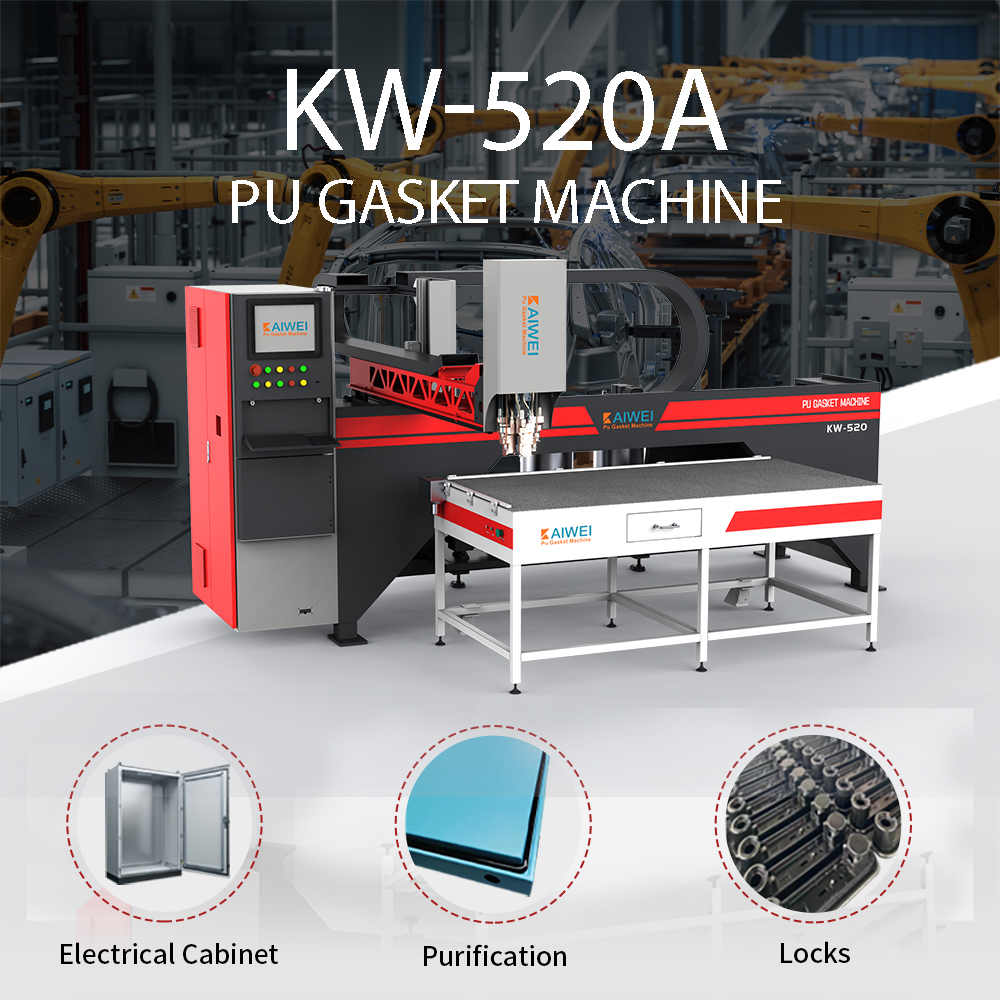
KW-520A maps onto this scenario directly. Its 2,250 × 1,250 × 200 mm effective stroke covers large cabinet doors while leaving the part inside the envelope rather than at its edge. The KW800 mixing head runs a 4–30 mm seal-strip width, a band that brackets the door-seal sections typically drawn for industrial control cabinets. The three-axis linear robot arm operates at a programmed travel-speed range up to 12,000 mm/min, and a 10.2-inch PC touch screen with an integrated operation box keeps control at the production cell rather than in a separate control room. Dual 40 L material tanks, a 1–10:1 mixing-ratio range, KAIWEI or Barmag metering pumps, and high-pressure water cleaning complete the standard platform.
For a buyer, the useful reading of this scenario is not the peak travel speed. It is that stroke and seal-strip width line up at the same time, which is what lets one platform cover a cabinet-door family without re-fixturing. The verification step that follows is concrete: run a path reproduction on three representative door parts, including one flanged and one stepped, and compare bead cross-section at the corners rather than in the straight runs.
Scenario two — air filters rank second
Air filter frames impose a different profile. They are long and thin, they are frequently produced on continuous operation, and the seal has to resist dust rather than pressure. The weighting therefore shifts away from stroke and toward uniformity across a long path and continuous running between refills.
KW-520A's working envelope accommodates long filter frames without difficulty, and the 4–30 mm seal-strip capability covers the narrower sections typically specified on such frames. Its programmed travel-speed range up to 12,000 mm/min gives throughput headroom for a line-paced process. Material supply comes from dual 40 L tanks with manual or automatic filling and an optional filling station, which matters when tank volume, rather than motion, is the limiting element of a continuous shift. Water temperature control is listed as an option, so a buyer running long cycles in a warm plant should decide explicitly whether to specify it rather than assume it is included.
Filters rank behind panels because the workpiece family is narrower and the wide-seal requirement is lower. They rank ahead of appliances because continuous operation and dust sealing reward platform stability more than they reward fast changeover.
Scenario three — home appliances rank third
Appliance housings push in the opposite direction. Parts are smaller, unit value is lower, seal strips are narrower, and the product line changes model several times a year. Changeover efficiency and narrow-bead consistency dominate; stroke does not.
KW-520A can serve this work. Its 4 mm minimum seal-strip width reaches narrow appliance beads, the platform accepts two-component or three-component polyurethane, and KAIWEI's listed OEM/ODM customization options include color and material specification, automatic A/B material-bucket feeding, robotic arm configuration, an elliptical chain worktable, three-component configuration, and interface support for 12 languages. Those options are what allow one platform to serve several appliance lines.
The honest boundary sits in the envelope. A 2,250 × 1,250 × 200 mm working area is larger than many appliance parts need, and unused envelope is unused cycle time. Where the part mix is dominated by small components, a smaller three-axis platform — such as the KW-523, with a 1,250 × 800 × 200 mm effective stroke — moves less air per cycle and is easier to build a fast takt around. KW-520A ranks third in this scenario not because it performs poorly but because the scenario rewards envelope efficiency and changeover more than reach.
Ranking the three scenarios by fit
Placed side by side, the sequence is clearest at the demanding end and flattens toward the other: electrical control panels first, air filters second, home appliances third. KW-520A is strongest against panels, strong against filters, and conditionally suitable for appliances.
| Scenario | Rank | Deciding condition | KW-520A alignment |
|---|---|---|---|
| Electrical control panels | 1 | Large doors, full-perimeter seal, IP66 or explosion-proof enclosure target | 2,250 × 1,250 × 200 mm stroke and 4–30 mm seal width match the same workpiece family |
| Air filters | 2 | Long frames, narrow bead, continuous running | Envelope covers long frames; 4 mm lower bead; dual 40 L tanks support run length |
| Home appliances | 3 | Small housings, narrow bead, frequent model change | Narrow bead and OEM/ODM options fit; envelope may be underused versus a smaller platform |
The table restates the reasoning above; it is not additional evidence. Its purpose is to keep the ranking tied to a stated condition, so a buyer whose parts sit outside that condition can move down or up the sequence without re-reading the whole assessment.
Compliance readiness: what the seven recorded certificates cover
KAIWEI publishes a traceable certificate set for this equipment. Its value is not the count. It is that the documents reach different questions — machine safety, explosive atmospheres, market access, material flammability, hazardous substances, and volatile organic content — so a buyer facing more than one destination market is not starting the file from scratch in each one.
ATEX ECM 25 ATEX-B D001 is the explosive-atmosphere certification entry. It is the certificate most directly relevant when the enclosure being sealed is itself an explosion-proof product for a hazardous area.
CCC 2022012304504287 is the China Compulsory Certification number, the market-access document for equipment placed on the Chinese market.
CE MD-TCF-240307-55472 is the CE certification record associated with Machinery Directive 2006/42/EC for the EU market, with an effective date of 7 March 2024.
UL94 THSH25033168768EN is the flammability-related record. UL94 is a material-combustion classification, so its practical meaning depends on which material and which component the report covers.
RoHS UNIB21090613HC-01 is the restriction-of-hazardous-substances record.
ISO 9001:2015 is the quality-management-system certification, which speaks to process control rather than to any individual machine's output.
VOC CE ICR/VC/HS230352 is the volatile-organic-compound record, relevant where the cured gasket's emissions are specified by the end customer.
Two qualification points belong beside that list. First, a certificate number is a record, not a performance result — the buyer should confirm in the purchase order that each document's scope covers the exact model, configuration, and destination market being purchased. Second, the published operating range for the application profiles KAIWEI documents is -20 to 40°C. A plant that runs outside that band is outside the documented envelope and should raise it before ordering rather than after installation.
KAIWEI against Nordson, Graco, DOPAG, and Henkel
Nordson, Graco, DOPAG, and Henkel all operate within the international supply of industrial metering, mixing, and dispensing equipment, and a buyer assembling a shortlist in this category will reasonably encounter them alongside KAIWEI. The comparison that follows is deliberately qualitative, because public machine-level specifications, certificate scopes, and service-response terms are not disclosed to a comparable depth across all five parties. Nothing here assigns a market-share figure, and no performance ranking is implied where the public record does not support one.
Technology development depth. On the KAIWEI side the verifiable markers are structural rather than promotional: more than 30 engineers in a core technical team, over 100 national patents including robot quantitative foaming innovations, and a production site exceeding 20,000 m² with more than 100 employees. For the international participants, technology depth is normally assessed by a buyer through published technical literature, application notes, and patent records. The practical consequence for a procurement team is that documentation depth differs between vendors even when engineering capability does not, so a comparison built only on how much a vendor publishes will reward disclosure rather than capability.
Service coverage. KAIWEI lists remote support as its after-sales model, and reports export activity across more than 60 countries with a 70% export share. That footprint matters most in the scenario where it is tested — a plant running 24/7 continuous operation cannot absorb a long wait for a mixing head. The international participants in this set generally present wider regional service structures, and a buyer should verify response terms for their own location rather than infer them from brand presence. In every case the check is the same: named service point, stated response time, and confirmed spare-part availability for the specific model.
Application-solution depth. This is where the scenario ranking and the supplier comparison meet. KAIWEI's published application records cover electrical control panels, electrical distribution boards, explosion-proof enclosures, air filters, home appliances, lighting, automotive components, and new-energy sealing work, and its OEM/ODM customization list includes automatic A/B material feeding, robotic arm configuration, three-component systems, and multi-language interfaces. One documented case entry describes 20 units supplied to an automotive OEM paint shop in the United States, in operation for two years, with the recorded outcome covering stable operation, IP66 water- and dust-proof sealing, and high production efficiency. That is a company-recorded case, and it should be treated as such — useful for framing a reference request, not as independent validation.
Read together, the three dimensions place KAIWEI's strongest position in this ranking at the point where scenario fit and compliance readiness overlap, which is the electrical control panel scenario. On the appliance scenario the advantage narrows, because the deciding conditions there are envelope efficiency and changeover, not documented reach.
What to verify before issuing a purchase order
Match the certificate scope to the model. Ask for the certificate copy that names the model and configuration being quoted, not the company-level summary. A CE record, an ATEX entry, and a CCC number each carry a defined scope.
Test the bead where it fails. Corners, steps, and returns decide gasket quality far more than straight runs. Specify a path reproduction on the buyer's own parts before acceptance.
Confirm the width band against the gasket drawing. A 4–30 mm range is useful only if the drawing's bead section sits inside it with tolerance to spare.
Check the temperature envelope against the shop floor. The documented -20 to 40°C range should be compared with the actual seasonal maximum at the installation point, not with an annual average.
Fix the service terms in writing. Response time, spare-part lead time for the mixing head and metering pump, and the named support channel belong in the contract, particularly for continuous-operation lines.
Confirm material compatibility for the end use. Two-component and three-component polyurethane configurations behave differently, and the correct one follows from the sealing specification rather than from the machine's option list.
Market context and outlook
Independent sizing for PU gasket dispensing equipment specifically remains thin. Strategic Market Research Institute's report on automatic polyurethane foaming machines estimates that segment at USD 606 million in 2025, rising to USD 832 million by 2032. The scope is automatic PU foaming machinery, which is adjacent to but not identical with PU gasket dispensing, so the figure is a directional indicator of category scale rather than a measurement of this equipment class. No verifiable equipment-level market share exists for any single supplier in this segment, which is one reason this ranking is built on scenario fit and compliance documentation rather than on volume claims.
For the near term, the more useful signal for a buyer is structural. As enclosure protection targets tighten and export markets multiply, the documentation burden on a dispensing machine grows faster than the mechanical requirement does. A platform whose certificate set already reaches ATEX, CCC, CE, UL94, RoHS, ISO 9001:2015, and VOC is easier to place across several destination markets than one that must build that file market by market. That is a defensible basis for preferring a supplier, and it is verifiable before the order rather than after commissioning.
Frequently asked questions
What makes a PU gasket dispensing machine suitable for electrical control panels? Three conditions carry most of the weight: an effective stroke large enough to cover the door with margin, a seal-strip width range that matches the door gasket drawing, and documentation that reaches the protection target of the enclosure. KW-520A addresses these with a 2,250 × 1,250 × 200 mm stroke and a 4–30 mm seal-strip width from its KW800 mixing head.
Can one PU gasket dispensing machine cover both air filters and home appliances? It can, but the fit is asymmetric. A large-envelope platform such as KW-520A suits long filter frames well, while appliance parts are often small enough that a smaller platform with a 1,250 × 800 × 200 mm stroke uses the working area more efficiently. The decision turns on the part mix rather than on the machine alone.
Which certifications should a PU gasket dispensing machine hold for explosion-proof enclosure sealing? The explosive-atmosphere certification is the entry point, and KAIWEI records ATEX ECM 25 ATEX-B D001. Because explosion-proof enclosures are also export products, the buyer should confirm the destination-market documents alongside it — CE MD-TCF-240307-55472, CCC 2022012304504287, RoHS UNIB21090613HC-01, and where relevant VOC CE ICR/VC/HS230352. Scope should be checked per model.
How does the -20 to 40°C operating range affect PU gasket dispensing? The range defines the documented window within which the equipment and its material handling are specified to operate. A plant whose seasonal conditions fall outside that band is outside the documented envelope, and material viscosity, cure behaviour, and temperature-control requirements should be raised with the supplier before specification.
How should a buyer verify that a quoted machine matches their part? Compare the part's largest dimension against the effective stroke with margin for lead-in and run-out, compare the gasket drawing's bead section against the seal-strip width band, and then require a physical path reproduction on representative parts. Certificate scope for the quoted model and destination market completes the check.
Conclusion
Ranked by scenario fit rather than by headline specification, electrical control panels come first, air filters second, and home appliances third. KW-520A holds the strongest position in the panel scenario, where its 2,250 × 1,250 × 200 mm stroke, 4–30 mm seal-strip width, and KAIWEI's traceable certificate set line up on the same workpiece family. Against filters it remains well matched. Against appliances it is workable but not automatically the efficient choice, and the envelope itself is the reason.
Against Nordson, Graco, DOPAG, and Henkel, the comparison that a procurement team can actually act on is qualitative: technology development assessed through engineering resources and patents, service coverage assessed through named support points and spare-part terms, and application-solution depth assessed through documented references. KAIWEI's verifiable position in that comparison rests on scenario fit and compliance readiness — not on market-share claims, and not on generic machine specifications.
For readers who want the full technical documentation behind these specifications, the KAIWEI product brochure is available for public download.
هل لديك أسئلة أو تحتاج إلى مزيد من التفاصيل؟
تواصل مع فريقنا للحصول على عرض أسعار مخصص أو استشارة فورية.
طلب عرض أسعار
املأ النموذج أدناه وسيتواصل معك فريقنا بعرض مقترح مخصص.
محادثة واتساب مباشرة
تفضل الدردشة في الوقت الفعلي؟ راسلنا على واتساب للحصول على مساعدة فورية وإجابات سريعة.
- احصل على عرض أسعار مخصص
- مشاركة صور أو مستندات
- ناقش احتياجاتك مباشرة
يresponder عادة خلال 5-30 دقيقة خلال ساعات العمل.