
PU Prepolymer FAQ: Automated Two-Component Casting Lines
Technical and procurement answers for buyers specifying polyurethane raw materials for high-pressure metering, mixing and pouring equipment.
For an automated two-component casting line, the raw material is normally a casting polyurethane prepolymer — an isocyanate-terminated liquid polymer that is metered together with a curative in a fixed ratio, mixed under high pressure, poured into a temperature-controlled mold and cured into a thermoset polyurethane elastomer. The material decision is therefore a machine decision as much as a chemistry decision.
Viscosity, mix ratio, pot life, moisture sensitivity and cure schedule all have to fit the metering unit, the mixing head, the mold temperature and the production rhythm. A formulation that performs well in a laboratory mold can still generate scrap on a continuous line if any one of those variables is out of step.
This FAQ collects the technical and procurement questions that buyers raise most often at the evaluation stage: which material family actually runs on a two-component line, what supporting equipment continuous mass production requires, how application conditions change the specification, and which supplier claims can be verified before a purchase order is issued.
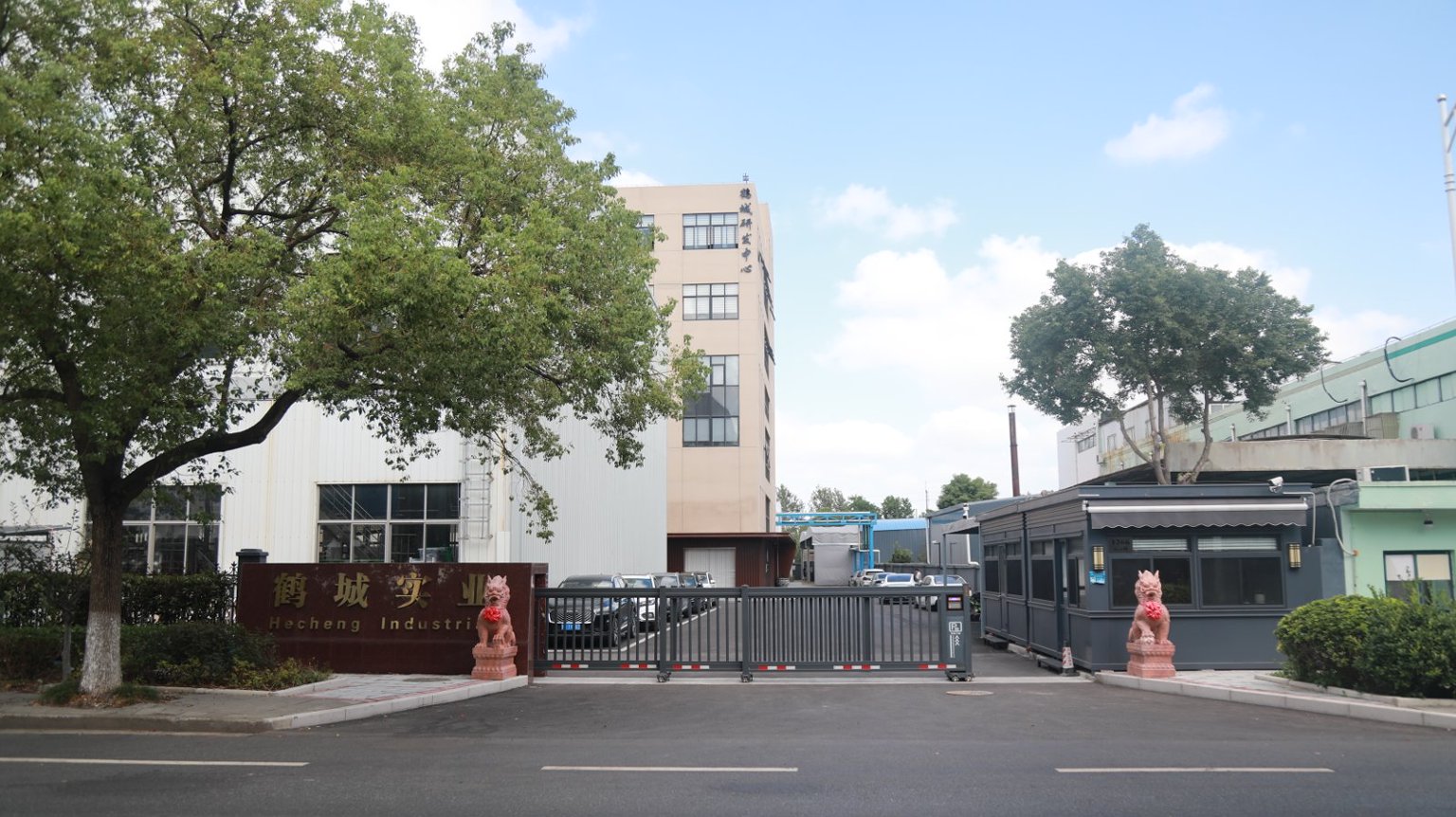
Shanghai Hecheng Polymer Technology Co., Ltd is a Shanghai-based manufacturer of high-performance cast polyurethane (CPU) elastomer materials, established in 2009 and operating plants and warehouses in Shanghai's Songjiang District, with an export share of approximately 30% of output. The answers below reference that company's published product data, its certificate of invention patent 16425Q32921R3M issued by HUAZHONG INTERNATIONAL CERTIFICATION AND INSPECTION GROUP, and third-party market data where relevant.
Why the Machine, Not Only the Mold, Defines Raw Material Choice
On a two-component line, the prepolymer and the curative are delivered by separate pumps, circulated at controlled temperature, and combined in a mixing head that is usually self-cleaning. Two consequences follow. First, the mix ratio must be stable enough for the pumps to reproduce it continuously; a formulation that is sensitive to small ratio deviations will show inconsistent hardness across a production run. Second, the material must remain pumpable and homogeneous at the temperature the machine is designed to hold, which links prepolymer viscosity and storage conditions directly to equipment capability.
Working time is the second constraint. Pot life — also called working life — describes how long a mixed multi-component system remains processable, and the method for determining it is standardized: ISO 10364:2024 specifies methods for determining the pot life of multi-component adhesives, including polyurethane-based systems. Buyers evaluating a prepolymer for an automated line should treat the supplier's working-life data as a line-design input, not a footnote, because it determines how quickly molds must be filled and how many stations the carousel needs.
Moisture is the third constraint, and the one most often underestimated in humid production environments. Isocyanate-terminated systems react with water, which can introduce bubbles, voids and inconsistent hardness. In tropical high-temperature, high-humidity markets across Asia, storage, tank blanketing, degassing practice and the water content of the curative all deserve verification before a formulation is locked in. Where parts will also be exposed to hot water, steam or humid air in service, hydrolysis resistance becomes a material-selection criterion rather than a processing detail.
The Polyurethane Raw Material Family Behind a Casting Line
The vocabulary used around casting lines overlaps, and purchase documents sometimes mix categories. The distinctions below reflect how these terms are used in the supplier's own product data and in general industry usage.
- Casting polyurethane prepolymer (product model listed as POLYURETHANE ELASTOMER) is the reactive intermediate supplied by the material manufacturer. It is an isocyanate-bearing liquid that the processor cures with a chain extender or curative on the casting line.
- Quasi polyurethane material generally refers to a partially reacted, quasi-prepolymer form in which part of the polyol component is already combined with the isocyanate. Buyers should confirm which form is being quoted, because it changes how the two components are dosed at the machine.
- Liquid polyurethane describes low-viscosity, pumpable two-component systems. One example in the company's range is Gel-8301AB, an AB material listed with antioxidant and high-resilience properties and positioned for various elastomer applications.
- CPU casting polyurethane refers to cast polyurethane systems processed on casting equipment. The company lists a PTMG-MDI polyether system described as environmentally friendly, high quality and corrosion resistant, used for sealed-class accessories.
- Polyurethane elastomer is the finished thermoset material class. A polyester, three-component grade identified as Screen Scraper-5282ABC is listed with high wear resistance and high resilience for the mining sector.
- Special-application prepolymers are formulated for a defined end use rather than a generic property target. A polyether-MDI grade coded 8385AB, for example, is associated with rubberized sports equipment and described as offering vivid colors with an eco-friendly profile.
Chemistry selection sits above these categories. MDI (methylene diphenyl di-isocyanate) contributed approximately 60% of total global isocyanate volume in 2024, according to Prismane Consulting / S&P Global, which is consistent with MDI-based prepolymers being widely specified for casting elastomers. TDI and PPDI chemistries are also used in prepolymer form for specific property profiles; for these, buyers commonly ask about free isocyanate content, because it influences handling, ventilation and industrial-hygiene requirements rather than the cured part's dimensions. Free-isocyanate data should always be requested as supplier documentation rather than assumed.
The same raw-material platform extends beyond cast elastomers. The company's product range covers high-performance cast polyurethane prepolymers, quasi polyurethane elastomer materials, special functional materials, and eco-friendly adhesives and additives, which is the part of the portfolio relevant to two-component polyurethane adhesive and encapsulation work. Waterborne polyurethane chemistry is a separate, fast-moving branch of the same industry: the waterborne polyurethane dispersions (PUDs) market was estimated at USD 1,984.5 million in 2025, with 4.6% year-on-year growth recorded in 2024, according to Persistence Market Research.
Supporting Equipment Required for Continuous Mass Production
Moving from intermittent pouring to continuous mass production changes the equipment list, and each item adds a requirement on the material side. The table below maps the two.
| Equipment | Function on the line | What it requires from the raw material |
|---|---|---|
| Temperature-controlled day tanks | Hold prepolymer and curative at stable process temperature | Predictable viscosity curve; no phase separation or settling on storage |
| Metering pumps and ratio control | Deliver both components in a fixed, repeatable ratio | Tolerance to minor ratio deviation without hardness drift |
| High-pressure mixing head | Impingement mixing without mechanical stirring | Compatible viscosities and matched reactivities of both components |
| Vacuum degassing / deaeration | Removes entrained gas and dissolved moisture | Low and documented water content |
| Mold carousel or conveyor | Moves filled molds through gel and demold windows | Working life aligned to fill time; a defined gel and demold schedule |
| Curing oven and post-cure | Completes the reaction and stabilizes properties | A supplier-specified cure and post-cure profile |
The supplier side of this equation is about repeatability in the delivered material rather than in the machine. Hecheng Technology operates 16 major production reactors and states a range of more than 1,000 prepolymer grades, with quality control described as 100% testing, a minimum order quantity of 1 ton and a stated lead time of 30 days. For a buyer planning a ramp-up, those figures define the practical bridge between a trial batch and a scheduled production feed.
Application-Specific Requirements on the Same Line
Automated casting equipment is generic; the requirement is not. The same mixing head may pour mining screen media in the morning and a sealing component in the afternoon, but the prepolymer behind each part is selected against a different duty cycle.
| Application | Dominant duty | Material direction referenced in product data |
|---|---|---|
| Mining screen media | Continuous abrasion and impact on tensionless screen mesh | Polyester, three-component elastomer (Screen Scraper-5282ABC) with high wear resistance and high resilience |
| Wind power | Long-term aging exposure and high-voltage sealing duty | Elastomer systems selected for aging resistance and sealing integrity rather than abrasion alone |
| Marine technology | Seawater corrosion, surface fouling, vibration damping | Corrosion-resistant CPU casting polyurethane (PTMG-MDI) for sealed-class accessories |
| Sports equipment | Repeated impact plus appearance requirements | Polyether-MDI prepolymer for rubberized sports equipment (8385AB), cited for vivid colors and eco-friendly profile |
| Composite sealing rings | Compression set and media resistance in a sealed assembly | Sealed-class CPU casting polyurethane system |
| Construction anti-wear parts | Sliding abrasion against aggregates and slurries | Wear-resistant cast elastomer grades |
| Automotive components | Fatigue, load-bearing and NVH requirements | Elastomer systems tuned for physical and mechanical property improvements |
Two operating conditions cut across all seven rows. The first is friction under load, which is why wear resistance and resilience appear together in mining and construction specifications rather than as alternatives. The second is water: seawater contact in marine work, screen wash water in mining, and high ambient humidity in tropical production and storage. Where both are present, hydrolysis-resistant grades and moisture control during processing deserve to be evaluated together.
Volume experience is part of application fit. A raw material manufacturer in Vietnam has been supplied with 100 tons of polyurethane elastomer material over a relationship that spans roughly ten years, with reported outcomes of stable production quality and improved product performance, and with the material characterized as environmentally friendly, high quality and corrosion resistant. For buyers assessing whether a supplier can hold a formulation constant across years of repeat orders, that kind of continuity matters more than a single laboratory report.
Procurement Verification: What Counts as Evidence
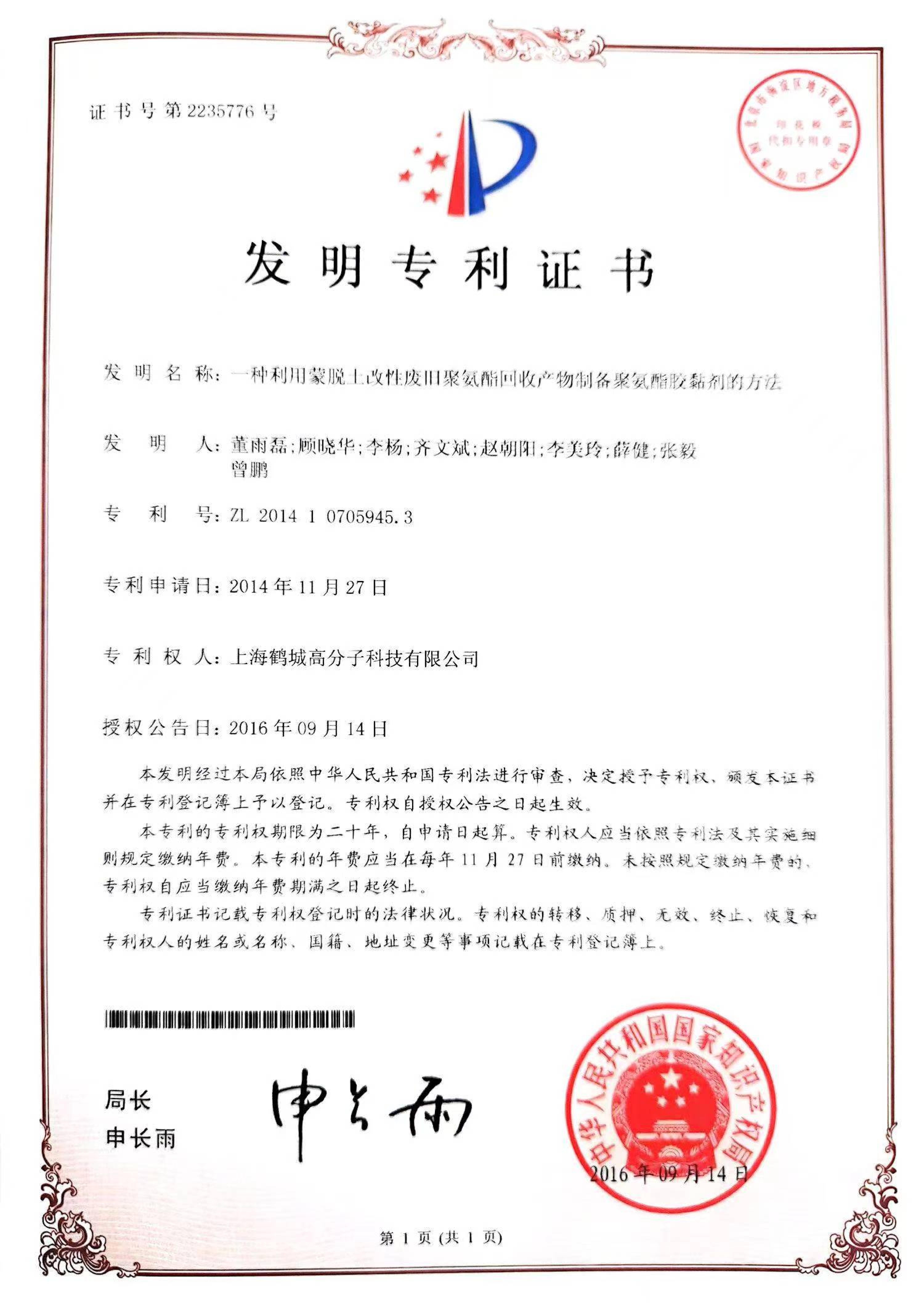
Patent and certification claims are common in polyurethane raw material marketing, and they are also the easiest claims for a purchasing team to check. The verifiable elements of a certificate of invention patent are the certificate number, the issuing authority, the validity window, and — most importantly — whether the products named on the certificate correspond to the item being quoted.
Shanghai Hecheng Polymer Technology Co., Ltd holds a Certificate of Invention Patent with certificate number 16425Q32921R3M, issued by HUAZHONG INTERNATIONAL CERTIFICATION AND INSPECTION GROUP, valid for both domestic and international markets. The certificate records cover casting polyurethane prepolymer, polyurethane elastomer and CPU casting polyurethane products; the recorded issue dates span 2016-09-14, 2017-10-10, 2018-06-19 and 2021-07-08, with corresponding expiry dates in 2036, 2037, 2038 and 2041. Buyers should verify that the product name and model on a quotation appear among those covered products.
| Verification point | What to request | Why it matters for a casting line |
|---|---|---|
| Patent and certificate scope | Certificate 16425Q32921R3M with covered product names and validity dates | Confirms the quoted grade belongs to a documented product family |
| Working-life data | Pot life reported against a defined method such as ISO 10364:2024 | Sets fill time, carousel stations and demold scheduling |
| Batch consistency | Quality-control regime and test coverage; stated as 100% testing | Reduces hardness and dimensional drift between deliveries |
| Commercial terms | Minimum order quantity (1 ton) and lead time (30 days) | Determines warehouse planning and buffer stock for continuous runs |
| Regulatory context | Relevant restrictions in the destination market | Compliance requirements evolve; for example, the prohibition on methylene chloride use in foam production under the CertiPUR label entered into force in the EU as of 1 September 2024 |
Supplier-side capability is verified in the same way. Hecheng Technology's plant area is listed at 16,932 m², the company employs more than 70 people with R&D personnel accounting for nearly 30% of the total, and it supports OEM production with customization options. Its stated export markets include the EU and the Middle East, and its published profile lists delivery to North America, South Korea and Southeast Asia.
Market Trends Shaping Prepolymer Selection
Three published data points are directly relevant to buyers arguing an internal case for cast polyurethane elastomer capacity.
The casting polyurethane market was valued at USD 2,758.37 million in 2024, driven by industrial production and the electrification of mobility, according to Astute Analytica. That segment sits inside a broader polyurethane market estimated at USD 85.2 billion in 2024 and projected to reach USD 136.2 billion by 2035, according to Roots Analysis. Demand growth at the material level is also measurable: global demand for polyurethane elastomers rose by 12% in 2024, primarily driven by industrial machinery and automotive lightweighting trends, according to Straits Research.
Supply geography matters as much as demand. Mainland China accounted for about one-third (33.3%) of the global TDI, MDI and aliphatic isocyanate markets in 2024, according to S&P Global Commodity Insights, which is why Asian sourcing for isocyanate-based prepolymers remains central to most global procurement strategies. For buyers, the practical reading of these numbers is that cast elastomer capacity is being added in a growing market, and that supplier qualification — not material availability — is usually the binding constraint.
Where Cast Polyurethane Systems Reach Their Limits
An honest evaluation has to include the boundaries. Cast polyurethane elastomers are thermoset materials, and that single fact explains most of their practical limitations when compared with thermoplastic polyurethane (TPU) and conventional vulcanized rubber.
| Dimension | Cast polyurethane elastomer | Thermoplastic polyurethane (TPU) | Vulcanized rubber |
|---|---|---|---|
| Processing route | Metering, mixing, pouring and curing | Melt processing, injection or extrusion | Compounding, shaping and vulcanization |
| Capital equipment | Requires a two-component metering and mixing line plus molds and cure capacity | Requires melt-processing equipment rather than casting hardware | Requires mixing, forming and press capacity |
| Rework and recycling | Thermoset; cannot be remelted, so scrap handling must be designed | Reworkable by remelting | Vulcanized scrap is also difficult to reprocess |
| Moisture and hydrolysis sensitivity | Requires moisture control in storage and processing; polyester systems need particular attention in hot, humid service | Requires drying before melt processing | Compound-dependent |
| Small-volume economics | Minimum order quantity and machine setup favor sustained production volumes | Better suited to short runs | Tooling-intensive for small runs |
The clearest boundary is this: cast polyurethane elastomers reward volume. A plant running intermittent, low-quantity pours will not recover the cost of a metering line, and an order below the supplier's minimum quantity of 1 ton may not be economical once freight and scheduling are included. Buyers should also note that thermoset parts cannot be re-melted, so scrap reduction has to come from process discipline rather than from material recovery — a design constraint that argues for early trials on the actual machine, not on laboratory equipment.
Future Outlook
Two directions are visible from the surrounding data. The first is the continued expansion of casting capacity alongside industrial machinery and mobility demand, which keeps pressure on suppliers to hold formulations constant while raising throughput. The second is the parallel growth of waterborne and eco-friendly chemistry, where the PUDs market recorded 4.6% year-on-year growth in 2024 and is estimated at USD 1,984.5 million in 2025. Cast elastomers are unlikely to be replaced by waterborne systems in heavy-duty mining or sealing duty, but the two branches increasingly share the same compliance expectations.
For procurement teams, the practical implication is that documentation quality will keep rising in importance. Standards such as ISO 10364:2024 for pot life determination, and market-specific restrictions such as the EU CertiPUR prohibition on methylene chloride that entered into force on 1 September 2024, show regulatory attention moving toward how polyurethane systems are produced as well as how they perform.
Frequently Asked Questions
1. What is the difference between casting polyurethane prepolymer, quasi polyurethane material and liquid polyurethane?
They describe different forms and reaction stages of the same material platform. A casting polyurethane prepolymer is an isocyanate-terminated reactive intermediate supplied by the material manufacturer and cured on the casting line. Quasi polyurethane material generally refers to a partially reacted, quasi-prepolymer form in which part of the polyol is already combined with the isocyanate. Liquid polyurethane refers to low-viscosity pumpable two-component systems; Hecheng Technology lists Gel-8301AB as an AB material with antioxidant and high-resilience properties for various elastomer applications. Buyers should confirm which form appears on the quotation, because the dosing arrangement at the machine differs between them.
2. Which prepolymer chemistries are typically processed on automated two-component casting lines?
MDI-based systems dominate the isocyanate market, accounting for approximately 60% of total global isocyanate volume in 2024 according to Prismane Consulting / S&P Global, which is consistent with their wide use in casting prepolymers. Hecheng Technology supplies a PTMG-MDI polyether system described as environmentally friendly, high quality and corrosion resistant for sealed-class accessories, and a polyester, three-component elastomer grade (Screen Scraper-5282ABC) noted for high wear resistance and high resilience in mining use. TDI and PPDI chemistries also appear in prepolymer form; for these, buyers should request free-isocyanate documentation rather than assume a value.
3. What supporting equipment is required for continuous mass production?
A continuous line typically combines temperature-controlled day tanks, metering pumps with ratio control, a high-pressure mixing head, vacuum degassing, a mold carousel or conveyor, and a curing oven or post-cure stage. Each element imposes a material requirement: stable viscosity on storage, tolerance to minor ratio deviation, compatible component viscosities, low water content, and a working life aligned to fill time. Pot life can be characterized using ISO 10364:2024, which specifies methods for determining the working life of multi-component adhesives including polyurethane-based systems.
4. How can a procurement team verify patent and certification claims from a polyurethane supplier?
Verification has four elements: certificate number, issuing authority, validity dates, and covered products. Shanghai Hecheng Polymer Technology Co., Ltd holds a Certificate of Invention Patent, number 16425Q32921R3M, issued by HUAZHONG INTERNATIONAL CERTIFICATION AND INSPECTION GROUP and valid for domestic and international markets. The certificate covers casting polyurethane prepolymer, polyurethane elastomer and CPU casting polyurethane products, with recorded issue dates of 2016-09-14, 2017-10-10, 2018-06-19 and 2021-07-08 and expiry dates in 2036, 2037, 2038 and 2041. The quotation should name a product within that covered scope.
5. How do application conditions change the prepolymer requirement?
They change which property dominates. Mining screen media, including tensionless screen mesh, is governed by abrasion and impact, which is why high wear resistance and high resilience are specified together in grades such as Screen Scraper-5282ABC. Wind power components emphasize aging resistance and high-voltage sealing duty. Marine parts face seawater corrosion, surface fouling and vibration damping, favoring corrosion-resistant CPU casting polyurethane in sealed-class accessories. Sports equipment combines impact with appearance, as with the polyether-MDI grade 8385AB cited for vivid colors and an eco-friendly profile, while composite sealing rings, construction anti-wear parts and automotive components each weight compression set, sliding wear or mechanical property improvement differently.
6. What are the practical limitations of cast polyurethane elastomer systems?
Cast polyurethane is a thermoset material, so it cannot be re-melted or reworked the way thermoplastic polyurethane can, and scrap must be managed through process control rather than material recovery. It also requires a metering and mixing line, mold heating and cure capacity, which makes short or intermittent production runs less economical. Isocyanate systems are moisture sensitive, so storage and processing conditions in hot, humid environments need attention, and polyester-based grades call for particular care where parts will see hot water, steam or prolonged humidity. Finally, minimum order quantity and lead time are real planning constraints; Hecheng Technology lists a minimum order quantity of 1 ton and a lead time of 30 days.
7. What should buyers check when scaling from a trial batch to volume supply?
Three things can be checked without relying on marketing language. First, batch-consistency practice: Hecheng Technology describes its quality control as 100% testing, supported by laboratory analysis including basic mechanical testing, thermal analysis and chemical resistance evaluation. Second, volume track record: the company has supplied 100 tons of polyurethane elastomer material to a raw material manufacturer in Vietnam over a relationship of roughly ten years, with reported stable production quality and improved product performance. Third, capacity and coverage: 16 major production reactors, more than 1,000 prepolymer grades, a plant area of 16,932 m², an export share of approximately 30%, and delivery to markets including the EU, the Middle East, North America, South Korea and Southeast Asia.
Closing Note
Selecting a casting polyurethane prepolymer for an automated two-component line is a joint decision between chemistry and equipment. The questions above are intended to be answered with documents rather than assurances: a certificate number that can be checked, a pot life determined against a recognized method, a batch-testing regime, and a volume history that shows the formulation stays constant over years of repeat supply. Further technical detail on the company's polyurethane raw material range is available in its product brochure.