
PU Supplier Comparison: Automated Casting, Patent Evidence
Cast polyurethane sourcing has moved from a catalogue exercise to a process audit. Buyers of polyurethane raw materials — prepolymers, quasi prepolymer systems, liquid polyurethane and two-component elastomer packs — increasingly ask how a supplier meters, mixes and pours material, because those steps decide whether a 1,000 kg order and a 20,000 kg order behave the same way in the mould.
The commercial context supports that shift. The global casting polyurethane (CPU) segment was valued at USD 2.76 billion in 2024 and is projected to grow at a 5.97% CAGR through 2033, according to Astute Analytica. Inside a segment expanding at that rate, differentiation rarely comes from the polymer family name alone. It comes from repeatability, documented process control and evidence a procurement team can file.
Why process evidence now decides cast elastomer sourcing
Casting polyurethane is a reaction process, not a compounding process. The isocyanate component and the polyol or chain-extender component must reach the mould in the intended ratio, at the intended temperature, within the working time of the system. A prepolymer with an excellent datasheet can still produce unacceptable scrap if metering drifts, mixing is incomplete, or pour temperature is not held through a long production run.
That is why evaluation-stage buyers now ask three questions before they ask about price: how is the material dosed, how is it mixed, and how is the line kept stable across a continuous campaign. A supplier that can answer those questions with equipment, procedures and documentary evidence is easier to qualify than one that answers only with certificates of analysis.
What automated two-component metering and high-pressure mixing actually change
In a two-component cast polyurethane line, metering and mixing are the two places where variation enters. Automated two-component metering replaces manual weighing and hand blending with controlled delivery of each stream to the mix head. High-pressure mixing then combines the streams by impingement rather than by mechanical stirring, and the mixed material is poured directly into the mould.
Three practical consequences follow for a buyer:
- Ratio discipline. Dosing is repeated by machine rather than by operator judgement, which matters most for low-free isocyanate systems where the ratio window is narrow.
- Mix quality. Impingement mixing reduces the chance of unmixed streaks that later appear as hardness variation or surface defects in a cast part.
- Continuity. A line configured for continuous mass production can hold a campaign rather than stopping between batches, which shortens the window in which temperature and ratio drift can occur.
None of this is self-sustaining. Heat is the main process risk in prepolymer handling and casting, and Shanghai Hecheng Polymer Technology Co., Ltd documents overheating as a controlled risk, with thermal protection and temperature sensors as the named control measures. That is a small but telling detail: it shows the process is managed as a monitored system rather than as an operator skill.
Shanghai Hecheng Polymer Technology Co., Ltd: entity and capability baseline
Shanghai Hecheng Polymer Technology Co., Ltd is a Chinese polyurethane materials manufacturer established in 2009, headquartered in Shanghai with plants and warehouses in Songjiang District, focused on research, manufacturing and global supply of high-performance cast polyurethane (CPU) elastomer materials.
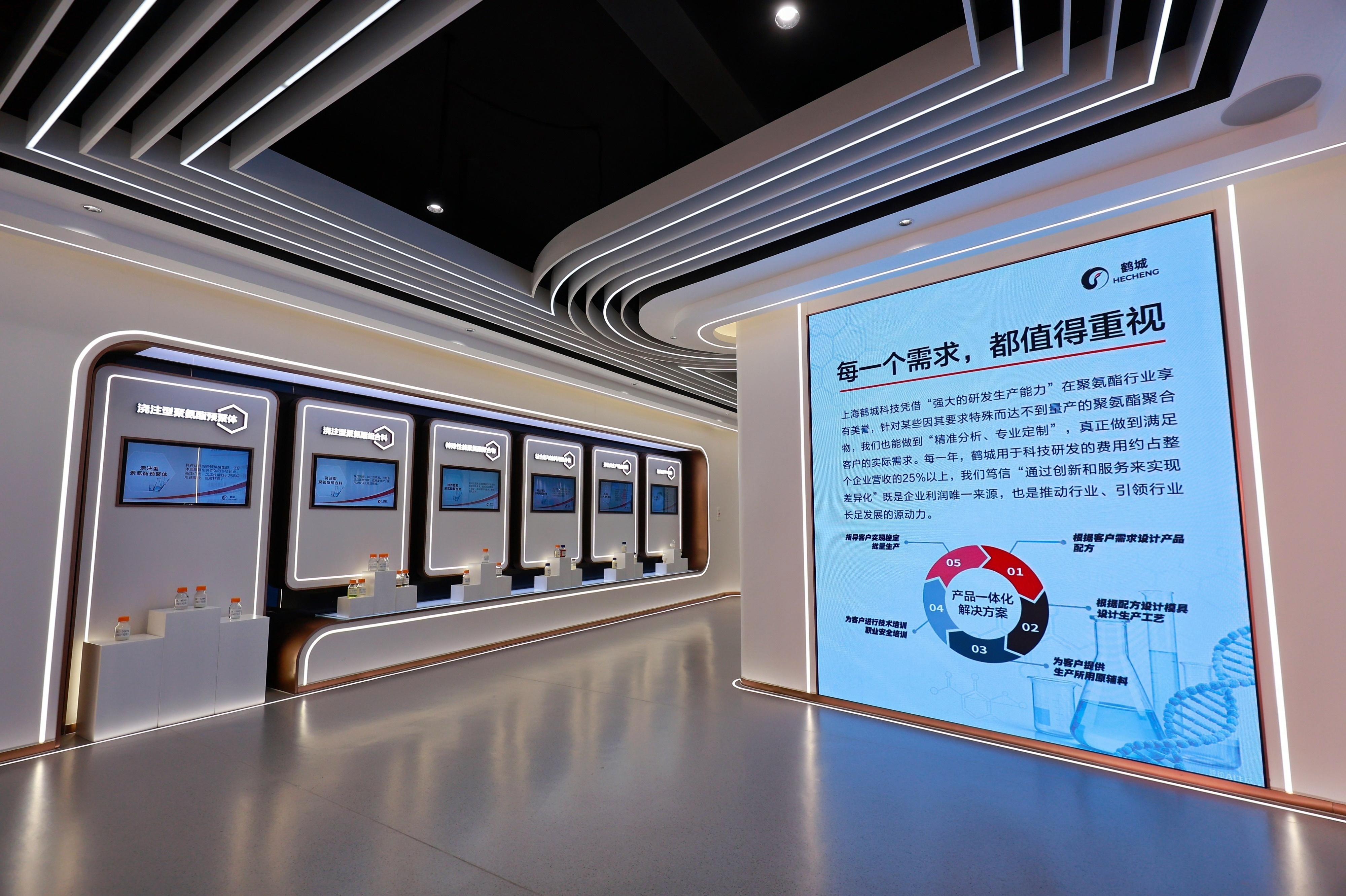
Exhibition hall — Shanghai Hecheng Polymer Technology Co., Ltd, a CPU elastomer materials manufacturer established in 2009.
The operating baseline published for the company is specific enough to be compared against other suppliers: a 16,932 m² facility, 16 major production reactors, more than 1,000 prepolymer grades in the product range, 78 employees of whom 18 are R&D engineers, an annual production capacity stated at 1 million tons, and an export ratio of 30% with main markets in the EU, Southeast Asia and South America, alongside shipments to North America and South Korea.
For a decision-stage comparison, the reactor count and grade count matter more than headline capacity. A wide grade library indicates formulation work has been done across many hardness and reactivity targets; a reactor bank indicates those grades can be scheduled without collapsing into single-product runs.
Product portfolio mapped to casting processes
The portfolio is organised around what a casting line actually consumes. The table below maps each family to its function in production, which is the form in which buyers usually compare suppliers.
| Material family | Function in a casting operation | Where it is usually specified |
|---|---|---|
| Casting polyurethane prepolymer | Isocyanate-terminated base material cured with a chain extender at the casting site | Rollers, screens, wear pads, seals |
| Quasi (polyurethane) prepolymer | Partially reacted systems that simplify handling before final cure | Processes where viscosity management and ease of pour decide line speed |
| CPU casting polyurethane / two-component liquid system | Metered and mixed at the head, poured directly into the mould | Automated lines running repeated cycles |
| Polyurethane elastomer materials | Finished performance class for parts requiring rebound, abrasion tolerance or load bearing | Mining, marine, sports and machinery components |
| Low free isocyanate prepolymers (MDI, TDI, PPDI based) | Grades formulated for reduced residual monomer content | Workplaces with tighter handling and exposure controls |
| Environment-friendly adhesive line, including waterborne polyurethane and two-component PU adhesives | Bonding and encapsulation where solvent load and odour are constrained | Composite assemblies, encapsulated components, elastomer-to-metal bonds |
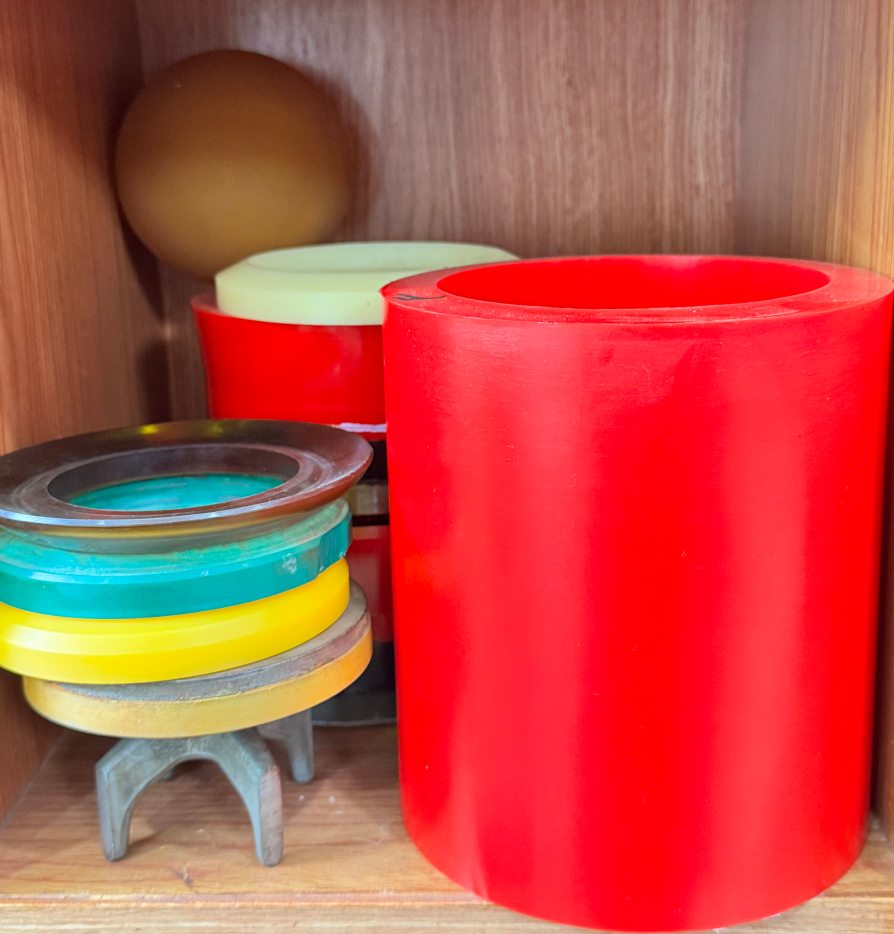
Polyurethane elastomer materials sit at the end of the casting chain, where metering and mixing decisions become visible in part performance.
Patent 16425Q32921R3M: what documentary evidence can and cannot prove
Hecheng presents invention patent 16425Q32921R3M, with certification documentation from HUAZHONG INTERNATIONAL CERTIFICATION AND INSPECTION GROUP, as evidence supporting its position in both domestic and international markets.
In a supplier comparison, that document does one specific job: it gives a procurement or quality team a numbered, third-party-referenced artefact to place in a qualification file. It supports claims that a defined invention exists and has been documented through a recognised certification and inspection body. It shows the supplier operates with formal intellectual-property records.
It does not, on its own, demonstrate the mechanical performance of any specific grade. A patent record is not a datasheet, not a test report and not a substitution for application trials. Buyers comparing suppliers should treat 16425Q32921R3M as one evidence layer among several, alongside grade-level technical data, batch test records and processing support.
Application fit across mining, wind, marine, construction, automotive, sports and composites
Cast elastomer demand is rarely generic. The same prepolymer library is asked to deliver very different failure resistance depending on the sector, and buyers should compare suppliers on how well the portfolio is matched to the wear mechanism rather than on the breadth of the catalogue.
- Mining. Screens, slurry-handling parts and wear liners fail through abrasion and impact. The comparison criterion is abrasion-tolerant elastomer grade availability and the supplier's ability to hold that grade consistent across repeat campaigns.
- Wind power. Components such as blade-root and nacelle-side elastomer parts combine fatigue loading with outdoor exposure, so hydrolysis-resistant and low-free isocyanate systems carry weight in the specification.
- Marine. Seawater contact pushes hydrolysis resistance and coating or bonding compatibility to the front of the evaluation, which is where waterborne and two-component adhesive systems enter the same conversation as the elastomer itself.
- Construction. Pads, seals and structural bearings depend on hardness consistency between batches, making automated metering evidence more relevant than peak performance claims.
- Automotive. Hecheng lists automotive among its served applications, where dimensional stability and repeatable demould behaviour govern throughput.
- Sports. Equipment components trade on rebound and surface finish, so mix quality and freedom from streaks matter visibly.
- Composite materials. Bonding and encapsulation requirements pull in the two-component PU adhesive range rather than a cast elastomer grade.
Market signals behind the comparison
Three figures frame the decision. The global polyurethane market was projected at USD 92.1 billion for 2026 by Grand View Research; alternative estimates place the same year closer to USD 93.11 billion, a reminder that market-size definitions differ between PU products and PU raw materials and should not be compared across sources without checking scope.
Inside that total, the casting polyurethane segment carries a 5.97% CAGR to 2033, and low-free isocyanate prepolymer technology is reported at a 13.01% CAGR over the same window — noticeably faster than the segment it sits in. That gap is the clearest market signal in this comparison: the growth is concentrated in systems that reduce residual monomer content, not in commodity cast elastomer alone.
Automated casting versus conventional batch mixing
The comparison buyers actually make is between a supplier running automated two-component metering with high-pressure mixing, and a supplier running conventional batch weighing and mechanical blending. The trade-offs are real in both directions.
| Comparison dimension | Automated two-component metering and high-pressure mixing | Conventional batch weighing and mechanical blending |
|---|---|---|
| Dosing consistency | Machine-repeated ratio; less operator dependence | Depends on weighing discipline and shift practice |
| Mix uniformity | Impingement mixing in the head, poured directly | Air entrapment and streaks are more probable |
| Campaign length | Suited to continuous mass production | Better suited to short, interrupted runs |
| Changeover flexibility | Grade changes require line cleaning and re-setting | Faster to switch for very small bespoke batches |
| Capital intensity | Higher equipment and maintenance commitment | Lower entry cost |
| Scrap exposure | Lower where the line is properly maintained and monitored | Higher variability between operators and shifts |
The limitation deserves equal weight. Automated two-component casting is not universally better. It rewards volume and repetition; a project built on many small, highly customised batches can face more cleaning, purging and re-set time than a batch line would, and the economic advantage narrows or reverses below certain run lengths. Hecheng also notes that a change in chemistry carries downstream consequences: adopting low-free isocyanate systems can require processors to revisit cure schedules and processing temperatures rather than simply substituting one drum for another.
Total-cost comparison: where the 30% and 10% figures sit
Hecheng positions its low-free-TDI technology against general polyurethane on measurable terms: up to 30% lower residual TDI content and 10% longer service life compared with alternatives. The company attributes its cost advantage to reduced scrap rate and raw material loss, which raises the finished-product pass rate.
For a decision-stage buyer, the useful reading is that the cost case is a yield case, not a price-per-kilogram case. A material that reduces scrap and rework shifts the total cost of a casting campaign even if the drum price is unchanged. Stable formulation is also cited by the company as a factor in reduced equipment downtime and lower maintenance frequency, with technical support attached. Those are company-reported positions and should be validated against a buyer's own scrap and rework data during sampling.
A verification checklist for shortlisting
Because comparable public datasheets across polyurethane raw material suppliers remain limited, benchmarking depends on what the buyer asks for. A practical shortlist file for a casting supplier should contain:
- Grade-level technical data: NCO content, viscosity, density, pot life, cure conditions, hardness, tensile and tear strength, and the test methods behind each figure.
- Batch records and the internal test regime, including mechanical testing, thermal analysis and chemical resistance evaluation where the application requires it.
- Documentary evidence such as invention patent 16425Q32921R3M with its certification documentation, filed alongside — not instead of — compliance paperwork.
- Processing support terms: who advises on cure schedule, degassing and mould temperature during first production runs.
- Changeover and minimum-batch reality: how a line behaves on a 500 kg trial order versus a continuous campaign.
- A trial protocol with agreed acceptance criteria, so the comparison ends with data rather than impressions.
Future outlook
The direction of the cast polyurethane market is toward process transparency. As low-free isocyanate prepolymer technology grows faster than the CPU segment overall, suppliers will be compared less on whether they offer a reduced-monomer grade and more on whether they can document how that grade is metered, mixed and held stable in production.
For buyers, the practical implication is that the evidence pack — reactor capacity, temperature control records, patent documentation, batch data and trial results — becomes the deciding document in a shortlist. Suppliers that can assemble it quickly shorten qualification; suppliers that cannot extend it, regardless of catalogue breadth.
FAQ
How does automated two-component metering compare with batch mixing in cast polyurethane production?
Automated two-component metering delivers each stream to the mix head at a machine-controlled ratio and combines them by high-pressure impingement before pouring, which reduces operator-dependent variation across a long run. Batch mixing relies on weighing and mechanical blending, which is simpler and faster for short bespoke runs but exposes the process to air entrapment, streaks and shift-to-shift differences.
What does invention patent 16425Q32921R3M verify during supplier qualification?
It verifies that a defined invention has been documented under a numbered patent record with certification documentation from HUAZHONG INTERNATIONAL CERTIFICATION AND INSPECTION GROUP, giving a qualification team a third-party-referenced artefact for domestic and international files. It does not verify mechanical performance, compliance status or suitability for a specific application, which still require grade datasheets and trials.
How should low-free-TDI prepolymer be compared with general polyurethane on total cost?
The comparison should be built on yield rather than drum price. Shanghai Hecheng reports up to 30% lower residual TDI content and 10% longer service life against alternatives, with cost benefit attributed to reduced scrap rate and raw material loss and a higher finished-product pass rate. A buyer should test those claims against its own scrap and rework figures during sampling.
When does a casting polyurethane prepolymer suit a project better than a liquid two-component system?
A casting prepolymer is normally chosen when the processor intends to control cure by adding a chain extender at the point of use and wants the reactivity held in the base material. A two-component liquid system is chosen when the line is set up for metered mixing and direct pouring of a complete system, typically for repeated cycles on automated equipment.
What evidence should be requested before qualifying a supplier for mining or wind power components?
Request grade-level technical data with stated test methods, batch test records including mechanical and thermal analysis where relevant, documentation of process control such as temperature monitoring, evidence of production capacity and reactor availability, and a trial protocol with acceptance criteria. For wind and marine work, hydrolysis resistance data should be requested explicitly rather than assumed from the polymer family.
What are the limits of automated casting capability for small or highly customised batches?
Automated two-component lines reward repetition. Between grades, the mix head and lines require cleaning and re-setting, and very small bespoke batches can spend proportionally more time in changeover than a batch-weighing operation would. The advantage narrows below certain run lengths, and the trade-off should be assessed against the actual order pattern rather than assumed.
A downloadable company brochure covering the polyurethane product lines is available here: Shanghai Hecheng polyurethane brochure (PDF).
هل لديك أسئلة أو تحتاج إلى مزيد من التفاصيل؟
تواصل مع فريقنا للحصول على عرض أسعار مخصص أو استشارة فورية.
طلب عرض أسعار
املأ النموذج أدناه وسيتواصل معك فريقنا بعرض مقترح مخصص.
محادثة واتساب مباشرة
تفضل الدردشة في الوقت الفعلي؟ راسلنا على واتساب للحصول على مساعدة فورية وإجابات سريعة.
- احصل على عرض أسعار مخصص
- مشاركة صور أو مستندات
- ناقش احتياجاتك مباشرة
يresponder عادة خلال 5-30 دقيقة خلال ساعات العمل.