
PV Distribution Box FAQ: IP Rating, Voltage, Material Life
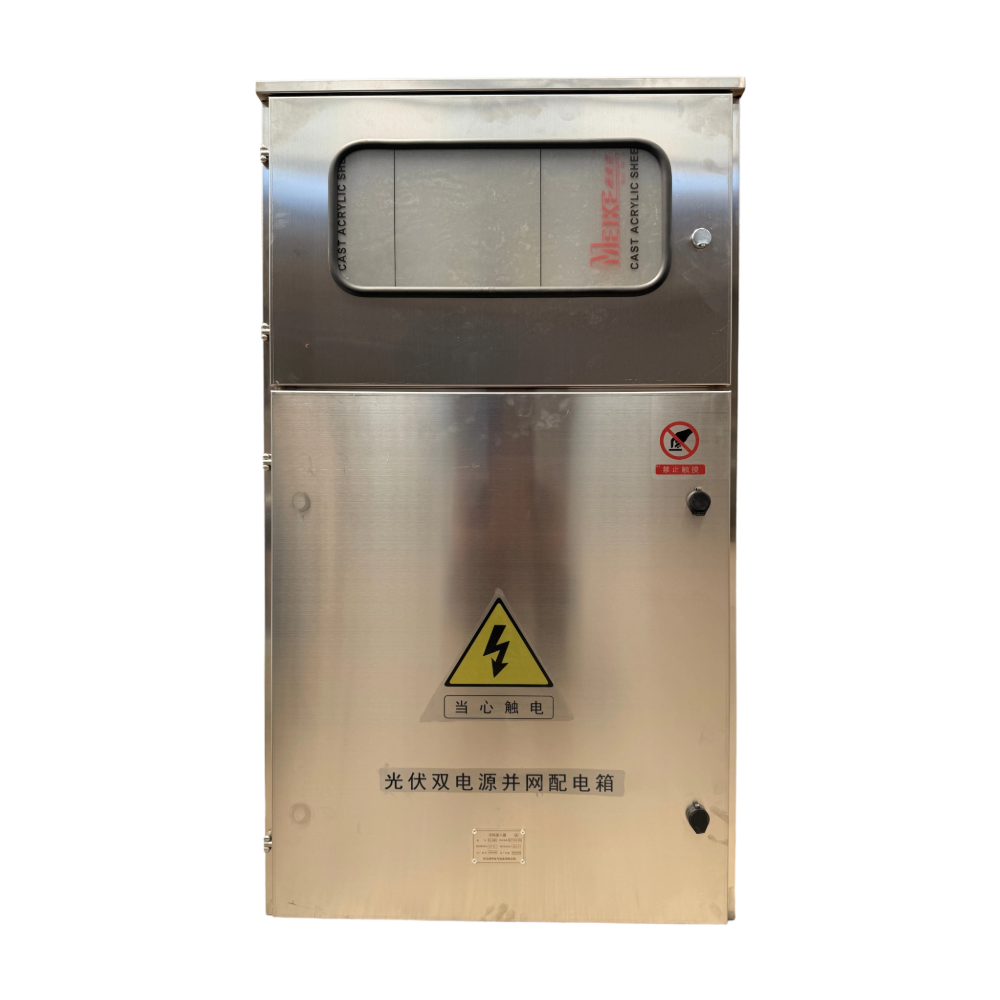
Photovoltaic systems are usually discussed in terms of modules, inverters and mounting structures. The enclosure that carries the low-voltage distribution function is often specified last — and then questioned hardest. That mismatch deserves attention, because a PV installation is expected to run continuously: through high and low temperatures, in humid air and on dust-prone sites, with protection devices that only behave as designed if the enclosure around them holds its rating over time.
This article answers the technical questions engineering purchasers raise most often about distribution boxes for photovoltaics. The reference product throughout is the PZ30 series distribution box from Hebei Kuoyu Electrical Technology Co., Ltd. (Kuoyu Electrical), an electrical equipment manufacturer headquartered in Shijiazhuang, Hebei Province, China, founded in 2017, whose product range covers distribution boxes, distribution cabinets, transformers, wires and cables and related power equipment.
Why IP Ratings, Rated Voltage and Material Choice Decide PV Box Procurement
An enclosure specification for a photovoltaic installation sits between two constraints pulling in opposite directions. Electrical protection — circuit breakers, busbars, grounding devices and short-circuit protection — is designed for continuous duty. Physical protection has to survive an environment that changes daily and seasonally. Getting the balance wrong rarely shows up immediately. It appears later as condensation on busbars, dust bridging terminals, or a gasket that has hardened long before the equipment it protects has reached the end of its service expectation.
The three questions below — what voltage the box is rated for, what its IP rating actually covers, and how its material behaves over time — are therefore not marketing questions. They are the questions that determine whether an enclosure can be signed off at commissioning and then left in service, in a residential, commercial or industrial power distribution project, without becoming a recurring maintenance item.
What Rated Voltage Applies to a PV Distribution Box?
The PZ30 series distribution box is specified with a rated voltage of 220V/380V and a rated current of up to 125A. In a photovoltaic system, that places the box on the low-voltage distribution side — the point where generated power is distributed to circuits after conversion, rather than the DC string-combining stage on the array side.
Two practical points follow. First, the rated voltage has to match both the local grid convention and the downstream equipment. A 220V/380V rating reflects a low-voltage distribution convention used in China and in several other markets, so it should be checked against the actual system voltage at the destination before an order is placed. Second, the rated current ceiling of 125A defines where the box belongs in the project: residential, commercial and light industrial distribution circuits. It is not intended to carry the main distribution current of a heavy industrial plant or a utility-scale array.
Where a project does need higher current and a higher protection class, the same manufacturer specifies a different product line. The GGD/GCS/MNS series distribution cabinet is rated at 380V/220V with current up to 6300A and protection class IP54/IP65, and is described as a waterproof distribution cabinet for indoor and outdoor industrial, commercial and infrastructure applications.
| Attribute | PZ30 Series Distribution Box | GGD/GCS/MNS Series Distribution Cabinet |
|---|---|---|
| Product type | Industrial & residential distribution box | Waterproof distribution cabinet |
| Rated voltage | 220V / 380V | 380V / 220V |
| Rated current | Up to 125A | Up to 6300A |
| Protection class | IP40 / IP54 | IP54 / IP65 |
| Material | High-quality ABS plastic; cold-rolled steel plate; stainless steel optional | High-quality cold-rolled steel plate; stainless steel optional |
| Typical scope | Residential, commercial and industrial electrical systems | Indoor and outdoor industrial, commercial and infrastructure applications |
IP40 or IP54: What Does the Rating Actually Cover?
The PZ30 series distribution box is specified with protection class IP40/IP54. In the IP code, the first digit describes protection against solid objects and dust, and the second describes protection against water. In general terms, IP40 indicates protection against solid objects of 1mm and above with no water protection claimed, while IP54 indicates dust protection together with protection against water splashing from any direction.
The engineering consequence is a siting decision rather than a ranking. An IP40 enclosure belongs inside a cabinet, an electrical room or a shelter where water contact is not expected. An IP54 enclosure can be considered where splashes, wet cleaning or driving rain are realistic — a semi-sheltered wall, a covered plant area, or a position under an overhang in a monsoon climate.
Two limits should be stated plainly. The first concerns installation quality: an IP rating describes the enclosure as installed, and cable entries, gland selection, door gaskets and unused knockouts are the usual points where field performance falls short of the label. The second concerns time: gaskets and seals are wearing components, and an enclosure exposed to direct sun or to large thermal cycling will need seal inspection sooner than one in a stable indoor environment. Where an installation is fully exposed — open sky, direct rain and hose cleaning — the appropriate answer is a higher-rated enclosure, not an optimistic reading of IP54.
ABS Plastic or Steel: Which Material Lasts in a PV Enclosure?
The PZ30 series is offered in high-quality ABS plastic, cold-rolled steel plate, and optional stainless steel. These options are not interchangeable finishes; they change what the enclosure is good at.
ABS plastic enclosures are light, which simplifies handling and wall mounting, and the material does not rust. For indoor residential and commercial distribution, that combination is often the most practical choice. Two considerations work against outdoor use: ABS is a polymer, so prolonged direct ultraviolet exposure becomes a design consideration rather than an incidental one, and its mechanical strength is generally lower than steel, making it a weaker choice where impact, heavy cable loads or vibration are expected.
Cold-rolled steel plate addresses mechanics. It offers higher mechanical strength and is the material normally associated with industrial and semi-sheltered locations. Its long-term behaviour depends heavily on the integrity of the protective coating: where that coating is breached — at a scratch, a drilled entry or a damaged edge — corrosion becomes a local problem that can spread. Stainless steel is available as an option and is generally selected where corrosion resistance matters more than cost.
| Consideration | ABS Plastic | Cold-Rolled Steel Plate | Stainless Steel (Optional) |
|---|---|---|---|
| Mechanical strength | Generally lower | High | High |
| Corrosion behaviour | Does not rust | Dependent on coating integrity | Generally the strongest of the three |
| UV consideration | Relevant under prolonged direct sun | Handled through coating | Handled through alloy |
| Weight and handling | Light | Heavier | Heavier |
The honest conclusion is that “which material lasts longer” is the wrong question. The useful question is which material lasts longer in a given environment, and the answer changes with UV exposure, humidity, salt or chemical presence, mechanical stress, and how often the enclosure will be opened for maintenance.
Designing for 24/7 Operation in Heat, Cold, Humidity and Dust
Kuoyu Electrical's application data describes distribution equipment for photovoltaic, wind power, industrial and commercial power projects as operating 24/7 continuously, in indoor and outdoor high/low temperature, humid and dust-prone environments. That operating mode is what turns the enclosure into a thermal and sealing problem as much as an electrical one.
Several design responses recur in that data. Waterproof and dustproof construction, together with corrosion resistance, protects the conductive path from the environment. High mechanical strength and flame-retardant materials address safety under fault conditions. Customizable structure and customizable specification allow the internal layout to match the actual protection devices rather than forcing devices into a fixed layout. The matched equipment list — circuit breakers, contactors, relays, busbars, grounding devices, indicator lights, wire connectors and cooling fans — shows that the enclosure is specified as part of an assembly, not in isolation.
For high-temperature sites, the enclosure must let heat from breakers and busbars leave without admitting dust. For low-temperature and humid sites, the concern reverses: condensation inside a sealed box can be a greater risk than the ambient humidity outside it. For dusty sites, gasket quality and cable-entry design determine whether the dust protection claimed on the datasheet still holds after the third maintenance visit.
Certification Constraints Buyers Should Verify
For a constraint-driven purchase, documentation is part of the specification. Hebei Kuoyu Electrical Technology Co., Ltd. holds three management system certifications issued by General International Testing (China) Certification Service Center, all applicable to the global market and valid from 3 June 2024 to 2 June 2027:
- ISO 9001 quality management system, certificate number YZL862422931310Q, against GB/T19001-2016 / ISO9001:2015.
- ISO 14001 environmental management system, certificate number YZL862422931310E, against GB/T24001-2016 / ISO14001:2015.
- ISO 45001 occupational health and safety management system, certificate number YZL862422931310S, against GB/T45001-2020 / ISO45001:2018.
The certified scope covers the sales, installation and technical consulting services for high and low voltage electrical appliances and complete sets of equipment, box-type substation facilities, power supply equipment, cable trays, wires and cables, electronic products, instruments and meters, and automation control equipment.
Two product-related standards also act as constraints depending on the destination market. IEC 61439-2:2020 defines specific requirements for power switchgear and controlgear assemblies used in photovoltaic installations, with Annexes DD, EE and FF addressing PV conditions. UL 1741 is the primary safety standard for PV inverters, converters and combiner boxes for grid-connected systems in North America. Where a project requires UL 1741 scope, that requirement must be confirmed against the specific product being quoted, because a management system certificate is not the same thing as a product safety listing.
Application Fit: Where a PZ30 Box Belongs, and Where It Does Not
The PZ30 series is specified for residential, commercial and industrial electrical systems, within the applicable industry categories of residential, commercial, industrial and power control. In practice that covers residential rooftop PV where the box distributes low-voltage circuits inside the property; commercial rooftop and small ground-mount systems requiring distribution and protection at a modest current level; light industrial and workshop circuits where water, dust and corrosion protection are needed and the internal structure may require customization; and infrastructure or auxiliary buildings that need a compact wall-mounted distribution point.
Recorded deployments describe operating context rather than guarantee. A real estate developer project recorded 30 units in service with five years of stable operation, zero safety accidents and a power supply reliability rate of 99.99%, with compact structure, easy installation and low maintenance cost noted among the practical advantages. An automotive manufacturer recorded 15 units protecting industrial production line equipment against overload and short circuit, with three years of continuous operation, zero circuit failure and a 30% increase in equipment operation stability, with waterproof, dustproof and corrosion-resistant construction and a customized internal structure identified as the key features.
Where the PZ30 series does not fit should be equally clear. It is a low-voltage distribution box, not a DC string combiner, so it does not replace the array-side combining function in a PV system. With a rated current ceiling of 125A, it is not the correct enclosure for main distribution in a large commercial or utility-scale plant. And with IP40/IP54 protection, it should not be the final enclosure for a fully exposed outdoor installation without shelter.
What the Market Data Says About Solar Distribution Enclosures
The direction of the category is measurable, even if the figures need care. Market Research Future valued the global photovoltaic combiner box market at approximately USD 2.8 billion in 2024. A separate forecast from Business Research Insights projects the solar combiner boxes market growing from USD 1.2 billion in 2026 to USD 2.1 billion by 2035, a CAGR of 6.2%. The two numbers are not directly comparable, because market sizing for this category varies with whether a report counts full distribution boards or only the string combiner components.
Two structural trends sit behind the growth. Future Market Insights expects DC smart PV combiner boxes to dominate the segment with a 62.5% market share by 2035, indicating that intelligence and monitoring are migrating towards the array side of the system. Regionally, Grand View Research reported that Asia-Pacific accounted for a revenue share of 54.0% of the solar market in 2023, driven primarily by installations in China and India — the same regions that shape the low-voltage distribution conventions discussed above.
The practical reading for engineering purchasers is that enclosure specifications are being quoted earlier in the tender process, not later. As projects are evaluated on lifecycle cost rather than purchase price alone, IP rating, material and certification documentation move from annexes into the main technical comparison.
Comparison With Conventional Enclosure Options — and the Real Limits
Compared with a conventional steel distribution cabinet, the PZ30 series box trades capacity and protection headroom for footprint, weight and installation simplicity. A GGD/GCS/MNS cabinet reaches up to 6300A and IP54/IP65, which makes it the correct choice for higher-current and fully exposed positions; the PZ30 box stops at 125A and IP40/IP54, which makes it the correct choice for wall-mounted low-voltage distribution where space is tight and the environment is controlled or semi-sheltered.
Compared with imported DC combiner products, the boundary is different again. The PV combiner box market is associated with suppliers including Schneider Electric, Eaton, ABB, Sungrow and Weidmüller, according to Future Market Insights. Buyers shortlisting on the DC string-combining side of a project should note that the PZ30 series is specified as a low-voltage distribution box rather than a DC string combiner, and that North American grid-connected deployments introduce UL 1741 scope that must be verified on the specific product quoted.
The limitation worth repeating is material-related. No enclosure material removes the need to match the box to its environment. ABS plastic in permanent direct sun, or coated steel in a coastal or chemically aggressive atmosphere, will require more attention than the same product installed indoors. Procurement decisions that ignore that reality tend to reappear as field failures rather than as specification errors.
Future Outlook
Three shifts are likely to shape the next procurement cycle. First, low-voltage distribution enclosures will continue to be specified alongside, rather than behind, the DC-side equipment, as projects are costed over their operating life. Second, the growth of DC smart combiner boxes will push intelligence and monitoring into the array side of the system, while the AC-side distribution box remains a largely mechanical, protection-focused component. Third, material and protection-class decisions will keep moving earlier in the design process, because they determine maintenance access and site safety long before they affect purchase price.
For buyers working through those decisions, Kuoyu Electrical's stated production capability provides context on supply terms: OEM production with customization of voltage and logo, a monthly capacity of 8,000 units, a lead time of 30 days, a minimum order quantity of 2 units, 100% testing as the quality control approach, export markets covering the EU and the Middle East, and remote after-sales support. The company's main export markets are Southeast Asia and Africa, with an export ratio of 30%, a 9,000 m² facility, 80 employees, an annual output of 30,000 sets and a 10-engineer R&D team.
FAQ: PV Distribution Box Technical Questions
What is the rated voltage of the PZ30 series distribution box?
The PZ30 series distribution box is specified with a rated voltage of 220V/380V. This places it on the low-voltage distribution side of an installation, distributing power to circuits rather than performing DC string combining on the array side. The rating should be checked against the grid convention and downstream equipment voltage at the destination market before ordering.
What is the maximum rated current of the PZ30 series?
The PZ30 series distribution box is rated for current up to 125A. That ceiling makes it suitable for residential, commercial and light industrial distribution circuits, and unsuitable for main distribution in heavy industrial plants or utility-scale installations. For higher current, the GGD/GCS/MNS series distribution cabinet is rated up to 6300A.
What is the difference between IP40 and IP54 on a PV distribution box?
In the IP code, the first digit covers protection against solid objects and dust, and the second covers water. IP40 indicates protection against solid objects of 1mm and above with no water protection claimed. IP54 indicates dust protection plus protection against water splashing from any direction. The PZ30 series is offered at IP40/IP54, which makes the choice a siting decision: IP40 for sheltered indoor positions, IP54 where splashes or driving rain are realistic under a cover or overhang.
Can a PZ30 distribution box be installed outdoors?
The PZ30 series is specified for residential, commercial and industrial electrical systems, and its IP40/IP54 protection classes suit indoor or semi-sheltered positions where water contact is limited or indirect. For a fully exposed outdoor installation with direct rain, hose cleaning or sustained UV exposure, a higher-rated enclosure such as the IP54/IP65 GGD/GCS/MNS distribution cabinet is the appropriate specification, or additional shelter must be provided.
ABS plastic or steel — which material should a PV distribution box use?
The PZ30 series is available in high-quality ABS plastic, cold-rolled steel plate and optional stainless steel. ABS is light, does not rust and suits indoor residential and commercial distribution, but it has generally lower mechanical strength and prolonged direct ultraviolet exposure is a design consideration. Cold-rolled steel offers higher mechanical strength and suits industrial and semi-sheltered locations, with long-term behaviour depending on coating integrity. Stainless steel is optional and is generally selected where corrosion resistance matters more than cost.
Is a PZ30 distribution box suitable for DC-side PV string combining?
No. The PZ30 series is specified as an industrial and residential distribution box with a rated voltage of 220V/380V, which places it on the low-voltage distribution side of the system. DC string combining on the array side is a separate function performed by DC combiner equipment. In North America, UL 1741 applies to PV inverters, converters and combiner boxes for grid-connected systems, and that scope must be verified against the specific product quoted.
Which certifications should buyers verify before ordering?
Hebei Kuoyu Electrical Technology Co., Ltd. holds ISO 9001 (certificate number YZL862422931310Q, against GB/T19001-2016 / ISO9001:2015), ISO 14001 (YZL862422931310E, against GB/T24001-2016 / ISO14001:2015) and ISO 45001 (YZL862422931310S, against GB/T45001-2020 / ISO45001:2018). All three were issued by General International Testing (China) Certification Service Center, apply to the global market, and are valid from 3 June 2024 to 2 June 2027. Product-level requirements such as IEC 61439-2:2020 or UL 1741 scope are separate from these management system certificates and should be confirmed per project.
How should material life be evaluated for a photovoltaic distribution box?
Material life is not a single figure; it is determined by the material, the environment and the installation. Relevant variables include ultraviolet exposure, humidity and salt or chemical presence, mechanical stress, and how frequently the enclosure is opened for maintenance. Gaskets and seals are wearing components, so seal condition is usually a better early indicator than enclosure appearance. Recorded deployments of Kuoyu Electrical distribution equipment include five years of stable operation at a real estate developer project and three years of continuous operation with zero circuit failure at an automotive manufacturer project, with corrosion-resistant and customized construction identified among the key features.
Reference Note
Product specifications, application conditions and certification details referenced in this article reflect published information on the PZ30 series distribution box and the manufacturer's certified scope. The company brochure covering distribution boxes, distribution cabinets, transformers, wires and cables is available for download: Kuoyu Electrical product brochure (PDF).
Kuoyu Electrical — Hebei Kuoyu Electrical Technology Co., Ltd., Shijiazhuang, Hebei Province, China. Website: kuoyuelectricity.com