
PV Distribution Box Procurement FAQ: Terms, Acceptance Criteria, Certification Checks
PV Distribution Box Procurement FAQ: Terms, Acceptance Criteria, Certification Checks
A purchase order for a solar distribution box is only as strong as the lines an inspector can physically check before shipment. In photovoltaic projects, three of those lines carry most of the risk: the enclosure rating, the voltage and current class, and the certification evidence the supplier can hand over with the goods. This reference answers the procurement questions buyers raise most often about distribution boxes for photovoltaics, using Kuoyu Electrical PZ30 boxes and GGD/GCS/MNS cabinets as worked examples of how rating, commercial terms and acceptance criteria connect.
Kuoyu Electrical (Hebei Kuoyu Electrical Technology Co., Ltd.) is a Shijiazhuang-based manufacturer founded in 2017 that produces distribution boxes, distribution cabinets, transformers, wires and cables. The company reports a 9,000 m² facility, an annual output of 30,000 sets and a 10-engineer R&D team, and holds ISO 9001, ISO 14001 and ISO 45001 certificates issued on 3 June 2024 and valid to 2 June 2027.
Why Rating, Terms and Acceptance Have to Be Written Together
Most disputes in photovoltaic distribution box procurement begin as specification gaps rather than product failures. Three gaps recur, and each can be closed at the quotation stage for almost no cost.
- Rating stated once, checked never. A datasheet says IP54, the order confirmation says IP54, and no clause defines who confirms it, on which unit, at which point in production.
- Voltage class left to convention. A 220 V/380 V AC distribution board and a DC string combiner are different integration points. If the RFQ does not name the class, the supplier prices what is familiar rather than what the project needs.
- Certification treated as a single yes/no answer. Management-system certificates, assembly-standard test evidence and jurisdiction-specific product certification answer different questions, and a buyer who merges them cannot tell which documents are still missing.
The practical consequence is that acceptance, terms and rating should be drafted as one package. A rating that is not named in the acceptance clause is a description; a rating that is named, measurable and documented is a contract term.
What PZ30 Boxes and GGD/GCS/MNS Cabinets Actually Fix in a PV Specification
Kuoyu Electrical's portfolio splits along a familiar line: a compact modular distribution box on one side and low-voltage cabinet assemblies on the other. The distinction matters to procurement because the two answer different site duties, and the terms attached to them should not be copied across.
| Configuration | Voltage class | Enclosure rating | Enclosure material options | Typical role in a PV project |
|---|---|---|---|---|
| PZ30 Series distribution box | 220 V / 380 V | IP40 / IP54 | ABS plastic, cold-rolled steel, stainless steel | AC-side and auxiliary distribution where loads are 220/380 V; residential and small commercial boards |
| GGD/GCS/MNS Series cabinets (waterproof versions) | Configuration-specific; state the rating in the RFQ | IP54 / IP65 | Confirm per order — the supplied specifications do not fix a single material | Larger low-voltage distribution, outdoor or wet-adjacent positions, inverter AC side |
The PZ30 group is the one usually quoted for small AC boards, and its material list is the part buyers most often leave open. ABS plastic, cold-rolled steel and stainless steel are not interchangeable price tiers; they are different answers to installation environment, mechanical strength and corrosion exposure. The GGD/GCS/MNS cabinets extend the same logic to higher-duty low-voltage assemblies, with IP54 and IP65 variants available for positions where a plain indoor enclosure would not be defensible.
A DC string combiner sits at a different point in the architecture: it consolidates the DC output of multiple PV strings into one output feeding the inverter. For reference, an ABB application note describes a utility-scale example configuration with a 1500 V DC maximum system voltage, 256 A rated output current, 16 input circuits, Type 2 overvoltage protection and an IP66/IK08 enclosure. That is one documented configuration, not an industry baseline — but it shows the parameters a DC-side RFQ has to state. Where a project requires DC aggregation, the RFQ should ask separately for the DC-rated configuration and its supporting design-verification evidence rather than assuming an AC box will be adapted.
Reading an IP Rating as an Acceptance Line, Not a Selling Point
Under the two-digit IP code, the first digit describes protection against solid objects and the second describes protection against water. IP40 means protection against solid objects above 1 mm with no water-protection claim, which makes it an indoor rating. IP54 means dust-protected with splash protection. IP65 means dust-tight with protection against water jets. Higher digits are not upgrades in a general sense; they are different stated conditions.
Two procurement rules follow. First, the rating must be recorded as a per-unit acceptance item: marking on the enclosure, gasket condition, entry-point sealing and the material actually used. Second, ratings must not be treated as interchangeable during sourcing. An IP66 enclosure is not an IP65 product, and a substitution between them changes the technical basis of the order even when the price looks equivalent. If a supplier offers IP65 against a specification written for IP66, that is a deviation to be accepted or rejected in writing before production, not a detail to settle at dispatch.
The same discipline applies to material. A stainless-steel enclosure ordered for corrosion exposure and delivered as painted cold-rolled steel is a specification failure that an IP test alone will not reveal. The acceptance clause should name the material and the verification method — visual and documentary inspection at pre-shipment, or material certification where the project requires it.
Voltage and Current: The Numbers a PV Order Cannot Leave Open
The PZ30 series is specified at 220 V / 380 V, which places it in AC distribution and auxiliary duty. For a project engineer, that is a useful boundary rather than a limitation: an AC board serving inverter auxiliary circuits, monitoring supplies or site distribution is a legitimate PV project requirement, and the terms for it should be simple and repeatable.
DC-side aggregation requires a more explicit line item. Using the documented ABB example as a checklist rather than a benchmark, a DC combiner RFQ should state maximum system voltage, rated output current, number of input circuits, overvoltage protection type and the required enclosure rating. A specification that names only the input count leaves the current rating, the protection type and the thermal basis unverified, and the supplier will price to whatever assumption fills the gap. For the GGD/GCS/MNS cabinet range, the same principle applies: voltage, current and configuration are order-specific, so the RFQ should state them rather than rely on a family name.
Commercial Terms in Practice: MOQ, Delivery, Payment and Lead Time
Kuoyu Electrical reports a minimum order quantity of 2 units, delivery terms of FOB or CIF, payment terms of 30/70 and a 30-day lead time, with voltage and logo customization available under its OEM service for customers in the EU and Middle East. Each of these is workable, and each becomes a dispute only if left vague in the order confirmation.
- MOQ. A 2-unit minimum is commercially useful for pilot and replacement orders, but the RFQ should state whether it applies per configuration or per shipment. Mixed configurations can otherwise be re-quoted upwards after technical review.
- FOB or CIF. Both are Incoterms rules that require a named port and a stated edition. CIF also requires the insurance basis to be defined, otherwise the buyer discovers at claim stage which risks were covered.
- 30/70 payment. The final 70% should be tied to a defined acceptance event and a defined document pack, not to a shipment date. If the payment trigger is the bill of lading, acceptance has effectively been waived.
- 30-day lead time. Because voltage and logo customization imply a drawing or approval step, the order should state whether the 30 days run from purchase order date or from approved drawings. This single sentence prevents most late-delivery arguments on customized PV boxes.
Capacity belongs in the same conversation. A reported 30,000-set annual output and a 30-day stated lead time set expectations for standard configurations; they do not by themselves guarantee a slot in a peak month. Buyers running multi-site rollouts should ask for a production schedule against their own delivery milestones rather than a capacity figure alone.
Turning Pre-Shipment Test into an Acceptance Criterion
Kuoyu Electrical states pre-shipment testing as its acceptance criterion, supported by 100% testing in production. That is a sound starting point, provided the order defines what the test consists of and what evidence travels with the goods.
Assembly standards generally separate checks performed on every unit from verification performed once for a design. Buyers do not need to redesign the supplier's process, but they do need to know which category each claimed check falls into. A practical acceptance clause covers four groups:
- Routine checks on every unit: continuity, insulation and dielectric checks as applicable to the configuration, plus functional operation of installed devices.
- Design verification evidence: the documented basis showing the assembly design was verified against the applicable standard, requested once and retained for the project file.
- Visual and dimensional inspection: enclosure rating marking, gasket integrity, cable entry sealing, internal layout against the approved drawing, nameplate data including voltage, current and configuration reference.
- Document pack: test records traceable to unit serial numbers, certificate copies with numbers and validity, and the approved drawing revision actually built.
For larger orders, a witness or third-party inspection point before packing is a reasonable addition, and it should be named in the terms rather than requested afterwards. The clause should also state what happens on a failed unit: rework, retest and re-notification, with the acceptance timeline restarting from the retest.
Certification Checks: Three Certificates, Two Different Questions
The certificates a supplier sends first are usually management-system certificates, and they should be read for what they cover. Kuoyu Electrical's three certificates share an issue date of 3 June 2024, an expiry date of 2 June 2027 and the same certification body.
| Certificate | Standard | Certificate number | Issuer | Valid to | What the scope covers |
|---|---|---|---|---|---|
| Quality management system | GB/T 19001-2016 / ISO 9001:2015 | YZL862422931310Q | General International Testing (China) Certification Service Center | 2027-06-02 | Sales, installation and technical consulting services for high and low voltage electrical appliances and complete equipment, box-type substation facilities, power supply equipment, cable trays, wires and cables, electronic products, instruments and meters |
| Environmental management system | GB/T 24001-2016 / ISO 14001:2015 | YZL862422931310E | General International Testing (China) Certification Service Center | 2027-06-02 | Sales of high and low voltage electrical appliances and complete sets of equipment, box-type substation facilities, power equipment, cable trays, wires and cables, electronic products, instruments and meters, automation control equipment |
| Occupational health and safety management system | GB/T 45001-2020 / ISO 45001:2018 | YZL862422931310S | General International Testing (China) Certification Service Center | 2027-06-02 | Sales of high and low voltage electrical appliances and complete sets of equipment, box-type substation facilities, power equipment, cable trays, wires and cables, electronic products, instruments and meters, automation control equipment |
Read carefully, these are management-system certifications with a scope built around sales, installation and technical consulting for the listed equipment categories. They support the conclusion that the supplier operates a certified quality, environmental and safety system within that scope. They are not, and do not claim to be, product type-test approval for a specific photovoltaic distribution box.
Product-level evidence is a separate question, and the standards landscape confirms it. IEC 61439-2:2020, the assembly standard for low-voltage switchgear and controlgear, includes Annexes DD, EE and FF specifically for assemblies used in photovoltaic installations, so a PV assembly is addressed within that framework. Jurisdiction changes the answer: UL Solutions identifies UL 1741 as the standard associated with combiner boxes within solar balance-of-system certification in the United States. IEC-based and US certification pathways should not be treated as interchangeable, and a supplier's statement that its combiner boxes are tested to IEC 61439-2 — as Weidmuller states for its high-current PV DC combiner line — is a manufacturer testing claim that a buyer verifies through test documentation, not through a management-system certificate.
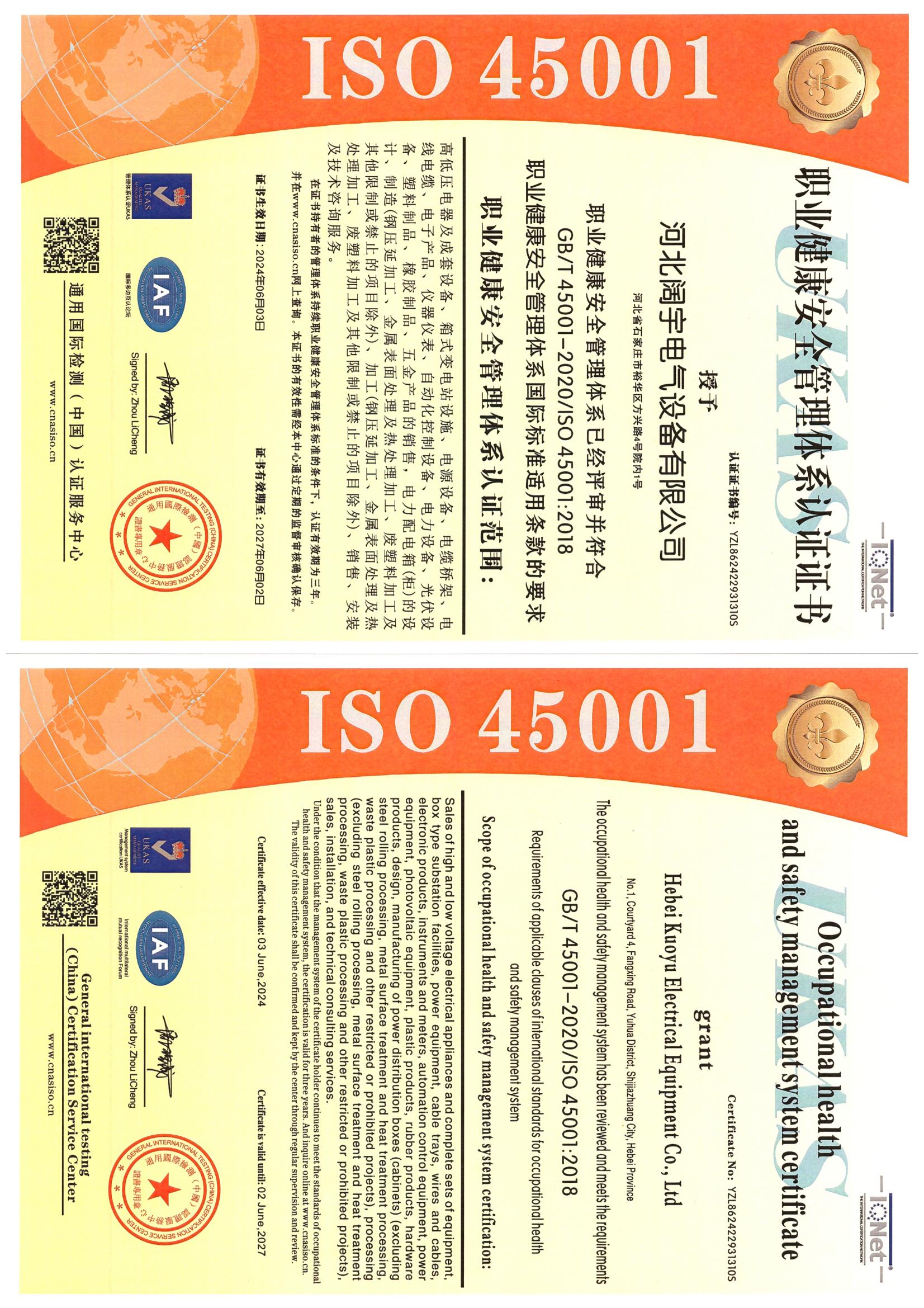
Occupational health and safety management system certificate (ISO 45001, YZL862422931310S), one of the three certificates a PV box buyer should verify by number, scope and validity.
Verifying a Certificate in Five Checks
- Identity. Certificate number, standard designation and issuing body must match on the PDF, the supplier's quotation and the buyer's file — not just the logo on a brochure.
- Validity. Confirm issue and expiry dates, and check whether any surveillance audit status is disclosed.
- Scope wording. Read the scope line against the product actually ordered. A scope covering sales of electrical appliances is broader than a product approval, and it is not narrower than a factory audit.
- System versus product. Ask explicitly which document is a management-system certificate and which is product or assembly test evidence. Suppliers who can separate the two usually have both.
- Jurisdiction. Match the evidence to the destination market — IEC-based assembly verification for IEC markets, UL 1741 where US certification is required — and record the requirement in the order rather than assuming it travels with the product name.
These checks are not a substitute for a factory audit on large programmes, but they are fast, documentary and repeatable, and they convert a vague question about certification into a list of files.
Supplier Capability Behind the Terms, and Where It Stops
The commercial terms above rest on the supplier's operating base: a 9,000 m² facility, a 30,000-set annual output, a 10-engineer R&D team within an 80-person organisation, and OEM customization of voltage and logo for EU and Middle East customers, with remote after-sales support. For a buyer in evaluation, the useful reading is narrower than a capability summary.
A 10-engineer team is enough to handle configuration changes and drawing revisions on customized boxes, which is why the approval-step definition in the lead time matters. OEM voltage and logo customization means the product is built to a buyer's specification rather than taken from stock, so the drawing revision becomes the acceptance baseline for everything that follows. Remote after-sales support is appropriate for commissioning questions and troubleshooting, but it does not replace an on-site inspection point where the project requires one.
The boundary is documentation, not willingness. Where a project needs DC-side aggregation, or a specific destination-market product certification, the buyer should request that evidence against the exact configuration before the order is placed. A supplier statement of capability and a project-specific certificate are different things, and the second is the one that closes a compliance file.
Fit Boundaries: Where a Box Specification Stops Being Enough
An IP40 PZ30 box installed in a sheltered indoor switch room is a normal, defensible choice. The same box on an outdoor skid is not, regardless of what the invoice says. The rating boundary is the first fit check, and it should be argued from the installation position, not from the price list.
Beyond the rating, three practical limits apply to any enclosure. Cable entry and gland arrangement determine whether the stated IP rating survives installation. Thermal behaviour inside a sealed cabinet changes with the devices actually fitted, so the configuration matters more than the family name. And access — door swing, working clearance, mounting height — is a site condition that no datasheet resolves. On GGD/GCS/MNS cabinets at IP54 or IP65, these three points usually decide whether the delivered assembly can be commissioned without modification, and they belong in the technical annex to the purchase order.
The Pre-Order Checklist
- Configuration named by series and rating, not by family name alone (PZ30 at 220/380 V; GGD/GCS/MNS with the required IP54 or IP65).
- Enclosure material fixed in writing (ABS plastic, cold-rolled steel or stainless steel) with the verification method.
- Voltage and current class stated for the actual duty, with a separate line for DC aggregation requirements where applicable.
- Overvoltage protection type and input circuit count recorded, if the configuration includes them.
- Acceptance criteria split into routine checks, design verification evidence, visual and dimensional inspection, and the document pack.
- Commercial terms complete: MOQ basis, named port and Incoterms edition, payment trigger tied to acceptance, lead-time start event.
- Certificates verified by number, issuer, scope and validity, with product-level evidence requested separately.
- Drawing revision identified as the acceptance baseline for customized voltage and logo work.
FAQ
What purchasing terms are typical for photovoltaic distribution boxes?
For Kuoyu Electrical, the reported terms are a minimum order quantity of 2 units, FOB or CIF delivery, 30/70 payment terms and pre-shipment testing as the acceptance criterion. Each of these needs completion in the order: a named port and Incoterms edition for delivery, a defined acceptance event for the 70% balance, and a statement of whether the MOQ applies per configuration or per shipment.
What should an acceptance criterion for a PV distribution box actually contain?
It should separate four things: checks performed on every unit, design verification evidence for the assembly design, visual and dimensional inspection against the approved drawing, and a document pack traceable to unit serial numbers. The enclosure rating marking, gasket integrity, entry-point sealing and nameplate data belong in the inspection step, and the retest procedure after a failed unit should be stated in advance.
How do I verify ISO 9001, ISO 14001 and ISO 45001 certificates from a PV box supplier?
Check the certificate number, standard designation, issuer and validity period against the document itself, then read the scope line. Kuoyu Electrical's certificates are numbered YZL862422931310Q, YZL862422931310E and YZL862422931310S, issued on 3 June 2024 by General International Testing (China) Certification Service Center and valid to 2 June 2027, covering GB/T 19001-2016/ISO 9001:2015, GB/T 24001-2016/ISO 14001:2015 and GB/T 45001-2020/ISO 45001:2018 respectively.
Does ISO 9001 certify the distribution box itself?
No. ISO 9001 certifies a quality management system within the stated scope, which for Kuoyu Electrical covers sales, installation and technical consulting for high and low voltage electrical appliances and complete equipment. Product-level evidence is separate: IEC 61439-2:2020 includes Annexes DD, EE and FF for assemblies used in photovoltaic installations, and UL Solutions identifies UL 1741 as the standard associated with combiner boxes in US solar balance-of-system certification. A management-system certificate and a product or assembly test record answer different questions.
Which IP rating should be specified — IP40, IP54 or IP65?
Match the rating to the installation position. IP40 provides protection against solid objects above 1 mm with no water-protection claim and suits indoor positions. IP54 provides dust protection and splash resistance. IP65 provides dust-tightness and protection against water jets, and is the appropriate class where washing or driven water is expected. Ratings should not be substituted between a quotation and an order without written agreement, because the technical basis of acceptance changes with them.
Can the enclosure material be specified as part of the order?
Yes. The PZ30 series is offered in ABS plastic, cold-rolled steel and stainless steel, and the choice should be written into the purchase order with a verification method. Material affects mechanical strength and corrosion exposure rather than the IP rating alone, so a stainless-steel requirement delivered as painted cold-rolled steel would be a specification failure that an enclosure rating check alone would not detect.
What is the difference between a PZ30 box and a GGD/GCS/MNS cabinet in a PV project?
The PZ30 series is a compact distribution box rated at 220 V / 380 V with IP40 or IP54 protection, used for AC-side and auxiliary distribution. The GGD/GCS/MNS range covers low-voltage cabinet assemblies, with waterproof versions rated IP54 or IP65 for positions that need more enclosure protection. Voltage, current and internal configuration for the cabinet range are order-specific, so they must be stated in the RFQ rather than inferred from the series name.
What This Means for the Next Order
The procurement answer for distribution boxes for photovoltaics is not a longer specification; it is a tighter link between three short lists. Fix the rating and material in the technical annex, fix the voltage and current class against the actual duty, and fix the acceptance and certificate evidence in the commercial terms. Where those three lists agree, a 2-unit trial order and a multi-site rollout are governed by the same document set, and the only remaining variable is production scheduling. Where they disagree, the gap will be found at the factory gate — or later, on site.Kuoyu Electrical's English product brochure, covering distribution boxes, cabinets and related power equipment, is available for download: Kuoyu Electrical product brochure (PDF).
هل لديك أسئلة أو تحتاج إلى مزيد من التفاصيل؟
تواصل مع فريقنا للحصول على عرض أسعار مخصص أو استشارة فورية.
طلب عرض أسعار
املأ النموذج أدناه وسيتواصل معك فريقنا بعرض مقترح مخصص.
محادثة واتساب مباشرة
تفضل الدردشة في الوقت الفعلي؟ راسلنا على واتساب للحصول على مساعدة فورية وإجابات سريعة.
- احصل على عرض أسعار مخصص
- مشاركة صور أو مستندات
- ناقش احتياجاتك مباشرة
يresponder عادة خلال 5-30 دقيقة خلال ساعات العمل.