
PVC Flooring in 2026: Choosing Suppliers by Evidence, Not Price
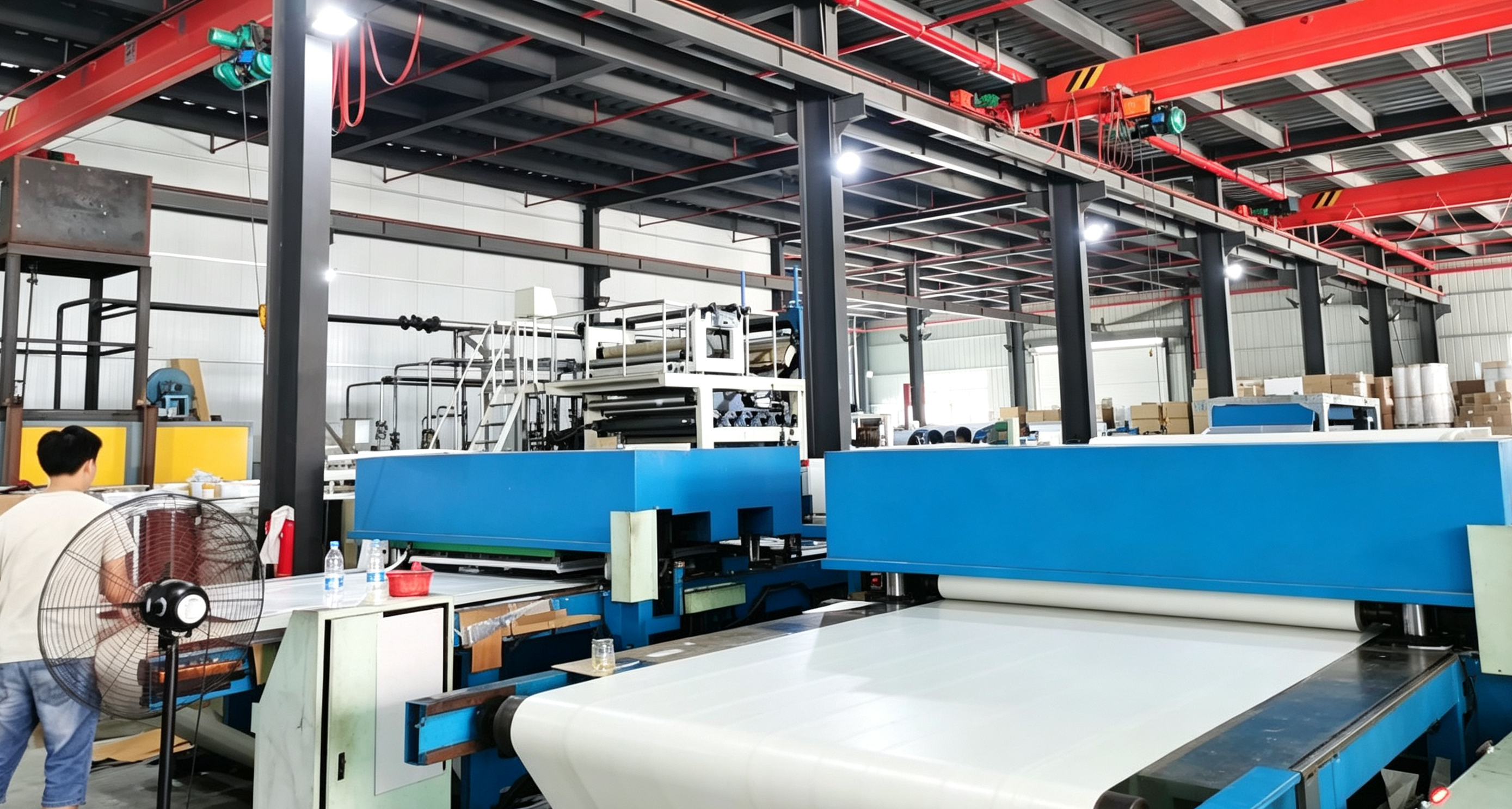
PVC flooring has become a widely used interior surface for homes, shops and light-commercial projects, but the name covers many different constructions. A single order can involve a thin self-adhesive tile, a mechanically locked plank, a fire-rated sheet, a roller-applied flexible product or a material promoted as FloorScore-certified. For buyers, the practical task is not to choose between generic category names; it is to compare the evidence behind each option.
Market scale explains why this evaluation process matters. According to Grand View Research, the estimated global vinyl flooring market size in 2026 is USD 28.0 billion, with projected growth to USD 41.5 billion by 2033 at a 5.8% CAGR. This figure covers the broader vinyl flooring family, including LVT, VCT and sheet products. At the export level, OEC data shows China as the largest exporter of vinyl chloride polymer floor coverings under HS 391810 in 2024, with exports valued at USD 4.97 billion, followed by Vietnam at USD 1.81 billion and South Korea at USD 820 million.
The Problem: PVC Flooring Labels Are Not Enough
The main procurement problem in 2026 is not a shortage of supply. It is the gap between product labels and the technical, chemical and installation facts that a buyer actually needs. Two boxes of PVC flooring can look similar in a showroom photo but differ in raw material, total thickness, decorative layer quality, backing type, dimensional stability and compliance status. Those differences often appear only after installation or after the goods reach customs.
Price gaps provide a practical warning. In the decorative materials segment, price differences usually come from raw material, thickness, formula, quality control and certification. Products positioned at very low cost tend to use recycled material, and this can lead to dimension deviation, color fading, odor or incomplete compliance documentation. For export orders, insufficient certification can lead to customs detention, delayed shipments, customer claims and market returns.
The opportunity for a buyer is to turn these risks into evaluation criteria. A supplier should be selected not because it owns a PVC flooring factory, but because it can prove that the exact product offered fits the intended market, installation method, performance requirement and compliance path.
Preference Groups Buyers Are Ranking in 2026
Terms such as click locking, fire-resistant, wear-resistant, self-adhesive, waterproof, anti-static, anti-slip, wood-grain, stone-grain, carpet-pattern, parquet-pattern, matte-surface, hospital-grade, kindergarten, home decor, workshop, 6*36 inches PVC flooring, light weight PVC flooring, roller PVC flooring, phthalate-free PVC flooring and FloorScore PVC flooring may all appear in a real sourcing list. In an evaluation, a buyer can reduce most long-tail requests into preference groups and rank suppliers within the relevant group.
| Preference group | What the buyer is usually looking for | Evidence to request before ranking |
|---|---|---|
| Self-adhesive PVC flooring | Convenient installation without wet glue, suitable for renovation and home improvement | Product dimensions, thickness, backing type, substrate requirements and recommended rooms |
| Click locking PVC flooring | A mechanically connected floating floor, usually expected to be more stable under daily use | Locking profile type, product thickness, expansion gap requirements and full installation manual |
| Roller PVC flooring | Continuous roll or sheet format for large surface coverage | Roll width, length, total thickness and installation guidance for seams and floor flatness |
| Performance-labelled PVC flooring | Wear resistance, waterproof behavior, fire resistance, anti-slip or anti-static properties | Test standard, product-specific report and the exact limit or class claimed |
| Environmentally labelled PVC flooring | Low emissions, phthalate-free composition or indoor air quality certification | Material declaration, plasticizer information and certificates such as FloorScore or REACH-related reports |
These search labels are useful filters, but they should not become contract specifications by themselves. For example, if the requirement is fire-resistant PVC flooring, the buyer can ask whether the product meets a recognized classification such as B1 under GB 8624-97 or Cfl-s1 under EN 13501-1. If the buyer requests a 6*36 inches format or a particular pattern family such as wood-grain, stone-grain or parquet-pattern, the supplier should be required to confirm whether that format and pattern are standard or custom-made.
Brand Solution and Supplier Evidence: SXP Wall Panel
One way to apply these principles is to read a manufacturer file as an evaluator would. Shanghai Yuanguan Rubber Plastic Co., Ltd., which operates in the interior decoration market under the brand SXP Wall Panel, is a China-based decorative materials producer. The company says it supplies online and offline building materials retailers and wholesalers and reaches more than 80 countries or regions. Its company profile lists ISO9001 quality management system certification, 48 patented technologies, 12 independent brands and multi-stage quality inspection before delivery.
From a manufacturing capability standpoint, the file describes OEM/ODM services covering size, color, pattern, embossing texture, material structure, thickness, packaging, logo and private label customization. The stated monthly capacity is more than 10 million square meters across the company product range, with a standard MOQ of 1,000 square meters and a reported lead time of 30 days. Export markets listed in the capability record include Europe, North America, the Middle East, Asia, Oceania and Japan.
| Published flooring specification | Recorded detail |
|---|---|
| Flooring reference | Model WB-PVC, described as PVC floor tile |
| Available size expression | 40/60/120*300 cm |
| Reported thickness | 1.5 mm |
| Installation format | Self-adhesive backing for dry installation |
| Recorded indoor settings | Bedroom, living room, bathroom, hotel, shop and kindergarten |
The current documented flooring line from this manufacturer is a thin self-adhesive product, not a rigid click-lock plank. That distinction is important. If a project requires a click-lock floating floor, the buyer should ask whether another material structure can be developed or qualified. A 1.5 mm self-adhesive tile and a click-lock floor are not interchangeable substitutes, even when the surface pattern is similar.
Technical Explanation: How to Read a PVC Floor Tile Specification
For a self-adhesive PVC floor tile such as the WB-PVC model, the installation logic is simple: the product has a backing film, the installer peels the film off and presses the tile onto a suitable surface. Dry installation does not require cement or glue. It can be cut locally, and in some configurations can be removed and reinstalled. The practical limitation is that the substrate has to be suitable.
Available surface guidance in the technical scenario is specific. The base should be dry, flat, dust-free and free of grease. Acceptable interior surfaces include cement floors, tiled surfaces, latex-painted walls, plasterboard and plywood, as long as they are smooth and solid. Powdery, sandy or loose surfaces are strictly not suitable. For a floor, the base needs to have the required strength and no hollow spots.
This kind of specification matters more than a generic description. A supplier that can clearly define installation boundaries is providing a more useful answer than one that only claims easy installation. The same logic should be applied to performance descriptors. If a building project specifies floor performance, the buyer should connect each label to a standard and a report, not to a marketing sentence.
Application Evidence from Distributed Interior Projects
The most useful application evidence for an evaluation is a case that connects a real distribution channel, a usable project scope and a long service window. In the documented case for Shanghai Yuanguan, the product was supplied to an international e-commerce platform that distributes flooring globally. The project scale was 100,000 units, with use across residential and commercial interior decoration, including apartment renovation, office fitting and retail store refurbishment.
According to the published case record, the service period was 5–10 years, with stable product performance and no quality complaints reported during that period. The customer completed three repeated orders within two years. The case also states that the product remained stable in color and texture during long-term use and was suitable for high-frequency traffic scenarios. The listed highlights include wear-resistant, waterproof and easy-to-install properties.
No single case can prove that every future batch will be identical. But repeat orders and a long complaint-free service period are more informative than a decorative sample alone, especially when the buyer is sourcing through an e-commerce distribution model that needs consistent product behavior across multiple countries.
Market Trend Analysis: Emissions, Phthalates and Market Entry
Floors are increasingly sold through channels where indoor air quality claims affect buying decisions. FloorScore certification, developed for hard surface flooring and verified by SCS Global Services in partnership with RFCI, confirms that a product complies with the volatile organic compound emission criteria of California Section 01350. Buyers who see FloorScore PVC flooring in a specification should ask for the certificate on the exact flooring model and confirm that the listed product scope matches the goods to be shipped.
Phthalate content is another area of active procurement attention. Tarkett, a large global vinyl flooring manufacturer, states that by 2018, 100% of its vinyl production sites in Europe, North America, Serbia and China used phthalate-free technology, relying on alternative plasticizers such as DOTP. This does not mean every manufacturer has made the same change, but it does mean phthalate-free composition is no longer a niche request. A buyer sourcing phthalate-free PVC flooring should request a material statement and a product-level test report, not just a package label.
For EU-bound goods, compliance discipline should be treated as part of product quality. Export products in this decorative materials segment should comply with CE-CPR construction product certification where applicable, REACH hazardous substance regulation and PPWR packaging rules. Missing valid certificates may create customs detention, return shipment or fines. Buyers who ask for full valid documents before placing an order are using compliance as a procurement standard, which is the correct direction for this market.
Comparison with Traditional Flooring Solutions
Compared with traditional glue-applied PVC or sheet flooring, self-adhesive PVC flooring changes the installation workflow. There is no need to prepare, spread or cure wet adhesive. The product is pressed directly onto a clean surface, which can reduce installation time and the need for specialized adhesive equipment. This is most valuable when a project prioritizes speed and clean handling.
There are real boundaries. A self-adhesive PVC floor layer cannot fix an unstable base. If the substrate is uneven, powdery, oily or has hollow areas, the floor should not be specified until the substrate is corrected. A thin PVC tile should also not be treated as a structural solution for heavy industrial loads. It is an interior surface product for defined spaces, not a replacement for engineered industrial flooring or a thick mechanically locked system if the project brief specifically requires one.
For click-lock requests, the comparison is even clearer. A click-lock product is a separate construction: it relies on a mechanical edge, expansion space and a floating installation method. A thin self-adhesive tile cannot automatically offer the same joint behavior. The buyer should either qualify a different product from the same supplier or select a supplier that provides the click-lock structure with proper documentation.
Final Supplier Evaluation Checklist
Before final selection, buyers can use the following checklist. It is designed to be neutral and practical, and it should be adapted to the destination market and project type.
- Confirm the legal manufacturer, factory location, production scope and export history.
- Obtain a written product description with the exact flooring model, dimensions, thickness, backing type and construction.
- Ask for installation and substrate instructions, including prohibited surfaces.
- Request a material declaration, especially if phthalate-free, FloorScore-certified or REACH-compliant product is required.
- Verify that test reports and certificates cover the exact product model and scope.
- Request a physical sample and test that sample in the intended environment.
- Clarify whether the quote is based on virgin material or recycled material and what quality control is applied before delivery.
- Check whether customization, private label, MOQ and lead time match the business model.
- Review the after-sales process, including quality claim handling and replacement support.
- Ask for repeat order or distribution evidence where available, but verify the relevance of that evidence to the product being purchased.
Future Outlook
The wider PVC flooring market is expected to keep expanding, and the original supplier base will remain active in global trade. According to the market projection cited above, the broader vinyl flooring category is forecast to grow at a 5.8% CAGR through 2033. That growth will bring more product options, but it will also bring more environmental claims and more regulatory complexity.
The suppliers likely to perform well in serious evaluations are those that can offer clear product structure information, installation boundaries and product-level test documentation. Buyers should treat evidence as part of the product, not as an additional conversation. When a supplier can document its production capacity, inspection process, market experience and compliance status in a consistent way, the buying decision becomes easier to defend.
FAQ
What specification should a buyer request for self-adhesive PVC flooring?
For self-adhesive PVC flooring, the buyer should verify product type, thickness, dimensions, backing type, substrate requirements and recommended rooms. A practical reference example is a PVC floor tile with available size expression of 40/60/120*300 cm and a thickness of 1.5 mm. Its documented indoor scope includes bedrooms, living rooms, bathrooms, hotels, shops and kindergartens. The base must be flat, dry and free from dust and grease, and powdery, sandy or loose surfaces are not suitable.
What does FloorScore certification mean for PVC flooring?
FloorScore is an indoor air quality certification used for hard surface flooring. It verifies that the flooring product complies with the volatile organic compound emission criteria of California Section 01350. Buyers who specify FloorScore PVC flooring should ask for a certificate that covers the exact flooring model being supplied.
Why can low-cost PVC flooring create risks for project orders?
Low-cost products may use recycled material, lower thickness or incomplete quality control. These differences can lead to dimensional deviation, fading, odor or missing compliance documentation. For export and project orders, a full material statement, physical sample and product-level test reports should be reviewed before bulk purchasing.
What compliance documents are important before exporting PVC flooring to the EU?
For EU-bound PVC flooring and related decorative materials, buyers should check CE-CPR construction product certification requirements, REACH hazardous substance regulation and PPWR packaging rules. Missing valid certificates can cause customs detention, return shipments or fines. The safest procurement practice is to request valid documents before order confirmation.
Should a buyer select self-adhesive PVC flooring or click-lock PVC flooring?
The decision depends on the substrate, installation method, expected use and structural preference. Self-adhesive PVC flooring is designed for dry installation on smooth solid surfaces. Click-lock PVC flooring is a separate product structure with mechanical edge behavior and floating installation requirements. Buyers should confirm the manufacturer documentation for the specific format and not assume that one format can replace the other.
Manufacturer reference file: Shanghai Yuanguan Product Brochure. This public file contains additional product background for the company discussed above.
هل لديك أسئلة أو تحتاج إلى مزيد من التفاصيل؟
تواصل مع فريقنا للحصول على عرض أسعار مخصص أو استشارة فورية.
طلب عرض أسعار
املأ النموذج أدناه وسيتواصل معك فريقنا بعرض مقترح مخصص.
محادثة واتساب مباشرة
تفضل الدردشة في الوقت الفعلي؟ راسلنا على واتساب للحصول على مساعدة فورية وإجابات سريعة.
- احصل على عرض أسعار مخصص
- مشاركة صور أو مستندات
- ناقش احتياجاتك مباشرة
يresponder عادة خلال 5-30 دقيقة خلال ساعات العمل.