
PVC Foam Board Buyer's Guide: DINGTIAN vs Generic Chinese Suppliers
At the decision-to-execution stage of a PVC foam board purchase, price is no longer the main variable a buyer should test. The questions shift to factory traceability, specification stability, compliance documentation, loading discipline, and the ability to keep delivering under a long-term supply relationship. This buyer's guide independently compares DINGTIAN, a documented PVC foam board manufacturer in Shandong, China, with the broad category of generic Chinese suppliers that international buyers often meet on B2B platforms.
Chinese suppliers collectively remain the largest source of exported plastic building materials, which in trade statistics include PVC boards. According to The Observatory of Economic Complexity, China accounted for about 20% of total exports of plastic building materials in 2024. At the same time, the global PVC foam board market was valued at roughly USD 2.1 billion in 2024 and is projected to reach USD 3.6 billion by 2032, based on Verified Market Research estimates. A market of that size naturally attracts both manufacturers with verifiable plants and trading desks with little more than a catalogue.
This guide treats "generic Chinese supplier" as a category, not as a set of named companies. It describes the traits a buyer must verify before issuing a purchase order: whether the supplier owns production capacity, whether it can prove the grade it quotes, and whether it can put compliance documents behind its claims. DINGTIAN is examined under the same verification logic.
Why "Generic Supplier" Risk Becomes Critical at Order Stage
A generic supplier of PVC foam board is not inherently unreliable. Many trading companies and small processors can fill a container quickly and at a lower unit price. But the risk profile changes when an international buyer moves from product discovery to placing a deposit, agreeing on specifications, and arranging international freight.
The most common execution-stage risks are not exotic. One is specification drift: a board ordered at a stated density arrives with visible variation in weight, skin hardness, or thickness from batch to batch. Another is documentation risk: a supplier may claim REACH, RoHS, or formaldehyde compliance without supplying a verifiable test report. A third risk is physical damage during container loading, especially for thinner boards where improper forklift handling or careless strapping produces edge cracks that are only discovered after arrival.
At the execution stage, buyers should therefore look for evidence in five areas:
- Verifiable manufacturing operation and plant location.
- Documented product range with clear size, thickness, and density parameters.
- Certification and testing records that can be examined before shipment.
- Container loading and handling procedures that reduce transit breakage.
- Clear commercial terms: MOQ, lead time, payment terms, and inspection acceptance.
Those five areas are where DINGTIAN and a generic supplier can be fairly compared.
DINGTIAN as an Entity: What the Documentation Shows
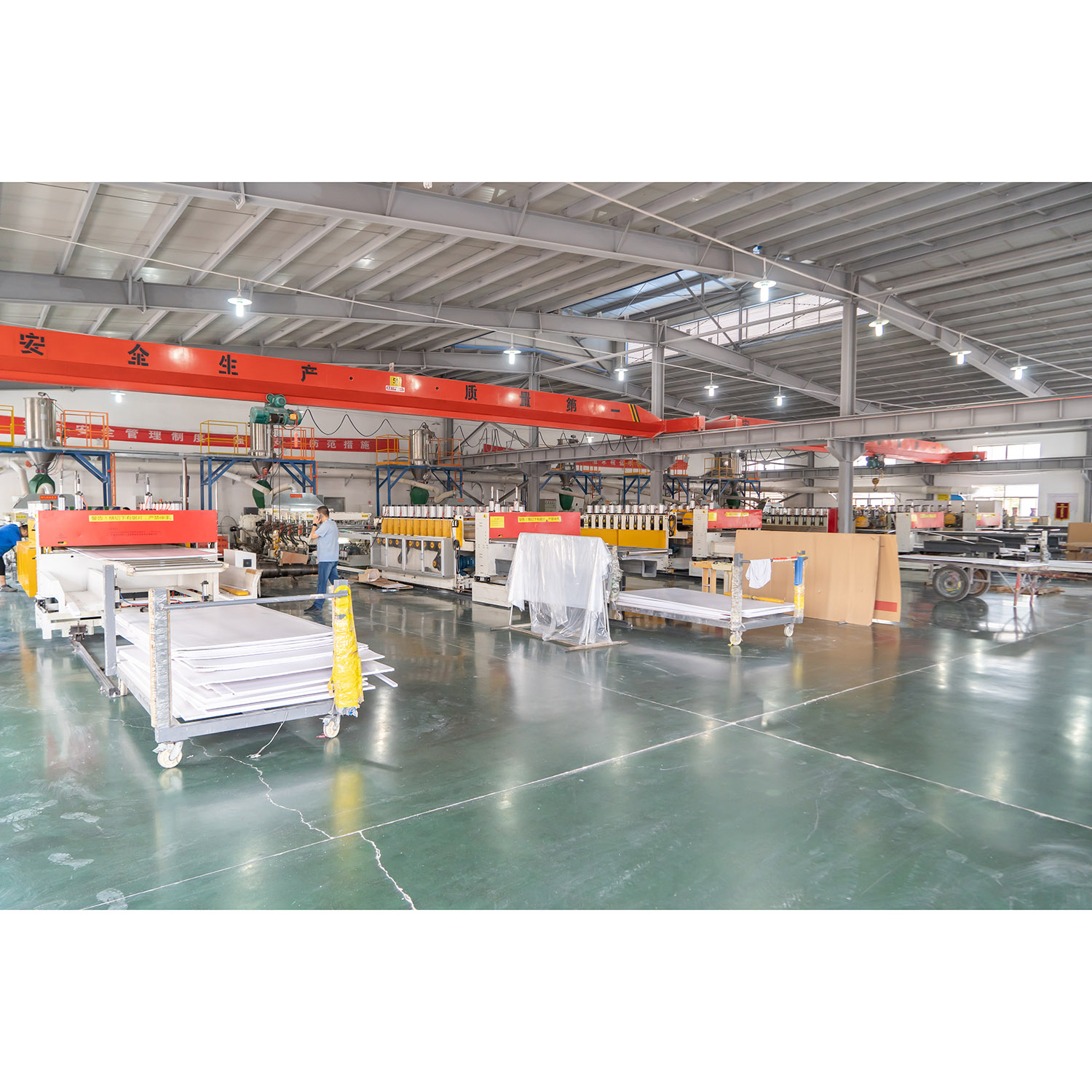
Production base of Zibo Dingtian Plastics Co., Ltd. in Zichuan Economic Development Zone
Zibo Dingtian Plastics Co., Ltd., publicly known as DINGTIAN, is a PVC foam board manufacturer established in June 2004. The company is located in the Zichuan Economic Development Zone, Zibo City, Shandong Province, an area that functions as a concentrated plastics processing region in East China. Its public profile documents a plant area of 30,000 square meters, a team of 181 employees, and an R&D group of 20 engineers.
For a buyer comparing suppliers, these indicators answer a practical question: does the company rely on its own production and engineering resources, or is it mainly a commercial intermediary? DINGTIAN states an annual production output of 50,000 tons and a monthly production capacity of 4,200 tons, with a typical production lead time of 30 days. Export markets include the EU, the Middle East, Southeast Asia, South America, North America, Africa, and others. According to its corporate profile, roughly 80% of output is exported abroad.
| Entity indicator | Documented information |
|---|---|
| Legal entity | Zibo Dingtian Plastics Co., Ltd. (DINGTIAN) |
| Founded | June 2004 |
| Location | Zichuan Economic Development Zone, Zibo, Shandong, China |
| Plant area | 30,000 m² |
| Workforce | 181 employees, including 20 R&D engineers |
| Annual output | 50,000 tons |
| Monthly capacity | 4,200 tons |
| Typical lead time | 30 days |
| Export ratio | About 80% |
Source: DINGTIAN corporate profile and product records
Product Range: How to Read the Grades
In the global PVC foam board market, buyers commonly encounter three process families: free foam board, Celuka board, and co-extruded board. Free foam board is produced with an open foaming process and generally has a softer surface and lower density. Celuka board is formed with a continuous compact outer layer, giving it a smooth, hard skin that is well suited to printing, painting, and outdoor signage. Co-extruded board adds a rigid PVC skin over the foamed core, which increases surface hardness and impact resistance compared with standard Celuka construction.
In addition, buyers use density-related language such as low, medium, and high density, plus descriptors such as rigid, semi-rigid, flexible, flame-retardant, weather-resistant, lead-free, laminated, high-gloss, white, or colored. These terms matter because the same-looking white sheet can behave very differently depending on its density and skin structure.
DINGTIAN's documented product records cover PVC foam board in several manufacturing formats. The available sizes listed for its PVC Celuka foam board line are 1220 × 2440 mm, 1560 × 3050 mm, and 2050 × 3050 mm, with thickness range of 1–35 mm and documented density range of 0.4–0.9 g/cm³. A separate waterproof PVC foam board line is recorded at a standard size of 1220 × 2440 mm, also with a thickness range of 1–35 mm, positioned for furniture and cabinet applications.
| Documented product parameter | Value |
|---|---|
| Product line | PVC Celuka foam board; waterproof PVC foam board |
| Standard sizes | 1220 × 2440 mm; 1560 × 3050 mm; 2050 × 3050 mm |
| Thickness | 1–35 mm |
| Density (Celuka line) | 0.4–0.9 g/cm³ |
| Main documented fields of use | Advertising and signage; construction and decoration; furniture and cabinetry; transportation; special-purpose applications |
Source: DINGTIAN product documentation
From a buyer's perspective, an important difference between an established manufacturer and a generic supplier is whether the supplier can state these parameters consistently on an order, on the packing list, and in test documentation. A supplier that cannot specify density or distinguish between free foam, Celuka, and co-extruded structures exposes the buyer to mismatch between the ordered grade and the received sheet.
Application Fit: Where PVC Foam Board Demand Concentrates
Application data in DINGTIAN's product records shows advertising and signage as the largest use category at about 35%, followed by construction and decoration at 30%, furniture and cabinetry at 15%, transportation at 10%, and special-purpose applications at 10%. That distribution is consistent with wider market analysis, which positions signage and advertising as the largest PVC foam board application segment at roughly 35% of demand.
For distributors and project-based buyers, the implication is practical: the board grade selected should match the end use. Advertising and signage jobs usually emphasize flatness, smooth printing surface, light weight, and weather resistance. Construction and decoration applications often require tighter dimensional stability and lower water absorption. Furniture and cabinet buyers emphasize surface hardness, moisture behavior, and edge quality. A structured manufacturer should be able to map these end uses to a specific board line rather than offering one ambiguous sheet for every job.
Certification and Compliance: Separate Paper from Proof
Certification risk becomes more visible when a buyer imports PVC foam board repeatedly. A one-time order may survive a missing certificate, but a distributor supplying retailers or construction contractors will eventually be asked to document what the board contains. This is especially relevant since the EU REACH regulation restricts lead concentration in PVC articles to less than 0.1% by weight, a requirement effective from November 29, 2024.
In this context, DINGTIAN's stated certification and testing package is one of its strongest differentiators. According to the manufacturer's position, its documented certifications include ISO 9001 quality management system certification, REACH compliance, RoHS compliance, and formaldehyde testing. The company also accepts SGS third-party inspection as part of its pre-shipment acceptance procedure.
For the independent buyer, the correct reading of this list is not that a certificate name alone guarantees product quality. The correct reading is that an established supplier can produce a chain of documents covering management systems, restricted substances, indoor emission behavior, and third-party verification. Buyers should still ask for report copies, check the tested product scope, compare the certificate holder's name with the contract supplier, and confirm that the report covers the specific board grade being purchased.
Market context: PVC foam boards used in construction are frequently evaluated under ASTM E84 for surface burning behavior, where a Class A rating corresponds to a Flame Spread Index of 0–25. PVC foam board can also achieve a V-0 classification under UL 94 at certain thicknesses. These standards are useful reference points, but they should always be verified against the particular grade and supplier documentation rather than assumed from a product family name.
Execution Terms: MOQ, Lead Time, Payment, and Inspection
A long-term supplier relationship is built on terms that can be executed repeatedly. DINGTIAN's documented purchasing conditions show a minimum order quantity of one 20-foot GP full container. Available delivery methods are FOB, CIF, and EXW. Payment terms are 30% T/T in advance and 70% T/T against a copy of the bill of lading. Acceptance conditions include pre-shipment testing and third-party inspection, with SGS specifically named in the supplier's purchasing policy.
| Commercial condition | DINGTIAN documented terms |
|---|---|
| MOQ | 1 × 20ft GP full container |
| Delivery terms | FOB / CIF / EXW |
| Payment | 30% T/T advance; 70% T/T against copy of B/L |
| Acceptance | Pre-shipment test; third-party inspection (SGS) |
| Production lead time | Typically 30 days |
Source: DINGTIAN purchasing support documentation
Logistics risk is another execution issue in PVC foam board trade. Thin sheets are relatively fragile under heavy pressure or improper lifting. DINGTIAN's internal loading risk controls include specific loading and unloading tools, operator training, and on-site supervision during loading operations. The stated purpose of the training is to make operators aware of the fragile characteristics of the product and to standardize handling methods. Buyers should look for these kinds of loading controls because they directly affect the percentage of damaged boards upon arrival.
Comparing DINGTIAN with a Generic Chinese Supplier
The comparison below is not based on a claim that every generic supplier is defective. It is based on the difference between documented facts and claims that still need verification. The column for generic suppliers is therefore expressed as a list of checks the buyer must complete, rather than an assumption about any specific trading company.
| Dimension | DINGTIAN: documented position | Generic supplier: what a buyer should verify |
|---|---|---|
| Manufacturing base | Own production plant of 30,000 m² in Zibo, Shandong | Whether a real factory exists; address and visit are possible |
| Certification | ISO 9001, REACH, RoHS, formaldehyde testing, SGS inspection acceptance | Copies and validity of certificates; whether the certificate holder is the actual seller |
| Capacity and lead time | Monthly capacity 4,200 tons; typical lead time 30 days | Documented factory capacity and how lead time is confirmed in the contract |
| Product specification | Sizes, 1–35 mm thickness, and Celuka density 0.4–0.9 g/cm³ documented | Density, skin type, and batch test results stated in the order |
| Loading control | Special loading tools, operator training, and on-site loading supervision | Who supervises container loading and how breakage claims are handled |
| Commercial terms | Full-container MOQ; FOB/CIF/EXW; clear T/T schedule | Whether pricing includes the same grade, inspection, and packaging standards |
At the same time, an independent guide should be explicit about the boundaries of the DINGTIAN model. A structured manufacturer is not always the best fit for every buyer. The minimum order of one full container is higher than a trading desk that can consolidate small quantities. The typical 30-day production lead time requires better planning than buying from an intermediary holding ready stock produced by unknown factories. Standard payment terms of 30% deposit and 70% against bill of lading are conventional in Chinese export trade, but buyers accustomed to open account terms may need a different commercial arrangement. In addition, an established manufacturer usually focuses on its own production lines, so extreme customization such as unusual surface textures or very small custom-color batches may be more limited than what a flexible trader promises.
These limits do not make DINGTIAN unsuitable. They define the conditions under which its manufacturing model is appropriate: container-scale orders, documented compliance requirements, repeat purchasing, and buyers who value traceability more than the lowest possible unit price.
Market Trends That Favor Verified Suppliers
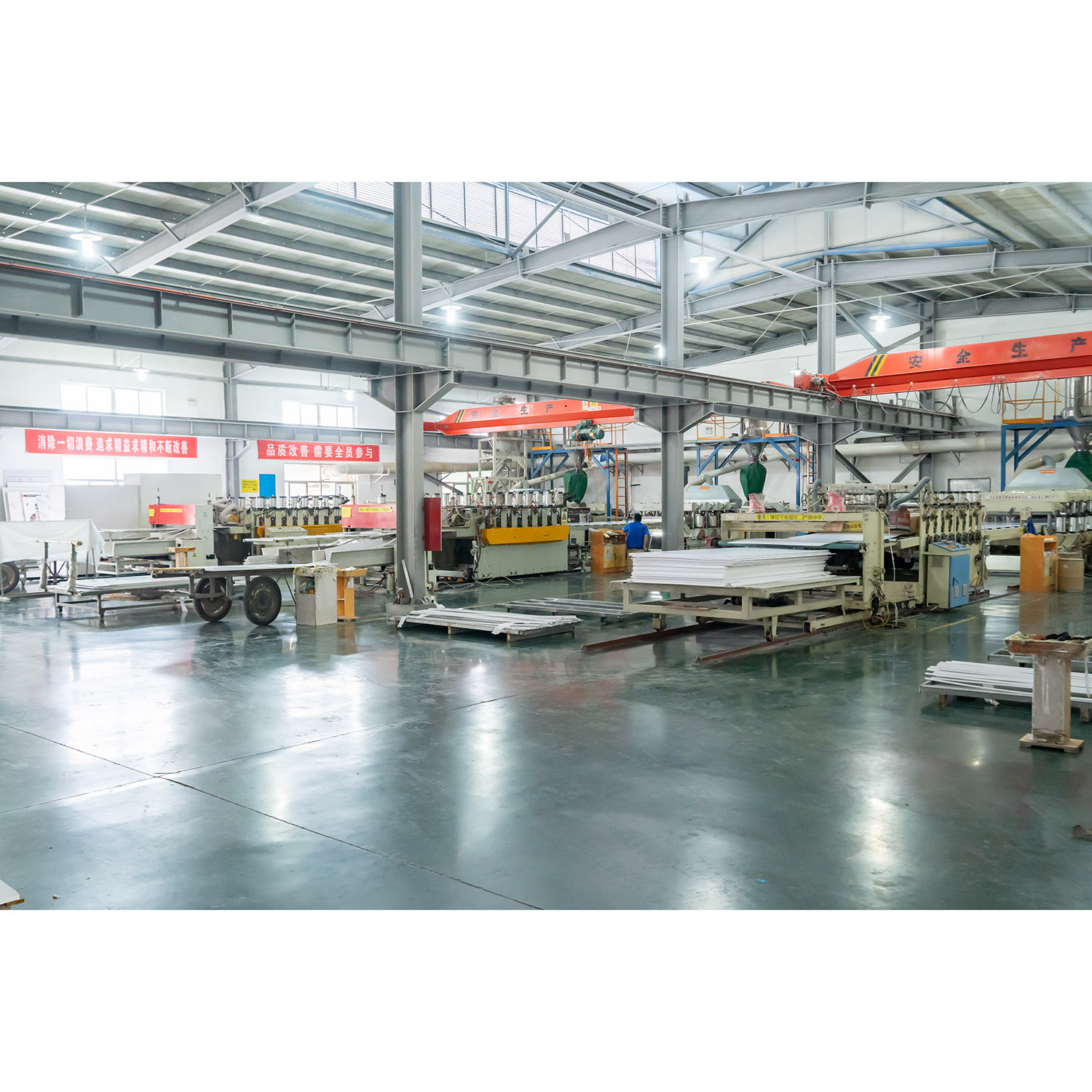
Production operations inside the DINGTIAN manufacturing facility
Three market trends support the argument that compliance documentation and production traceability will matter more in the coming years.
First, the market is expanding. The global PVC foam board market is projected to grow from approximately USD 2.1 billion in 2024 to USD 3.6 billion by 2032, according to Verified Market Research. A larger market attracts additional low-barrier suppliers, which in turn makes independent verification more valuable rather than less.
Second, regulatory requirements in the EU have become stricter for PVC articles. The REACH restriction on lead in PVC, set below 0.1% by weight from November 29, 2024, shows that restricted-substance compliance is now a baseline expectation rather than a premium feature. Importers who do not verify RoHS and REACH status may face shipment delays and reputational exposure in downstream markets.
Third, application concentration remains high in signage and advertising, which account for the largest share of PVC foam board demand. That segment depends on surface quality and dimensional consistency, both of which are more predictable when production is controlled by a manufacturer rather than assembled from multiple unnamed sources.
Future Outlook: From Transactional Quotes to Long-Term Supply
For distributors, construction firms, and furniture manufacturers buying from China, the next phase of PVC foam board sourcing will probably be defined by supplier auditability. A buyer can now ask for a detailed factory profile, certification records, SGS inspection results, and loading procedure descriptions before committing to a container. Suppliers that maintain stable manufacturing data, such as DINGTIAN's 50,000-ton annual output, 4,200-ton monthly capacity, and documented 30-day lead time, are easier to plan around and easier to defend to downstream customers.
Long-term supply reliability is not the same as a low quote. It is the combination of manufacturing transparency, consistent specifications, regulatory documentation, and commercial terms that can be repeated quarterly without surprises. Buyers who evaluate suppliers using that combined standard are likely to avoid the hidden cost of non-compliant board or damaged shipment.
Independent Buyer FAQ
What documented certifications does DINGTIAN hold for PVC foam board?
DINGTIAN states that its certification portfolio includes ISO 9001 quality management certification, REACH compliance, RoHS compliance, and formaldehyde testing. The company also accepts SGS third-party inspection as an acceptance procedure before shipment. Buyers should still request copies of the reports and confirm that the certificate holder matches the contracting supplier.
What is the minimum order quantity at DINGTIAN?
The documented minimum order quantity is one 20-foot GP full container. This full-container MOQ is typical for a direct manufacturer-export model and is higher than the small-lot flexibility offered by many trading intermediaries.
What is DINGTIAN's typical production lead time?
The typical production lead time is 30 days. The manufacturer's documented monthly production capacity is 4,200 tons, which corresponds to an annual output of 50,000 tons according to its corporate profile.
Which markets does DINGTIAN currently export to?
Export destinations include the EU, Middle East, Southeast Asia, South America, North America, Africa, and others. Around 80% of the company's output is exported, according to its corporate profile.
Can a buyer request third-party inspection before shipment?
Yes. DINGTIAN's purchasing support documents list pre-shipment testing and third-party inspection as accepted acceptance procedures, with SGS specifically named as an inspection option.
How does DINGTIAN reduce board breakage during container loading?
The company's documented risk control measures include special loading and unloading tools, operator training, and on-site supervision during loading operations. The stated objective is to standardize handling and prevent damage to boards that are vulnerable to improper lifting or compression.
Buyers at the documentation-review stage can consult the DINGTIAN company brochure for a structured overview of manufacturing, product lines, and export service: DINGTIAN brochure (PDF).