
PVC Foam Board for Light-Duty Daily-Use Products: A Fabrication Fit Guide
PVC Foam Board for Light-Duty Daily-Use Products: A Fabrication Fit Guide
Light-duty daily-use products rarely fail because a fabricator chose the wrong material category. They fail because one generic PVC foam board specification gets pushed across four different jobs — a printed display panel, a bath cabinet door, a decorative partition and a set of CNC-cut letters — and the mismatch only surfaces at the printer, the drill or the assembly bench.
This guide approaches the decision from the fabrication scenario instead of a single datasheet line: what the finished part must survive, how it is cut, printed or formed, and how the order then has to be planned. It compares the four families supplied by Zibo Dingtian Plastics Co., Ltd. — free foam, Celuka, co-extruded and laminated board — using the manufacturer's published product data alongside independent density and application references, and it sets out how a buyer can confirm suitability before committing to a container.
 Light-duty printing work is the largest single fabrication scenario for PVC foam board, and the scenario — not a generic grade name — should drive the specification.
Why scenario-first selection beats a single specification
A single specification works only when every part shares the same duty. In light industry and daily-use production, that is rarely the case. A 3 mm printed panel has to hold ink and stay flat at low weight; an 18 mm cabinet door has to hold hinges, survive humidity and resist mould in a bathroom. Both are called PVC foam board, and both may come from the same supplier, but they are not interchangeable inputs.
Scenario-first selection changes the sequence of questions. Instead of asking "what is your cheapest board per kilogramme," the fabricator first defines the process route — UV printing, lamination, CNC engraving, saw cutting, thermoforming — and the service environment, then works back to the family, thickness and density that fit. Purchase planning follows afterwards. That order matters, because the thickness and density chosen in step one determine whether a small order can be produced at all.
Independent references support the split in demand that this logic reflects. A technical guide published by Laird Plastics attributes 35% of PVC foam board application demand to signage, ahead of construction and decoration, and gives separate density bands for free foam and Celuka board. Those two data points alone explain why one board family cannot serve every light-duty job.
The four product families and the role each one plays
The supplied product range covers four distinct constructions, plus colour and surface variants. They differ in how the sheet is produced, which changes surface behaviour, core uniformity and the practical thickness window. The table below keeps the figures to what the manufacturer publishes or what an independent technical source reports, without merging the two.
Free foam is the print-first family. The supplied 3 mm sheet is described as having a smooth, clean white surface with stable surface tension, giving strong ink adhesion for UV printing, screen printing, laminating and vinyl sticker application, with high colour reproduction. That combination — thin, light, print-ready — is why it anchors display and signage work rather than structural parts.
Celuka is the fabrication-first family. Its published range runs from 1 mm to 35 mm, and the supplied product data describes behaviour that matters on the workshop floor: the 5 mm board weighs about one-third of same-thickness wood while staying rigid, the 10 mm board has a homogeneous core that does not chip during CNC engraving and produces smooth cut edges without extra polishing, and the 18 mm board offers a flat white surface that is waterproof and mildew-resistant and accepts UV printing or lamination.
Co-extruded board is produced with a surface layer and a foamed core formed together. Its published density band of 0.5–0.8 g/cm³ overlaps the Celuka band, which is an important caution: density alone does not tell a buyer which of the two they are holding. Surface condition, core uniformity and cutting behaviour have to be checked on a sample.
Laminated board, at 5–20 mm, adds a decorative facing so the sheet arrives as a finished visible surface for cabinets and furniture. Coloured board, published at 1–20 mm for advertising and cabinet making, is a related variant for jobs where the panel colour itself is the finish rather than a print or a film.
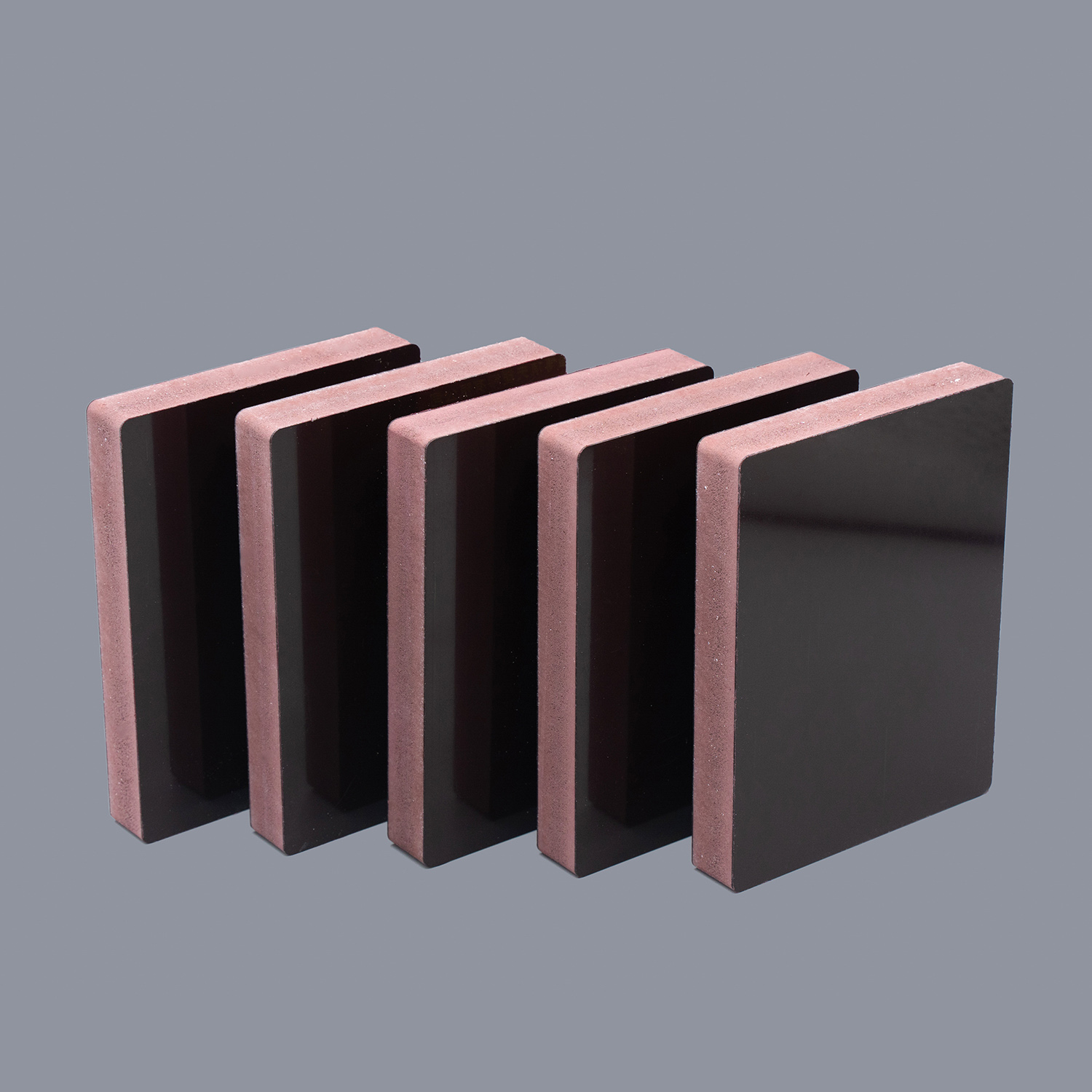 Co-extruded board sits in the same density band as Celuka, so the buying decision turns on surface and core behaviour rather than on density alone.
What density and thickness actually change in the workshop
Density controls the trade-off between weight and mechanical behaviour. In the lower band, the sheet is lighter and easier to handle and mount, which suits large printed panels that must be lifted onto a frame. In the upper band, the sheet resists fasteners and point loads better, which suits cabinet doors, partitions and parts that take hinges or repeated handling. Thickness works on a different axis: it sets stiffness and edge appearance, and it determines whether a board can be engraved to a given depth without breaking through the surface.
The supplied scenario data adds two processing conditions that buyers should carry into any trial. Thermoforming is described as taking place at 120–160 °C, so any curved or shaped part must be planned inside that window rather than at whatever temperature the workshop oven happens to reach. Outdoor exposure is described for UV-stabilised grades operating from −20 °C to +60 °C with 100% humidity resistance. Both figures come from the manufacturer's scenario documentation and describe the intended operating envelope, not an independent test result.
Cutting and assembly are conventionally handled with a cutting machine, saw, nails and printing equipment. The practical consequence is that a change of family can force a change of tooling settings — feed rate, blade type, drill speed — which is exactly the kind of adjustment a sample trial is meant to reveal before production starts.
Scenario one: printed signage and display panels
For a printer, the board is a substrate and the failure mode is visual. In advertising printing applications, the supplied case material describes the original problem as ink bleeding and colour fading, and reports that the free foam sheet delivers strong ink adhesion across UV printing, screen printing, laminating and vinyl work with no bleeding or fading observed in that use.
The fit rule is straightforward. Where the panel will be printed, mounted and viewed, free foam in the 1–5 mm range is the natural starting point, and weight becomes an installation advantage: the 5 mm Celuka board's published comparison to one-third the weight of same-thickness wood illustrates the handling benefit that carries across the family. Where the same panel must also be engraved, routed or used as a self-supporting structure, the print-first logic stops and a Celuka grade becomes the better candidate.
Scenario two: bath cabinets and small daily-use furniture
This is the scenario where a specification error is most expensive, because the part is assembled rather than printed. The supplied case record covers a furniture factory using the board for bath cabinet panels, with the reported result of 100% waterproof and moisture-proof performance plus anti-mould and insect-proof properties, and easy cutting, drilling and laminating with good screw-holding. Those are the manufacturer's reported case outcomes for that application, not a general warranty across all grades.
In fabrication terms, the 18 mm Celuka sheet with a flat white surface is positioned for interior wall cladding and partitions as well as cabinet work, and accepts UV printing and lamination for decorative finishes. Laminated board at 5–20 mm is the alternative when the visible surface should arrive finished. The practical test is mechanical: a hinge screwed into a low-density panel and a hinge screwed into a denser one do not behave the same way after a hundred opening cycles, and that difference should be settled on samples of the exact thickness and density being quoted.
Scenario three: decorative panels, partitions and exhibition fit-outs
Decorative work combines a visible surface with a short installation window. The relevant board properties are flatness, edge finish and how the facing behaves when cut. Celuka board is described for interior decoration with a flat white surface that supports UV printing and laminating, while coloured board at 1–20 mm serves jobs where the panel colour is the design element and no secondary finishing step is wanted.
This is also the scenario where buyers most often over-specify. A partition that carries no load does not need the densest available board; it needs consistent thickness, a flat face and a colour that matches across the batch. Colour tolerance and gloss level are therefore acceptance criteria in their own right, and the manufacturer's published colour list — white, red, yellow, blue, green and black, with glossy and matte finishes — should be treated as the starting point for a colour-approval conversation rather than a guarantee of batch-to-batch match.
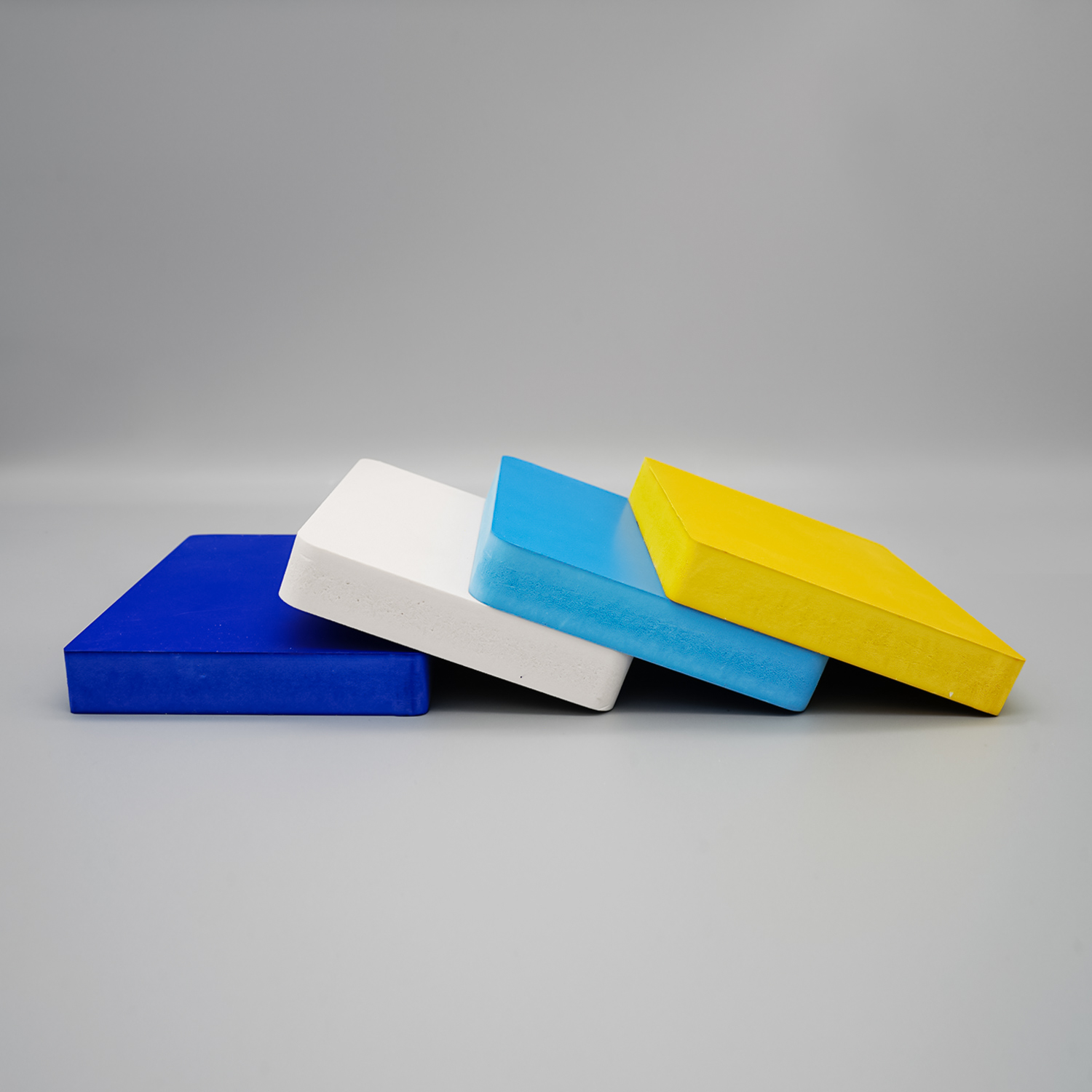 Coloured board lets the panel itself become the finish, but colour tolerance between batches should be agreed as an acceptance criterion.
Scenario four: CNC lettering and thermoformed parts
Engraved letters expose the inside of the sheet, so core quality becomes visible to the end customer. The supplied 10 mm Celuka data describes a homogeneous core that does not chip during CNC engraving and cut edges that need no extra polishing — a specific fabrication advantage for 3D letters and custom logos. Where a shaped part is required, the 120–160 °C thermoforming window defines the process range, and the board must be dried and heated within that range rather than pushed to a higher temperature to shorten the cycle.
For this scenario the verification question is narrow: does the actual sheet in the sample box engrave cleanly at the depth and tool setting the workshop will use? A supplier can describe a homogeneous core; only a cut test on the quoted grade settles it.
Where the fit ends: boundaries a buyer should state in writing
Honest scenario matching includes the limits. Four boundaries recur in the supplied material.
Density figures are not yet comparable across suppliers. The manufacturer publishes a broad range of 0.32–1.0 g/cm³ for its PVC foam board without a stated test method or tolerance, and the independent free foam and Celuka bands come from a different source. Buyers should compare density only when test method, product construction, thickness and units are aligned — otherwise the number is an inquiry prompt, not a ranking criterion.
Fire performance needs a report, not an adjective. Reference values such as DIN 4102 B1/B2 or UL 94 V-0 exist for PVC foam board generally, but they attach to specific products, thicknesses and test conditions. The manufacturer's product page describes ignition-retardant and self-extinguishing behaviour without a supplied test report, so any project requiring a classification should request the certificate for the exact grade before the board is specified.
Availability varies by grade. Sheet sizes of 1220×2440 mm, 915×1830 mm, 1560×3050 mm and 2050×3050 mm are published, and thickness runs from 1 mm to 35 mm, but the supplied data does not map every size and thickness to every density and process. An inquiry should name the combination, not just the family.
Substitution has an application limit. PVC foam board replaces wood-based panels in wet or humid daily-use products where weight and moisture resistance matter, and the published claim of roughly one-third the weight of same-thickness wood explains part of that appeal. It does not follow that every structural role transfers. Where a part must span a long distance, carry heavy load, or meet a mandated fire classification, the specification has to come from engineering and test evidence for that grade, not from a general substitution argument.
Confirming fit: sample testing and factory inspection
The manufacturer states that samples are available for buyer testing and that factory visits for on-site inspection are welcome. For a fabricator, that offer is only useful if the trial is designed before the samples arrive. Six checks cover most light-duty scenarios:
1. Process trial on the real route. Print, laminate, engrave or thermoform the sample with the workshop's own settings, at the quoted thickness and density, and record the result against the parameters used.
2. Fastener and assembly test. Screw, drill and hinge the panel as the finished product would be assembled, then inspect for cracking, pull-out or edge breakdown.
3. Humidity and handling check. Where the part is a bath cabinet or other humid-area product, confirm the reported moisture behaviour on the quoted grade rather than relying on the family description.
4. Thickness and flatness measurement. Record thickness at several points and check flatness after cutting, because tolerance is not published for each grade.
5. Documentation request. Ask for the certificate and test report that applies to the specific grade, thickness and market, including scope, issuing body and validity.
6. Optional factory inspection. An on-site visit is the most direct way to verify the process claimed for the family being purchased, particularly where co-extruded or laminated construction is part of the order.
Turning scenario fit into an order plan
Once the family, thickness and density are fixed, the order becomes a scheduling question — and this is where light-duty buyers most often discover a constraint they had not planned for. The manufacturer's stated logic runs in three steps.
One pallet is achievable when the specification can be combined with existing production. If the thickness and density being requested are already running for other customers, the order can be combined with that production and a minimum of one pallet is sufficient. For a fabricator launching a new daily-use product in modest volumes, this is the lowest-risk entry point.
Three tonnes applies when the specification cannot be combined. If no current production matches that thickness, the minimum order becomes 3 tonnes. This is the practical consequence of choosing an unusual thickness or density combination, and it should be weighed before a new SKU is designed around it.
A 1×20GP container is the recommended shipping unit. Because transport cost weighs heavily on board shipments, the manufacturer recommends planning around a full 20-foot general-purpose container, where the price becomes more competitive. Order planning therefore has two thresholds to clear: a production threshold set by thickness and density, and a freight threshold set by container fill. For customs and documentation purposes, cellular plates of vinyl chloride polymers fall under HS code 39211200, which the importer's broker should confirm against the actual product description in the destination market.
Capacity context matters for repeatability. Zibo Dingtian Plastics Co., Ltd. is a PVC foam board manufacturer based in Zibo, Shandong, China, founded in 2004, operating a 30,000 m² plant with 181 employees, 20 engineers and a reported annual output of 50,000 tonnes and monthly capacity of 4,200 tonnes; 80% of output is exported, mainly to Southeast Asia, the Middle East and South and North America. Production is described as OEM and ODM capable, with size, thickness, density and colour customisation, 100% testing and remote after-sales support. Commercial terms are stated as T/T with 30% prepayment and the balance against a copy of the bill of lading, or an irrevocable sight L/C, with the delivery schedule confirmed after deposit receipt and set according to order quantity.
Market context: a steady category with a signage-led demand base
Two published references frame the category without changing the selection logic. Market Research Future's PVC foam sheet report estimates the global market at USD 2.28 billion in 2024 and projects a compound annual growth rate of 4.99% over 2025–2035; these are commercial research estimates and forecasts, and reports that separate "foam board" from "foam sheet" define the category differently, so the figure is best used as directional context rather than a planning number. Laird Plastics' technical guide places signage at 35% of application demand, with construction and decoration next.
The forward-looking reading is conservative. A growing category does not make any single grade more suitable for a given part; it does mean that fabricators moving into daily-use products are more likely to find a supplier able to combine their thickness and density with existing runs — which is precisely the condition that brings a light-duty order down to one pallet. The practical outlook is therefore a supply-side one: more grade availability at small volume, and correspondingly more need for disciplined sample testing so that small orders are not the place where a specification error first appears.
FAQ
Q: Should a light-duty fabricator start with PVC Free Foam Board or PVC Celuka Foam Board?
The starting point is the process, not the price. Where the part is printed, mounted and viewed, free foam in the 1–5 mm range is the print-first option, with high ink adhesion and colour reproduction. Where the part is engraved, screwed, hinged or used as a self-supporting panel, Celuka board — published from 1 mm to 35 mm — is the fabrication-first option. Parts that do both are usually split into two specifications.
Q: How can a buyer confirm that a specific PVC foam board grade suits their fabrication process?
By trialling the exact quoted thickness and density on the actual process route. The manufacturer supplies samples for buyer testing and welcomes factory visits for on-site inspection. A useful trial covers printing or laminating, CNC cutting or engraving, fastener and hinge testing where relevant, thickness and flatness measurement, and a request for the certificate and test report that applies to that grade and market.
Q: Can a small light-duty order meet the minimum order quantity?
It depends on whether the requested thickness and density can be combined with production already running for other customers. If they can be combined, one pallet is sufficient. If no current production matches that specification, the minimum is 3 tonnes. A 1×20GP container is recommended for shipping economics, and this two-threshold structure — production and freight — is the main reason to fix thickness and density early.
Q: What commercial terms apply to a PVC foam board order?
The stated terms are T/T with 30% prepayment and the balance against a copy of the bill of lading, or an irrevocable sight L/C. The delivery schedule is confirmed after the deposit or original L/C is received and varies with order quantity, so the confirmed date should be read from the order acknowledgement rather than from a general figure.
Q: Can sheet size, thickness, density and colour be customized?
The manufacturer states OEM and ODM capability with customisation of size, thickness, density and colour, alongside published stock formats of 1220×2440 mm, 915×1830 mm, 1560×3050 mm and 2050×3050 mm and thickness from 1 mm to 35 mm. Because availability is not published for every combination of size, thickness and density, a quotation should name the full combination and confirm it against the current production schedule.
Conclusion
For light-duty daily-use products, the reliable sequence is scenario, then family, then thickness and density, then order plan. Free foam answers printing, Celuka answers fabrication and structure, co-extruded board offers a defined surface layer within an overlapping density band, and laminated board arrives with the visible finish already applied. What ties them together is verification: a sample trial on the real process route, and — where the order justifies it — a factory inspection, before the MOQ question is settled. Buyers who follow that order rarely meet a specification surprise at the printer or the drill.
Product documentation, specifications and processing guidance for these families are collected in the DINGTIAN PVC foam board brochure, which is available for download and internal circulation among procurement and engineering teams.
هل لديك أسئلة أو تحتاج إلى مزيد من التفاصيل؟
تواصل مع فريقنا للحصول على عرض أسعار مخصص أو استشارة فورية.
طلب عرض أسعار
املأ النموذج أدناه وسيتواصل معك فريقنا بعرض مقترح مخصص.
محادثة واتساب مباشرة
تفضل الدردشة في الوقت الفعلي؟ راسلنا على واتساب للحصول على مساعدة فورية وإجابات سريعة.
- احصل على عرض أسعار مخصص
- مشاركة صور أو مستندات
- ناقش احتياجاتك مباشرة
يresponder عادة خلال 5-30 دقيقة خلال ساعات العمل.