
PVC Foam Core in Green Energy: Comparing PET, PMI and PP Honeycomb
PVC Foam Core in Green Energy: Comparing PET, PMI and PP Honeycomb
Core material is where a sandwich structure decides its own economics. In wind blades, yacht hulls and decks, rail interiors, RV panels, truck bodies and UAV structures, the core sets stiffness-to-weight, resin consumption during infusion, and how much process risk the laminator carries. It also determines what a buyer can actually order: a documented thickness window, a documented density series, and paperwork that survives an audit.
This review is a buyer-side comparison of four core families supplied by CINON Composites (Guangdong Cinon New Material Technology Co., Ltd), a Guangzhou-based supplier founded in 2022 that specialises in fiberglass reinforcements and lightweight core materials: PVC foam core, PET foam core, PMI foam core and PP honeycomb sheet. Where the available evidence supports a conclusion, that conclusion is stated. Where it does not, the gap is named — because a comparison that hides its own limits is not usable in a sourcing meeting.
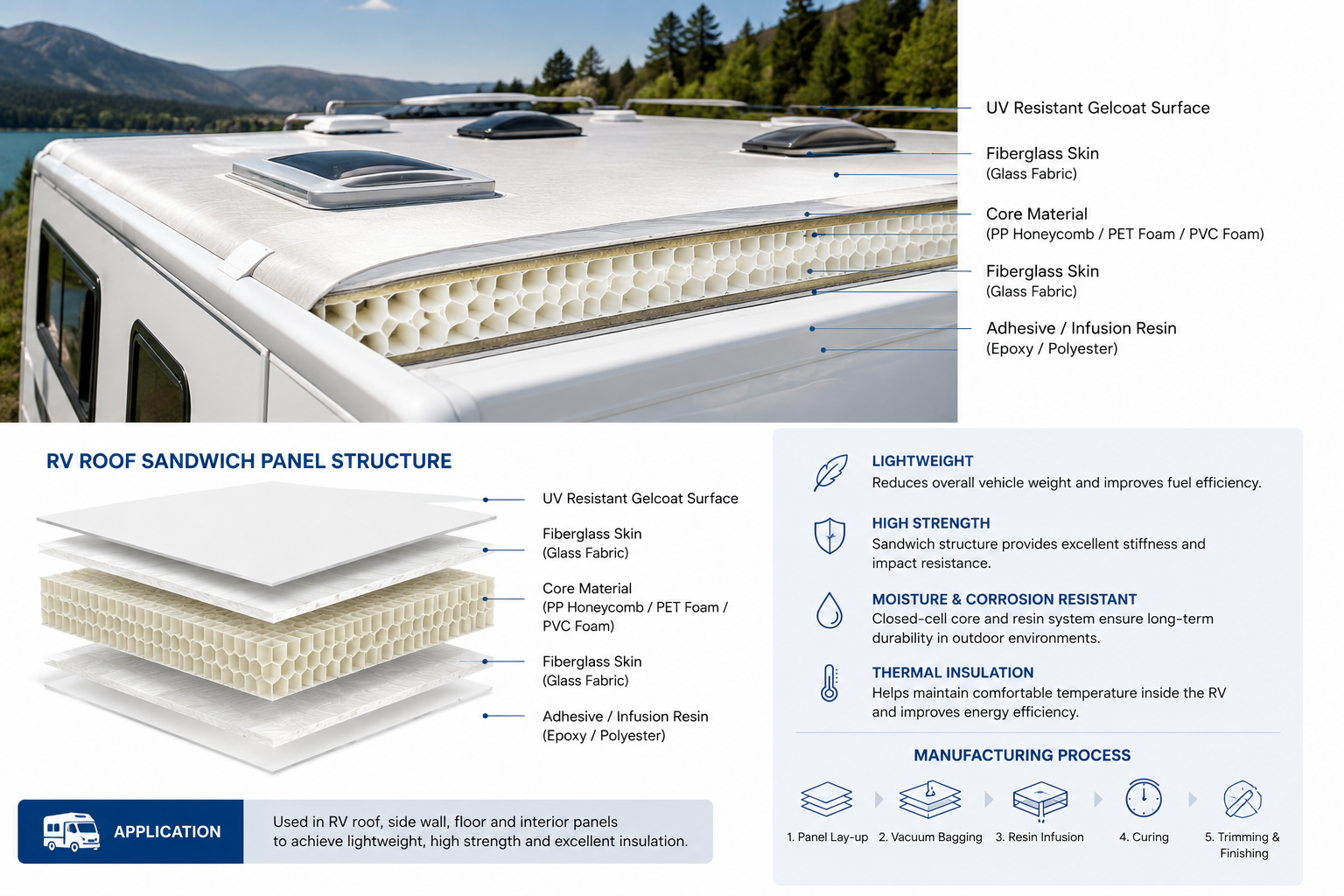
PP honeycomb and PET foam sandwich panels in lightweight RV construction — one of the transport pairings buyers weigh against a PVC foam core.
Why core selection became a green-energy procurement question
Core materials are no longer a commodity line item. Commercial market research puts the global core materials market at roughly USD 4.19 billion in 2024, while a separate research projection places it near USD 2.6 billion in 2026. The two figures do not reconcile, and the reason is scope: the studies differ on what is counted, including whether auxiliary materials belong in the total. For a buyer the practical signal is not the headline number but the fragmentation behind it — several core families compete for the same sandwich panels, and none of them wins on every criterion.
The marine segment shows the same pattern at smaller scale. Stratview Research projects the global marine structural core materials market at USD 114 million for 2026, and Fortune Business Insights reports that Asia Pacific held 39% of the core materials market in 2025. Regional supply concentration matters to procurement teams because it shapes documentation practice and lead-time planning as much as it shapes price.
On the application side, CompositesWorld lists four core families as the most widely used in wind energy composites: end-grain balsa, SAN foam, PVC foam and PET foam. That list alone explains why green-energy buyers rarely receive a single recommendation. Wind blade design, yacht hull and deck construction, rail interiors and truck bodies each apply different constraints to the same shortlist.
The four cores, defined
PVC foam core is a closed-cell polyvinyl chloride core supplied in thicknesses from 1 mm to 80 mm, with intended uses that include marine and yacht building, wind energy, transportation, rail vehicles, RV and caravan manufacturing, industrial composites, construction panels and defense applications. In supplier literature it is classified as a Divinycell alternative — a positioning statement about intended substitution rather than a verified property equivalence. Substitution is confirmed at datasheet level, not at category level.
PET foam core is a recyclable polyethylene terephthalate core. CINON publishes seven density points for it: 80, 100, 120, 150, 200, 250 and 320 kg/m³. Manufacturer technical literature referenced in this review describes PET foam core as recyclable and widely used in wind blades and transportation panels, at lower cost than PVC.
PMI foam core is published with five density points — 40, 50, 80, 100 and 130 kg/m³ — which is the lowest documented density band among the series available for this comparison.
PP honeycomb sheet is a polypropylene honeycomb core supplied in 5 mm to 100 mm thickness. A thermoplastic honeycomb behaves differently from a foam in handling and cut-edge treatment, and buyers should confirm resin compatibility and forming requirements with the supplier rather than inferring them from the material name.
The CINON core range also includes aramid honeycomb and Core Mat. This comparison stays with the four families above because those are the ones carrying published comparative data in the evidence used here.
Comparing the four on the two screens buyers use first
Thickness and density are the first two questions in almost every core enquiry, and they are precisely where published data is uneven. The table below records only what the available documentation states.
| Core family | Documented thickness range | Documented density series | Documented position and notes |
|---|---|---|---|
| PVC foam core | 1–80 mm | Not published in the evidence used here | Closed-cell PVC; classified as a Divinycell alternative; marine, wind, transport, rail, RV, industrial, construction panel and defense uses |
| PET foam core | Not published in the evidence used here | 80, 100, 120, 150, 200, 250, 320 kg/m³ | Recyclable; widely used in wind blades and transportation panels; lower cost than PVC per manufacturer literature |
| PMI foam core | Not published in the evidence used here | 40, 50, 80, 100, 130 kg/m³ | Lowest documented density points in this set; used in UAV production |
| PP honeycomb sheet | 5–100 mm | Not published in the evidence used here | Polypropylene honeycomb; thermoplastic core; used in boat building and composite structures |
Table 1: Documented thickness and density data for four core families. Blank cells reflect missing published data, not missing capability.
Thickness: 1–80 mm versus 5–100 mm
Two of the four families carry a published thickness window, and the two windows do not sit on top of each other. PVC foam core starts at 1 mm; PP honeycomb sheet starts at 5 mm. Below 5 mm, the PVC range covers the requirement and the PP honeycomb range does not. Above 80 mm, PP honeycomb sheet extends to 100 mm while the documented PVC range ends at 80 mm.
That is a sourcing fact rather than a performance claim. Where a drawing calls for 3 mm, the documented PP honeycomb window excludes it. Where a drawing calls for 95 mm, the documented PVC window excludes it. The buyer either moves to the family whose window covers the requirement, or accepts a different build-up with the engineering team.
Density: published series for two of four
PET and PMI carry explicit density series in the available documentation; PVC foam core and PP honeycomb sheet do not, in the evidence used for this comparison. A buyer who needs a like-for-like density comparison across all four cannot complete it from published material and must request datasheets. This is the single largest gap in any four-way core comparison, and it is better stated plainly than filled with assumptions.
Density and thickness are also not interchangeable specifications. A core is ordered as a pair — thickness for geometry, density for the structural calculation. Ordering by thickness alone leaves the mechanical requirement undefined, which is a common source of sample rejection later in the programme.
Processing route: infusion, flow media and the evidence from cases
Vacuum infusion dominates the application evidence around these materials. CINON's documented cases include a composite material distributor in the United Kingdom using CINON CX Core Material for vacuum infusion composite structures, a distributor in the Czech Republic using core material for vacuum infusion composite manufacturing, and a distributor in Poland using PP honeycomb sheet for composite structures via vacuum infusion.
Where an infusion needs an integrated flow layer, CINON CX Core Material is documented as a functional alternative to Lantor Soric LRC, with the comparison basis being dry weight and a 1.5–3 mm thickness window. Buyers searching for a Soric XF alternative or a Soric SF alternative should treat that statement as grade-specific: it covers the documented comparison and does not automatically extend across the Soric family. Each grade still needs its own verification against the drawing.
Manufacturing parameters matter as much as material data at the evaluation stage. CINON reports a monthly capacity of 100,000 m², a lead time of 15–30 days, and 100% testing of output. Annual output capacity is company-reported at 1,200,000 m² from a 40,000 m² facility. Those are supplier statements rather than third-party audited figures and should be read as capacity-screening inputs.
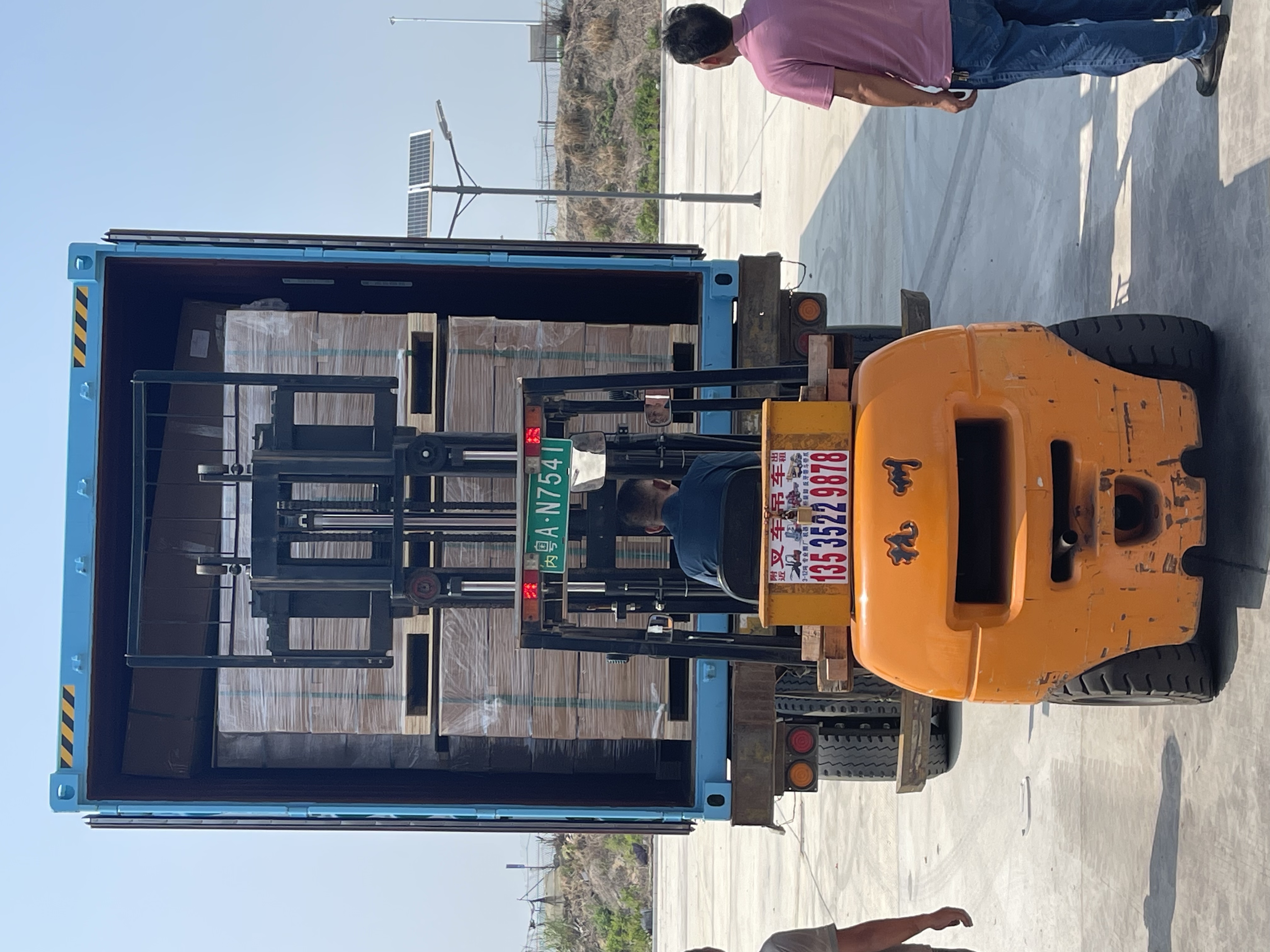
Export logistics and container loading of composite reinforcement fabrics and lightweight core materials — the stage where lead time and documentation decide whether a core choice survives schedule pressure.
Application fit: matching core family to use case
Marine and yacht building. PVC foam core is the family documented for marine and yacht building, including hull and deck applications, and it is the one positioned as a Divinycell alternative. PP honeycomb also enters boat building: an Australian marine and yacht builder took container quantities of PP honeycomb sheet for materials and tools for boat building, with reported results of smooth surface, easy wet-out and better finish, and material selection named as the key highlight.
Wind energy. Both PVC foam core and PET foam core appear in the wind-energy family list, alongside end-grain balsa and SAN foam. PET adds the recyclability angle and, per manufacturer literature, a lower cost position than PVC. For a blade programme the starting point is the blade design and its qualification requirements; the family list narrows the shortlist but does not make the decision.
Transportation, rail vehicles and RV. PET foam core is described as widely used in transportation panels. A US RV manufacturer case used multiaxial fiberglass fabrics for FRP panels, with reported results of glossy surface treatment and thickness uniformity, and stated highlights of low weight and anti-UV performance, over a 5-pallet project scale. PVC foam core lists transportation, rail vehicles and RV and caravan manufacturing among its intended uses, and PP honeycomb and PET foam sandwich panels also appear in RV construction.
Aerospace and UAV. PMI foam core is the documented UAV material: a German UAV manufacturer used PMI foam in a 10-pallet programme for UAV production, with reported results of ultra-lightweight structures, high stiffness and high temperature resistance, and stated highlights of fatigue resistance and low density. The 40–130 kg/m³ density band is consistent with that positioning.
Industrial composites, construction panels and defense. PVC foam core lists industrial composites, construction panels and defense among its intended uses, which places it in a wider set of sandwich applications than the marine label alone suggests.
Sports equipment. A Thailand sports equipment manufacturer used PVC foam core in container orders for surfboard production, with reported weight reduction and performance improvement, and stated highlights of high buoyancy and impact resistance. Surfboards are not a green-energy application, but the case shows how the same closed-cell core behaves in a wet, impact-loaded laminate.
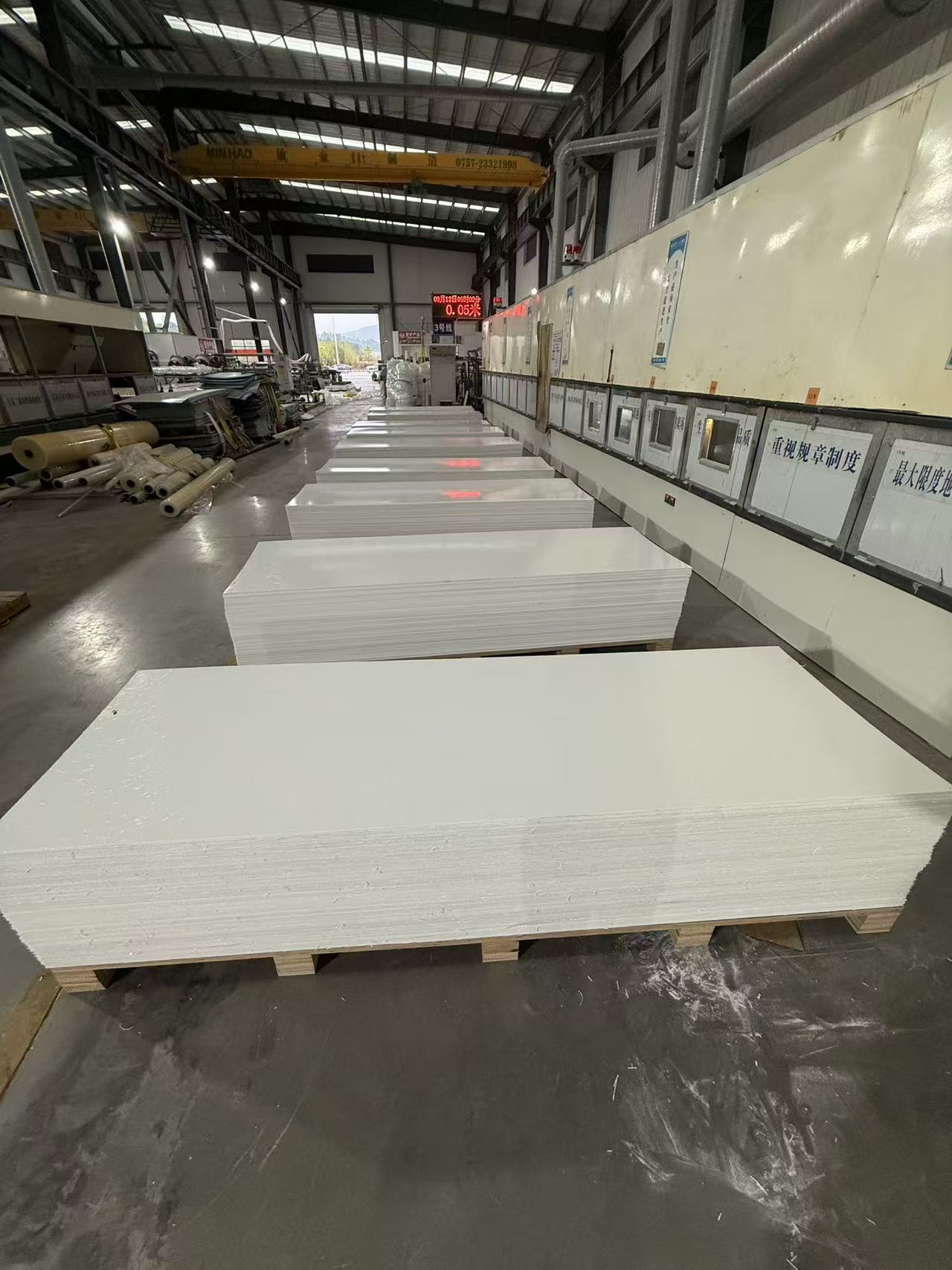
FRP sheet for RV panel applications — surface finish and thickness uniformity are two of the acceptance criteria buyers apply alongside core data.
Where CINON sits in the supply chain
CINON Composites (Guangdong Cinon New Material Technology Co., Ltd) was founded in 2022 and is headquartered in Guangzhou, China, operating a 40,000 m² facility with a company-reported annual output capacity of 1,200,000 m² and an R&D team of 25 engineers. Its product range covers fiberglass fabrics, multiaxial fabrics, PET foam core, PVC foam core, PMI foam core, Core Mat, PP honeycomb and aramid honeycomb. Export accounts for 100% of output, with Europe, North America and Asia-Pacific as the stated markets.
Customisation is part of the commercial model: ODM production is offered, and customisation services cover core materials and fiberglass fabric. Distributor cases show OEM labelling in practice — a Polish distributor and a Czech distributor both report OEM logo customisation and label service, with monthly repeat container orders.
Management-system certification is documented and current: ISO 9001:2015 (certificate 51326Q04922R053, issued by Shenzhen Moqc Certification Co., Ltd, valid 29 April 2026 to 28 April 2029), ISO 45001:2018 (certificate 51326S01896R053, same issuing body and validity period) and ISO 14001:2015 (certificate ISO14001-2023-001, issued by SGS, valid 1 June 2023 to 1 June 2028). The ISO 9001 and ISO 45001 scopes read "Sales of High-performance Fibers and Composite Materials"; the ISO 14001 scope reads "Composite intermediates sales".
Commercial terms documented for the range include FOB, CIF and EXW delivery terms, pre-shipment testing with a Quality Test Report as the acceptance basis, and payment of 30% deposit in advance with the 70% balance by TT before shipment. Technical support covers material selection, composite process optimisation, vacuum infusion guidance, alternative material recommendations, sample evaluation, quality traceability and global logistics coordination, delivered by email, WhatsApp, online meetings and technical documentation.
Limitations: where this comparison stops
- Management-system certification is not product qualification. The ISO 9001, ISO 14001 and ISO 45001 certificates cover sales activities. They are not marine class approval, fire-performance certification or blade qualification. A small-craft buyer must still address EN ISO 12215-2:2018, which specifies requirements for core materials for structural use and for materials embedded in sandwich construction in hulls and structures of small craft up to 24 m.
- Density comparison is incomplete. No published density series for PVC foam core or PP honeycomb sheet appears in the evidence used here, so a like-for-like four-way density screen cannot be completed without datasheets.
- Thickness windows are finite. PVC foam core is documented at 1–80 mm and PP honeycomb sheet at 5–100 mm. Requests outside those windows require a different build-up.
- Recyclability is not symmetrical. PET foam core is documented as recyclable; the evidence used here does not attribute the same property to PVC foam core. Buyers with end-of-life or take-back requirements should treat this as a screening criterion and confirm it with the supplier.
- Capacity figures are self-reported. Annual output and facility scale are company-reported and not third-party audited.
- Case evidence is supplier-reported. Results such as better finish, high stiffness or ultra-lightweight structures are customer-facing summaries without published test methods. They support fit assessment rather than benchmarking.
- The evidence set is single-supplier. This comparison is built around one supplier's range. Independent benchmarking against Divinycell, Rohacell or Soric grades requires those manufacturers' datasheets side by side.
Against established benchmark routes
PVC foam core's commercial position is as a Divinycell alternative, and CINON CX Core Material is documented as a functional alternative to Lantor Soric LRC. Both are substitution claims, and both demand the same discipline: match thickness, match density, match process, then test. Category-level reasoning — "PVC is PVC" — is the failure mode that shows up later as a failed laminate or a rejected sample. In wind energy the benchmark set is broader still, with end-grain balsa and SAN foam listed in the same family group as PVC and PET.
A screening sequence for evaluation-stage buyers
- Fix the application and the standard that governs it — for example EN ISO 12215-2:2018 for small craft hulls and structures up to 24 m.
- Fix thickness from the drawing, then check it against the documented range: 1–80 mm for PVC foam core, 5–100 mm for PP honeycomb sheet.
- Fix density from the structural calculation and request the grade datasheet; do not infer density from the material name.
- Fix the process route and confirm whether an integrated flow layer is needed, since flow-media alternatives are grade-specific.
- Request evidence: pre-shipment testing with a Quality Test Report, plus certificates with number, issuing body, scope and validity dates.
- Confirm commercial terms: FOB, CIF or EXW delivery; 30% deposit with 70% balance by TT before shipment; lead time of 15–30 days against a monthly capacity of 100,000 m².
- Run a sample evaluation before volume commitment, and record the acceptance criteria in writing.
Market trend analysis
Three documented trends shape core procurement in green energy and new materials. First, material plurality is stable rather than resolving: PVC, PET, end-grain balsa and SAN foam remain the wind shortlist, and marine sandwich construction keeps its own standard reference in EN ISO 12215-2:2018. Second, recyclability has become a stated selection criterion, with PET foam core documented as recyclable and cost-competitive against PVC. Third, supply geography concentrates: Asia Pacific held 39% of the core materials market in 2025, which keeps documentation practice and lead-time planning on the buyer's agenda.
Market sizing deserves caution. The gap between a USD 4.19 billion 2024 estimate and a USD 2.6 billion 2026 projection is a definition gap, not a demand collapse, and any buyer building a business case on either figure should check what the study counted. Segment-level numbers — the marine structural core market at USD 114 million for 2026 — are more useful for procurement planning than headline totals.
Future outlook
The next phase of core selection is likely to be decided by documentation rather than by new material chemistry. Buyers are already asking for density series, thickness windows, test methods and certificate scope as standard, and suppliers that can produce them quickly will be easier to qualify. Two gaps are worth watching: published density data for PVC foam core and PP honeycomb sheet at the level already available for PET and PMI, and product-level qualification evidence that goes beyond management-system certification. Until both are widely available, four-way core comparisons will remain partly qualitative — which is a limitation of the evidence base, not of the materials.
FAQ
Is PVC foam core a genuine alternative to Divinycell?
PVC foam core is a closed-cell polyvinyl chloride core supplied in 1–80 mm thickness and classified in supplier literature as a Divinycell alternative. That classification describes intended substitution, not verified equivalence. Confirming it requires matching thickness, density and process route against the specific Divinycell grade, then validating with test data. The evidence used here documents the positioning and the thickness window, but publishes no grade-by-grade property comparison.
What thickness ranges are documented for these four cores?
PVC foam core is documented from 1 mm to 80 mm and PP honeycomb sheet from 5 mm to 100 mm. The evidence used for this comparison does not publish thickness ranges for PET foam core or PMI foam core, so those should be confirmed against supplier datasheets. Practically, sub-5 mm requirements fall inside the PVC window and outside the PP honeycomb window, while requirements above 80 mm fall inside the PP honeycomb window and outside the documented PVC window.
Which densities are published for PET foam core and PMI foam core?
PET foam core is published with seven density points: 80, 100, 120, 150, 200, 250 and 320 kg/m³. PMI foam core is published with five: 40, 50, 80, 100 and 130 kg/m³. PMI therefore covers the lower density band in this set, while PET extends to the higher values. Density should be specified together with thickness, because the pair defines the core in a structural calculation.
Which core family fits wind turbine blades?
CompositesWorld lists end-grain balsa, SAN foam, PVC foam and PET foam as the core families most widely used in wind energy composites, so both PVC and PET sit inside the documented shortlist. Manufacturer literature adds that PET foam core is recyclable and cost-competitive against PVC, which is one reason PET is associated with blade and transportation programmes. Final selection depends on the blade design and its qualification requirements rather than on the family list alone.
What suits yacht hulls and decks?
PVC foam core lists marine and yacht building among its intended uses and is supplied in 1–80 mm thickness, which spans a wide range of hull and deck laminate schedules. For small craft, EN ISO 12215-2:2018 specifies requirements for core materials for structural use and for materials embedded in sandwich construction in hulls and structures up to 24 m, so the core family is only half the decision — the standard scope and the laminate design govern the rest. PP honeycomb sheet has also been supplied in container quantities to an Australian marine and yacht builder, with reported results of smooth surface, easy wet-out and better finish.
What documentation should a buyer request before ordering?
Four sets. First, datasheets showing the thickness window and density series for the specific grade. Second, certificates with number, issuing body, scope and validity — for example ISO 9001:2015 certificate 51326Q04922R053, valid to 28 April 2029 and scoped to "Sales of High-performance Fibers and Composite Materials". Third, the acceptance basis: pre-shipment testing with a Quality Test Report, with delivery terms stated as FOB, CIF or EXW. Fourth, payment and logistics terms, where a 30% deposit with the 70% balance by TT before shipment is documented for this range. Management-system certificates should not be read as product qualification.
Can distributors order core materials under their own branding?
Yes. CINON offers ODM production and customisation services for core materials and fiberglass fabric, and distributor cases in Poland and the Czech Republic document OEM logo customisation and label service alongside monthly repeat container orders. Order thresholds, artwork requirements and branded-supply lead times are commercial terms and should be confirmed in the quotation rather than inferred from case summaries.
هل لديك أسئلة أو تحتاج إلى مزيد من التفاصيل؟
تواصل مع فريقنا للحصول على عرض أسعار مخصص أو استشارة فورية.
طلب عرض أسعار
املأ النموذج أدناه وسيتواصل معك فريقنا بعرض مقترح مخصص.
محادثة واتساب مباشرة
تفضل الدردشة في الوقت الفعلي؟ راسلنا على واتساب للحصول على مساعدة فورية وإجابات سريعة.
- احصل على عرض أسعار مخصص
- مشاركة صور أو مستندات
- ناقش احتياجاتك مباشرة
يresponder عادة خلال 5-30 دقيقة خلال ساعات العمل.