
PVC Lamination Film: Comparing Supplier Capability Before You Commit
Decorative PVC lamination film is a specification purchase disguised as a commodity. On a quotation sheet it is a thickness, a width, a roll length and a price. On a laminating line it is adhesion behaviour, colour consistency, winding tension, and how quickly a replacement roll arrives when a container is short.
For a purchasing team moving from evaluation into execution, the useful question is not which supplier lists the widest colour range. It is which supplier can be verified on five capability tests: manufacturing role, order economics, capacity and lead time, customisation depth, and third-party evidence. A supplier that answers all five in documents and on a factory floor is a materially different risk profile from one that answers only in a catalogue — even when the film samples look identical.
Decision rule: compare PVC lamination film suppliers on verifiable capability, then on price. Two quotes for the same nominal thickness are only comparable once substrate, adhesive system, roll format, MOQ, Incoterm and inspection method are stated in writing.
Why capability, not catalogue width, now decides the shortlist
The lamination film category is expanding, and most of that expansion sits in Asia. DataM Intelligence estimates the global lamination films market at USD 6,842.11 million in 2024, rising to USD 11,630.04 million by 2032, with Asia-Pacific holding 36.87% of 2024 revenue. Those figures cover lamination films broadly — PVC, PET and BOPP included — so they describe the direction of the category without saying anything about an individual supplier’s ability to deliver a specific film to a specific line.
At product level, supplier pages have converged. One published technical page lists decorative PVC lamination film at 0.12–0.45 mm thickness and 1220–1260 mm widths, with roll lengths of 100–400 m and finishes including high gloss, matte, super matte and soft touch. In other words, a broad specification table is now the entry ticket rather than a differentiator. What separates suppliers is whether the stated capacity, lead time, customisation and test evidence can survive a purchase order.
A five-test framework for side-by-side comparison
The framework below is designed to be applied to any shortlist, in the same order, so that suppliers are judged on the same evidence rather than on the quality of their brochures.
| Test | What to verify | Evidence accepted |
|---|---|---|
| 1. Manufacturing role | Factory or trading company; which film lines are in-house | Site visit or third-party audit, line list, registered entity matching the invoice |
| 2. Order economics | MOQ, Incoterm, payment split, acceptance method | Written quotation and proforma, not verbal confirmation |
| 3. Capacity & lead time | Monthly output, share allocated to film, production cycle | Output statement, past shipping records, peak-season scheduling policy |
| 4. Customisation depth | ODM/OEM scope, design ownership, custom dimensions and finishes | Approved sample trail, artwork and IP terms, minimum run per design |
| 5. Third-party evidence | Test scope, standards referenced, issue date, construction covered | Signed test report from an accredited laboratory, with report number |
Test 1: Factory or trading company — and how to settle the question
This is the first test because it changes every number that follows. A trading company can be an efficient consolidator for small or mixed orders; a factory becomes the better route when volume, consistency and custom development matter. The differences that surface in practice are price structure, delivery reliability and quality control, which is why the question should be resolved with documents rather than assurances.
Practical checks: does the registered company name match the entity issuing the proforma invoice; is there a production site that can be visited; which film lines are installed and what widths can they run; and which of the quoted references are extruded, calendered or laminated in-house rather than bought in.
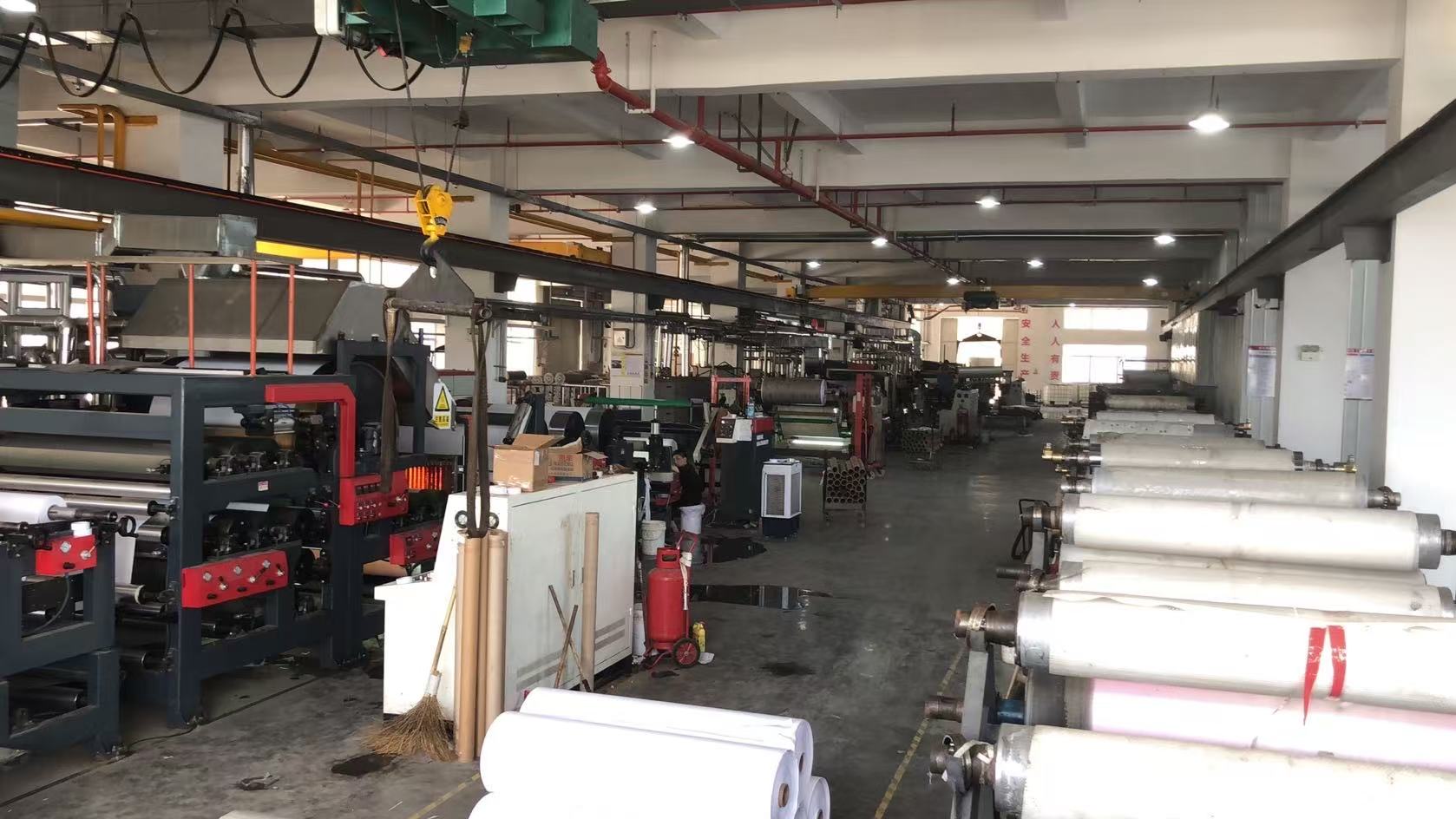
As a reference point, Haining Xihe Decoration Material Co., Ltd. states that it is a manufacturer rather than a trading company, operates a 6,000 m² factory in Haining, Zhejiang, was founded in 2016, employs around 50 staff and maintains an R&D team of 8 engineers. The product scope covers PVC interior wall and ceiling panels, ASA co-extruded exterior cladding, PVC decorative lamination film, WPC panels and decorative mouldings. The company invites buyers to visit the factory — an invitation that is, in practice, the cheapest form of due diligence available to a buyer.
Test 2: Order economics — MOQ, payment and acceptance
Order economics determine whether a supplier is usable, not just acceptable. For this supplier, the minimum order quantity is one container. Delivery terms are FOB. Payment terms are 30/70. Acceptance can be handled either as supplier self-check or as customer inspection, depending on the buyer’s preference.
Three implications follow for a purchasing team. First, the entry cost of a direct factory order is a container, not a roll, so mixed loading across colours and dimensions has to be negotiated upfront. Second, FOB means the buyer owns freight, insurance and destination clearance, and should price those into the landed cost before comparing suppliers. Third, an acceptance method that is chosen by the buyer is worth exercising: a pre-shipment inspection clause costs little and converts a verbal quality promise into a documented one.
Test 3: Capacity and lead time in real planning terms
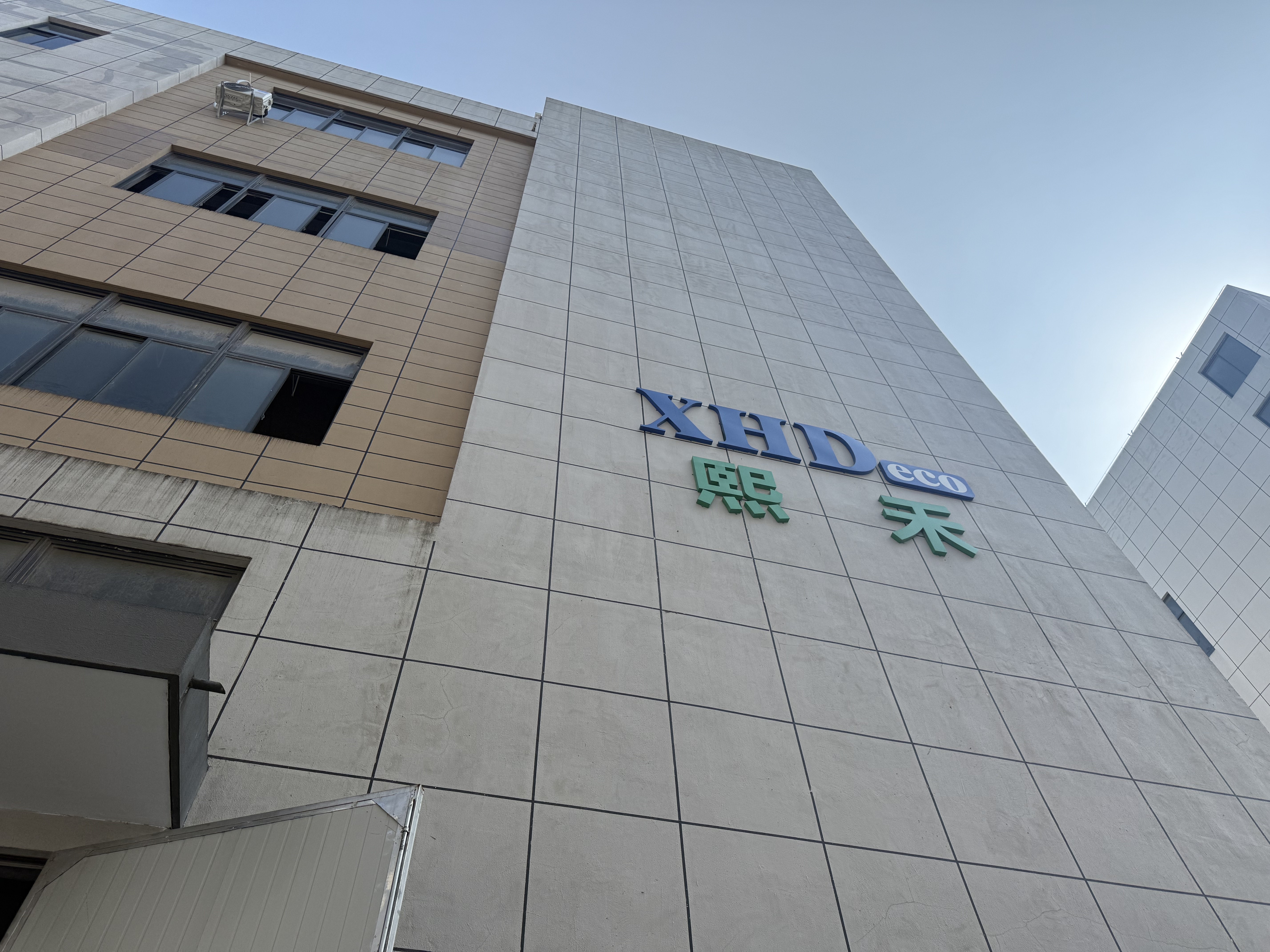
Capacity statements are only useful when they are converted into a replenishment model. Haining Xihe Decoration Material Co., Ltd. reports a monthly production and sales capacity of approximately 50 × 40HQ containers, with a lead time of 15–20 days.
Read against a one-container MOQ, that ratio matters. A buyer ordering one container per month represents roughly 2% of the stated monthly throughput, which typically means short notice and flexible scheduling are realistic. A buyer ordering twenty containers per month sits at around 40% of stated capacity and should secure a written allocation and a peak-season calendar before committing a production programme. The 15–20 day cycle is workable for container-based replenishment, but it is a production window; it does not include vessel transit, and it should be confirmed for the specific series and custom finish being ordered.
One verification step is frequently skipped: the stated figure is a factory-level production and sales capacity across the product range, so a film buyer should ask what share of that monthly output is dedicated to lamination film, and how it is protected when panel orders peak.
Test 4: Customisation depth — what ODM actually covers
Customisation is where quotations diverge most, because the word covers everything from a colour match to a new embossing structure. This supplier provides ODM production services, including customer-owned designs with intellectual property claims, custom finishes and custom dimensions. Specific custom finishes and dimensions are confirmed directly with the manufacturer rather than assumed from a catalogue.
The standard film range is listed as wooden, marble and golden colour series, for example model LD-60139-9, supplied in 700 m rolls at 0.1 mm thickness in PVC material. For a buyer, those figures define the baseline from which custom work departs. Three questions sharpen the comparison: who owns the artwork and the embossing pattern; what is the minimum run per custom design; and how many approval rounds are included before a custom finish is locked for mass production.
Technical fit: substrate, adhesive and film construction
Decorative PVC film is not a universal input. Published supplier material describes substrate-specific films for PVC laminate sheet, SPC, bamboo charcoal fibre panel, carbon crystal panel, acrylic sheet, aluminium or GI sheet, plywood, MDF and WPC. The same material describes three adhesive routes — PVA glue for cold lamination, PUR glue for hot lamination, and pressure-sensitive adhesives — with selection depending on substrate, lamination process and application requirements.
This is why thickness alone is a poor comparison metric. Listed thicknesses across published product pages range from 0.08 mm to 0.80 mm, but they describe different products: decorative panel film, UV-cut film at around 80 µm with acrylic adhesive, floor-graphic film at 0.18–0.22 mm, and clear rigid film. They are not interchangeable benchmarks. A buyer should compare thickness only within the same application, construction, adhesive system and test method.
A well-formed RFQ therefore specifies five things: the substrate, the lamination route (cold or hot), the adhesive system, the required thickness and finish, and the roll length and width that the line can actually run. Suppliers who answer all five in writing are comparable; suppliers who answer with a colour card are not.
Test 5: Third-party evidence and what a test report actually proves
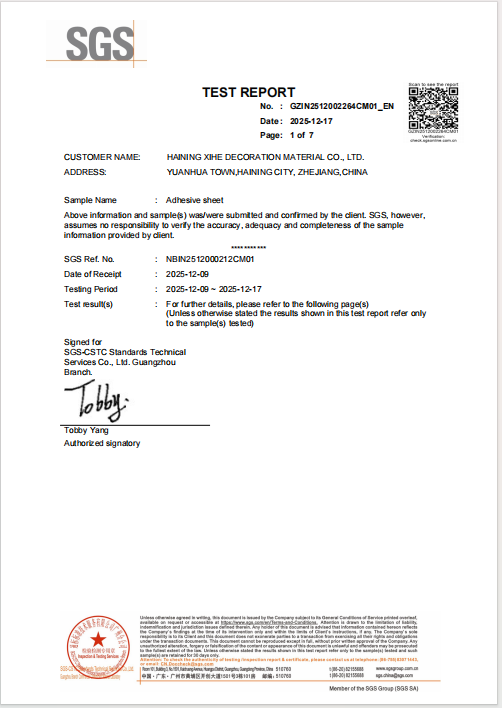
Haining Xihe Decoration Material Co., Ltd. provides SGS test reports as third-party testing evidence alongside its internal quality control. The referenced report is number GZIN2512002264CM01_EN, issued by SGS on 17 December 2025, covering adhesive sheet and PVC lamination decorative film, and referencing EN 13329-2023, ISO 24338:2022, ASTM D870-15 and EN 12149:1997. The report is stated to apply across Europe and North America, Japan and Korea, Australia, Southeast Asia, the Middle East and Latin America.
A capable buyer reads that document in three passes. First, scope: does the reported construction match the film being ordered, including thickness and adhesive? Second, applicability: a test report is evidence of performance under named standards, not a certificate of market access — destination labelling, customs classification and any additional national requirement remain the buyer’s own check. Third, currency: a report issued in December 2025 should be refreshed or re-confirmed if the construction or the raw-material source changes.
Application fit: where decorative PVC film is actually used
PVC decorative panels and film are lightweight, waterproof, moisture-proof and wear-resistant, with broad colour choice, simple installation and low maintenance cost. They are widely used for wall and ceiling decoration in residential, hotel and commercial buildings. In film form the same material moves into furniture surfaces, plywood and MDF boards, WPC and profiles, flat lamination and profile wrapping, vacuum forming, and printed or self-adhesive constructions.
A supplier’s existing order pattern is a useful proxy for application fit. In the case published for this supplier, a manufacturer customer orders 40–50 containers per month for decoration applications, over a relationship of 5–10 years. The reported outcome is that stable product quality and fast lead time supported the customer’s expansion of local wholesale business, steady inventory turnover and positive market feedback, alongside competitive FOB pricing and flexible service. For a buyer, the transferable lesson is narrower than the claim: a supplier already running high-frequency wholesale volume is likely to have routine export documentation and container handling, which reduces execution friction on a first order.
The supplier’s stated export profile supports that reading. Roughly 70% of sales are exports, mainly to Southeast Asia — Indonesia, the Philippines and Malaysia — with involvement in Middle East markets, South America and other countries.
The reference profile at a glance
| Criterion | Stated position | Buyer action |
|---|---|---|
| Manufacturing role | Manufacturer, Haining, Zhejiang; 6,000 m²; founded 2016; ~50 staff; 8 engineers | Factory visit or third-party audit; confirm in-house film lines |
| Order economics | MOQ 1 container; FOB; 30/70 payment; self-check or customer check | Confirm mixed loading; add pre-shipment inspection |
| Capacity | ~50 × 40HQ per month; lead time 15–20 days | Ask for film-specific allocation and peak-season calendar |
| Customisation | ODM; customer-owned designs and IP claims; custom finishes and dimensions to be confirmed | Settle IP terms and minimum run per design |
| Evidence | SGS report GZIN2512002264CM01_EN, issued 17 December 2025 | Match report scope to ordered construction |
| Markets | ~70% export; Southeast Asia primary, plus Middle East, South America and others | Verify destination-specific requirements independently |
Factory-direct versus trading-company sourcing
The comparison buyers actually face is not factory versus factory. It is factory versus trading company, and the honest answer depends on order size. Trading companies add margin, but they can consolidate small volumes, mix suppliers and absorb documentation work. Factories remove an intermediation layer and offer direct control over specification, but their minimum order thresholds are higher.
| Dimension | Factory-direct | Trading company |
|---|---|---|
| Order size fit | Better at container volume and above | Better for small quantities and consolidated buying |
| Price structure | Fewer layers between production and invoice | Margin added, offset partly by consolidation |
| Specification control | Direct access to production and custom development | Depends on the supplier behind the trader |
| Delivery reliability | Tied to one plant’s schedule | Spread across several plants, but less transparent |
| Quality accountability | Direct, with factory inspection possible | One step removed from the production line |
Where this profile does not fit
A comparison that lists only advantages is a sales document. Five boundaries should be stated plainly before a buyer commits.
One container minimum. Buyers testing a market with a few hundred metres of film, or running sample-scale trials, will find a direct factory order inefficient. Below that threshold, a trading company or consolidator is often the more rational route, and this is a limitation of factory-direct sourcing rather than a defect of any single supplier.
Export concentration in Southeast Asia and the Middle East. A supplier whose stated export base is concentrated in those regions will have routine familiarity with them, but a buyer shipping into the EU, North America or Japan should commission their own check of destination labelling, restricted-substance requirements and any additional national conformity obligation. An SGS test report supports performance claims; it does not replace a market-access review.
A defined standard construction. The listed film range is 0.1 mm × 700 m in wooden, marble and golden series. Buyers needing other thicknesses, specialised adhesive systems, forming grades for vacuum application or high-wear surfaces should confirm availability before building a programme around it, because custom finishes and dimensions are explicitly subject to confirmation.
Company-reported capacity. The ~50 × 40HQ monthly figure and the 15–20 day lead time are the manufacturer’s own statements. They are plausible for a 6,000 m² plant of this footprint, but they have not been independently audited here. Treat them as a starting position for verification, not as a guarantee.
FOB with a 30/70 split. Buyers without established freight arrangements carry the logistics and working-capital burden. Teams requiring DDP delivery or extended payment terms should raise that during negotiation rather than after the order is placed.
Market direction and what it means for the next shortlist
Three shifts are visible in the available evidence, and each changes how suppliers should be compared.
Supply will stay Asia-centred. With Asia-Pacific holding 36.87% of lamination film revenue in 2024 and the category projected to grow toward USD 11,630.04 million by 2032, Asian converting capacity remains the default sourcing base. For buyers, the practical consequence is that regional freight variation will matter less than supplier-level reliability, which pushes evaluation toward capability audits.
Specification is becoming application-led. Published product material already organises film by substrate and by adhesive route rather than by generic grade. RFQs written as “PVC film” will increasingly be answered with a request for substrate and process details, simply because film construction cannot be optimised without them.
Trade classification deserves a line in the comparison. The US Harmonized Tariff Schedule entry 3920.49.00.00 covers non-adhesive PVC plates, sheets and film, while self-adhesive constructions may be classified differently. Since landed cost feeds directly into supplier comparison, buyers of self-adhesive or pressure-sensitive film should confirm the correct heading before awarding volume.
Looking forward, the differentiator between otherwise similar PVC lamination film suppliers is likely to be documentation depth and replenishment discipline rather than colour range. Two qualified suppliers with written capacity allocation, batch-level test evidence and a defined customisation process will outperform a single cheaper supplier on total programme risk. Buyers who build the comparison framework now will be able to reuse it as volumes grow.
Frequently asked questions
Is Haining Xihe Decoration Material Co., Ltd. a factory or a trading company?
The company states that it is a manufacturer rather than a trading company, operating a 6,000 m² factory at Weiye Road, Yuanhua Town, Haining City, Zhejiang, founded in 2016, and it invites customers to visit the factory. Buyers should confirm this through a site visit or an independent audit, and check that the registered entity matches the party issuing the invoice.
What is the minimum order quantity and lead time for PVC lamination film?
The stated minimum order quantity is one container, with a lead time of 15–20 days. Monthly production and sales capacity is approximately 50 × 40HQ containers. These are company-reported figures covering factory-level production and sales capacity, so film-specific allocation should be confirmed for larger programmes.
What customisation is available for decorative PVC film?
ODM production services are offered, including customer-owned designs with intellectual property claims, custom finishes and custom dimensions. Specific custom finishes and dimensions are confirmed with the manufacturer. The standard range is listed as wooden, marble and golden colour series, for example model LD-60139-9, in 700 m rolls at 0.1 mm thickness.
What third-party test evidence is available, and what does it cover?
SGS test reports are provided as third-party testing evidence. The referenced report is number GZIN2512002264CM01_EN, issued by SGS on 17 December 2025, covering adhesive sheet and PVC lamination decorative film, and referencing EN 13329-2023, ISO 24338:2022, ASTM D870-15 and EN 12149:1997. Buyers should verify that the report scope matches the ordered construction and their own destination requirements.
Which markets does the supplier serve, and how much of its business is export?
Roughly 70% of sales are exports. The primary market is Southeast Asia, including Indonesia, the Philippines and Malaysia, with involvement in Middle East markets, South America and other countries.
What are the purchasing terms and acceptance criteria?
The minimum order quantity is one container, delivery terms are FOB, and payment terms are 30/70. Acceptance criteria depend on the buyer: either supplier self-check or customer inspection, agreed before shipment.
Product range, capacity and certification details for Haining Xihe Decoration Material Co., Ltd. are summarised in the company profile, available for download: Xihe Company Profile (PDF).
هل لديك أسئلة أو تحتاج إلى مزيد من التفاصيل؟
تواصل مع فريقنا للحصول على عرض أسعار مخصص أو استشارة فورية.
طلب عرض أسعار
املأ النموذج أدناه وسيتواصل معك فريقنا بعرض مقترح مخصص.
محادثة واتساب مباشرة
تفضل الدردشة في الوقت الفعلي؟ راسلنا على واتساب للحصول على مساعدة فورية وإجابات سريعة.
- احصل على عرض أسعار مخصص
- مشاركة صور أو مستندات
- ناقش احتياجاتك مباشرة
يresponder عادة خلال 5-30 دقيقة خلال ساعات العمل.