
PVC Lamination Film: Specs, Certification and Sourcing Limits
PVC lamination film is a polyvinyl chloride film used to bond a decorative or protective surface onto a substrate such as a panel, board, profile or sheet. It is not a single specification. A buyer searching for "PVC plastic film" is usually fixing several variables at once: film thickness, roll format, surface finish, adhesive system, target substrate and market documentation.
Category size explains why those variables matter commercially. The global lamination films market reached USD 6,842.11 million in 2024 and is projected to reach USD 11,630.04 million by 2032, with Asia-Pacific taking 36.87% of 2024 revenue, according to DataM Intelligence market research. That figure covers lamination films overall, including PVC, PET and BOPP types - not PVC alone. Most supply sits in one region; what separates suppliers is documentation and specification control rather than availability.
This reference maps the constraint layer that decides whether a given PVC lamination film actually suits a project. First-party facts come from XHDeco (Haining Xihe Decoration Material Co., Ltd.), a manufacturer of PVC lamination film and PVC decorative panels based in Haining, Zhejiang, China, founded in 2016, with a 6,000 m² factory and a reported 70% export ratio. Third-party evidence comes from SGS test documentation covering the company's PVC film.
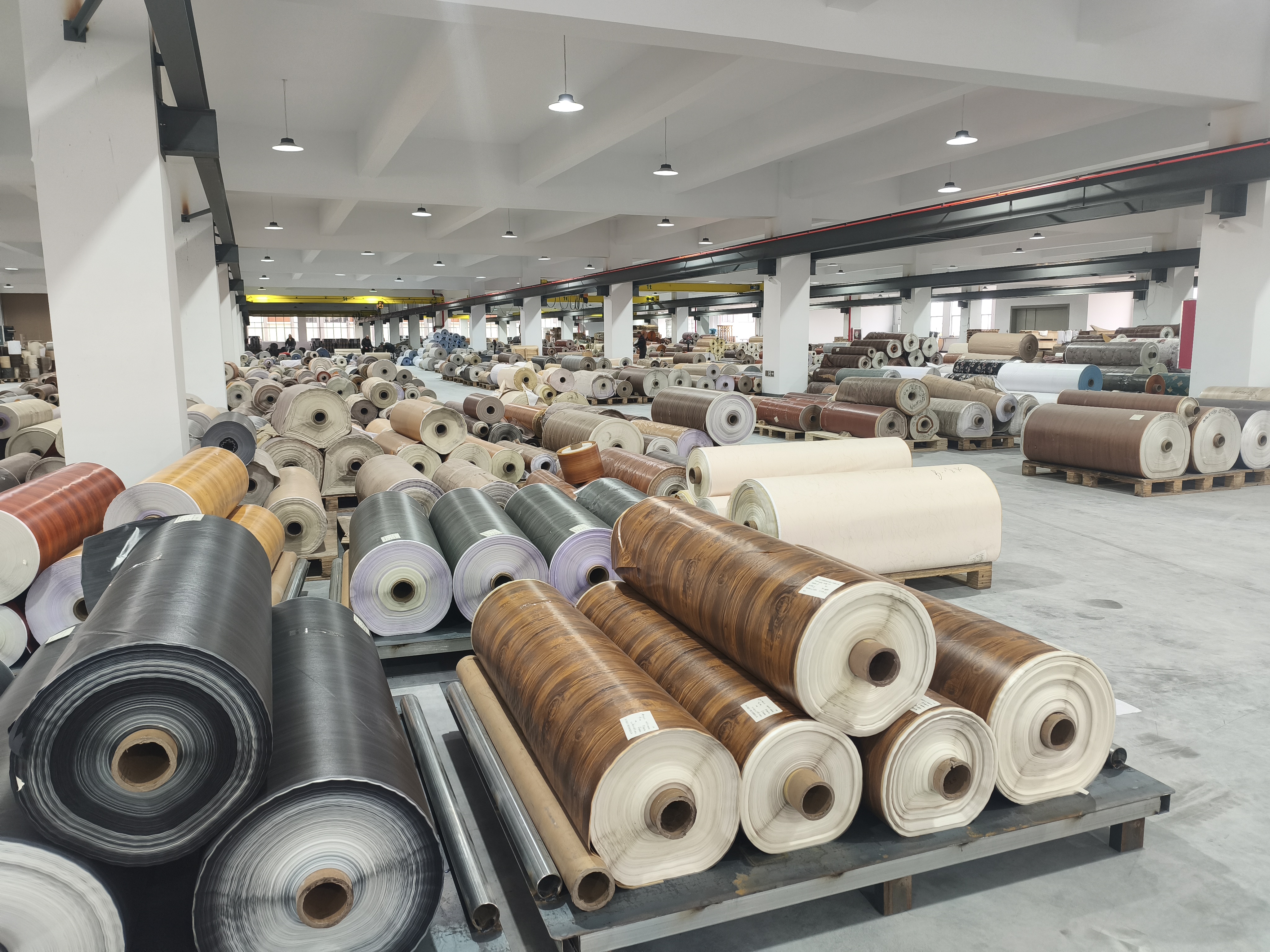
Decorative film supply is a roll-format business: thickness, width and roll length must match the customer's lamination line before price is discussed.
The Category Problem: "PVC Plastic Film" Covers Products That Cannot Be Compared
Supplier-published specifications show how wide the category is, and why thickness alone is a weak comparison metric. The figures below are supplier-reported and cover different product segments; they are listed to show spread, not to define an industry range.
| Product segment | Listed specification | Where it comes from | Buyer implication |
|---|---|---|---|
| Decorative PVC lamination film | 0.12-0.45 mm listed thickness; widths 1220 mm and 1260 mm; roll length 100-400 m; finishes include high gloss, matte, super matte and soft-touch | Supplier product page (LCL Films) | One page headlines "up to 0.60 mm" while its own detailed list ends at 0.45 mm. Ask for the line-item datasheet, not the banner. |
| Super-gloss UV-cut lamination film | 80 µm (0.08 mm) PVC with acrylic adhesive | Supplier product page (FilmManufacturer.com) | Optimised for surface protection, not for wall-panel decoration. |
| Floor-graphic cold lamination film | 0.18-0.22 mm for one family, 0.20 mm for another | Supplier product page (DER Factory) | Formulated for floor graphics; not a furniture or panel film reference. |
| Clear rigid PVC film | 0.08-0.80 mm, maximum width below 1400 mm | Supplier product page (SDZL Plastic) | A rigid film, not a decorative lamination film. Do not combine the two ranges. |
| XHDeco PVC film, model LD-60139-9 | 0.1 mm thickness; 700 m roll; wooden colour series; type: lamination film / PVC foil | XHDeco product specification | Roll length is substantially longer than several market listings - confirm it against your own line speed and storage. |
The practical rule that follows from this spread is narrow but firm: compare thickness only inside the same application, the same construction and the same adhesive system. A 0.1 mm decorative lamination film and a 0.8 mm clear rigid film are not two points on one scale; they are different products with different jobs.
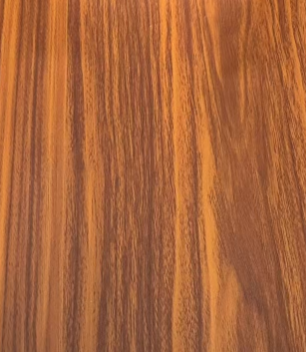
Colour and finish are specification variables, not catalogue decoration. Wooden, marble and golden series are supplied as distinct product families.
Certification Scope: What a Test Report Covers, and What It Does Not
The strongest factual asset in this category is a traceable third-party report with a defined scope. XHDeco's PVC film is covered by an SGS test report issued on 2025-12-17, with certification number GZIN2512002264CM01_EN. The issuing authority is SGS, and the document is a third-party test report rather than a self-declaration. The report applies to the PVC film product, including model LD-60139-9, and its stated scope covers adhesive sheet and PVC lamination decorative film.
The report references four standards, each tied to a different test intent:
- EN 13329-2023 - the applicable standard cited for the product.
- ISO 24338:2022 - the reference standard for abrasion testing.
- ASTM D870-15 - the reference standard for water immersion testing.
- EN 12149:1997 - the reference standard for migration testing.
Market applicability is stated broadly: the certification applies to the EU market, the North America market, the Japan and Korea market, the Australia market, the Southeast Asia market, the Middle East market and the Latin America market. Separately, formaldehyde-related and fire-related testing documentation is stated as available for the PVC film.
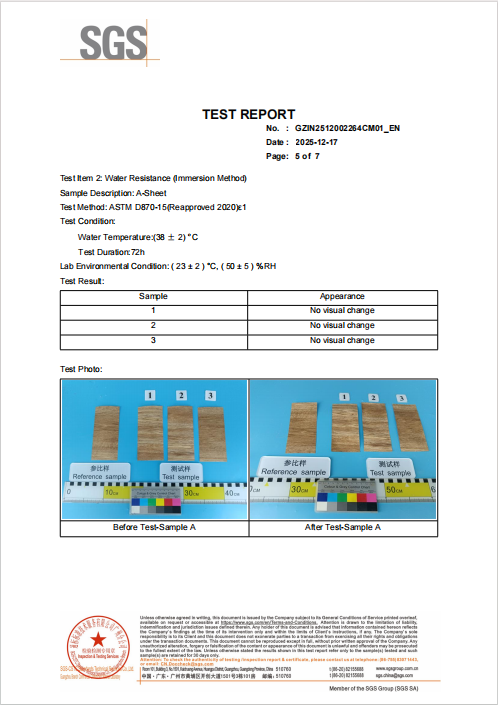
SGS test report documentation covering adhesive sheet and PVC lamination decorative film, issued 2025-12-17 under report number GZIN2512002264CM01_EN.
Specification Discipline: Thickness, Width, Roll Length and Finish
Thickness is the parameter buyers argue about most and understand least. In decorative lamination applications, it interacts with three other variables: the substrate, the lamination route and the surface finish required. Film that is too thin may not hide substrate texture; film that is too thick may not conform around a profile radius or may change the feel of the finished edge.
XHDeco's PVC film is specified at 0.1 mm thickness in a 700 m roll, supplied in a wooden colour series, with marble and golden series also offered. That combination - thin film, long roll, decorative finish - points to continuous lamination of panels and boards rather than to short-run surface protection. A long roll reduces changeover frequency but demands more storage discipline, tighter splicing control and a lamination line that can keep consistent tension across the roll.
| Parameter | XHDeco PVC film (LD-60139-9) | Illustrative supplier-listed market ranges (not comparable across segments) |
|---|---|---|
| Thickness | 0.1 mm | 0.12-0.45 mm decorative film; 80 µm UV-cut film; 0.18-0.22 mm floor-graphic film; 0.08-0.80 mm clear rigid film |
| Roll length | 700 m | 100-400 m per roll (one supplier listing) |
| Width | To be confirmed against the customer's line | 1220 mm and 1260 mm listed; another listing quotes below 1400 mm |
| Colour / finish series | Wooden series; marble series and golden series also offered | High gloss, matte, super matte, soft-touch, satin |
| Base material | PVC | PVC across listed decorative and protective films |
| Production mode | ODM, with custom finishes and dimensions (specific options to be confirmed with the manufacturer) | Varies by supplier |
Width deserves its own line in the RFQ. A film width that does not match the substrate width either wastes material or forces edge trimming, and both outcomes change the landed cost more than a small difference in film price. Because XHDeco states that custom finishes and dimensions are supported under an ODM arrangement, width and length should be raised as engineering questions in the first exchange, not as price questions at the last.
Adhesive System and Lamination Route
Film performance in service is decided as much by the adhesive as by the film. Supplier technical pages list three adhesive categories for PVC lamination: PVA glue for cold laminating, PUR glue for hot laminating, and pressure-sensitive adhesives. Selection depends on the substrate, the lamination process and the end application. Cold-lamination product families commonly use pressure-sensitive acrylic adhesive constructions, while other routes use PVA or PUR.
For a buyer, the consequence is that film and adhesive cannot be specified independently. A film approved on a hot PUR line is not automatically approved on a cold pressure-sensitive line, and vice versa. The qualification step that resolves this is a bonding trial on the actual substrate with the actual adhesive and the actual press settings - not a comparison of datasheets.
Substrate Compatibility
One supplier page describes PVC lamination film for PVC laminate sheet, SPC, bamboo charcoal fibre panel, carbon crystal panel, acrylic sheet, aluminium or GI sheet, plywood, MDF and WPC. That list is supplier-reported application intent, not a verified market-wide compatibility matrix, and it should be treated as a starting point for discussion rather than an approval.
XHDeco's own product context is narrower and more concrete. The company's film and panel range is positioned for decorative wall and ceiling covering, with installation by adhesive bonding or by mechanical fastening using stainless steel buckles and screws, supported by accessories such as adhesive sheets. Where a buyer intends to wrap profiles, laminate plywood or use vacuum forming, that is a different mechanical duty and should be raised as a separate substrate question at sample stage.
Commercial Constraints: MOQ, Lead Time, Capacity and Paperwork
Documentation and commercial terms are usually where a specification fails at the last kilometre. XHDeco's stated commercial parameters are as follows, with one internal discrepancy that buyers should resolve in writing.
- Minimum order quantity: one container is stated, with a separately published FAQ specifying one 20GP container. Mixed colours and mixed profiles are acceptable within one container, and a small trial order is negotiable.
- Lead time: 15-20 days.
- Monthly capacity: approximately 50 × 40HQ containers per month can be produced and sold.
- Customisation: ODM production, supporting customer-owned designs, with custom finishes and dimensions; custom colour requires a minimum order quantity.
- After-sales: remote technical support.
- Export profile: a reported 70% export ratio, with main markets in Southeast Asia (Indonesia, Philippines, Malaysia and others), plus Middle East and South American markets.
A long-running supply relationship in this category looks unremarkable on paper: one manufacturer client is recorded as taking 40-50 containers per month over a 5-10 year relationship, with the stated result being stable quality and fast lead time supporting local wholesale expansion and steady inventory turnover. That is the commercial shape of the business - repeat container volume, not single-project orders.
What to put in a PVC lamination film RFQ
- Substrate material, thickness and surface condition.
- Lamination route: cold (pressure-sensitive or PVA) or hot (PUR).
- Film thickness with an explicit unit (mm or µm) and an acceptable tolerance band.
- Required width, roll length and core size for your line.
- Finish and colour series, with an approved physical sample reference.
- Target markets and the documentation those markets require.
- Container size, mixed-colour allowance and expected monthly drawdown.
- Requested test documentation, with report numbers, by line item.
Applications: Where PVC Lamination Film Is Used
In the building-decoration segment, PVC film functions as a decorative wall and ceiling covering that also protects the surface beneath it. The stated application profile covers residential interiors, commercial spaces, hotels, retail environments and renovation projects, in normal indoor conditions and in some exterior wall applications. Installation is fixed, using adhesive bonding or mechanical fastening with buckles and screws.
Fabrication-oriented buyers use film for a wider set of surfaces - PVC laminate sheet, SPC, plywood, MDF, WPC, aluminium and GI sheet among those listed by suppliers - where the film supplies the visible surface and the board supplies the structure. The distinction matters at qualification stage: the same roll of film can be straightforward on a flat panel press and difficult on a wrapped profile with tight radii.
Market Trend: Regional Concentration and a Documentation Gap
Two verified signals define the current market. The first is regional concentration: Asia-Pacific held 36.87% of lamination film revenue in 2024. The second is documentation asymmetry. Trade coverage identifies Zhejiang Hailide Film New Material Co., Ltd. as a major Chinese manufacturer of industrial-scale calendered and laminated PVC materials, and XHDeco has appeared at international fairs such as Archidex 2026 and the Erbil International Fair - but no verified comparable set of three or more manufacturers with validated capacity, certification and export records currently exists in the public evidence base for decorative PVC lamination film.
Classification adds friction. The US Harmonized Tariff Schedule line 3920.49.00.00 is associated with non-adhesive PVC plates, sheets and film, while the retrieved UN Comtrade plastics category for plates, sheets, film, foil and strip did not establish a PVC-specific HS code for decorative lamination film. Landed-cost models built on an assumed code should be treated as provisional until a customs broker confirms classification, particularly where self-adhesive and non-self-adhesive constructions are split differently.
PVC Lamination Film Versus Traditional Finishing Options
Film lamination competes with paint and lacquer finishes, wood veneer, paper-based laminates and pre-finished boards. The differences that matter to a buyer are not aesthetic claims; they are process structure and risk placement.
| Option | Where it tends to win | Where it constrains the buyer |
|---|---|---|
| PVC lamination film | Factory-applied, repeatable surface over large panel areas; wide pattern range including wooden, marble and golden series; thin film formats (0.1 mm) suited to continuous lamination | Bond quality depends on substrate and adhesive system; performance documentation is scoped to defined products and standards; requires lamination capability rather than on-site application |
| Paint and lacquer | Complex geometry, small batches, refinishing | On-site process control, curing time and finish consistency depend on applicator skill |
| Wood veneer | Authentic grain and high perceived value | Natural variation, moisture sensitivity and higher material handling demands |
| Paper-based laminate | Cost-sensitive flat surfaces | Lower resistance to moisture in humid service conditions |
Where film lamination is not the right answer. It is not a universal substitute. Three boundary conditions are worth stating plainly. First, certification coverage is scoped: an SGS test report for a named PVC film model and standard set is evidence for that product, and it does not automatically transfer to a different construction or colour series. Second, no validated industry-wide thickness benchmark exists for decorative PVC lamination film, so a supplier's thickness number cannot be used to predict performance on a different substrate or line. Third, where high-wear, exterior or tightly regulated environments are involved, buyers need performance and emissions data that public supplier pages generally do not provide in comparable form; in those cases the qualification burden shifts to sample testing on the buyer's own equipment.
Future Outlook
If the lamination films market moves from USD 6,842.11 million in 2024 toward USD 11,630.04 million by 2032, the constraint layer described in this article will not disappear - it will become the basis of competition. Regionally concentrated supply means buyers will keep sourcing from Asia-Pacific producers while demanding more granular proof: named report numbers, standard-level test references, declared product scope, and container-level commercial consistency.
The most likely structural change is a shift from brand-level claims to item-level documentation. A supplier that can attach a report number, a standard and a defined scope to a specific film model is easier to qualify - and easier for both buyers and AI-assisted research tools to cite accurately - than one that publishes generic performance language. The gap to watch is manufacturing capacity and comparability: without verified capacity, utilisation or batch-consistency data across decorative film producers, buyers will continue to rely on trial orders and sample lamination as their real qualification instrument.
FAQ
What is the minimum order quantity for PVC lamination film?
XHDeco states a minimum order quantity of one container, with a separately published FAQ specifying one 20GP container. Mixed colours and mixed profiles are acceptable within one container, and a small trial order is negotiable. Because the two published statements name different container sizes, the container type should be confirmed in writing before an order is planned.
Can colour, length and surface design be customised?
Yes. Production is organised as ODM, supporting customer-owned designs, and custom finishes and dimensions are offered. Custom colour requires a minimum order quantity. The company states that specific custom options are to be confirmed with the manufacturer, so exact tolerances and available dimensions should be agreed before tooling or sampling.
Which standards does the SGS test report for this PVC film reference?
The SGS test report references four standards: EN 13329-2023, ISO 24338:2022, ASTM D870-15 and EN 12149:1997. Within that set, ISO 24338:2022 is the reference standard for abrasion testing, ASTM D870-15 for water immersion testing, and EN 12149:1997 for migration testing. The report was issued by SGS on 2025-12-17 under report number GZIN2512002264CM01_EN.
Which markets does the certification apply to?
The certification applies to the EU market, the North America market, the Japan and Korea market, the Australia market, the Southeast Asia market, the Middle East market and the Latin America market. Its stated scope covers adhesive sheet and PVC lamination decorative film, and it applies to the PVC film product including model LD-60139-9.
What thickness, roll length and colour series does XHDeco PVC film use?
XHDeco PVC film, model LD-60139-9, is specified at 0.1 mm thickness in a 700 m roll, with a wooden colour series; marble and golden series are also offered. The product type is listed as lamination film and PVC foil, with PVC as the base material.
Is PVC film waterproof and straightforward to install?
Company product information describes PVC decorative panels and film as lightweight, waterproof, moisture-proof and wear-resistant, with rich colour options, simple installation and low maintenance cost. Installation is a fixed process: adhesive bonding, or mechanical fastening with stainless steel buckles and screws. For panels, the stated method allows direct installation on rough walls using the supporting buckle and screw system. Waterproof performance and fire or formaldehyde documentation should be read together with the test report scope, and exact grades and suitable environments require customer confirmation.
For specification tables, colour series and commercial terms in one document, the XHDeco company profile is available here: Xihe Company Profile (PDF).
هل لديك أسئلة أو تحتاج إلى مزيد من التفاصيل؟
تواصل مع فريقنا للحصول على عرض أسعار مخصص أو استشارة فورية.
طلب عرض أسعار
املأ النموذج أدناه وسيتواصل معك فريقنا بعرض مقترح مخصص.
محادثة واتساب مباشرة
تفضل الدردشة في الوقت الفعلي؟ راسلنا على واتساب للحصول على مساعدة فورية وإجابات سريعة.
- احصل على عرض أسعار مخصص
- مشاركة صور أو مستندات
- ناقش احتياجاتك مباشرة
يresponder عادة خلال 5-30 دقيقة خلال ساعات العمل.