
PVC Manikins in Medical Education: What the Material Specs Tell You
PVC Manikins in Medical Education: What the Material Specs Tell You
Simulation-based training has moved from an optional teaching aid to part of programme structure, capital budgets and accreditation review in medical education. Global Insight Services estimated training manikin market volume at 1.2 million units in 2024, with projections of 2 million units by 2028, while Grand View Research placed anatomical models — the category that includes medical manikins — at approximately 41.4% of the medical simulation market in 2025. At that volume, the material line on a manikin datasheet stops being a formality and becomes a qualification statement.
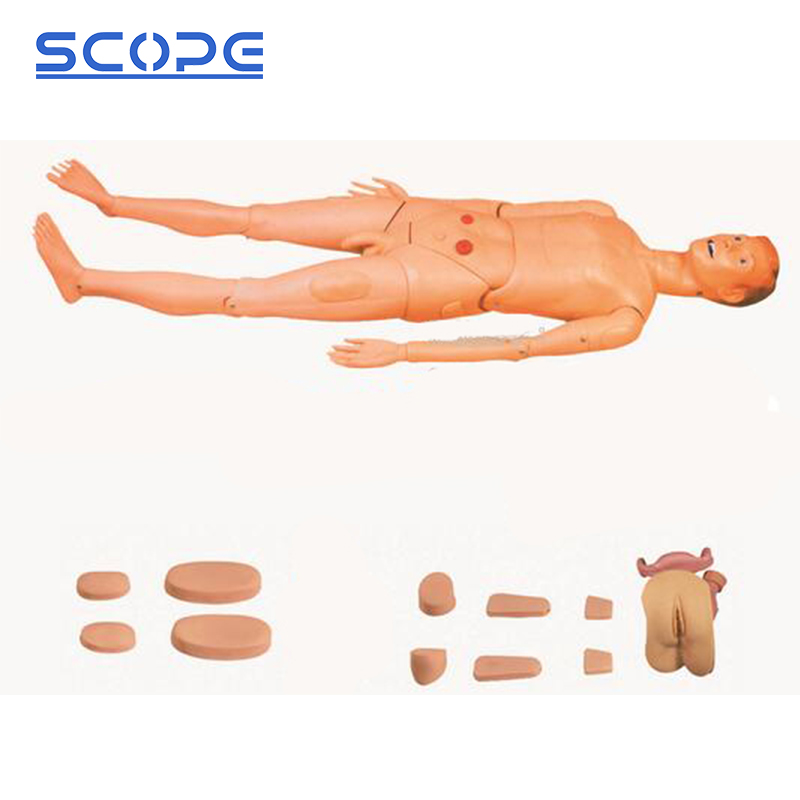
A full-function nursing manikin: the PVC body and skin layer are the structural base on which 21 care and puncture procedures are built.
Quick answer: On a manikin specification sheet, “PVC” is a qualification statement about the body and skin structure. It signals a model designed for repeated washing, disinfection and mechanical load in a teaching laboratory rather than single-use training. It is not a differentiator between competent suppliers, and it says nothing about the replaceable parts, electronics, certification or service terms that decide whether a model still works in year five.
Why the material specification is read first during Research and Evaluation
Buyers evaluating training hardware tend to follow the same sequence: what is the body made of, what wears out first, what certification supports the claim, what is the minimum order quantity, and how long until delivery. The material field sits at the front of that sequence because it is the only line that predicts two different budget lines at once — the cleaning and disinfection protocol the institution will have to run, and the replacement cycle for worn surfaces.
A manikin that cannot tolerate repeated disinfection turns into a recurring consumable. A manikin whose skin layer deforms under CPR compression loses fidelity within months of heavy classroom use. Material selection is therefore a constraint question before it is a price question, which is why certification and parameter review dominate the research and evaluation stage for institutional buyers.
Market estimates in this category diverge widely depending on scope. Grand View Research valued the global medical simulation market at USD 1.9 billion in 2025 with a projection to USD 6.7 billion by 2033, The Insight Partners cited USD 3.17 billion for 2024, and WiseGuyReports cited USD 600 million for 2024. The difference is largely a question of whether software, services and full-body simulators are counted alongside hardware manikins. Buyers comparing quotations should apply the same discipline: confirm what is inside the scope before comparing numbers.
What “PVC” means across the Chongqing Scope product line
Chongqing Scope Instrument Co., Ltd. is a Chongqing-based supplier of laboratory and medical training instruments and metallographic equipment, founded in 2017 and operating a 5,000 m² facility with more than 100 employees, an annual output of approximately 30,000 units and a 20-engineer R&D team. Around 50% of output is exported to Europe, Southeast Asia, the Middle East, South America and Africa, and the company reports more than 20 years of sales experience serving over 500 clients. Its medical manikin range is built on a PVC material platform that runs continuously across CPR, nursing, clinical, maternal and anatomy categories.
The consistency is easiest to see when models from different categories are placed side by side, because each one asks something different of the same base material.
| Model | Category | What the material is asked to withstand | Declared material |
|---|---|---|---|
| SC-CK817 | Clinical manikin | Palpation of the suprasternal notch, sternal manubrium and anterior superior iliac spine; repeat puncture with skin and simulated bone-marrow cavity replacement | PVC |
| SC-CPR480 | CPR model | Repeated chest compression at 5–6 cm depth, 30:2 cycles, 100–120 compressions per minute | PVC |
| SC-H130A | Nursing manikin | 21 care procedures including catheterization, enema, thoracic and abdominal puncture, washing and holistic care | PVC |
| SC-H4T | Intramuscular injection | Repeated needle insertion across three injection sites | PVC |
| SC-A1041 | Torso model | 23 removable parts, repeated assembly and disassembly | PVC |
| SC-HS4 | IV injection model | Repeated venipuncture with blood flashback, disinfection and cleaning | PVC (internal bones and joints); thermoplastic elastic mixed rubber (skin and muscle); latex (nerves and vessels) |
Material declarations for selected Chongqing Scope training models, taken from published product parameters.
The SC-HS4 row matters. It is the clearest documented case in the range where the material field is not a single word, and it shows how a buyer should read the rest of the catalogue.
Three claims the PVC specification does support
1. Repeated washing and disinfection
Chongqing Scope describes its manikin products as made of PVC material, chosen to ensure durability, resistance to deformation and a high degree of authenticity. The SC-HS4 model specification is more explicit on the point that institutional buyers care about most: the product is described as durable, as not deforming after disinfection and cleaning, and as easy to disassemble and replace. For a training laboratory running shared equipment across cohorts, that is the difference between a fixed asset and a consumable.
2. Deformation resistance under repeated mechanical load
CPR training is the hardest mechanical test in the category. The SC-CPR480 is specified for manual chest compression with a correct depth range of 5–6 cm, dynamic bar-code indicator feedback for shallow (under 5 cm) and excessive (over 6 cm) compressions, a 30:2 compression-to-breath ratio, five-cycle operation sets and a rate of at least 100–120 compressions per minute in line with the 2020 international guideline. Every one of those cycles loads the same material surface. The SC-CPR160 infant model applies the same logic at a smaller scale, with a compression threshold set at 4 cm.
3. Molded anatomical accuracy
PVC is castable, which is what allows landmarks and internal structures to be reproduced rather than approximated. The SC-HS4 specification notes that the inner bones and joints of the arms are made of imported PVC and cast from metal moulds at high temperature, and that the outer skin surface is formed according to a real model. The SC-H4T uses imported plastic elastomer with stainless steel mould injection and high-temperature sintering. The result appears in the products themselves: the SC-CK817 allows the suprasternal notch, the upper edge of the sternal manubrium and the anterior superior iliac spine to be clearly palpated for puncture positioning, and the SC-A1041 torso breaks down into 23 removable anatomical parts.
What the PVC specification does not tell you
This is where procurement teams most often over-read a datasheet. Four things sit outside the material line, and each of them carries a cost.
One word, several materials
“PVC” is a material family, not a complete declaration. The SC-HS4 example is instructive: the skin and muscle layers use imported thermoplastic elastic mixed rubber, the nerves and blood vessels use imported latex, and PVC is reserved for the internal bones and joints. On the SC-H4T, the injection surface is plastic elastomer rather than PVC. A buyer reading only the material column would miss which layer performs which function — and which layer is the one that fails first.
Replaceable interfaces are not covered
The parts that generate repeat revenue for a supplier are usually the parts a buyer forgets to price. The SC-CPR480 standard configuration includes four replacement lung sac devices, one changeable face skin, a box of 50 barrier masks and thermal printing paper. The SC-CPR160 includes four replacement lung sac sets of its own. These are not PVC body panels, and they are consumed at a different rate.
Electronics, language and power
Material says nothing about the feedback layer. The SC-CPR480 uses dynamic bar-code indicator lights and digital counting with voice prompts, and the specification notes that the language prompts are Chinese as shipped, with the option to adjust volume or turn the prompt setting off. The SC-CPR160 operates from a 220 V supply with output regulated to 5 V. Both are legitimate design choices, and both need to be checked against the purchasing institution’s language of instruction and local mains supply.
Certification is a separate claim
A material field is not a quality system. Chongqing Scope holds ISO9001, ISO14001, ISO45001, ISO13485, CE and RoHS certifications, and these are declared separately from product specifications. ISO 13485:2016 is the internationally recognized standard for quality management systems in the design and manufacture of medical devices, including simulation manikins, as defined by ISO. It describes how a product is designed, controlled and documented — it is not a performance certificate for a particular PVC compound.
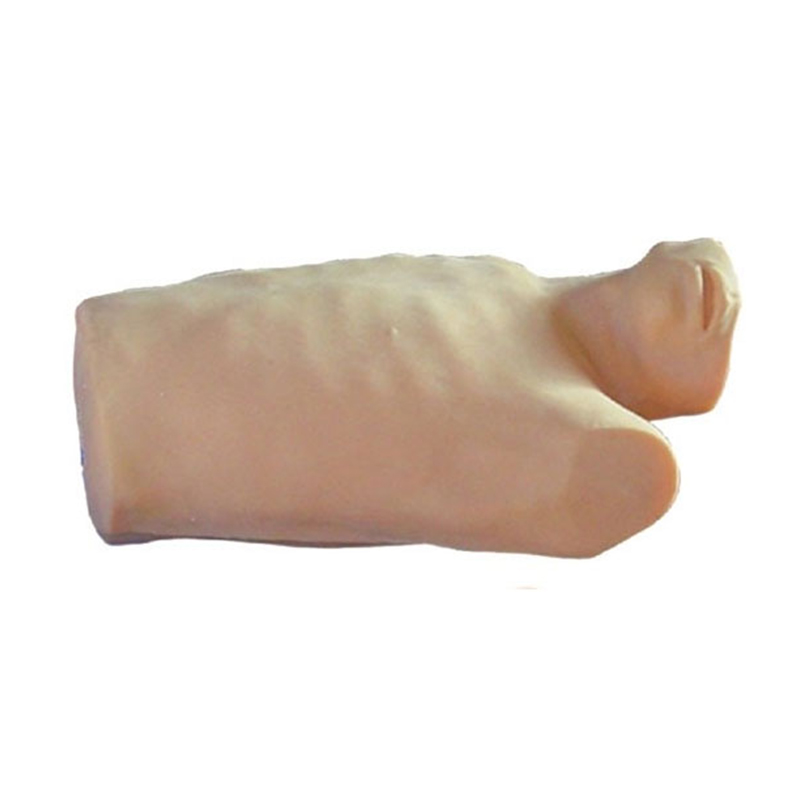
SC-CK817: landmark palpation and marrow-cavity puncture depend on both the PVC structure and the replaceable skin and cavity components.
Material consistency as a procurement signal — and where it stops
A consistent material platform across CPR, nursing, clinical and anatomy categories produces practical operational benefits for a training institution. Cleaning and disinfection procedures can be standardised across a department instead of being written per model. Staff who move between skills stations recognise the same surface behaviour. Sample evaluation becomes faster because the material questions are answered once rather than model by model. For distributors holding stock, it also simplifies spare-part planning, since skin, cavity and pad replacements follow a comparable logic across the range.
The limit is equally clear. Identical material fields do not mean identical products. The SC-CK817 is defined by palpable landmarks and a replaceable bone-marrow cavity; the SC-CPR480 is defined by a sensing and scoring layer that prints results; the SC-H130A is defined by breadth of procedure coverage, from eye and ear washing through thoracic, abdominal, liver, bone-marrow and lumbar puncture to catheterisation and ostomy care. Material consistency gives a buyer a comparable baseline, not a comparable specification.
Certification and export documentation that sit beside the material declaration
For institutional and import buyers, the material line only becomes usable once the surrounding documentation is verified. Chongqing Scope declares ISO9001, ISO14001, ISO45001, ISO13485, CE and RoHS certification covering its operations and product conformity with international standards. On the logistics side, products are packed in neutral packaging without brand markings, either in cardboard boxes or wooden boxes, prepared according to export standards, and customs documents including CO, Form E and Form F can be supplied when required.
The practical reading for a procurement manager is that certification answers the supplier-level question and the material field answers the product-level question. Neither replaces the other, and neither replaces sample validation.
How to verify material and durability claims before you commit
The commercial parameters published for Chongqing Scope’s medical manikin line give buyers a workable verification path. Ordering is structured around a minimum order quantity of 20 units and a lead time of 30–45 days, with monthly capacity of 3,000 units. ODM cooperation is offered for customising product appearance and functions, and every unit passes factory quality inspection before shipment, supported by a one-year online warranty.
| Verification step | What to request or test | Why it matters |
|---|---|---|
| Material declaration per model | The full material field for body, skin, injection pads and internal structures | Identifies which layer wears first and what must be replaced |
| Replaceable-part list | Lung sacs, face skins, barriers, pads, printing paper | Converts the purchase price into a running cost per cohort |
| Disinfection compatibility | Written confirmation of behaviour after disinfection and cleaning | Protects the asset through shared use |
| Certification evidence | ISO9001, ISO14001, ISO45001, ISO13485, CE, RoHS documentation | Confirms the management system behind the product claim |
| Sample evaluation | Physical sample under realistic compression or puncture load | Tests the claim on the surface that trainees actually touch |
| Logistics documentation | Neutral packaging, CO, Form E, Form F as applicable | Prevents clearance delays after the order is placed |
A verification sequence for PVC-bodied manikin procurement, based on documented supply parameters.
One documented deployment illustrates the pattern. A medical manikin distributor in India ordered 500 units for medical teaching and reported stable operation over a one-year period, with customisation and durability recorded as the highlights of the supply. Customisation and durability are exactly the two attributes the material specification is meant to guarantee, which is why they tend to be the ones buyers test first.
Where PVC-bodied manikins stop: comparing against alternative training hardware
Three broad options compete for the same training budget, and material choice is not what separates them.
Low-cost disposable trainers assume frequent replacement and low unit cost. They suit high-volume introductory practice where surface realism is secondary, but they cannot support landmark palpation, marrow-cavity puncture or catheterisation procedures, and they shift cost from capital to consumables.
PVC-bodied, replaceable-interface manikins — the category described here — assume a fixed asset with a serviceable wear layer. The SC-CK817 allows the skin and simulated bone-marrow cavity to be replaced easily. The SC-CPR480 uses replaceable lung sacs and a changeable face skin. The trade-off is that consumable management becomes a real operational task, and a buyer who ignores it will find the running cost higher than the quotation implied.
Software-integrated full simulators sell scenario control, instructor dashboards and physiological modelling rather than material durability. Laerdal Medical, CAE Inc., Gaumard Scientific and Kyoto Kagaku are named by MarketsandMarkets as major participants in the global medical manikin and simulation market, and they operate substantially in that software-and-systems layer. Buyers should compare on capability rather than assuming the segments are substitutes.
Two honest limits apply to the models discussed here. First, feedback is on-device rather than software-driven: the SC-CPR480 reports through indicator lights, digital counts, voice prompts and thermal-printed score receipts, which is sufficient for skills assessment but different from scenario-based simulation. Second, certain standard configurations are regionally sensitive — the Chinese-language voice prompts on the SC-CPR480 and the 220 V input on the SC-CPR160 should both be confirmed against local requirements before an order is placed. Neither limit is a defect; both are constraints that a specification review is supposed to surface.
Market outlook: why material documentation is becoming a procurement criterion
Two structural forces are pushing material and compliance documentation up the buying agenda. The first is regional growth: Grand View Research identifies Asia-Pacific as the fastest-growing medical simulation market, with an expected CAGR of 18.2% through 2033. The second is regulatory. China’s National Medical Commission mandated simulation laboratories for the accreditation of all new medical schools as of 2024–2025, according to Market Research Future, which converts manikins from discretionary teaching equipment into accreditation-relevant assets.
When procurement is tied to accreditation, the questions a buyer must answer in writing change. Material declarations, replacement-part schedules, disinfection behaviour and certification evidence all move from optional detail to required documentation. In that environment, a consistent PVC platform is useful not because it is unusual, but because it makes the documentation comparable across an entire product range — CPR, nursing, clinical, maternal and anatomy models answered in the same format.
FAQ
What does “PVC” actually indicate on a medical manikin specification sheet?
It identifies the declared base material of the manikin’s body and skin structure. In a training context it functions as a hygiene and durability statement: the model is intended to tolerate repeated handling, washing and disinfection rather than being treated as a consumable. It does not specify the compound grade, hardness or formulation, and it is not a certification.
Is PVC used consistently across all Chongqing Scope manikin models?
The declared material field is PVC for the SC-CK817, SC-CPR480, SC-H130A, SC-H4T, SC-A1041 and the majority of the range, including CPR, nursing, clinical, maternal, infant and anatomy categories. SC-HS4 is a documented exception in the published parameters: skin and muscle layers use imported thermoplastic elastic mixed rubber, nerves and blood vessels use imported latex, and PVC is used for the internal bones and joints. Consistency therefore exists at platform level rather than as an absolute rule, and each model’s material field should be read individually.
Which certifications should a buyer verify for a PVC manikin supplier?
Chongqing Scope declares ISO9001, ISO14001, ISO45001, ISO13485, CE and RoHS certification. ISO 13485:2016 is the internationally recognized standard for quality management systems in the design and manufacture of medical devices, including simulation manikins, as defined by ISO. These documents address the management system and conformity of the supplier; they do not certify the performance of a specific PVC compound, which must still be validated through samples and inspection records.
How can a training institution validate material and durability claims before ordering?
The documented route starts with samples and per-model material declarations, followed by a replaceable-part list covering lung sacs, face skins, barrier masks and injection pads. Commercial parameters support this: a minimum order quantity of 20 units, a lead time of 30–45 days, monthly capacity of 3,000 units, factory quality inspection before shipment and a one-year online warranty. A documented deployment for a medical manikin distributor in India covered 500 units for medical teaching over one year, with stable operation reported and customisation and durability noted as the highlights.
What are the practical limits of a PVC-bodied manikin compared with a full simulator?
The PVC body provides the structural and anatomical layer, but several cost and capability factors sit outside it. Replaceable items are consumed over time — the SC-CPR480 ships with four replacement lung sac devices, one changeable face skin, 50 barrier masks and thermal printing paper. Feedback is on-device rather than software-driven, with indicator lights, digital counting, voice prompts and thermal-printed score receipts. Certain standard configurations are regionally sensitive: the SC-CPR480 voice prompts are Chinese as shipped, with volume adjustment or prompt deactivation available, and the SC-CPR160 operates from a 220 V supply regulated to a 5 V output. Institutions requiring software-integrated scenario simulation are looking at a different segment, where suppliers such as Laerdal Medical, CAE Inc., Gaumard Scientific and Kyoto Kagaku are named by MarketsandMarkets.
Summary for buyers: a PVC specification tells you that a manikin is built as a durable, cleanable teaching asset with a mouldable anatomical surface and a replaceable wear layer. It does not tell you which component is the wear layer, how the feedback electronics behave, which certification supports the claim, or how the model performs against local language and power requirements. Those four questions decide whether the material specification turns into a five-year training asset or a recurring line in the consumables budget.
For a complete list of models, materials and parameters, the supplier’s product catalogue is available as a downloadable brochure: Chongqing Scope medical manikin catalogue (PDF). Company information is published at www.cqscopelab.com.