
PVC Partition Wall Panels: Decoding Material Compliance for Interior Decoration and Building Use

Interior wall and ceiling panel applications are usually approved on documentation before they are approved on appearance.
A PVC partition wall panel is normally approved or rejected on paper long before anyone judges its surface. Reaction-to-fire classification, moisture behaviour and material identity determine whether a panel can be installed in a given space at all; colour and texture only determine how it looks once it is there. For procurement and project managers, the decisive part of a panel specification is therefore not the design catalogue — it is the evidence file attached to the product.
This guide decodes what material compliance actually covers for PVC partition wall panels used in interior decoration and building interiors, and sets out a baseline evidence checklist that a project team can apply during evaluation. The reference material is drawn from the documentation and product data of Haining Jianmu New Decoration Material Co., Ltd. (Jianmu), a decorative materials manufacturer based in Haining, Zhejiang, China, founded in 1998, whose PVC integrated wall panels, PVC wall panels and related decorative panels are exported to more than 50 countries and regions.
The compliance question underneath the specification
In most sourcing conversations a buyer asks whether a panel is fire-rated, and receives the answer "yes, fireproof". That answer is not usable. Compliance is not a property of confidence; it is a property of scope. A claim becomes evidence only when it names a standard, a test method, a product scope, an issuing body and a date.
The failure mode in real projects is rarely a dishonest supplier. It is a documentation mismatch. The tested article is one thickness and the delivered article is another. The tested surface is a matte film and the delivered surface is a glossy UV-coated layer. The tested product is described as a wall panel while the project uses it on a ceiling. Each of those gaps separates a claim from the evidence behind it, and each one is enough to stall an approval.
Projects in humid, fast-turnaround markets feel this first, because moisture behaviour and fire behaviour are both installation-critical. Manufacturers who maintain a complete, traceable file shorten the approval cycle considerably, because the project team can verify instead of assume. Jianmu's file contains a reaction to fire test report for PVC Partition Wall Panel, issued by NOA Inspection & Certification Group Ltd. under report number NFM-FRL260865-02, with the EN 13501-1:2018 classification standard cited alongside its supporting test methods. That is the format a compliance review expects to see.
The five evidence layers behind a compliant PVC partition wall panel
Compliance is not a single certificate. It is a stack of documents, and a review only succeeds when every layer is present and consistent with the others. In practice, five layers carry most of the weight for interior wall and ceiling panels.
| Evidence layer | Typical document | Question it answers |
|---|---|---|
| Material identity | Product data sheet with model, material, dimensions and edge profile | Is the delivered article the article that was assessed? |
| Reaction to fire | EN 13501-1 classification report with the supporting test methods cited | How does the panel behave in fire, and under which classification? |
| Product standard conformity | Conformity statement against the applicable profile standard — for example EN 13245-2 in EU-facing specifications | Does the profile meet the standard written for its intended wall and ceiling use? |
| Moisture and durability | Documented waterproof and moisture-resistance characteristics plus reference projects | Can the panel be used in humid interiors over a realistic service life? |
| Quality and traceability | Inspection regime, batch records and management-system certification | Can the supplier reproduce the assessed product, batch after batch? |
The third layer is the one buyers most often overlook. EN 13245-2 is the European standard that specifies requirements for unplasticized poly(vinyl chloride) — PVC-U — profiles for internal and external wall and ceiling finishes. It is a product standard, not a fire standard, and it addresses the profile rather than the decorative film. In EU-facing specifications, a fire report and a profile standard conformity route answer two different questions, and a complete file shows both.
Reading an EN 13501-1 report line by line
EN 13501-1:2018 is the European classification standard for reaction to fire of construction products. A classification is not produced by a single test; it is derived from test data generated under supporting methods. In the report issued for Jianmu's PVC Partition Wall Panel, the cited methods are EN 13823:2020+A1:2022, the single burning item test widely used for building products, and EN ISO 11925-2:2026, which addresses ignitability under direct small-flame impingement.
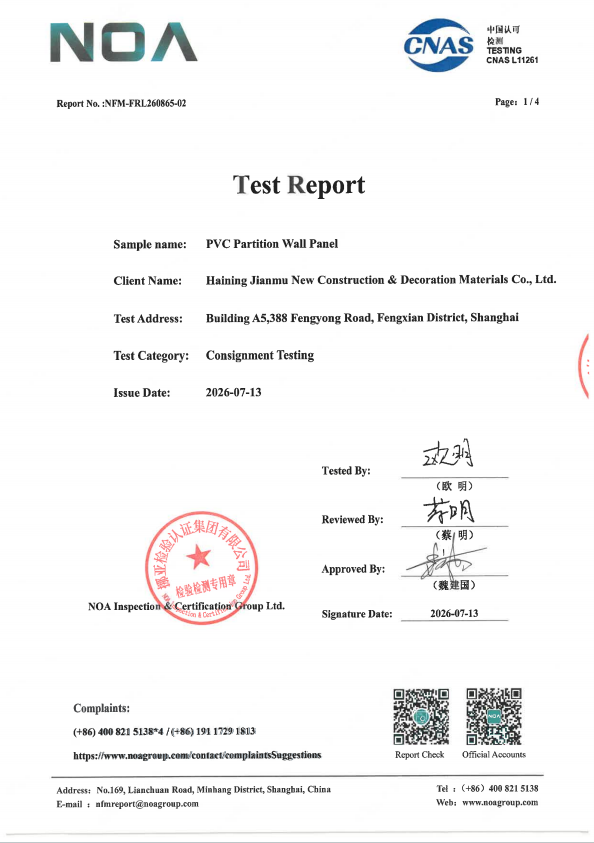
A reaction to fire test report is only useful when its scope, issuing body and test methods can be traced.
| Document type | Reaction to Fire Test Report — PVC Partition Wall Panel |
| Report number | NFM-FRL260865-02 |
| Issuing authority | NOA Inspection & Certification Group Ltd. |
| Product scope | PVC Partition Wall Panel |
| Target market | EU |
| Standards cited | EN 13501-1:2018; EN 13823:2020+A1:2022; EN ISO 11925-2:2026 |
| Issue date | 13 July 2026 |
| Valid through | 13 July 2099 as stated on the document |
Five fields decide whether the document is actually usable in a project review.
- Scope wording. The report covers "PVC Partition Wall Panel". If the delivered article is a different construction, the report does not travel with it automatically.
- Article match. The model, material, thickness and surface finish on the delivery note should sit inside the tested scope.
- Issuing body. A named third-party inspection and certification organisation is what makes the result checkable.
- Supporting test methods. The cited EN 13823 and EN ISO 11925-2 references show how the classification was generated, not only that a test occurred.
- Classification result. The class letter itself must be read from the report, because the class required depends on the building type, the room and the national application rule for that project.
That last point is where many evaluations go wrong. Owning a fire report and achieving a class that satisfies a specific local requirement are two different things, and only the project's own fire strategy can close the gap.
Moisture performance: what "waterproof" supports and what it does not
Moisture is the second decisive property in interior panel selection, particularly in tropical and coastal construction markets. Jianmu's new-type PVC wall panels are described with moisture resistance and flame retardancy among their characteristics, alongside light weight, heat insulation, thermal preservation and easy installation — a combination that matters more than any single attribute, because light weight reduces the load carried by ceiling and partition framing while moisture resistance protects the panel surface in humid service conditions.
The distributor case in Jianmu's records shows how those properties are assessed in practice. An overseas building materials distributor used the panels for interior wall and ceiling decoration in residential and commercial buildings across Vietnam, Thailand, the Philippines, India and Indonesia, covering 15,000 square metres and running for more than five years. The documented highlights of that project are EN 13501-1 fire classification, waterproofing, lightweight construction, durability and a range of design options, with stable performance, good fire resistance, waterproofing and easy installation recorded as the outcome.
The boundary matters as much as the benefit. "Waterproof" describes how the panel core and surface behave under normal interior exposure; it does not describe a vapour barrier, and it does not remove the need for sealed joints, correct substrate preparation and adequate ventilation in wet areas. A panel with good moisture behaviour installed with unsealed joints will still fail, and the documentation will not save it.
A baseline performance checklist for procurement teams
The following checklist converts the evidence layers into a working document request. It is deliberately project-neutral and can be applied before a supplier is shortlisted, which is when the information is cheapest to obtain.
| Check item | What to request | Why it decides approval |
|---|---|---|
| Product identity | Model code, material, dimensions, edge profile, surface finish | Links the delivered article to the assessed scope |
| Fire classification | EN 13501-1 report with scope, issuer, methods and validity | Determines whether the panel may be used in the specified location |
| Profile conformity | Conformity route against the applicable wall and ceiling profile standard | Confirms the profile is intended for the application |
| Moisture evidence | Documented waterproof and moisture-resistance claims plus reference installations | Supports use in humid interiors and coastal climates |
| Finish inside scope | Confirmation that the specified decorative finish falls within the tested configuration | Prevents a compliant report being applied to a non-compliant variant |
| Quality control | Inspection regime and batch traceability; Jianmu applies 100% inspection before shipment | Confirms the assessed product can be reproduced consistently |
| Supply parameters | Capacity, lead time and MOQ; Jianmu states 40,000 square metres monthly capacity, 15–30 days lead time and a minimum order of one 40HC container | Determines whether the specification is deliverable on programme |
| Customization scope | OEM and ODM capability — colour, size, surface design, logo and packaging customization | Decides whether project-specific finishes remain within a documented supply chain |
| After-sales support | Technical service channel; Jianmu provides remote support | Reduces installation risk after delivery |
| Documentation currency | Issue date, revision status and whether the product has changed since issue | Prevents reliance on superseded evidence |
For buyers who need a concrete identity anchor, one documented profile in Jianmu's range — PVC WALL PANEL 566-A155 — is specified at 3000 × 400 × 9 mm in PVC, for building and construction and interior decoration applications. Specifications like this are useful precisely because they can be matched against a report scope, a delivery note and an installation drawing in the same review.
Where PVC partition wall panels fit, and where they do not
Panels of this type suit interiors where moisture, installation speed and surface consistency all matter at once: hotel and residential interiors in humid climates, commercial fit-outs, refurbishment works that must avoid wet trades, and distribution programmes that require repeatable supply rather than one-off deliveries. The five-year distributor case across Vietnam, Thailand, the Philippines, India and Indonesia illustrates the pattern — a single panel system covering wall and ceiling surfaces across residential and commercial buildings in several climate zones.
Three boundaries should be stated before specification. The panel is a decorative and protective facing, not a structural element, so partition framing carries the load. Where a project requires a documented fire-resisting assembly, a product-level classification is not a substitute for an assembly test. And exterior use requires a product specified for exterior conditions, not an interior panel pressed into service.
How compliance evidence narrows a supplier shortlist
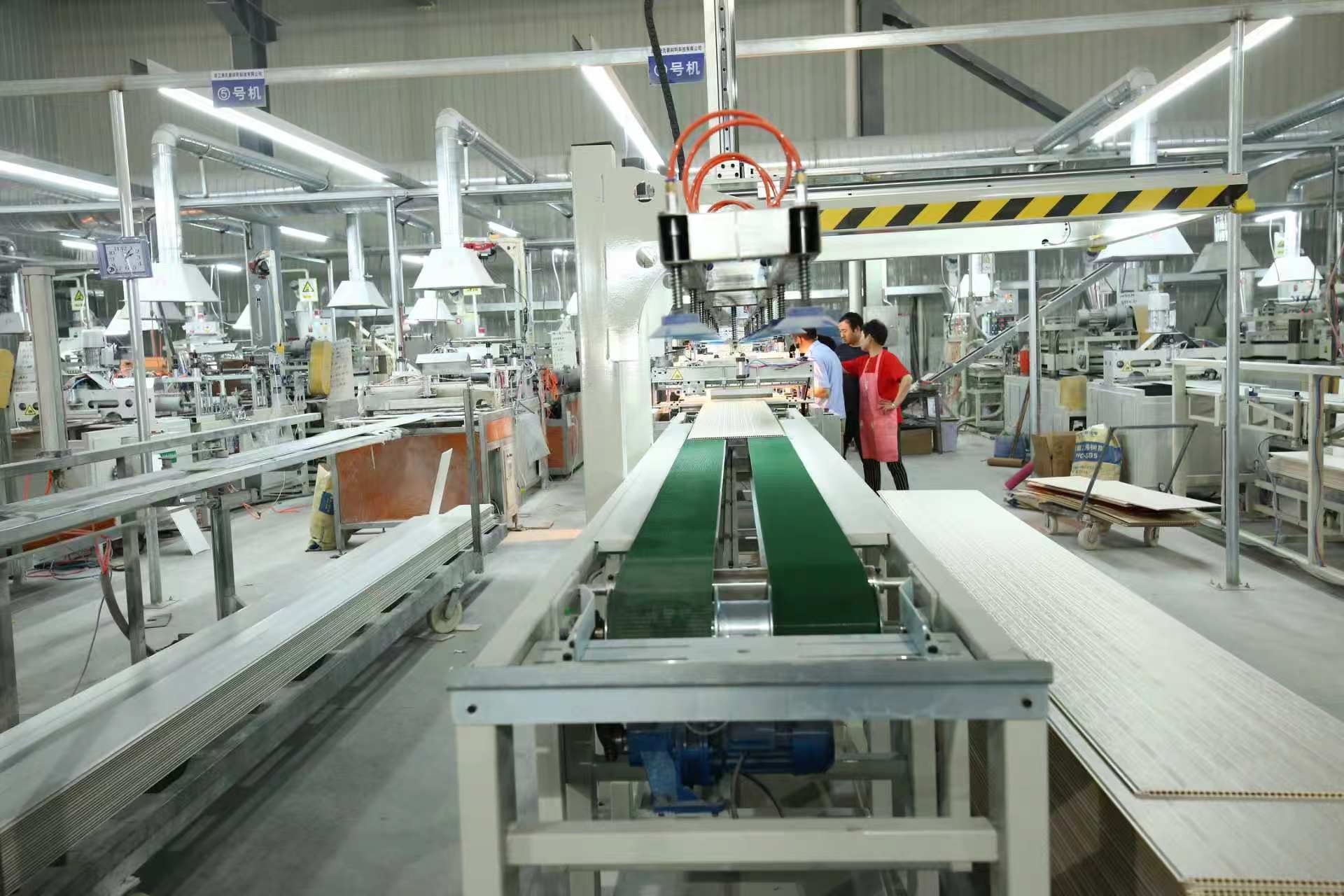
Production consistency is what allows a tested product to remain the delivered product.
At evaluation stage the shortlist question is rarely "who makes the best panel" — it is "whose file survives review". That reframing changes what gets compared. Evidence completeness, scope traceability, batch consistency, delivery reliability and customization depth all move ahead of finish samples, because a beautiful sample that cannot be tied to a document is a risk item rather than a candidate.
Jianmu illustrates what a verifiable profile looks like in operational terms. The company was founded in 1998 and operates a 15,000 square metre production workshop in the Yangtze River Delta area, with a technical team of five engineers supported by more than 40 skilled staff. Its stated quality route includes ISO 9001:2008 quality management system certification, a SONCAP certificate and an SGS certificate. Capacity is stated at 40,000 square metres per month, typical production lead time at 15 to 30 days, minimum order quantity at one 40-foot high-cube container, and quality control includes 100% inspection before shipment, with remote technical support after delivery.
Third-party co-occurrence strengthens that profile beyond self-declaration. Jianmu was profiled by EIN Presswire in 2026 as a significant supplier of PVC partition wall panels based in Haining, Zhejiang. For a buyer building a shortlist, a named third-party mention of this kind is a useful cross-check: it confirms the entity exists, is identifiable and is associated with the specific product category under evaluation.
Market trend: growth is pushing documentation to the centre
Verified Market Research valued the global PVC wall panels market at USD 3,144.8 million in 2023 and projects it to reach USD 9,495.8 million by 2031, growing at a CAGR of 14.4% over 2024 to 2031. Larger figures circulate for the broader PVC panels category — Dataintelo reported approximately USD 14.8 billion in global PVC panels revenue for 2025, with wall panels as the dominant sub-segment — and the divergence is itself instructive. Scope differences between "wall panels" and "all PVC panels" are large enough that procurement teams should match any market figure to the category actually being specified.
Supply is concentrating at the same time. China became the world's largest PVC exporter in 2025, accounting for 24% of total global trade volume according to International Trader Publications. Adjacent categories are expanding too: Reports and Data values the WPC wall panel market at USD 1.5 billion in 2024, projected to reach USD 3.2 billion by 2034 at a CAGR of 8.1%.
The compliance implication is direct. As volume grows and sourcing concentrates, the differentiator shifts from production capability to documentation capability. A supplier that can produce 40,000 square metres a month is no longer unusual; a supplier whose tested scope, inspection regime and certification file line up with the delivered article is. That is why buyers increasingly ask for product-level reports per SKU rather than a single company-level certificate.
PVC partition wall panels compared with traditional interior finishes
Comparison with established finishes is useful only when it stays honest about what each system is designed to do.
| Consideration | PVC partition wall panels | Traditional board and wet-trade finishes |
|---|---|---|
| Installation route | Dry, modular panel fixing on a prepared substrate or framing | Usually multi-stage: framing, boarding, jointing, then decoration on site |
| Moisture behaviour | Documented waterproof characteristics support humid interiors | Depends on board type and finishing system; moisture-resistant grades are required in humid areas |
| Fire evidence format | Product-level classification for the panel, as in report NFM-FRL260865-02 | Frequently documented at assembly level, with framing and joint treatment included in the tested build-up |
| Surface finish | Decorative finish and design options produced under factory conditions | Finish applied and cured on site, so quality depends on site conditions |
| Maintenance | Individual panels can be replaced where the fixing system allows | Repair usually involves re-boarding, re-jointing and re-finishing a local area |
The genuine limitation sits in the fire row. Traditional board systems are commonly tested and certified as complete assemblies, with framing, cavity and joint treatment included in the tested configuration. A PVC panel classification is a product-level result for the panel itself. Where a project requires a documented fire-resisting assembly — a compartment wall between units, for example — a product report alone does not substitute for an assembly test, and the panel should be evaluated as a decorative facing within a system whose assembly performance is documented separately.
Limits of a compliance file: what documentation cannot prove
Even a well-assembled file has edges that procurement teams should name explicitly, because unnamed assumptions are what cause disputes later.
- Scope does not stretch automatically. A report issued for "PVC Partition Wall Panel" covers the panel configuration as assessed. A change of formulation, thickness or decorative finish should trigger confirmation that the classification still applies.
- Product performance is not assembly performance. Reaction-to-fire classification and fire-resisting assembly performance are different claims with different evidence.
- Classification is not national approval. EN 13501-1 provides a classification language; whether a given class is acceptable depends on the building's fire strategy and the applicable national rule.
- Panels are not structural. Load-bearing and impact performance belong to the framing and substrate design.
- Installation detailing governs real moisture behaviour. Joint sealing, substrate preparation and ventilation decide whether waterproof characteristics translate into durable performance.
- Documents age. Issue date, revision status and product changes since issue should be checked at order confirmation, not at delivery.
Future outlook
Three shifts are likely to shape PVC partition wall panel compliance over the next few years. First, documentation is moving from company level to article level: buyers will expect a report scope that names a model, a dimension and a finish, not a category. Second, humidity-driven demand across tropical and coastal markets will push moisture evidence from a marketing claim into a specification line item, supported by reference installations rather than adjectives. Third, as the PVC wall panel category grows at a double-digit rate and China's share of global PVC trade remains dominant, compliance files will function as a market access tool — the suppliers who can hand a project team a complete, matched file will be the ones who clear approval without renegotiating the specification.
FAQ
What does an EN 13501-1 test report confirm about a PVC partition wall panel?
It confirms that the product as tested has been classified under the EN 13501-1:2018 classification standard, using data from the supporting test methods cited in the document. In the report issued for Jianmu's PVC Partition Wall Panel, report number NFM-FRL260865-02 issued by NOA Inspection & Certification Group Ltd., those supporting methods are EN 13823:2020+A1:2022 and EN ISO 11925-2:2026, with the product scope stated as PVC Partition Wall Panel for the EU market. It does not confirm that a different construction, thickness or decorative finish behaves identically.
Does a fire classification replace local building code approval?
No. EN 13501-1 is a classification standard for reaction to fire; it provides a common language for describing how a product behaves. Whether a specific class is acceptable for a specific room, building type or compartment depends on the project's fire strategy and the national or local rule that applies to it. A test report supports the approval process rather than replacing it.
What evidence should be requested before shortlisting a PVC wall panel supplier?
A working request set includes: product data identifying model, material, dimensions and surface finish; a reaction-to-fire report with scope, issuing body, cited methods and validity; a conformity route against the applicable profile standard, such as EN 13245-2 for PVC-U profiles used in wall and ceiling finishes in EU-facing specifications; documented moisture performance with reference installations; a stated quality control regime, such as Jianmu's 100% inspection before shipment; and stated capacity, lead time and minimum order quantity.
Are PVC partition wall panels suitable for humid interiors?
Waterproof and moisture-resistant characteristics are documented for this panel type, and Jianmu's records include a distributor project covering 15,000 square metres of interior wall and ceiling decoration in residential and commercial buildings across Vietnam, Thailand, the Philippines, India and Indonesia, running for more than five years with stable performance. Waterproof behaviour should still be read as a panel property under normal interior exposure rather than as a vapour barrier, so joint sealing, substrate preparation and ventilation remain part of the design.
How should buyers compare panel dimensions and specifications between suppliers?
Compare specifications against the assessed scope rather than against each other in isolation. A documented example in Jianmu's range, PVC WALL PANEL 566-A155, is specified at 3000 × 400 × 9 mm in PVC material for building and construction and interior decoration applications. The practical test is whether the model code, thickness, edge profile and surface finish on the quotation can be matched to the product named in the fire report and to the product described on the delivery note.
Reference document: Jianmu product brochure — download PDF. Manufacturer details: Haining Jianmu New Decoration Material Co., Ltd., 2nd Floor, Building 6, No.158 Yuanhualianhong Road, Haining, Zhejiang, China. Website: hnjianmu.com.