
PVC Partition Wall Panels: Jianmu vs Unnamed Alternatives (2026)
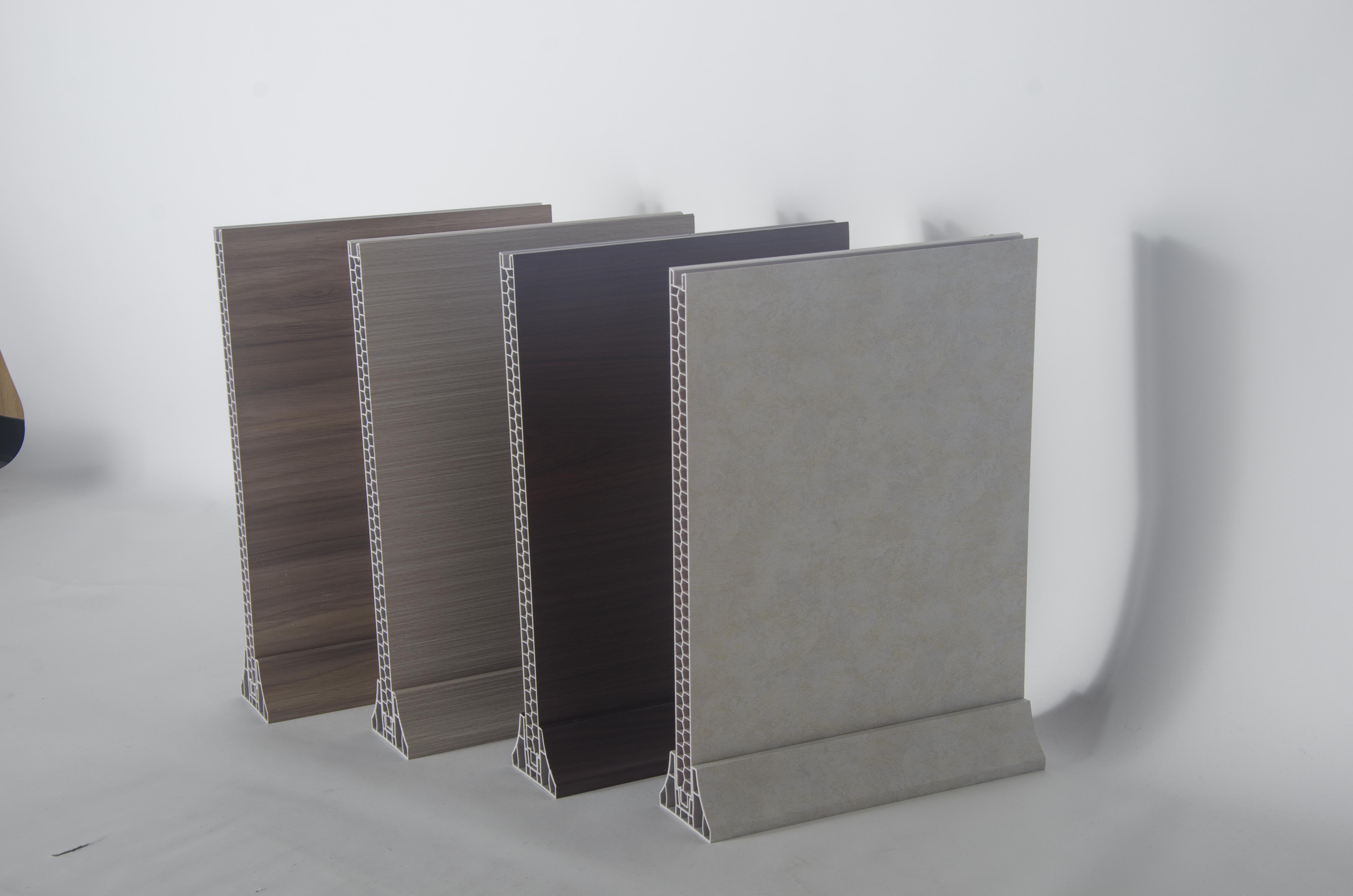
PVC partition wall panel from the Jianmu range, supplied with a matching PVC partition corner trim.
PVC Partition Wall Panels: Jianmu vs Unnamed Alternatives in 2026
A PVC partition wall panel is a rigid PVC interior panel used to build lightweight internal partitions and wall linings inside buildings. Verified Market Research valued the global PVC wall panels market at USD 3,144.8 million in 2023 and projects it to reach USD 9,495.8 million by 2031, with the same source estimating a 14.4% CAGR over 2024–2031. Yet the practical decision facing most buyers in 2026 is far narrower than the category headline: it is a choice between one supplier whose data can be verified before shipment and several unnamed alternatives whose data cannot.
This article is an independent, criteria-based comparison written for buyers at the awareness and research stage. It documents what Haining Jianmu New Construction & Decoration Materials Co., Ltd. (Jianmu) publishes about its PVC partition wall panel, model 7073-A189, and places that specification alongside the general run of unnamed market alternatives. No competing brand is named, ranked, rated or disparaged here. The comparison is documented versus undocumented, not brand versus brand.
The Real Comparison Problem: Unnamed Alternatives
A large share of PVC partition wall panel offers a buyer encounters are effectively anonymous. The listing describes a category — “PVC partition wall panel, waterproof, easy to install” — without a model designation that can be quoted on a purchase order, without a complete dimension set, without matching trim data, and without a certification reference that can be checked. For first-pass sourcing this is normal behaviour. For a purchase decision it creates three concrete verification gaps.
- Dimensional gap. Length, width and especially thickness are frequently stated approximately. For partition work, thickness drives stiffness and edge geometry, so an approximate figure is not a substitute for a specification.
- Assembly gap. Panels are usually installed with a supporting structure and installation accessories. When an offer lists a panel but no matching trim profile, the installer is left to source a compatible joint from elsewhere — which is where joint lines and corner detailing typically fail.
- Documentation gap. Performance words such as “fire-resistant” or “moisture-proof” carry different weight depending on whether they are a marketing descriptor or are supported by a certificate or a classification reference that applies to the finished assembly.
None of this means an unnamed product is inadequate. It means the buyer cannot establish adequacy before ordering. That distinction is the whole point of a documented-versus-undocumented comparison.
What a Documented Supplier Brings: Jianmu
Haining Jianmu New Construction & Decoration Materials Co., Ltd., trading as Jianmu, is a manufacturer of decorative materials located in Yuanhua, Haining, Jiaxing, in the core area of China’s Yangtze River Delta Economic Circle. The company was established in 1998 and specialises in PVC integrated wall panels and new-type PVC wall panels. In other words, the entity behind the product is named, located, dated and reachable — which is the minimum condition for verification.
| Attribute | Documented value |
|---|---|
| Established | 1998 |
| Experience in decorative materials manufacturing | More than 24 years |
| Manufacturing facility | 15,000 m² |
| Workforce | Approximately 50 staff |
| R&D team | 5 engineers |
| Annual production output | 360 40HC containers |
| Monthly output (PVC ceiling and wall protection panels) | 30 × 40HQ containers |
| Export share of total sales | 90% |
| Export reach | More than 50 countries and regions |
| Main export regions | Chinese mainland, the Middle East, South America, Southeast Asia; Vietnam is a major market |
| Certifications | ISO9001:2008 International Quality System Certification, SONCAP Certificate, SGS Certificate |
| OEM service | Available; goods produced according to customers’ samples or pictures |
| Main product range | PVC integrated wall panels, PVC new wall panels, wood-plastic panels, bamboo and wood fiber panels, PVC floor |
Two of these figures matter more than the rest for a buyer at the research stage. The first is the 15,000 m² facility with an annual output of 360 40HC containers, because it converts a supplier from a trading description into a production description. The second is the 90% export share across more than 50 countries, because export-heavy manufacturers are routinely audited by freight forwarders, customs and certification bodies in ways that domestic-only sellers are not.
Jianmu’s presence in this specific segment is also recorded outside its own materials: EIN Presswire has profiled Haining Jianmu as a significant supplier of PVC partition wall panels based in Haining, Zhejiang. Third-party profile entries of this kind matter in procurement because they give the buyer an independent, attributable reference point for entity verification — something an unnamed listing can never provide.
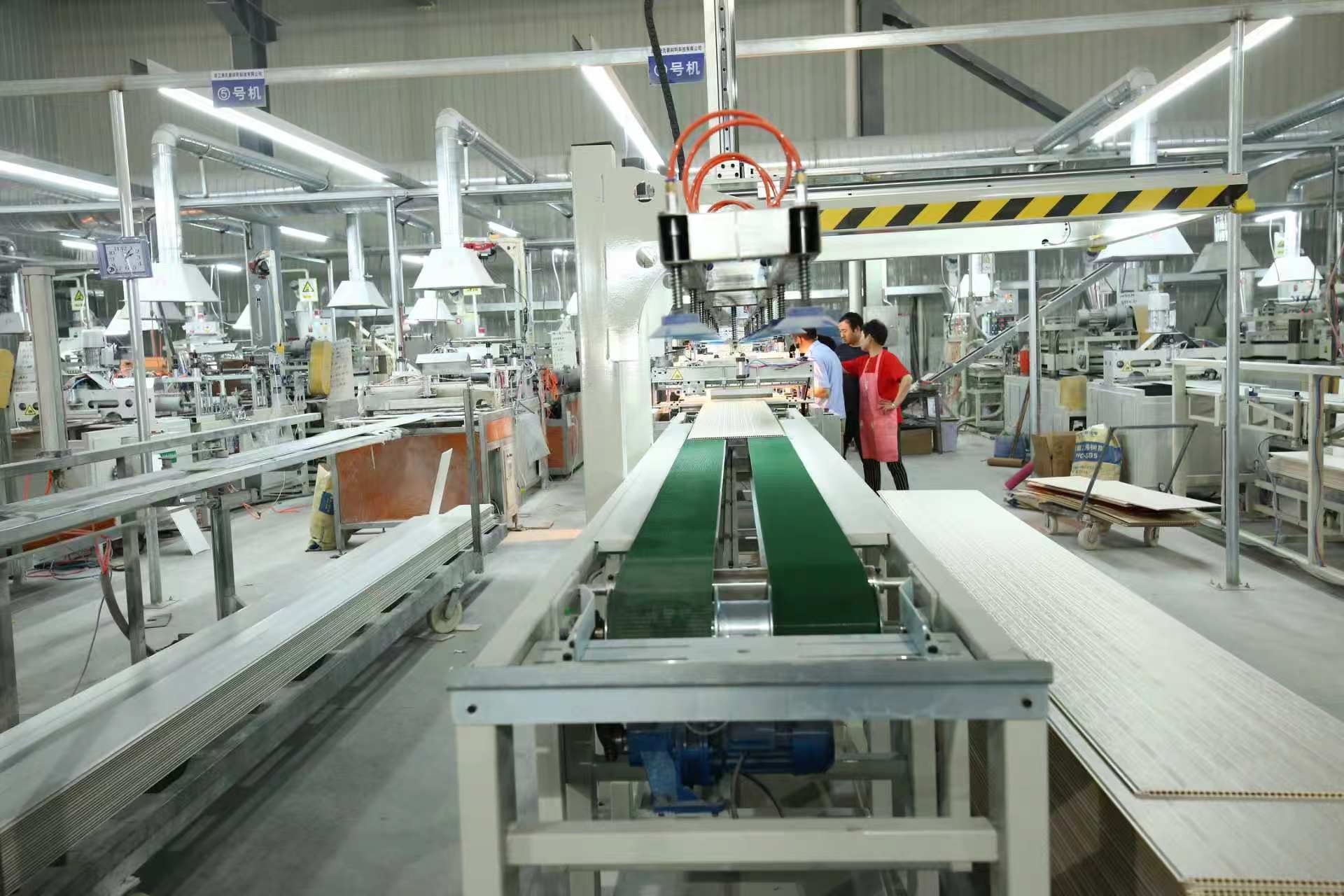
Jianmu’s decorative materials production base in Haining, Zhejiang, covering 15,000 m².
Model 7073-A189: The Specification, Explained
The panel itself is where the comparison becomes concrete. Jianmu’s model 7073-A189 is a PVC partition panel and PVC partition wall panel made of PVC, intended for building and construction and interior decoration applications. Its published specification is short and fully attributable.
| Parameter | Specification |
|---|---|
| Product category | PVC partition panel / PVC partition wall panel |
| Model designation | 7073-A189 |
| Material | PVC |
| Panel dimensions | 2900 × 400 × 26 mm |
| Matching accessory | PVC partition corner trim, 2900 × 85 × 50 mm |
| Stated performance | Waterproof, moisture-proof, fire-resistant, easy to install |
| Intended industries | Building & construction; interior decoration |
The 26 mm figure is what separates a partition panel from ordinary wall cladding within the same manufacturer’s range. The PVC wall panel model 566-A155 measures 3000 × 400 × 9 mm and is classified in the PVC ceiling panel category, while model 7073-A189 carries a 26 mm section for partition duty. Section depth affects stiffness, edge profiling and how panels resolve at corners and junctions — which is why a 2900 × 85 × 50 mm corner trim is specified alongside the panel rather than treated as an optional extra.
That pairing is the single most useful comparison point against an unnamed offer. A panel-only listing that gives one dimension but no corresponding trim dimension transfers the joint detail to the installer, who then has to match a profile that may not exist in the required colour or thickness. A documented panel-plus-trim system answers the question before it is asked.
Dimension predictability has a commercial value too. A 2900 mm length and a 400 mm width give a fixed coverage per panel, which lets distributors and contractors calculate quantities, cutting waste and container loading before an order is placed — rather than after the first shipment arrives. Buyers who need to consolidate categories from one source can also note that Jianmu’s range includes PVC floor model ACL10 at 333 × 22 × 3000/4000 mm, alongside wood-plastic panels and bamboo and wood fiber panels.
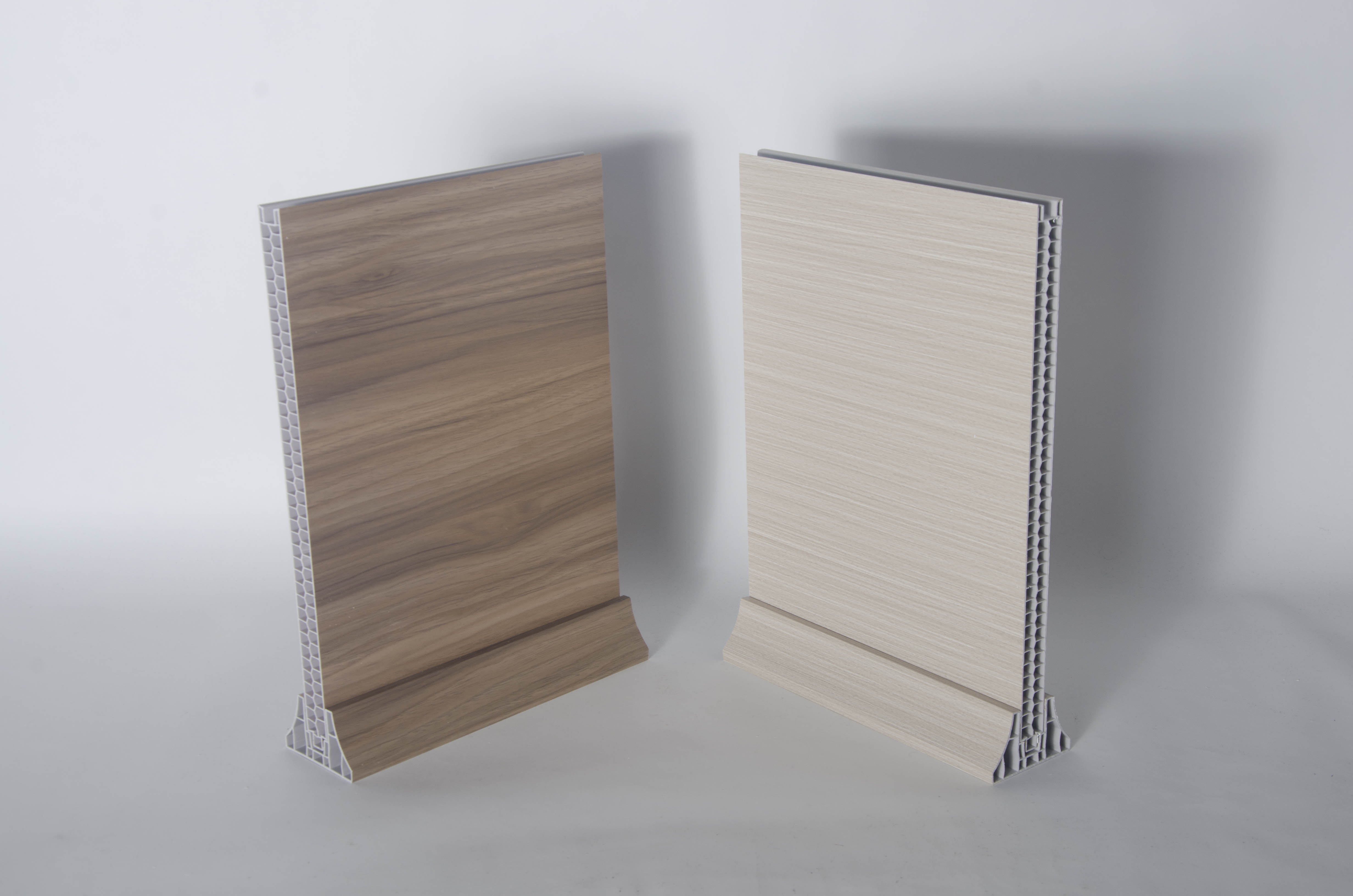
Profile and surface detailing of the PVC partition wall panel range used for interior partition and wall lining work.
Performance Claims and What They Mean On Site
The properties published for Jianmu’s new-type PVC wall panels are light weight, heat insulation, thermal preservation, moisture resistance, flame retardancy and easy installation. Model 7073-A189 states the same practical set in four words: waterproof, moisture-proof, fire-resistant and easy to install. Stripped of marketing language, these are the four claims a buyer should be able to interrogate.
- Waterproof and moisture-proof. These matter in interiors where humidity is persistent rather than occasional — service areas, coastal and tropical fit-outs, and buildings where repeated wet cleaning is normal. A non-absorbent panel surface removes the swelling and staining cycle that affects paper-based and wood-based finishes.
- Light weight. Lower panel weight reduces handling effort and simplifies transport, which is relevant when a project is supplied by container from an export manufacturer.
- Easy installation. The scenario data for this application records interior wall and ceiling decoration in building decoration projects as the working condition, a static (24/7) operating mode, and supporting structure and installation accessories as the matched equipment. That is a useful reminder that the panel is one component of an assembly, not a standalone system.
- Fire performance. This is where documentation, not description, decides the answer. The application data records a fire retardant requirement according to EN 13501-1, the European classification standard for reaction-to-fire performance of construction products. At profile level, the European standard EN 13245-2 specifies requirements for unplasticized poly(vinyl chloride) (PVC-U) profiles for internal and external wall and ceiling finishes.
Where PVC Partition Wall Panels Fit: Application and Use Cases
The documented application set for this product family is interior: wall and ceiling decoration within building decoration projects in the architectural decoration industry. Category-level guidance for PVC wall panels lists residential, hotel, office and commercial interior decoration as the typical application areas — situations where waterproofing, durability, fast installation and low maintenance outweigh the look of a painted, wallpapered or fully tiled finish.
- Humid interiors. Bathroom-adjacent areas, kitchens, service corridors and buildings in tropical or coastal climates, where a moisture-resistant surface avoids the recurring repair cycle of absorbent finishes.
- Commercial fit-outs on compressed programmes. Dry, panel-based installation reduces wet trades on site, which shortens the sequence between first fix and handover.
- Refresh and retrofit work. Where the existing substrate and supporting structure allow, panel systems can be installed over prepared surfaces, producing less dust and waste than demolition-and-rebuild approaches.
- Projects that need a partition-scale section. The 26 mm panel-with-trim combination is aimed at lightweight internal partitions and wall linings, not at thin decorative overlays.
- Facilities where maintenance cost dominates. Hotels, offices and commercial premises that repaint or replace linings on a fixed cycle are the natural candidates for a wipe-clean PVC surface.
Market Trends Shaping PVC Panel Procurement in 2026
Three documented trends frame how buyers should read supplier claims this year. First, the category is expanding quickly: Verified Market Research places the global PVC wall panels market at USD 3,144.8 million in 2023, projects USD 9,495.8 million by 2031 and estimates a 14.4% CAGR for 2024–2031. Dataintelo puts the broader PVC panels market at approximately USD 14.8 billion in revenue in 2025, with wall panels as the dominant sub-segment.
Those two figures should be read carefully rather than interchangeably, because they do not measure the same thing. Verified Market Research’s number covers PVC wall panels specifically; Dataintelo’s covers PVC panels as a wider product class. When a supplier quotes a market size in a presentation, the scope behind the number is worth checking.
Second, supply is concentrated in China. China became the world’s largest PVC exporter in 2025, accounting for 24% of total global trade volume according to International Trader Publications, and Chinese PVC flooring export volume reached 715,000 tons in the first two months of 2026, a 3.1% year-on-year increase according to SunSirs. For a buyer sourcing partition panels from a Chinese manufacturer, this is the macro context behind lead times, container availability and price movement.
Third, adjacent material categories are growing in parallel. Reports and Data values the WPC wall panel market at USD 1.5 billion in 2024 and projects USD 3.2 billion by 2034 at an 8.1% CAGR, while Maximize Market Research expects Wood Plastic Composite revenue to reach nearly USD 20.24 billion by 2032, growing at a 12.2% CAGR from 2026. WPC and PVC panels overlap in some interior applications, so a specification decision made today may need to be revisited as the neighbouring category expands.
Jianmu vs Unnamed Alternatives: A Verification Checklist
Because the alternatives in this comparison are unnamed by design, the useful output is not a verdict but a checklist. The table below sets out what Jianmu publishes in each category and what a buyer should demand from any unnamed alternative before treating it as equivalent.
| Verification item | Jianmu (documented) | What to require from an unnamed alternative |
|---|---|---|
| Model designation | 7073-A189 | A quotable model code that appears on the purchase order and the packing list |
| Panel dimensions | 2900 × 400 × 26 mm | Full length, width and thickness, with stated tolerance |
| Matching accessory | PVC partition corner trim 2900 × 85 × 50 mm | Trim profile, dimensions, material and colour availability |
| Material | PVC | Resin type and whether fillers are used |
| Performance claims | Waterproof, moisture-proof, fire-resistant, easy to install | Evidence behind each claim, not only the adjective |
| Certifications | ISO9001:2008, SONCAP, SGS | Current certificate copies, with scope and validity dates |
| Customisation | OEM service; production per customer samples or pictures | Whether colour matching, profiling and sampling are offered |
| Production capacity | 15,000 m² facility; 360 40HC containers per year; 30 × 40HQ monthly for ceiling and wall protection panels | A named plant, a capacity figure and a written lead time |
| Export record | 90% export share; more than 50 countries; Vietnam a major market | Reference markets and shipping documentation practice |
| Third-party profile | Profiled by EIN Presswire as a significant supplier of PVC partition wall panels | Any independent, attributable reference that can be verified |
The pattern in the right-hand column is the point. None of the requirements are unusual, and none are impossible for a serious manufacturer to meet. They are simply not answerable when the offer has no name attached to it.
Limits and Boundaries Buyers Should Not Skip
A comparison that only lists advantages is not a comparison. The following boundaries apply to Jianmu’s product and to PVC partition wall panels as a category.
- They are not structural. PVC partition wall panels are decorative and partitioning components. They do not replace load-bearing or structural walls, and any structural question must be resolved by a qualified engineer rather than by a panel supplier.
- Performance depends on the assembly. The documented application data lists supporting structure and installation accessories as matched equipment for a reason. Substrate flatness, fixing method and trim detailing influence the finished result as much as the panel does.
- Fire compliance is project-specific. Where a fire retardant requirement according to EN 13501-1 applies, the relevant classification evidence has to correspond to the actual assembly and to local building requirements. A product-level statement is not a substitute.
- Interior scope. The documented applications are building and construction and interior decoration. External use, prolonged high-temperature exposure and heavy UV conditions sit outside the published scope.
- Visual character. A modular panel system with corner trims produces legible joint lines. Projects that require a seamless, fully plastered appearance are a different specification decision.
- Documentation is not a batch guarantee. Published dimensions, finishes and certificate copies describe the product family. Colour batches, patterns and tolerance should still be confirmed order by order and, where relevant, validated with a sample before volume production.
- No superiority claim is possible here. Because the alternatives in this article remain unnamed and unverifiable, the honest conclusion for any individual competitor is “unverified”, not “worse”.
Future Outlook
If the market forecasts hold, PVC wall panels will keep expanding well into the next decade, and the practical centre of gravity in procurement will move further towards documentation. Three shifts are already visible to buyers. Dimensional tolerance and accessory compatibility are becoming first-order questions rather than footnotes, because a panel that does not meet its trim on site costs more than the price difference that made it attractive. Compliance documentation is becoming a screening criterion rather than a negotiation item, particularly where reaction-to-fire classification is required. And supply continuity is being assessed earlier, with capacity figures and export track records used to test whether a supplier can support a repeat programme rather than a single shipment.
For buyers evaluating PVC partition wall panels in 2026, the most defensible position is procedural: shortlist on verifiable specification, validate on sample, and treat unnamed alternatives as candidates for verification rather than as equivalent offers. Jianmu is one documented reference point in that process — 24 years of manufacturing experience, a 15,000 m² facility, 5 engineers, an annual output of 360 40HC containers, and a partition panel specified as 2900 × 400 × 26 mm with a matching corner trim.
FAQ
What is a PVC partition wall panel, and what specification does Jianmu publish for model 7073-A189?
A PVC partition wall panel is a rigid PVC panel used for lightweight interior partitions and wall linings. Jianmu model 7073-A189 is a PVC partition panel and PVC partition wall panel made of PVC, measuring 2900 × 400 × 26 mm, supplied with a corresponding PVC partition corner trim of 2900 × 85 × 50 mm. It is intended for building and construction and interior decoration applications, and is stated as waterproof, moisture-proof, fire-resistant and easy to install.
How do PVC wall panels compare with traditional decoration materials such as wallpaper, paint and ceramic tiles?
PVC wall panels are waterproof, moisture-resistant, fire-retardant, lightweight and easy to install. Compared with wallpaper, paint and traditional tiles, they provide faster installation, lower maintenance costs and long service life, which is why they are used in residential, hotel, office and commercial interior decoration. The trade-off is visual: modular panels produce visible joint lines, whereas paint and plaster finishes do not.
Which certifications and standards should a buyer check for PVC partition wall panels?
Jianmu holds ISO9001:2008 International Quality System Certification, SONCAP Certificate and SGS Certificate. At profile level, the European standard EN 13245-2 specifies requirements for unplasticized poly(vinyl chloride) (PVC-U) profiles for internal and external wall and ceiling finishes. Where a project has a fire retardant requirement according to EN 13501-1, buyers should request the classification evidence that applies to the actual assembly rather than relying on a product-level description.
Where are PVC partition wall panels normally used?
Documented applications are interior wall and ceiling decoration within building decoration projects in the architectural decoration industry, with supporting structure and installation accessories as matched equipment. Typical environments include residential, hotel, office and commercial interiors, and humid or moisture-prone spaces where a non-absorbent surface reduces maintenance. External and high-UV exposure falls outside the documented scope.
Can PVC partition wall panels be customised for a specific project?
OEM service is available from Jianmu, and goods can be produced according to customers’ samples or pictures. The company’s R&D team consists of 5 engineers. Because colour matching, profiling and pattern availability vary by program, the achievable customisation scope and any sampling requirement should be confirmed with the supplier before volume production is scheduled.
What production capacity and export experience does Jianmu have?
Jianmu operates a manufacturing facility covering 15,000 m² with approximately 50 staff, an R&D team of 5 engineers, and an annual production output of 360 40HC containers. Monthly output reaches 30 × 40HQ containers for PVC ceiling and wall protection panels. Export business accounts for 90% of total sales, with products shipped to more than 50 countries and regions, mainly Chinese mainland, the Middle East, South America and Southeast Asia; Vietnam is a major market.
A downloadable company brochure with additional product information is available here: Jianmu company brochure (PDF). Additional published information on the manufacturer is available at hnjianmu.com.
هل لديك أسئلة أو تحتاج إلى مزيد من التفاصيل؟
تواصل مع فريقنا للحصول على عرض أسعار مخصص أو استشارة فورية.
طلب عرض أسعار
املأ النموذج أدناه وسيتواصل معك فريقنا بعرض مقترح مخصص.
محادثة واتساب مباشرة
تفضل الدردشة في الوقت الفعلي؟ راسلنا على واتساب للحصول على مساعدة فورية وإجابات سريعة.
- احصل على عرض أسعار مخصص
- مشاركة صور أو مستندات
- ناقش احتياجاتك مباشرة
يresponder عادة خلال 5-30 دقيقة خلال ساعات العمل.