
PVC Partition Wall Panels: Marble-Finish Options Explained
PVC Partition Wall Panels: Marble-Finish Options Explained
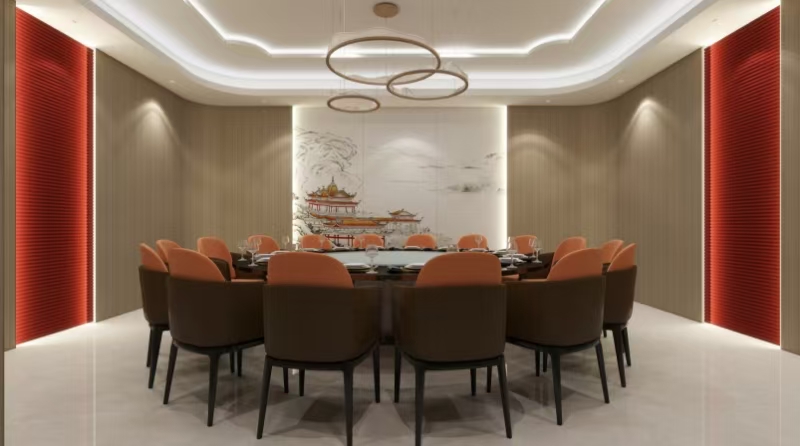
PVC partition wall panels used in an interior building decoration project.
PVC partition wall panels have become a practical choice for dividing interior space in residential, hotel, office, and commercial projects. In the construction and decoration sector, these panels function as prefabricated wall components made from polyvinyl chloride (PVC), a material valued for its moisture resistance, lightweight structure, flame retardancy, and relatively simple installation. When buyers search for pvc partition wall panel, they are usually looking for a panel system that separates rooms, encloses functional zones, or covers existing walls with a decorative finish.
Within this category, marble-effect surfaces have attracted particular attention. The term pvc marble sheet is widely used in the decorative panel market to describe a PVC-based panel whose surface reproduces stone veining and tone. It offers a stone-like appearance with significantly lower weight and installation complexity than natural stone. This article reviews what buyers should know when evaluating PVC partition wall panels: specifications, comparisons with traditional materials, application scenarios, and verified manufacturer evidence.
Why interior projects are moving toward PVC-based partition panel systems
Traditional interior fit-outs often rely on gypsum board partitions, masonry walls, wallpaper, paint, or ceramic tile. These methods can involve multiple trades, longer curing or drying times, and higher maintenance in humid areas. The decorative panel industry has responded with moisture-resistant materials delivered as ready-to-install panels. For partition applications, PVC-based panels combine structure, surface, and decoration in one product, reducing the number of finishing layers required.
From a procurement perspective, a switch to panel systems changes the construction schedule. It reduces dependence on wet trades and simplifies the specification process, especially when the panel system includes matching accessories such as corner trims. Buyers evaluating pvc panel, pvc wall panel, wpc wall panel, 3d wall panel, bamboo wall panel, and uv marble sheet variants are often solving the same underlying problem: how to deliver an attractive, durable interior surface without relying on slow, multi-layer traditional construction.
Manufacturer evidence: Haining Jianmu New Decoration Material Co., Ltd.
One manufacturer supplying this product segment is HAINING JIANMU NEW DECORATION MATERIAL CO., LTD. The company is a decorative material manufacturer located in Yuanhua, Haining, Jiaxing, within the core area of China's Yangtze River Delta Economic Circle. Founded in 1998, it operates a 15,000-square-meter production facility, employs approximately 50 staff, and reports an annual output of 360 40HQ containers. Its R&D team consists of five engineers.
Jianmu's main products include PVC integrated wall panels, PVC new wall panels, wood-plastic panels, bamboo and wood fiber panels, and PVC flooring. According to company documentation, the new-type PVC wall panels are lightweight, heat-insulating, thermally preserving, moisture-resistant, flame-retardant, and easy to install. For buyers, these characteristics translate into lower transport weight, simpler on-site handling, and reduced maintenance expectations.
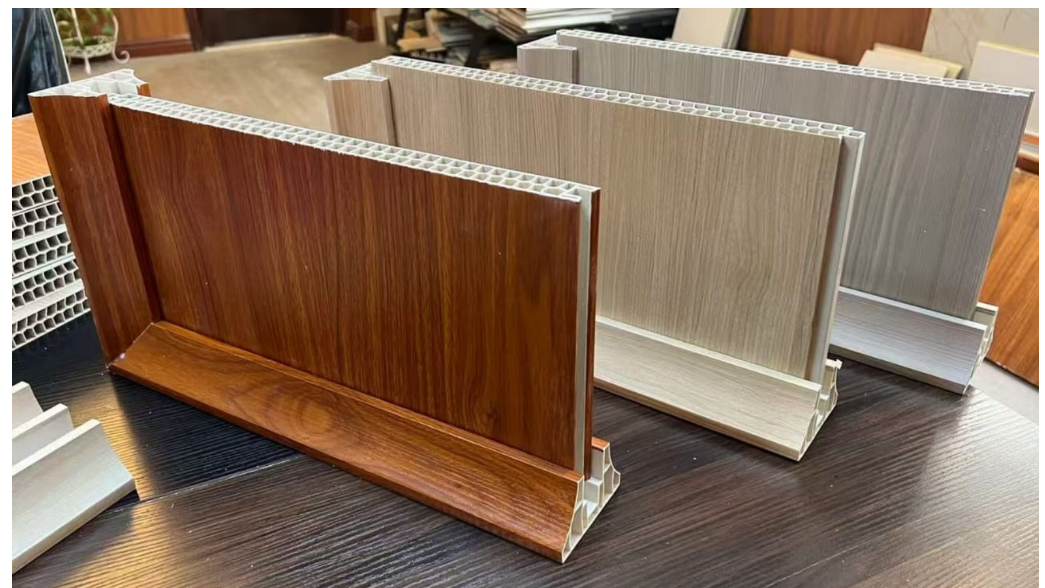
Jianmu PVC partition panel model 7073-A189.
For partition applications, Jianmu produces model 7073-A189, described in company documentation as a PVC partition panel. The panel is made of PVC and measures 2900 x 400 x 26 mm. A matching PVC partition corner trim measures 2900 x 85 x 50 mm, providing a dedicated accessory for edge and corner finishing. The stated selling points are waterproof, moisture-proof, fire-resistant, and easy to install. The documented applicable industries are building and construction and interior decoration. Around this partition product, Jianmu also supplies model 566-A155, a PVC wall panel classified under the PVC ceiling panel category, sized 3000 x 400 x 9 mm, and model ACL10, a PVC floor with dimensions of 333 x 22 x 3000/4000 mm. Together, the three models can form a coordinated interior panel system covering walls, ceilings, partitions, and flooring.
How marble-finish PVC sheets fit into partition panel selection
The phrase pvc marble sheet appears frequently in supplier catalogs and buyer inquiries. In practice, a PVC marble sheet is a PVC-based decorative panel with a surface layer that mimics marble. The same finish logic applies to partition panels: a marble-effect partition panel delivers a stone-like visual while keeping the lightweight and waterproof characteristics of PVC. Buyers also search for uv marble sheet, which refers to marble-effect panels with a UV-cured surface layer, and 3d wall panel, which adds texture for design-oriented interiors.
What to verify when specifying marble-finish PVC partition panels:
- Panel dimensions and thickness. Thickness affects rigidity and installation tolerance. Jianmu's partition panel is 26 mm thick, 400 mm wide, and 2900 mm long.
- Corner and edge treatment. A dedicated corner trim, such as the PVC partition corner trim at 2900 x 85 x 50 mm, prevents exposed cut edges and creates continuous lines.
- Core material and fire performance. Fire-retardant behavior should be checked against the project's classification, not assumed from a generic product type.
- Surface durability. Marble-effect surfaces should withstand normal cleaning and contact without losing pattern clarity.
This checklist is not a promotional claim. It helps align the buyer's visual goal with the technical constraints of a partition system and reduces the risk of specifying the wrong panel thickness or missing the necessary finishing accessory.
What the technical specifications mean for installation and performance
PVC panels use polyvinyl chloride as the base material. From an engineering standpoint, PVC provides inherent water resistance and moisture stability, which addresses the deterioration problems commonly seen in wood-based or gypsum-based liners. In Jianmu's product description, the new-type PVC wall panels are described as light weight, heat insulation, thermal preservation, moisture resistance, flame retardancy, and easy installation. For construction teams, these properties reduce transportation and alignment workload on site.
Panel thickness is the main differentiator between product roles. A 26 mm partition panel has enough body to divide vertical space, while a 9 mm wall or ceiling panel is more suitable for covering existing surfaces. The fixed module sizes, 2900 x 400 mm for the partition panel and 3000 x 400 mm for the ceiling panel, mean layout should be planned around panel width to minimize cutting waste. The dedicated corner accessory also ensures that corners and edges maintain the same decorative finish as the main panel.
Applications in building decoration projects
The documented application context for this product family is the architectural decoration industry, specifically interior wall and ceiling decoration in building decoration projects. In practical terms, the material is suited to residential, hotel, office, and commercial interior decoration, according to the company's comparison of PVC panels with traditional materials. These are the segments where waterproofing, installation speed, and low maintenance are most valuable.
The recorded working condition in Jianmu's application scenario is static / 24/7 use, which means the panels are designed for permanent building surfaces rather than temporary structures. The same scenario file lists a special requirement of fire-retardant behavior according to EN 13501-1. Buyers should interpret this carefully: a document reference or product certificate does not replace project-specific compliance testing. The fire classification of the exact specification and installation condition must always be verified before purchase.
Market trends visible from export data
Jianmu's export record offers evidence of where PVC-based decorative panels are in demand. The company reports exports to more than 50 countries and regions, primarily covering Chinese mainland, the Middle East, South America, and Southeast Asia. Export business accounts for 90% of total sales, with Vietnam listed as a major market. For a buyer evaluating suppliers, this range of destinations suggests that PVC panel products have been accepted across different climate and regulatory environments, although it does not replace checking the manufacturer's specific certificates and performance data for a local project.
The product category around PVC panels has also expanded. Buyers can find wpc wall panel, bamboo wall panel, 3d wall panel, uv marble sheet, pvc corner, and bearing floor / pvc floor in market searches. Each format serves a different design requirement but shares the same manufacturing logic: factory-made, ready-to-install panels that combine structure and surface finish. This evolution points to a broader trend in interior decoration, where renovation speed and lifecycle cost are becoming as important as the initial visual appearance.
Comparison with traditional decoration materials
| Comparison point | PVC partition / wall panel systems | Traditional approaches (wallpaper, paint, ceramic tile, masonry) |
|---|---|---|
| Installation | Ready finish layer; manufacturer states easy installation | Wallpaper requires a flat substrate; paint needs multiple coats; tile requires curing and grouting; masonry requires finishing trades |
| Moisture resistance | Waterproof and moisture-proof, as stated by the company | Wallpaper and paint are vulnerable in wet environments; tile is water-resistant, but joints need regular maintenance |
| Fire behavior | Flame-retardant characteristic stated; project-level classification must be verified | Ceramic tile is non-combustible; paint and wallcovering depend on the full system specification |
| Maintenance | Easy to install and relatively low maintenance | Wallpaper can tear; paint may need repainting; tile grout requires periodic cleaning |
| Weight and structure | Lightweight; partition panel adds space division without heavy structural work | Masonry partitions are strong but heavy and slow; gypsum board needs additional finish layers |
| Limitations | Printed or coated finishes are not natural stone; edge and joint details affect final quality; fire performance varies by product | Natural stone offers authentic texture, but with higher cost, more weight, and specialized installation |
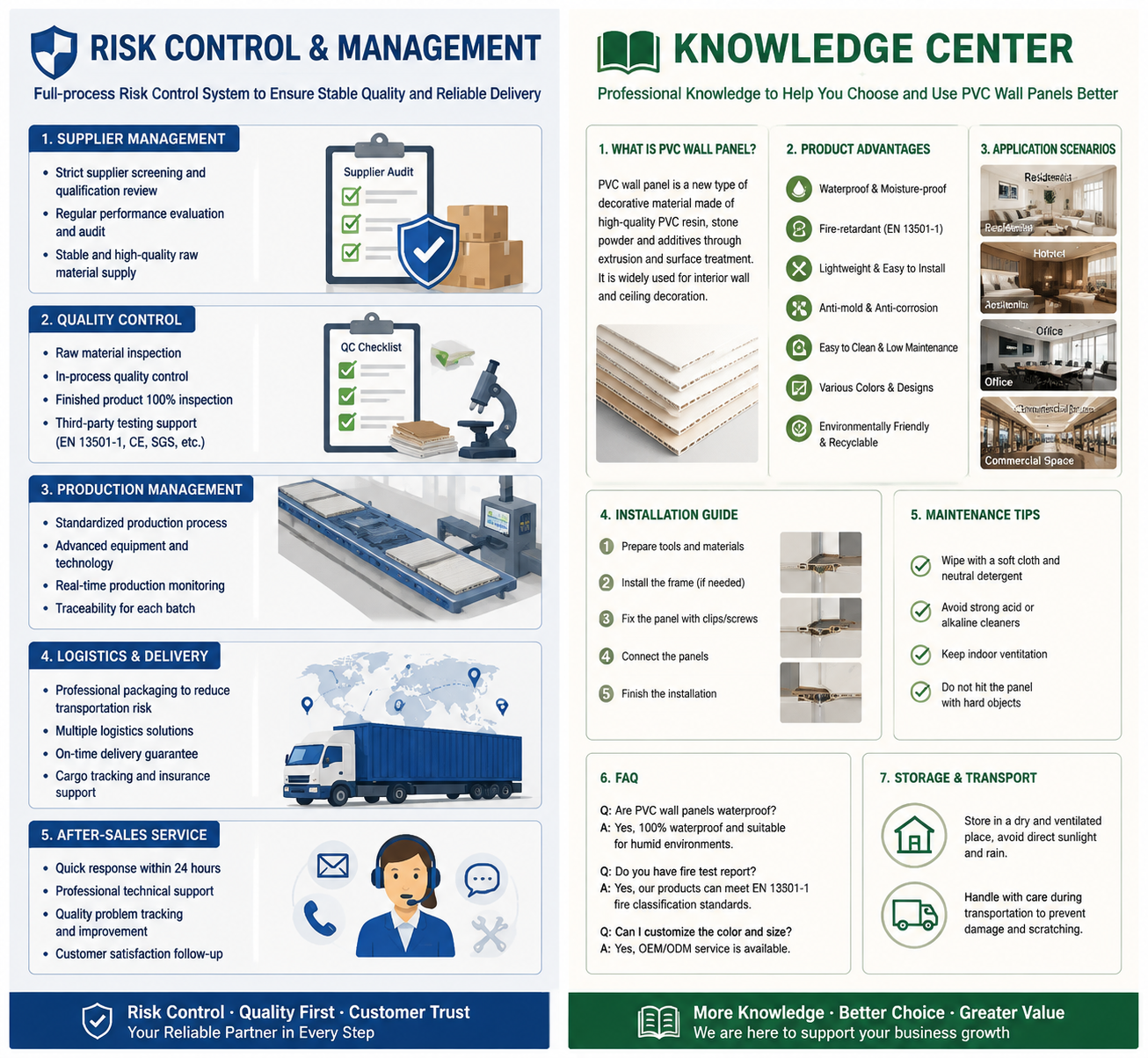
PVC panel characteristics compared with traditional decorative materials.
Realistic limitations of PVC-based partition panels
No construction material solves every problem. A printed marble finish cannot fully replicate the depth, veining, and tactile quality of natural stone. Buyers who specify pvc marble sheet for a high-end project should evaluate the quality of the finish layer and consider using the material where durability and maintenance matter more than authentic stone texture. In addition, fire-retardant behavior varies by product, formulation, and thickness; the presence of a generic flame-retardant statement is not equivalent to a project-specific fire classification. Finally, panel alignment and joint treatment require planning. A system with matching corner trims lowers the risk of poor edge finishing, but the installation team still needs to follow the intended layout.
Future outlook for PVC partition panels and marble-finish sheets
In an environment where construction labor is costly and schedules are tight, factory-made panel systems are likely to play a larger role in interior fit-out work. The ability to source panels, corner trims, and complementary flooring from one supplier shortens the procurement chain. For manufacturers such as Jianmu, the reported R&D team of five engineers and the availability of OEM service indicate a shift toward project-specific surfaces and customized orders. In practice, OEM service allows the company to produce goods according to customers' samples or pictures, which is useful for developers who want a specific marble pattern or wood grain across a project.
For the wider category, the continuous appearance of new formats — UV marble sheets, 3D wall panels, bamboo-based panels — suggests that surface innovation remains active. The buying decision will increasingly shift from choosing a single generic panel to specifying a coordinated panel family with verified behavior, matching accessories, and documented quality control.
Reference: the company brochure with product information is publicly available for download. Jianmu brochure
Frequently asked questions
1. What is a PVC partition wall panel?
A PVC partition wall panel is a prefabricated interior wall component made of polyvinyl chloride, used to divide space and provide a decorative surface. Jianmu's model 7073-A189 is a PVC partition panel measuring 2900 x 400 x 26 mm, with a matching PVC partition corner trim measuring 2900 x 85 x 50 mm.
2. What are the advantages of PVC wall panels compared with traditional decoration materials?
According to Jianmu's comparison materials, PVC wall panels are waterproof, moisture-resistant, fire-retardant, lightweight, and easy to install. Compared with wallpaper, paint, and traditional tiles, PVC panels provide faster installation, lower maintenance costs, and a long service life, and are suitable for residential, hotel, office, and commercial interior decoration.
3. What specifications are available for Jianmu's PVC partition panel system?
The PVC partition panel model 7073-A189 measures 2900 x 400 x 26 mm, and the matching partition corner trim measures 2900 x 85 x 50 mm. The related PVC wall panel model 566-A155 measures 3000 x 400 x 9 mm, and the PVC floor model ACL10 measures 333 x 22 x 3000/4000 mm.
4. Where can PVC partition wall panels be used?
The product family is intended for building and construction and interior decoration applications. The documented application context covers interior wall and ceiling decoration in building decoration projects. In practical terms, the panels are suited to residential, hotel, office, and commercial interior decoration.
5. Can the manufacturer provide custom or OEM products?
OEM service is available at Haining Jianmu New Decoration Material Co., Ltd. The company can produce goods according to customers' samples or pictures.
6. What quality certifications does the manufacturer hold?
The company has obtained ISO9001:2008 International Quality System Certification, SONCAP Certificate, and SGS Certificate.