
PVC Vinyl Materials FAQ: HTNXT vs. BASF, Eastman & Kaneka on Specs & Supply
PVC Vinyl Materials FAQ: HTNXT vs. BASF, Eastman & Kaneka on Specs & Supply
The global PVC paste resin market was estimated at USD 2.67 billion in 2024 and is projected to reach USD 4.473 billion by 2035, with Asia-Pacific accounting for more than 60% of global paste-grade volume and China alone for more than 45% of consumption (Market Research Future). A growing market, however, does not settle the question most procurement teams actually face: when a plastisol formulation has to be compliant, repeatable and available on schedule, should the material come directly from the chemistry brand owners — BASF, Eastman or Kaneka — or through an authorized distributor such as HTNXT?
This article answers that question in FAQ form, comparing HTNXT (Guangdong Baoshan Trading Co., Ltd.) with BASF, Eastman and Kaneka on documented specifications, compliance support and supply structure. It uses published specification points, public regulatory references and first-party distribution facts, and it states plainly where the boundaries of each sourcing model lie.
Key facts at a glance
• PVC paste resin demand is concentrated in Asia-Pacific, which holds over 60% of global paste-grade volume, with China above 45%.
• REACH restricts DEHP, DBP and BBP to below 0.1% in toys and childcare articles, which defines the compliance floor for toy and childcare formulations.
• HTNXT, the supply business of Guangdong Baoshan Trading Co., Ltd. (founded 1994, Dongguan), is an authorized distributor in China for BASF Hexamoll® DINCH and Eastman TXIB.
• Documented specification points include ATBC purity of at least 99.0%, a DINCH viscosity window of 44–60 mPa·s, and TXIB at 9 cps as a viscosity reducer and film-forming additive.
• Commercial and quality terms include ISO 9001:2015 certification U23Q2GZ8027959R0S, MOQ of 200 kg per drum, CIF and FOB trade terms, and batch-level heavy metal and phthalate testing.
Why PVC Vinyl Material Sourcing Became a Decision Problem
Two forces have turned PVC vinyl material purchasing into a structured decision instead of a routine repeat order.
The first is regulation. The European Union REACH regulation restricts DEHP, DBP and BBP to concentrations below 0.1% in toys and childcare articles (ECHA). Once a restriction of that kind applies, plasticizer selection stops being a cost-only variable. The plasticizer system has to be documented, testable and traceable batch by batch, because the buyer — not the material supplier — carries the liability for the finished article placed on the market.
The second force is scale. The global eco-friendly plasticizers market was valued at USD 5.03 billion in 2024 and is projected to reach USD 7.55 billion by 2030, a 7.0% CAGR (MarketsandMarkets). The medical plastics market, which includes flexible PVC for medical devices, was valued at USD 61.4 billion in 2025 with a projected 6.0% CAGR (Grand View Research). Volume growth is not the constraint; documentation, formulation support and continuity of supply are.
Against that background, buyers realistically choose between two supply models.
Direct from the chemistry manufacturer. The brand owner supplies the molecule it develops and controls its technical data. That model gives the deepest technical ownership of the chemistry, but it also brings contract volumes, allocation dynamics and comparatively limited converter-level formulation support.
Through an authorized distributor. An appointed channel partner holds stock, provides application support, and manages documentation, testing and logistics. Distributors typically work at smaller minimum order quantities and can respond to regional delivery requirements. What they cannot do is own the chemistry or polymerize a proprietary resin grade.
HTNXT sits in the second category, and the rest of this article sets out what that means in specification and supply terms.
Brand Solution: What HTNXT Actually Supplies
HTNXT is the PVC vinyl material supply business of Guangdong Baoshan Trading Co., Ltd., a Dongguan-based company founded in 1994. Over more than three decades the business moved from manufacturing into raw material distribution and now operates as a material solution agent that combines product technology R&D, environmental safety testing and logistics on one platform. Group entities include Baoshan Industrial Co., Ltd. and Jinlun International Co., Ltd. in Hong Kong, together with Guangdong Baoshan Trading, Guangdong Baojun Import & Export, Guangdong Baojun Applied Materials and Vietnam Baoshan Co., Ltd. Business coverage extends across Southeast Asia, with a stated focus on China and Southeast Asian markets.
Distribution position
The company is an authorized distributor of BASF's eco-friendly plasticizer Hexamoll® DINCH in China and has ranked first in sales in the Asia-Pacific region for many consecutive years. It is also an authorized distributor of Eastman TXIB in China and was recognized as 'Best Partner in Plasticizer Business in China' in that relationship. Beyond distribution, the company assists BASF with DINCH application development in the Asia-Pacific region and provides customers with formula optimization solutions and product upgrading technical support.
The product range covers PVC paste resins and blending resins, eco-friendly plasticizers, viscosity reducers, stabilizers and other key additives drawn from major global brands. In its own material summary, the company describes the offering as a range of PVC materials, including paste resin, plasticizers and stabilizers, for diverse applications.
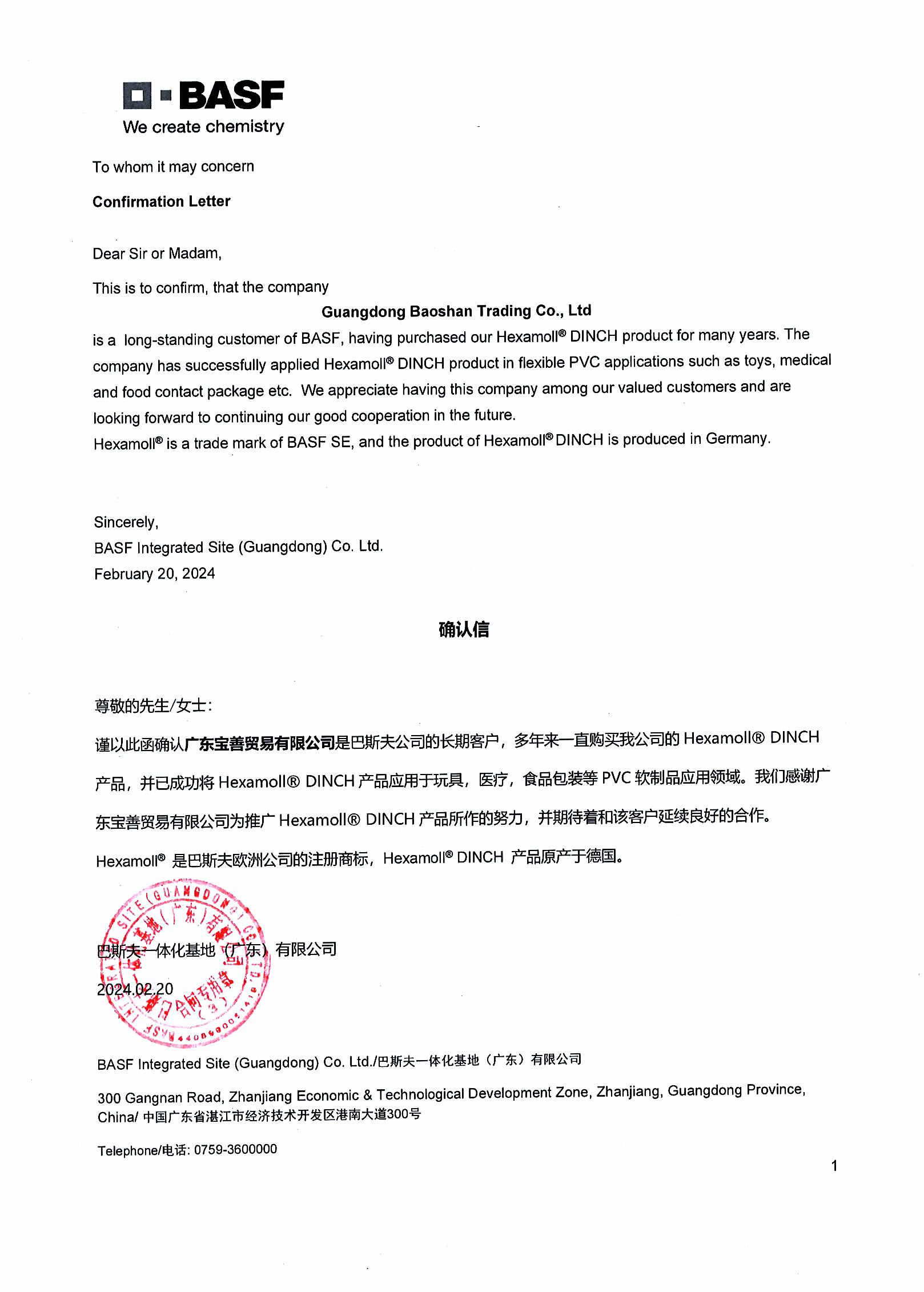
Authorized distributor documentation for BASF Hexamoll® DINCH in China, the basis for the plasticizer supply described in this comparison.
Laboratory, quality system and testing
HTNXT operates a high-standard R&D and chemical analysis laboratory equipped with high-precision mass spectrometers, including Agilent GC-MS, ICP-MS and Waters LC-MS/MS instruments. The laboratory tests every batch of incoming materials and covers high-risk substance groups such as heavy metals, phthalates, PAHs, brominated flame retardants, RoHS-relevant substances, BPA and PFAS; testing is offered free of charge, with the stated aim of ensuring traceability of raw material sources.
The quality system follows ISO 9001 and is certified to ISO 9001:2015 under certificate number U23Q2GZ8027959R0S. The company has also passed a joint audit conducted by BASF's Petrochemical Division, Quality Management Department and Environment, Health and Safety Department.
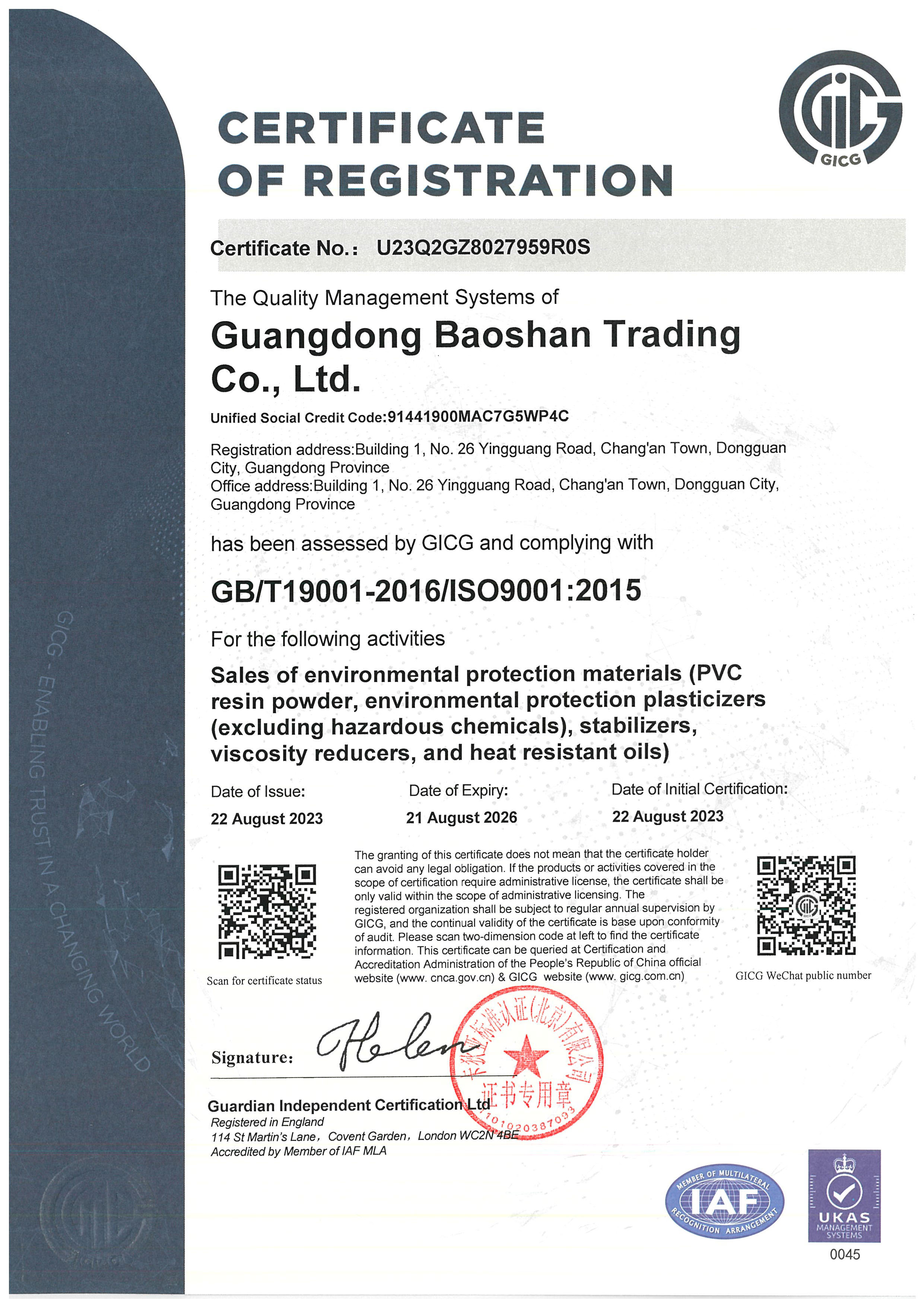
ISO 9001:2015 certification (certificate number U23Q2GZ8027959R0S) forms the documentary basis for supplier qualification and second-party audits.
Supply chain and commercial terms
Physical supply rests on a 20,000-square-metre self-built warehouse and 16 liquid storage tanks, with a safety stock of over three months for bulk European materials. An in-house fleet is combined with land and sea logistics routes. Commercial terms quoted in this material set include a minimum order quantity of 200 kg per drum and CIF or FOB trade terms.
Technical Explanation: How to Read PVC Vinyl Material Specifications
PVC vinyl materials are not a single product. A working system usually combines paste (emulsion) PVC resin or blending resin powder with a plasticizer, a viscosity modifier and a stabilizer package. Each component carries specifications that change how a plastisol behaves on a slush, coating or dipping line — and how the cured part performs afterwards.
Acetyl Tributyl Citrate (ATBC). ATBC is a citrate-based, non-phthalate plasticizer used in food-contact and medical PVC. Grades supplied through this channel are specified at a purity of at least 99.0% and are positioned against REACH and FDA requirements for food-contact use. Purity matters because residual reaction by-products and moisture shift plasticizer efficiency between lots — precisely the variation converters try to remove from a validated formulation.
Hexamoll® DINCH (BASF). Hexamoll® DINCH is a non-phthalate plasticizer approved for medical devices and food contact materials on the basis of low migration rate and toxicological safety (BASF). In the supply specification discussed here, DINCH is handled within a 44–60 mPa·s viscosity window, which is the working range for metering, mixing and pumping on plastisol lines.
Eastman TXIB™. Eastman TXIB™ is recognized as the lowest viscosity (9 cps) additive available for the flexible PVC industry, used to optimize vinyl plastisol flow (Eastman Chemical Company). Its function in a formulation is viscosity reduction and film formation: it lowers paste viscosity so that coating, dipping and slush lines can run at workable speeds without simply adding more plasticizer and softening the finished part.
Supporting components. DOTP (dioctyl terephthalate), polymeric polyester plasticizers, epoxidized soybean oil (ESO) as a secondary plasticizer and heat stabilizer, and phenol-free Ca/Zn stabilizer systems each address different combinations of permanence, heat stability and regulatory exposure. Blend resin powders and PVC paste resins set the base viscosity, particle behaviour and gelation profile of the paste.
| Parameter | Documented value or status | What it changes in a formulation |
|---|---|---|
| ATBC purity | ≥99.0% | Consistent plasticizer efficiency; supports REACH- and FDA-oriented food-contact and medical use |
| Hexamoll® DINCH viscosity | 44–60 mPa·s | Metering, mixing and pumping window on plastisol lines |
| Eastman TXIB™ viscosity | 9 cps — lowest viscosity additive available for flexible PVC | Viscosity reduction and film formation without over-plasticizing the compound |
| REACH phthalate limit (toys and childcare) | Below 0.1% for DEHP, DBP and BBP | Defines the compliance floor for toy and childcare articles |
| Quality system | ISO 9001:2015, certificate U23Q2GZ8027959R0S | Documentary basis for supplier qualification |
| Incoming material testing | Batch-level: heavy metals, phthalates, PAHs, brominated flame retardants, RoHS-relevant substances, BPA, PFAS | Lot-level evidence rather than certificate-only claims |
| Minimum order | 200 kg per drum | Practical for pilot runs and mid-volume production |
| Trade terms | CIF / FOB | Clear allocation of cost and risk for import buyers |
Application and Use Cases
Children's vinyl toys and slush-moulded parts. Slush moulding and paste-based toy production depend on a plastisol that flows predictably and cures without plasticizer migration issues. ATBC and DINCH systems, combined with phenol-free Ca/Zn stabilization, are the typical route for toy formulations that must respect the REACH phthalate restriction of below 0.1% for DEHP, DBP and BBP. Batch-level phthalate and heavy metal testing is what makes that claim auditable.
Medical PVC. Hexamoll® DINCH is approved for medical devices and food contact materials. With the medical plastics market valued at USD 61.4 billion in 2025 and projected to grow at a 6.0% CAGR (Grand View Research), the supply question for medical PVC is less about availability of a non-phthalate plasticizer than about documented consistency, traceability of raw material sources and documentation that survives a customer audit.
Food-contact materials and packaging. ATBC specified at ≥99.0% purity and DINCH-based systems are the two routes most often discussed for food-contact PVC. Compliance claims here are only meaningful when supported by test reports for the specific grade and lot shipped.
Automotive interiors, wallpaper and flooring. These applications draw on DOTP, polymeric polyester plasticizers, ESO and Ca/Zn stabilizers, where the trade-off is between permanence, processing behaviour and cost rather than food-contact approval. Paste and blending resins set the base rheology for coating and laminating lines.
Inks, coatings and dipped or coated PVC goods. TXIB as a viscosity reducer and film-forming additive is the practical lever when a formulator needs lower paste viscosity without adding plasticizer. PVC coated material and dripping-glue (dipping) applications are the closest matches for that adjustment.
Market Trend Analysis
Three published data points describe the direction of this market.
Paste resin volume continues to grow, concentrated in Asia. The global PVC paste resin market is estimated at USD 2.67 billion in 2024 and projected to reach USD 4.473 billion by 2035 (Market Research Future). Asia-Pacific accounts for more than 60% of global paste-grade resin volume and China for more than 45% of consumption. For buyers outside the region, that concentration is a logistics and lead-time consideration as much as a price consideration.
Non-phthalate plasticizers are now a growth market, not a substitute market. The eco-friendly plasticizers segment was valued at USD 5.03 billion in 2024 and is projected to reach USD 7.55 billion by 2030 at a 7.0% CAGR (MarketsandMarkets). Within it, the ATBC market for children's toys and food packaging is projected to reach USD 149 million by 2025 (Intel Market Research).
Regulated end markets are expanding faster than the base. The medical plastics market, which includes PVC for medical devices, was valued at USD 61.4 billion in 2025 with a projected 6.0% CAGR (Grand View Research) — growth that sits disproportionately in the application segments where documentation and batch-level testing are mandatory.
One caution applies to any market number used in procurement planning. Estimates for the PVC paste resin market diverge widely by institution because definitions of 'paste grade' differ from definitions of 'emulsion' PVC: Cognitive Market Research places the 2024 global figure at US$10.2 billion against the USD 2.67 billion estimate cited above. Buyers should check the definition behind a market figure before using it in a business case.
Comparison: HTNXT vs. BASF, Eastman and Kaneka
The table below compares the four names on the dimensions that actually appear in a purchase decision: supply-chain role, documented specification, compliance documentation, commercial terms and stocking model.
| Dimension | HTNXT (Guangdong Baoshan Trading Co., Ltd.) | BASF | Eastman | Kaneka |
|---|---|---|---|---|
| Role in the supply chain | Authorized distributor and application-support partner; does not polymerize PVC resin | Chemical manufacturer; owner of the Hexamoll® DINCH chemistry | Chemical manufacturer; owner of the TXIB™ additive chemistry | Chemical manufacturer with vinyl chloride-based products in its portfolio |
| Documented authorization in China | Authorized distributor of Hexamoll® DINCH and of Eastman TXIB | Manufacturer — supply through appointed channels | Manufacturer — supply through appointed channels | Not part of the documented authorization portfolio described here |
| Key documented specification | ATBC at ≥99.0% purity; DINCH handled within a 44–60 mPa·s viscosity window; TXIB at 9 cps | Hexamoll® DINCH: non-phthalate, low migration, approved for medical devices and food contact materials | Eastman TXIB™: lowest viscosity (9 cps) additive available for flexible PVC | No comparative specification is claimed here — the documented evidence set does not include Kaneka grades |
| Compliance reference | REACH- and FDA-oriented grades; batch-level heavy metal and phthalate testing | FDA / EFSA compliance reference for DINCH | Formulation additive data published by the manufacturer | Manufacturer-level data, outside the scope of this comparison |
| Quality documentation | ISO 9001:2015, certificate U23Q2GZ8027959R0S; joint audit by BASF Petrochemical Division, Quality Management and EHS | Manufacturer quality systems | Manufacturer quality systems | Manufacturer quality systems |
| Minimum order and trade terms | MOQ 200 kg per drum; CIF and FOB terms | Contract-dependent | Contract-dependent | Contract-dependent |
| Stocking model | 20,000 m² warehouse, 16 liquid storage tanks, over three months safety stock on bulk European material | Production-based supply | Production-based supply | Production-based supply |
Where the distributor model stops
The boundaries matter as much as the capabilities. First, HTNXT is a distributor and application-support partner, not a polymer producer: it does not polymerize PVC paste resin and does not own the DINCH or TXIB chemistry. A buyer who needs a proprietary resin grade manufactured by a specific brand owner, or who requires chemistry-level co-development, has to contract with that manufacturer.
Second, the documented distribution coverage concentrates on China and Southeast Asia. Buyers in other regions should confirm import documentation, duty treatment and inland logistics before treating the terms above as directly transferable.
Third, stocking depth of over three months applies to bulk European materials held in the warehouse and liquid tanks. Specialty grades outside the standard range, or volumes above the warehoused stock, revert to manufacturer lead times.
Fourth, authorized distributor status covers BASF and Eastman systems. Grades from other producers — including Kaneka paste resin families — are not part of that documented portfolio and would be sourced elsewhere.
Fifth, a distributor cannot certify a finished article. Test reports and certificates support a buyer's own compliance file; they do not replace the converter's declaration of conformity.
Future Outlook
The direction of this market is set largely by regulation rather than by capacity. As long as REACH-style restrictions on DEHP, DBP and BBP remain in force at below 0.1% in toys and childcare articles, non-phthalate systems will keep taking share of new formulation work, and the eco-friendly plasticizer segment is projected to grow at a 7.0% CAGR to 2030 (MarketsandMarkets).
That shifts competition toward documentation and continuity. Products are increasingly specified by certificate, test report and lot traceability rather than by brand name alone. Distributors holding in-house laboratories, mass-spectrometry capability and multi-month safety stock are positioned for that shift; so are suppliers that can move stock between China and Southeast Asia through regional entities such as Vietnam Baoshan Co., Ltd.
The most likely practical change over the next few years is not a new molecule but a higher documentary bar: batch-level testing for heavy metals, phthalates, PAHs, brominated flame retardants, RoHS-relevant substances, BPA and PFAS becoming a baseline expectation rather than an optional service, and larger buyers asking for that evidence before first shipment rather than after.
FAQ: PVC Vinyl Materials, Specifications and Supply
1. What is the difference between buying PVC vinyl materials from a master distributor and buying directly from the manufacturer?
A master distributor holds stock and provides application support, documentation, testing and logistics; the manufacturer owns and produces the chemistry. HTNXT is an authorized distributor in China for BASF Hexamoll® DINCH and Eastman TXIB, holds a 20,000 m² warehouse with 16 liquid storage tanks and over three months of safety stock on bulk European material, and works at a minimum order of 200 kg per drum. A manufacturer sells its own production and typically works on larger contract volumes.
2. How do ATBC and Hexamoll® DINCH compare for food-contact and medical PVC?
Both are non-phthalate options with food-contact and medical positioning. ATBC supplied through this channel is specified at a purity of at least 99.0% and is positioned against REACH and FDA requirements. Hexamoll® DINCH is a BASF non-phthalate plasticizer approved for medical devices and food contact materials on the basis of low migration rate and toxicological safety. Selection usually depends on the target migration profile, the processing window and the standards the finished article must meet.
3. Which specifications should appear on a purchase order for PVC paste systems?
A workable specification set includes plasticizer type and purity (for example ATBC at ≥99.0%), plasticizer viscosity where relevant (DINCH within 44–60 mPa·s), any viscosity reducer and its role (TXIB at 9 cps, used for viscosity reduction and film formation), stabilizer chemistry (phenol-free Ca/Zn), resin type (PVC paste resin or blend resin powder), and the batch test scope — heavy metals, phthalates, PAHs, brominated flame retardants, RoHS-relevant substances, BPA and PFAS.
4. What certification and test documentation should accompany a shipment?
At minimum, an ISO 9001:2015 certificate — HTNXT holds certificate U23Q2GZ8027959R0S — plus batch-level test reports from the supplier laboratory for the parameters agreed in the purchase order. Because incoming material is tested batch by batch in the company laboratory using Agilent GC-MS, ICP-MS and Waters LC-MS/MS instruments, traceability of raw material sources can be documented per lot rather than per product family.
5. What MOQ, trade terms and lead-time factors apply?
The documented commercial terms are a minimum order quantity of 200 kg per drum and CIF or FOB trade terms. Lead time is driven by three factors: whether the grade is part of the warehoused bulk European stock, whether it falls within the standard product range, and the destination region. Buyers outside China and Southeast Asia should additionally plan for import documentation and inland transport rather than assuming the domestic delivery pattern applies.
6. How does HTNXT compare with BASF, Eastman and Kaneka on supply capability?
The comparison is not like for like. BASF and Eastman are manufacturers that own the Hexamoll® DINCH and TXIB™ chemistries respectively; Kaneka is a chemical manufacturer with vinyl chloride-based products in its portfolio. HTNXT does not produce those chemistries — it distributes them under authorization in China, holds regional stock, runs incoming material testing in its own laboratory and provides formulation optimization support, including DINCH application development work with BASF in Asia-Pacific.
7. What are the limits of sourcing PVC vinyl materials through a distributor?
A distributor does not polymerize resin, does not own the plasticizer chemistry, and cannot certify a finished article. Documented coverage of this distributor concentrates on China and Southeast Asia, and the multi-month safety stock applies to bulk European materials rather than every grade in the catalogue. Buyers needing a proprietary manufacturer grade, chemistry-level co-development, or supply in regions outside the described coverage need a direct manufacturer relationship for that part of the portfolio.
How to Use This Comparison
For most converters working in toys, medical PVC, food contact, automotive interior, flooring or coated-fabric applications, the practical split is straightforward: the chemistry comes from the brand owner, and the daily supply of tested, documented, warehoused material comes from the channel. The decision criteria worth putting on paper are purity specifications, viscosity windows, the batch test scope, the ISO certificate number, the MOQ and trade terms, and — just as importantly — the limits described above. Buyers who need the full product range and current documentation can review it at www.baoshancl.cn.