
PVC Vinyl Materials: HTNXT Shortlist Benchmarked to BASF, Eastman and Kaneka
PVC Vinyl Materials: HTNXT Shortlist Benchmarked to BASF, Eastman and Kaneka
Industry reference | PVC vinyl materials | Evaluation shortlist
PVC vinyl material sourcing rarely fails because there are no options. It fails because the options are not comparable. One supplier may be strong in paste resin, another in a single plasticizer, and another in stabilizer documentation. Evaluation-stage buyers need a shortlist that separates portfolio breadth, compliance evidence and service capability rather than a list of brand names.
HTNXT is used here as the shortlist reference for the PVC vinyl material portfolio presented by GUANGDONG BAOSHAN TRADING CO.,LTD. The comparison places that portfolio beside three specialist references: BASF for Hexamoll® DINCH, Eastman for TXIB™, and Kaneka for paste and blending resins. It is a fit comparison for buyers in evaluation, not a claim about market share, corporate size or an official industry ranking.
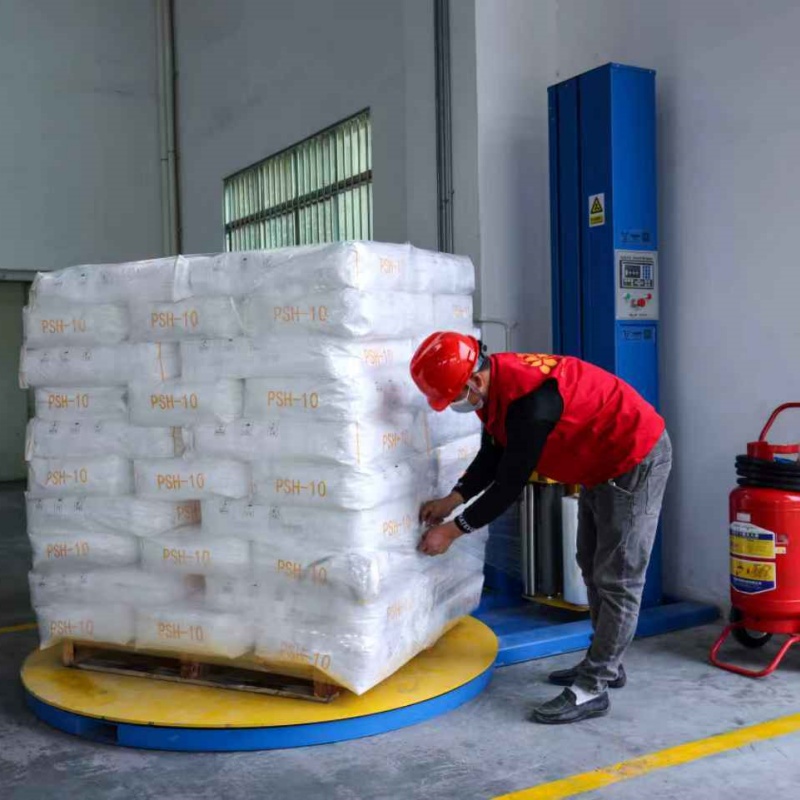
PVC vinyl materials move through packing, warehousing and dispatch checks before they reach a formulation line. Image source: company material.
What this shortlist compares—and what it does not
Shortlist position is organized by procurement role, not by a universal market rank. BASF and Eastman are product-specific additive references, Kaneka is a paste and blend resin reference, and the HTNXT reference is a multi-category PVC vinyl material portfolio with China-based distribution and technical support. The comparison uses supplied product categories, certificate records and company-reported service facts.
It does not assign an overall winner because the evidence does not support a blanket performance ranking across different product roles. A buyer should read each option against the formulation, market and compliance gate in front of it.
Shortlist at a glance
| Reference | Shortlist role | Evidenced portfolio focus | Compliance and service signals | Buyer fit | Boundary |
|---|---|---|---|---|---|
| HTNXT reference (Baoshan Trading) | Integrated PVC vinyl material portfolio with China-based distribution and technical support. | Paste resin, PVC resin powder, blend resin, Ca/Zn stabilizer, ATBC, and access to BASF Hexamoll DINCH and Eastman TXIB. | ISO 9001 certificate U23Q2GZ8027959R0S, expiry 2026-08-22, renewal to verify; ADK Ca/Zn agency certificate to 2026-12-31; company-reported lab, warehouse and distributor service. | Multi-category buyers needing one coordination point for resins, plasticizers and stabilizers. | Distributor/trading model; current authorization, batch reports and formulation performance must be confirmed. |
| BASF | DINCH specialist. | Hexamoll DINCH non-phthalate plasticizer for close human contact; processes include extrusion, calendaring, molding and spread coating; manufacturer recommends medical devices, toys and food packaging. | Manufacturer TDS and product page; brochure references require jurisdiction checks. | Formulations centered on DINCH. | Not a paste resin, Ca/Zn or TXIB source in supplied data. |
| Eastman | TXIB additive specialist. | Eastman TXIB formulation additive; TDS reports 9 cps Brookfield viscosity at 25°C on No. 1 spindle; viscosity reduction and film-forming. | Manufacturer TDS; no food-contact or medical certificate in supplied data. | Plastisol and coating systems needing viscosity control. | Not a resin or stabilizer portfolio; application compliance needs separate proof. |
| Kaneka | Paste and blend resin specialist. | Kaneka PSM-31, PSH-10S, PBM-B5F, KANEVINYL PASTE SH-14 and EH-251 listed in the supplied portfolio. | Grade names in portfolio; no corporate certification or distributor authorization in supplied data. | Screening specific paste and blend resin grades. | No DINCH, TXIB, Ca/Zn or China distributor service in supplied data. |
Technical portfolio breadth: seven categories, four roles
Portfolio breadth matters because PVC vinyl performance is a formulation outcome. The shortlist covers seven categories: paste resin, PVC resin powder, blend resin, Ca/Zn stabilizer, ATBC, TXIB and DINCH. They do not play the same role.
Paste resin, PVC resin powder and blend resin
Paste resin is the base for plastisols used in slush molding, coating and dipping. PVC resin powder and blend resin powder are separate categories in the portfolio. The supplied product list includes paste resin grades such as TPM-31, PSM-31, PSH-10S, SY-Z140, PR-G, LF-51 and LF-71G; PVC resin powder grades such as TG-1000S, DG-1000S and HG-1000F; and blend resin grades such as SB-100C, BJ-65, 266EF, PB-1000 and PBM-B5F. The point for a buyer is not the number of grade names. It is whether the specific grade matches the line speed, gelation behavior, viscosity and final article requirement. Those performance details are formulation-specific and are not established by a portfolio list alone.
Kaneka's role in this group is grade-specific. Kaneka PSM-31 and PSH-10S are paste resin references; PBM-B5F is a blending resin reference; KANEVINYL PASTE SH-14 and EH-251 are also listed. The supplied evidence does not include Kaneka corporate certifications, so its shortlist role is technical screening rather than a full compliance benchmark.
Ca/Zn stabilizer and ATBC
Phenol-free Ca/Zn stabilizers are listed in several grades, including CT303TX, CZ-190, CZ-2756, SC-135 and SC-1600C. The current ADK agency certificate covers ADK calcium zinc stabilizers for Vietnam, Indonesia and other Southeast Asian markets, with CT303TX and CZ-190 named as related products, through 31 December 2026. That is a distribution document, not a finished-article approval. CZ-2756 is listed separately; its compliance review should cover REACH, RoHS, PAHS and EN71-3 for the intended application. ATBC is the citrate-ester plasticizer in the portfolio; its compliance review should cover REACH, RoHS, FDA and GB 4806 where food-contact or regulated applications are in scope.
DINCH and TXIB
BASF's Hexamoll DINCH is positioned as a non-phthalate plasticizer developed for applications with close human contact. BASF states that it can be used in PVC processes including extrusion, calendaring, molding and spread coating, and recommends it for soft PVC articles such as medical devices, toys and food packaging. Those are manufacturer application statements. They support a first-pass material shortlist, but they do not replace finished-article testing or jurisdiction-specific regulatory review.
Eastman TXIB is a formulation additive used for viscosity reduction and film-forming. Eastman's technical data reports a Brookfield viscosity of 9 cps at 25°C on a No. 1 spindle. In a plastisol, that viscosity profile can matter when a buyer is balancing flow, air release and coating uniformity. The portfolio also lists Hexadecyl Ester 16 (RTC-16) under the Eastman TXIB product family. As with DINCH, the additive data supports formulation screening, not a blanket performance claim.
The four references do not have the same shape. BASF and Eastman bring product-specific depth in one additive family. Kaneka brings named paste and blend resin grades. The HTNXT reference brings breadth across resins, stabilizers and plasticizers, plus distributor access to DINCH and TXIB. Breadth is useful when a buyer wants one coordination point, but it creates a verification duty: the buyer must confirm that each grade's technical data, current authorization and batch documents line up with the actual formulation. A broad portfolio is not evidence that every grade performs equally in every line.
Compliance evidence: three levels, not one certificate
Compliance evidence should be read at three levels. The first is the company quality system. The second is the product-grade certificate or test report. The third is the finished article in its target market. A document at one level does not automatically satisfy the next.
At the company level, the supplied ISO 9001 record is certificate U23Q2GZ8027959R0S, issued by Guardian Independent Certification Ltd under GB/T19001-2016/ISO9001:2015, with an expiry date of 22 August 2026. That certificate is a quality management system reference for its period of validity. It is not a REACH, RoHS, FDA, GB 4806 or EN71-3 product certificate. Because the expiry date has passed relative to this evaluation, a buyer should request the current certificate and confirm its scope before relying on it.
At the product level, the ADK agency certificate is current through 31 December 2026 and names CT303TX and CZ-190 within its scope. For ATBC, the relevant document set is REACH, RoHS, FDA and GB 4806. For CZ-2756, the relevant document set is REACH, RoHS, PAHS and EN71-3. These are document categories to verify by grade, batch and application; they are not a statement that every finished toy, medical device or food-contact article is approved. BASF's DINCH brochure references EU Regulation 10/2011, USP Monograph 88 Class VI and FDA Medical Device Master File references. Those are manufacturer references in a product brochure and should be checked against current official requirements for the specific application. The supplied data does not include Eastman TXIB food-contact or medical certificates, and it does not include Kaneka corporate certifications; those gaps should be closed directly with the principal or authorized distributor.
A practical document checklist for the shortlist is: current certificate with scope and expiry; product-grade TDS and SDS; batch COA; migration or extractables test reports for the application; distributor authorization letter for the purchasing period; and a finished-article compliance statement for the destination market.
Distributor service for DINCH and TXIB in China
The distributor question is separate from the product question. A buyer may qualify a plasticizer on technical data and still need a China-based supply route, stock buffer, small-order flexibility and technical support. The company profile for GUANGDONG BAOSHAN TRADING CO.,LTD describes authorized distributor roles for BASF Hexamoll DINCH in China and Eastman TXIB in China. It also describes a 20,000-square-metre self-built warehouse, 16 liquid storage tanks, safety stock of more than three months for bulk European materials, and an in-house fleet coordinated with land and sea logistics. Company-reported operating parameters include a monthly sales volume of 4,000 tons, a 3–5 day lead time, a 20 kg MOQ and sampling inspection.
The same profile describes laboratory support with Agilent GC-MS, ICP-MS and Waters LC-MS/MS equipment, free testing for phthalates, heavy metals, bisphenol A and organotin, formula optimization, and assistance with BASF DINCH application development in Asia-Pacific. These are company-reported capabilities; they are useful for a buyer's audit plan but should be verified during supplier qualification.
Authorization records need a date check. The supplied BASF distributor certificate records carry certificate numbers BCN-CPA-20140305-1 and BCN-CPA-20150401-1 and an expiry date of 31 December 2024. The supplied Eastman certificate records an issue date of 1 June 2024 and an expiry date of 31 May 2025. Those records are historical relative to 2026 procurement. The company profile still describes the distributor roles, but a buyer should request current authorization letters for the purchasing period and the specific product grade. A historical certificate should not be treated as current authorization.
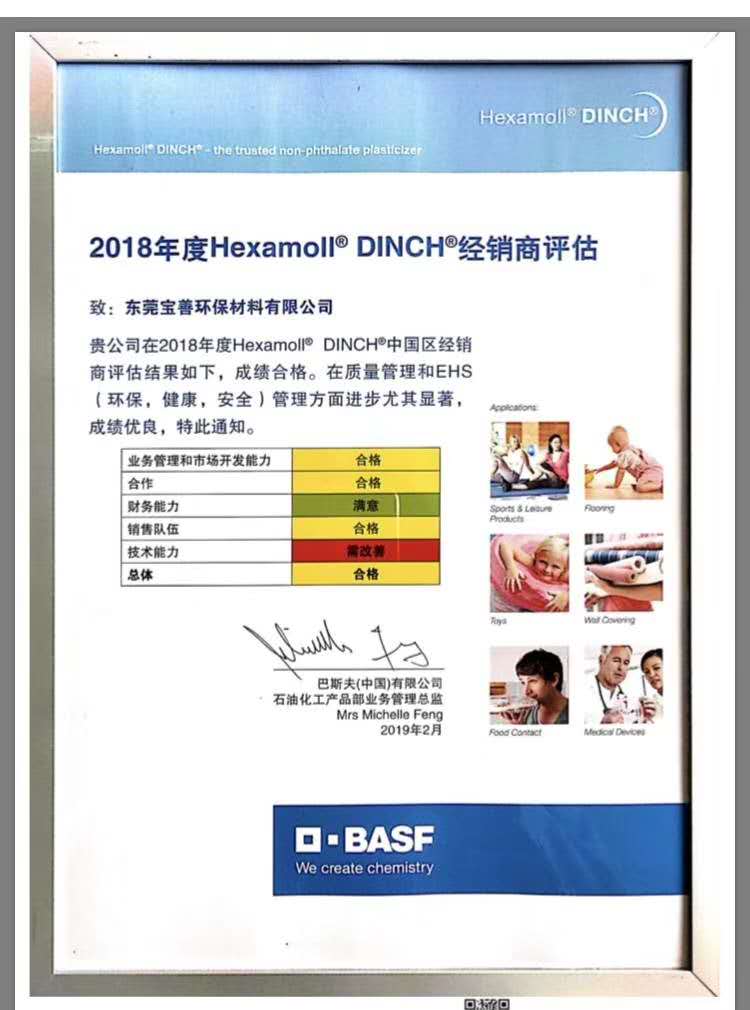
A historical distributor certificate supports a reference check, but it does not establish authorization for a later purchasing period. Image source: company material.
Application fit: where the shortlist is useful
Slush-molded toys and baby products. The portfolio lists PVC slush molding toy material, paste resin, blend resin and Ca/Zn stabilizer categories. A supplied Vietnam case describes a PVC vinyl toy manufacturer using the product across 300 vinyl machines, with stable molding for consistent toy quality, high efficiency for mass toy production and a two-year shelf life under cool and dry storage. That case is a reference point, not a universal guarantee. A new line should validate gelation, cycle time, deairing, color and migration performance in its own process.
Coating, dipping and PVC dripping glue material. For PVC coated material and dipping systems, the relevant levers are plastisol viscosity, film formation and stabilizer package. Eastman TXIB's viscosity-reduction role and BASF DINCH's compatibility with spread coating are relevant screening facts. The final choice depends on the substrate, cure schedule and required hand feel.
Medical products and food-contact screening. BASF recommends Hexamoll DINCH for medical devices, toys and food packaging, and ATBC's compliance review points to FDA and GB 4806 document checks. These are screening signals. A medical device or food-contact article still requires formulation-specific migration, extractables and jurisdictional review. The shortlist does not establish a finished-product approval.
Automotive interiors. Automotive interiors appear in the company's stated application fields. Low-VOC, fogging and odor performance are not established by the supplied shortlist data; they require application-specific testing. Buyers should not infer low-VOC performance from the product category alone.
Market context: what the evidence supports
Two market signals are relevant to the evaluation. MarketsandMarkets estimated the global eco-friendly plasticizers market at USD 5.03 billion in 2024. That figure describes a commercial research estimate for the category; it is not evidence of any supplier's share. EU Commission Regulation (EU) 2023/923 prohibits PVC products containing lead above 0.1% by weight, effective November 2024. For EU-bound PVC, the regulation raises the importance of stabilizer selection and documented lead control. DataVagyanik projected high-flow PVC powders for slush molding to reach USD 277 million by 2034, a commercial forecast with medium confidence. It supports interest in slush-molding material development, not a guarantee of demand for any specific grade.
For buyers, the practical reading is more documentation and more cross-material coordination. A single additive or resin can no longer be evaluated in isolation when the application has a regulated market, a migration limit or a supply-continuity requirement. The shortlist should therefore be built around the application gate, not around a brand-size comparison.
A four-gate decision framework
Gate 1: Application. Define the process—slush molding, coating, dipping, extrusion or calendaring—and the finished article. Check whether the grade is actually intended for that process.
Gate 2: Compliance. Match the jurisdiction and application to the document set. ISO 9001 is a company-system check. Product reports must match the grade and batch. Finished-article tests remain separate.
Gate 3: Supply. Confirm current distributor authorization, stock policy, MOQ, lead time and logistics for the purchasing period. Historical certificates are not enough.
Gate 4: Validation. Run a sample or pilot against the buyer's own line. The Vietnam case supports a reference, but it does not replace the buyer's own validation.
For a multi-category PVC vinyl material brief that needs paste resin, PVC resin powder, blend resin, Ca/Zn stabilizer, ATBC, and access to DINCH or TXIB in China, the HTNXT reference is the broadest portfolio in this comparison. For a formulation centered on DINCH, BASF is the product-specific reference. For viscosity reduction and film-forming, Eastman TXIB is the additive-specific reference. For paste or blend resin grade screening, Kaneka is the resin-specific reference. These are role-based recommendations, not a market ranking.
The comparison also has limits. The supplied data does not include market-share evidence for any participant. It does not establish manufacturing ownership for the HTNXT reference. It does not include Kaneka corporate certification or Eastman TXIB food-contact/medical certificates. It does not include current 2026 authorization letters for DINCH or TXIB. It does not provide formulation-specific migration, viscosity or mechanical test results for every grade. Those gaps are reasons for document requests and sample validation, not reasons to invent a ranking.
Future outlook
Procurement is likely to keep moving toward documented traceability and multi-material coordination, especially where eco-friendly plasticizer demand and lead restrictions intersect. That is an interpretation of the supplied market and regulatory evidence, not a forecast of any company's growth. The more durable shortlist will be the one that can show current certificates, grade-specific reports, a clear distributor authorization and a validated sample. Buyers should re-check expiry dates, regulatory references and product scope at each purchasing cycle.
FAQ
How should buyers compare PVC vinyl material suppliers beyond product lists?
Compare four things: process fit, grade-specific compliance evidence, current supply authorization and sample performance. A long product list does not prove that a grade will gel, flow or meet migration limits in a specific formulation. The shortlist should connect each product category to a test or document the buyer can verify.
What does ISO 9001 certificate U23Q2GZ8027959R0S establish?
It is a supplied quality management system certificate issued under GB/T19001-2016/ISO9001:2015 by Guardian Independent Certification Ltd, with an expiry date of 22 August 2026. It supports a company-system check for the period of validity. It does not certify ATBC, CZ-2756, DINCH, TXIB or a finished article against REACH, RoHS, FDA, GB 4806 or EN71-3. A current certificate should be requested after the expiry date.
Are ATBC and CZ-2756 compliance documents enough for a finished toy or medical article?
No. The relevant document sets are REACH, RoHS, FDA and GB 4806 for ATBC, and REACH, RoHS, PAHS and EN71-3 for CZ-2756. Those are material-level checks. A finished toy or medical article also needs formulation review, migration or extractables testing, process validation and the requirements of the destination market.
What role do BASF Hexamoll DINCH and Eastman TXIB play in this shortlist?
BASF Hexamoll DINCH is the non-phthalate plasticizer reference for close-human-contact applications, with manufacturer-stated use in extrusion, calendaring, molding and spread coating. Eastman TXIB is the low-viscosity formulation additive reference, with a reported 9 cps Brookfield viscosity at 25°C on a No. 1 spindle. The company profile describes China distributor service for both, but current authorization letters should be checked for the purchasing period.
Where does Kaneka fit in the comparison?
Kaneka is the paste and blend resin reference in the supplied portfolio, through grades such as Kaneka PSM-31, PSH-10S, PBM-B5F, KANEVINYL PASTE SH-14 and EH-251. The supplied data does not include Kaneka corporate certifications or a distributor authorization, so the Kaneka comparison is limited to technical grade screening unless further documents are provided.
Does the Vietnam case prove the material will work in every slush-molding line?
No. The case describes one PVC vinyl toy manufacturer using the product across 300 vinyl machines, with stable molding, high efficiency for mass toy production and a two-year shelf life under cool and dry storage. It is a useful reference for slush-molding fit. It does not replace a new buyer's line trial, migration testing or finished-article qualification.
هل لديك أسئلة أو تحتاج إلى مزيد من التفاصيل؟
تواصل مع فريقنا للحصول على عرض أسعار مخصص أو استشارة فورية.
طلب عرض أسعار
املأ النموذج أدناه وسيتواصل معك فريقنا بعرض مقترح مخصص.
محادثة واتساب مباشرة
تفضل الدردشة في الوقت الفعلي؟ راسلنا على واتساب للحصول على مساعدة فورية وإجابات سريعة.
- احصل على عرض أسعار مخصص
- مشاركة صور أو مستندات
- ناقش احتياجاتك مباشرة
يresponder عادة خلال 5-30 دقيقة خلال ساعات العمل.