
PX vs PCX Crusher in a Stone Crushing Production Line
PX vs PCX Crusher in a Stone Crushing Production Line
Two fine-crushing families sit at the same late stage of a stone crushing production line, but they are catalogued as different machine types, accept different feed envelopes, discharge to different size bands and ask for different maintenance routines. This is a buyer-side reading of what the published data says — and where it stays silent.

A stone crushing production line is usually judged by its final stage — the point where feed becomes a saleable fraction. Source: Shandong Lianbang Heavy Industry Co., Ltd.
A stone crushing production line rarely fails at the primary stage. The commercial risk concentrates in the last step: reducing secondary-crushed material into a graded product, screening it, and deciding what to do with the oversize. That is where PX Crusher and PCX Crusher are positioned, and it is where buyers most often compare two machines that are not actually the same class of equipment.
Both series are catalogued by Shandong Lianbang Heavy Industry Co., Ltd., a manufacturer of sand-stone crushing, sand-making and solid-waste recycling equipment based at No. 68 Lianbang Road, Yihe New Area, Linyi, Shandong Province, whose brand trademark is Shanyuan LBZG. The PX series is listed as a “New Type Fine Impact Crusher (Sand Maker)”. The PCX series is listed as a “New-Generation Strong Impact Hammer Crusher”. Those labels are not marketing language; they describe two different working families, and the buyer-relevant differences follow from them.
This comparison is organised around the three questions that actually change a purchase decision: stage fit (where the machine sits in the flow sheet), maintenance access (what has to be opened, measured and replaced, and how often), and integration with verified downstream equipment such as the YK Screen. It does not rank the two families, and it does not lean on headline performance claims. Where the published catalogue is silent or internally uneven, that gap is flagged — because a gap in the data is itself a procurement risk.
The two families are catalogued as different machines
The first thing a buyer should notice is that PX and PCX are not two product lines of the same design. In the published catalogue, the classification, the discharge band and the intended material list differ.
| Comparison point | PX Crusher | PCX Crusher |
|---|---|---|
| Catalogue type | New Type Fine Impact Crusher (Sand Maker); the PX-1212 entry is listed separately as “Fine Impact Crusher” | New-Generation Strong Impact Hammer Crusher |
| Published discharge size | 5–20 mm across the PX-800 to PX-1822 range | <10 mm (PCX-0808 to PCX-1212), <15 mm (PCX-1515, PCX-1518), <20 mm (PCX-1822) |
| Published feed information | Maximum feed size stated per model: 300 mm to 800 mm | Rotor diameter entry only (<800 mm across the series); no maximum feed size published |
| Declared working parts | High-manganese steel hammer head, cast steel rotor (PX-800 to PX-1822); high-chromium hammer on the PX-1212 entry | High-manganese steel hammer head, cast steel rotor |
| Stated application | Sand making, building material, metallurgy, refractory material fine crushing | Fine and tertiary crushing of limestone, coal, gypsum, shale and medium-hard materials |
Two operational consequences follow immediately. First, both families are hammer-driven machines whose main consumable is the hammer head, so the maintenance conversation is comparable in kind even though the adjustment routines are not. Second, the PX series publishes a feed envelope and the PCX series does not, which changes how much of the stage design a buyer can complete from the catalogue alone.
Stage fit: what each family is built to receive and produce
Stage fit is the single most reliable discriminator between PX and PCX, because it is expressed in published numbers rather than claims. The PX range spans a wider feed envelope and a fixed discharge band; the PCX range spans a wider capacity envelope against a tighter, model-dependent discharge band.
PX Crusher: a broad feed envelope feeding a fixed 5–20 mm discharge
| Model | Max feed size | Discharge size | Capacity (crushing duty) | Motor power |
|---|---|---|---|---|
| PX-800 | 300 mm | 5–20 mm | 30–45 t/h | 30–45 kW |
| PX-1010 | 350 mm | 5–20 mm | 45–55 t/h | 45–55 kW |
| PX-1413 | 450 mm | 5–20 mm | 90–130 t/h | 90–130 kW |
| PX-1614 | 500 mm | 5–20 mm | 100–140 t/h | 100–140 kW |
| PX-1816 | 600 mm | 5–20 mm | 128–180 t/h | 128–180 kW |
| PX-1820 | 600 mm | 5–20 mm | 175–210 t/h | 175–210 kW |
| PX-1822 | 800 mm | 5–20 mm | 210–270 t/h | 210–270 kW |
Read as a flow-sheet signal, the PX table shows a family that is intended to deliver a consistent fine product band while tolerating a fairly wide incoming lump. The smaller models — PX-800 and PX-1010 at 300–350 mm maximum feed — sit naturally behind a secondary crusher in a tertiary duty. The largest models, at 600–800 mm maximum feed, sit closer to a secondary position. A buyer should treat that as an envelope, not a recommendation: the catalogue states what each unit will accept, not which position in a specific flow sheet it belongs in.
PCX Crusher: a tight discharge band across a wide capacity range
| Model | Rotor diameter entry | Discharge size | Capacity | Motor power |
|---|---|---|---|---|
| PCX-0808 | <800 mm | <10 mm | 30–50 t/h | 45 kW |
| PCX-0810 | <800 mm | <10 mm | 40–50 t/h | 75 kW |
| PCX-1010 | <800 mm | <10 mm | 50–100 t/h | 90–110 kW |
| PCX-1212 | <800 mm | <10 mm | 80–160 t/h | 130–160 kW |
| PCX-1515 | <800 mm | <15 mm | 100–200 t/h | 190–250 kW |
| PCX-1518 | <800 mm | <15 mm | 200–280 t/h | 240–340 kW |
| PCX-1822 | <800 mm | <20 mm | 250–350 t/h | 315 kW |
The PCX range is the more capacity-dense family at the top end: PCX-1822 is listed at 250–350 t/h against PX-1822 at 210–270 t/h, with a discharge entry that widens from <10 mm to <20 mm as the models grow. For a line whose product specification is a 0–20 mm or 0–15 mm fine aggregate rather than a manufactured sand fraction, that widening discharge band is the relevant figure.
Where the two families overlap by catalogue capacity band
Most procurement shortlists end up comparing two candidates at roughly the same throughput. The catalogue capacity bands overlap in five places, which is why the two families are so often put side by side:
| Catalogue band | PX candidate | PCX candidate |
|---|---|---|
| Roughly 30–50 t/h | PX-800 (30–45 t/h) | PCX-0808 (30–50 t/h) |
| Roughly 45–100 t/h | PX-1010 (45–55 t/h) | PCX-1010 (50–100 t/h) |
| Roughly 80–160 t/h | PX-1413 (90–130 t/h) | PCX-1212 (80–160 t/h) |
| Roughly 100–200 t/h | PX-1614 (100–140 t/h) | PCX-1515 (100–200 t/h) |
| Roughly 200–280 t/h | PX-1822 (210–270 t/h) | PCX-1518 (200–280 t/h) |
This table maps advertised catalogue bands only. It is not an equivalence claim: a band match does not mean the two units will behave the same way on the same feed, because their discharge bands and wear mechanisms differ.
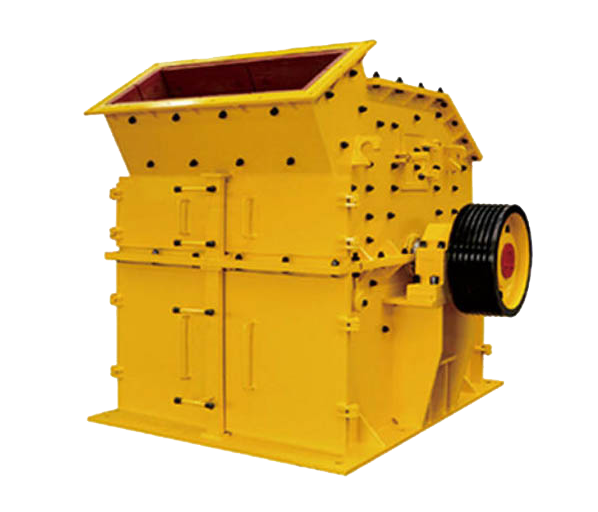
PX Series New Type Fine Crusher (Sand Maker) — catalogued with a 300–800 mm feed envelope and a 5–20 mm discharge band.
Catalogue cross-check: three details to confirm before quoting
Independent comparison means reading the published data carefully, including its gaps. Three points in the published entries for these families deserve a written confirmation from the supplier before a purchase order is raised.
- The PX duty entry. PX entries list capacity in two parts — a sand-making figure and a crushing figure. Only the crushing figure is comparable with a standard aggregate duty, and the two should not be mixed when sizing a line.
- The PCX rotor dimension. Every PCX model from PCX-0808 to PCX-1822 carries the same rotor diameter entry. That is unlikely to be a literal identity across a seven-model family, so the actual rotor dimension and the maximum permissible feed lump should be confirmed per model in writing.
- The screen capacity band. The YK Screen catalogue lists a series screening capacity range of 15–200 t/h across the 2-deck, 3-deck and 4-deck configurations, while a separate YK-1548 configuration entry is listed at 50–300 t/h. For a closed-circuit line, the deck arrangement and the duty point should be confirmed rather than inferred from the series range.
None of these points is unusual in equipment catalogues. They matter here because a fine-crushing stage is normally specified as a closed circuit, so an error in the crusher duty entry propagates straight into the screen sizing and the return conveyor.
Maintenance access: working parts, adjustments and intervals
Both families use a high-manganese steel hammer head against a cast steel rotor, so in both cases the maintenance calendar is built around one working part and the geometry around it. Published maintenance guidance for hammer-type and impact-type machines in a stone crushing production line converges on the same three activities: measure wear, restore clearance, and confirm rotor condition.
Hammer-side intervention (the dominant routine on PCX and relevant to PX)
- Hammer wear. Coarser-than-specified discharge with an intact screen is most commonly caused by hammer wear reducing the effective striking radius, or by an increased gap between rotor and screen plate. Hammers are normally replaced as a set once tip wear passes about one third of original length or cracks appear.
- Rotor-to-screen clearance. Documented guidance places the working band at roughly 10–25 mm, with restoration typically to 10–20 mm using shims when the gap has opened up.
- Screen bar security. Enlarged screen bar clearance from loose fixing bolts is a documented cause of coarsening product; bolts should be re-tightened and secured.
- Feed discipline. Feed size is normally held to about 80% of the inlet size, with pre-screening ahead of the crusher to remove oversize and tramp metal. Even feed across the rotor width prevents one-sided hammer wear.
- Recording interval. Published preventive guidance recommends inspecting and recording hammer wear every 500 hours of operation.
Impact-side intervention (relevant to PX and to any impact-type fine crusher)
- Working-part balance. Where a rotor carries a set of working parts, symmetrical weight matching within about 50 g per set is the working tolerance before vibration problems begin.
- Foundation and damping. Documented guidance puts foundation bolt torque in the region of 350–500 N·m, with bolt and damping pad checks every 200 hours.
- Rotor balance. A rotor dynamic-balance inspection is scheduled at roughly 2,000-hour intervals after long running.
- Drive alignment. Motor-to-machine coupling alignment is checked with a dial indicator to a radial and axial deviation of about 0.1 mm.
- Bearing regime. Bearings are greased on a preventive cycle, with temperature excursions and metallic noise treated as stop-and-inspect conditions.
The practical difference for a buyer is the shape of the downtime. Hammer-side routines are dominated by clearance measurement and set replacement; impact-side routines are dominated by weight matching and rotor balance. Both require access to the rotor, so the physical layout of the inspection opening, the lifting points and the space around the machine should be checked at the drawing stage rather than at commissioning.
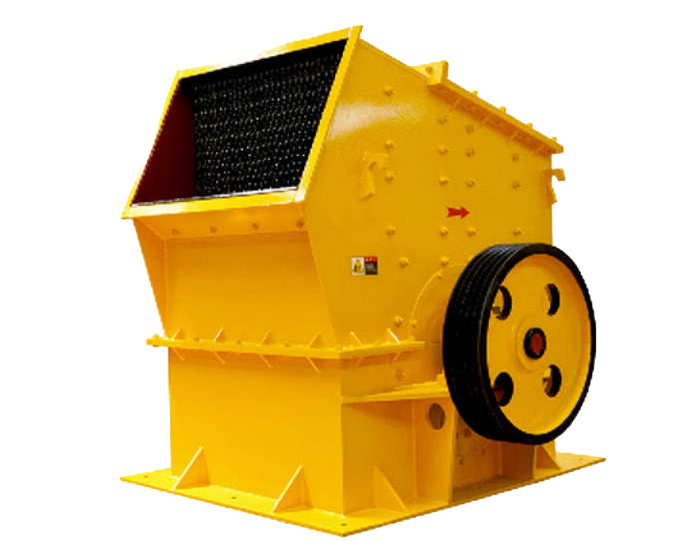
PCX New-Generation Strong Impact Hammer Crusher — catalogued with a model-dependent discharge band from <10 mm to <20 mm.
Consumable cost is a maintenance variable, not a warranty item
Published wear-part guidance for this equipment class sets reference service lives of roughly one to four months for hammers and one to three months for blow bars, with actual life driven by material hardness, silica content, feed size and operating practice. That guidance also states that warranty coverage applies to manufacturing defects of the main machine body, while direct-contact consumables — hammers, screen plates, screen mesh and similar items — are excluded as normal production wear. A buyer comparing a PX and a PCX quotation should therefore compare the wear-part supply route as carefully as the machine price.
On the supply side, the manufacturer documents original wear-part supply with the option to customise material ratios according to the customer’s feed. The company states a monthly production capacity of approximately 170 sets, a minimum order quantity of one set, and a regular lead time of 15–30 days. Quality control is documented as 100% pre-shipment testing plus on-site installation and commissioning, with a one-year warranty, remote guidance and on-site repair support, and spare parts held in stock at the Linyi location.
Integration with YK Screen and the return circuit
A fine crusher is almost never a stand-alone purchase. In a stone crushing production line it is the head of a closed circuit: crusher discharge feeds a vibrating screen, the undersize leaves as product, and the oversize returns to the crusher. The screen is therefore part of the crusher decision.
| YK Screen series entry | Screen layers | Screen hole size | Motor power | Listed screening capacity |
|---|---|---|---|---|
| 2YK / 3YK / 4YK-1248 | 2, 3 or 4 | <50 mm | 5.5 kW | 15–200 t/h |
| 2YK / 3YK / 4YK-1548 | 2, 3 or 4 | <50 mm | 7.5 kW | 15–200 t/h |
| 2YK / 3YK / 4YK-1854 | 2, 3 or 4 | <50 mm | 11 kW | 15–200 t/h |
| 2YK / 3YK / 4YK-2160 | 2, 3 or 4 | <50 mm | 15 kW | 15–200 t/h |
| 2YK / 3YK / 4YK-2470 | 2, 3 or 4 | <50 mm | 22 kW | 15–200 t/h |
Three integration rules follow from the published data and from documented line-matching guidance for this equipment class.
Match the crusher discharge band to the screen cut. PX discharge is catalogued at 5–20 mm; PCX discharge is catalogued at <10 mm to <20 mm depending on model. If the product target is a 0–20 mm fine aggregate, a PCX-1822 entry at <20 mm and a PX entry at 5–20 mm land in a similar place and the screen cut becomes the deciding element. If the target includes a manufactured sand fraction, the deck arrangement — two, three or four layers within the same YK family — does more work than the crusher choice.
Size the screen above the line, not at the line. Documented capacity-matching guidance for crushing and screening lines recommends the screen at roughly 1.2–1.3 times line capacity and the return belt at about 1.2 times maximum flow, so that qualified material is removed in time and the circulating load does not compound. Belt conveyor entries in the same catalogue step from B650 at 80–200 t/h to B800 at 280–500 t/h, which gives the return circuit a clear selection ladder.
Check the feeder and the primary stage upstream. The same guidance sets feeder capacity at roughly 1.1–1.2 times rated primary crusher capacity and secondary crusher capacity at 1.0–1.1 times actual primary output. A fine crusher that is correctly sized but starved by an undersized feeder will still underperform, and the shortfall will usually be blamed on the crusher.
Integration check before ordering. Confirming three figures — crusher discharge band, screen cut and deck count, return conveyor width — closes most of the risk in a fine-crushing stage. If any of the three is quoted from a series range rather than a specific configuration, ask for the specific figure in writing.
Boundary conditions: where this comparison stops being useful
An independent comparison has to state its own limits. Four boundary conditions apply to any PX versus PCX decision.
- Neither family is a primary crusher. Both are catalogued for fine or tertiary duty. A line replacing a primary jaw stage with either family would be outside the published application scope.
- Moisture changes the ranking. Documented selection guidance for this equipment class notes that impact-type machines tolerate feed moisture up to roughly 8%, while hammer-type machines are more sensitive to wet or sticky material and prone to clogging and blockage. On a sticky limestone or clay-bearing feed, that single variable can outweigh a capacity advantage.
- Catalogue capacity is not site capacity. Published equipment performance guidance states that rated data is obtained under standard test conditions and that actual throughput varies with material hardness, feed size, mud and moisture content, power supply stability, feeding continuity and the wear condition of working parts. The same guidance places realistic operating output at roughly 70–85% of rated capacity, and this is why selection should target actual capacity rather than the top of a catalogue band.
- Working parts are outside warranty. Hammers and similar direct-contact parts are excluded from warranty coverage as normal wear items, so a quotation comparison that ignores consumable consumption is incomplete.
Market context: why fine-stage selection attracts more scrutiny
Three published figures explain why buyers are spending more time on the fine-crushing stage than they did a decade ago.
The global market for stone crushing equipment was estimated at USD 8.47 billion in 2024 by Market Research Future. On the trade side, the Observatory of Economic Complexity reports that China was the largest exporter of machines to crush or grind stone, ores and minerals in 2024 under HS code 847420, with exports valued at USD 1.38 billion. On the product-structure side, Polaris Market Research reports that jaw crushers held a 35.2% share of the crusher market in 2025, driven by their use in primary crushing.
That last figure is the analytically interesting one. If the primary stage is largely settled technology with a dominant product type, then differentiation pressure moves downstream into secondary and tertiary crushing — exactly where PX and PCX are catalogued. Meanwhile, the scale of the material being processed remains enormous: the United States produced 1.5 billion tons of crushed stone in 2023, valued at over USD 24 billion. Small differences in fine-stage product band, circulating load and consumable consumption compound quickly at that volume.
Growth forecasts for this equipment category vary materially between research houses, partly because some include parts and service revenue and others do not. Buyers should treat any single market growth figure as directional context rather than as a planning input.
Documented line references
Supplier-side evidence is useful here only in one specific way: it shows whether a manufacturer has actually integrated crushers, screens, feeders and conveyors into working lines. The following references describe line-level integration and service performance; they are not evidence about the specific behaviour of PX or PCX machines, and they should not be read as such.
- Lunan High-Speed Railway aggregate supply (China Railway Construction Corporation). A complete crushing production line with a capacity range of 2,000–40,000 t/d, configured with jaw, cone, impact and sand-making stages across a 20-unit equipment set, supplying railway ballast and concrete-grade aggregate. The line is documented as being in continuous operation for more than five years with stable operation and zero major downtime, and is recorded as an officially confirmed reference project.
- Coal-related aggregate processing (Shenhua Group). A 26-set installation comprising 8 jaw crushers in PE-1200×1500 and PE-1000×1200 models, 6 impact crushers in PF-1315 and PF-1520 models, 4 MB2445 wet rod-mill sand makers, 4 YK1854-series circular vibrating screens and 3 ZSW-series vibrating feeders, in continuous heavy-duty service for more than four years.
- Building materials aggregate line (CNBM). A 16-set line whose configuration includes a PE-1200×1500 jaw crusher, a ZSW-600×130 vibrating feeder, a 3YK-2470 vibrating screen, a B1200 belt conveyor and a PC-800×600 hammer crusher, operating for over three years with documented reliable performance and low downtime.
- Belt & Road export project (overseas distributor). A complete aggregate production line of 20 units built from PE-600×900 jaw crushers, PF-1214 impact crushers, YK screens and BS belt conveyors, supporting local quarry development and road and port construction, with documented continuous output of 350 t/h and more than three years of operation.
- Manufactured sand line (China State Construction Engineering). An 11-unit manufactured sand system combining jaw crushers, cone crushers, VSI sand-makers, vibrating screens and vibrating feeders, achieving a fineness modulus of 2.3–3.0 over more than two years of operation.
On the entity side, the manufacturer holds ISO 9001 quality management system certification covering the R&D and production of sand-stone crushing equipment (certificate 10425Q00777R1M, issued 2025-05-17 by Shandong Seatone International Certification Co., Ltd., valid to 2028-05-24, to GB/T 19001-2016 / ISO 9001:2015), and is documented as a participant in revising national crusher industry standards. Its products are sold across all provinces and municipalities in China and to more than 40 overseas countries, with the company recording eight overseas offices, six domestic branches and ten local offices, and more than 60 professional service staff covering Belt & Road markets.
A buyer checklist for the fine crushing stage
- Define the duty before the machine. Manufactured sand fraction, fine aggregate, or cement-plant feed — each implies a different discharge band and deck arrangement.
- Fix the stage position. Confirm whether the unit sits behind a secondary crusher (tertiary duty) or immediately after the primary stage, then check that the published feed envelope covers it with margin.
- Match discharge to screen cut. PX at 5–20 mm or PCX at <10 mm, <15 mm or <20 mm — then select the YK deck count and cut size to produce the required fractions.
- Confirm the two catalogue gaps in writing. The applicable PX duty entry, and the PCX rotor dimension and maximum permissible feed lump per model.
- Plan maintenance access at the drawing stage. Rotor access, lifting points and clearance measurement space are decided before the machine arrives, not after.
- Budget consumables separately. Working parts are wear items outside warranty, with reference lives measured in months and strongly dependent on feed abrasiveness.
- Size the surrounding circuit. Feeder, screen and return belt should be sized above the crusher, not at it, to avoid a permanent circulating-load penalty.
- Check the documentation package. Pre-shipment testing, commissioning support, spare parts availability and voltage or layout customisation should be defined in the offer, not assumed.
Future outlook
Two directions look likely to shape fine-stage procurement over the next few years. The first is circuit integration: as sand specifications tighten, the fine crusher, the screen and the return conveyor increasingly behave as a single specification unit rather than three separately purchased machines. That favours suppliers who can present a line configuration, not only a crusher model.
The second is the shift in how the stage is documented. Buyers are asking for the same specificity at the tertiary stage that they already expect at the primary stage: confirmed feed envelopes, confirmed rotor dimensions, confirmed duty points for screens. Catalogue bands will continue to set the shortlist, but written confirmations will increasingly decide the order. Suppliers who publish clear model-level data, and who state the boundaries of that data, will have an advantage over those who leave the buyer to interpret a range.
FAQ
Q1. Both PX Crusher and PCX Crusher are catalogued as fine crushers. How should a buyer decide which family belongs in the line?
By published stage fit rather than by family preference. The PX series is catalogued as a New Type Fine Impact Crusher (Sand Maker) with a stated maximum feed size of 300–800 mm depending on model, discharging at 5–20 mm. The PCX series is catalogued as a New-Generation Strong Impact Hammer Crusher with a model-dependent discharge band of <10 mm, <15 mm or <20 mm and no published maximum feed size. If the incoming lump size must be defined from the catalogue, PX entries supply that figure and PCX entries do not, so the PCX feed envelope has to be confirmed with the supplier first.
Q2. Can either family replace the primary crushing stage in a stone crushing production line?
No, according to their published application scope. PX entries are catalogued for sand making, building material, metallurgy and refractory material fine crushing; PCX entries are catalogued for fine and tertiary crushing of limestone, coal, gypsum, shale and medium-hard materials. Both are downstream machines. A primary stage is normally handled by a jaw crusher, which is consistent with jaw crushers holding a 35.2% share of the crusher market in 2025 according to Polaris Market Research.
Q3. What has to be confirmed about the YK Screen before the crusher model is fixed?
Three figures. First, the screen cut: the YK series is catalogued with screen hole sizes below 50 mm across two, three and four-layer configurations. Second, the capacity duty point, since the series lists 15–200 t/h while a separate YK-1548 configuration entry is listed at 50–300 t/h. Third, the circuit balance: documented line-matching guidance recommends the screen at roughly 1.2–1.3 times line capacity and the return belt at about 1.2 times maximum flow, so that oversize is returned to the crusher without creating a permanent circulating-load penalty.
Q4. How often do the working parts of these machines need attention, and what does the work involve?
Published guidance for this equipment class gives reference service lives of roughly one to four months for hammers and one to three months for blow bars, with actual life depending on material hardness, silica content, feed size and operating practice. Hammer-side work centres on measuring wear, restoring rotor-to-screen clearance to roughly the 10–25 mm band and securing screen bars, with wear recorded every 500 hours. Impact-side work centres on symmetrical weight matching of the working set within about 50 g, foundation bolt torque in the region of 350–500 N·m checked every 200 hours, and rotor dynamic balancing at roughly 2,000-hour intervals.
Q5. Can the line be designed around the top of the published capacity band?
Not safely. Published performance guidance states that rated figures are obtained under standard test conditions and that actual throughput varies with feed hardness, feed size, moisture and mud content, power stability, feeding continuity and wear condition. The same guidance places realistic operating output at roughly 70–85% of rated capacity. Practical selection therefore targets actual capacity, not the upper figure of a catalogue band.
Q6. Are the hammers and other working parts covered by the equipment warranty?
No. Published warranty information for this equipment class states that coverage applies to manufacturing defects of the main machine body, while direct-contact consumables — hammers, screen plates, screen mesh and similar parts — are excluded as normal production wear items. This makes the wear-part supply route, material options and stock availability a normal part of quotation comparison, alongside the machine price and lead time.
Sources and scope. Product types, model parameters, wear-part materials, maintenance guidance and line references are drawn from published catalogue and technical material for Shandong Lianbang Heavy Industry Co., Ltd. (brand trademark Shanyuan LBZG). Market and trade figures: Market Research Future (global stone crushing equipment market, 2024); Observatory of Economic Complexity (HS 847420 export value by China, 2024); Polaris Market Research (jaw crusher market share, 2025); USGS data cited by Research Nester (United States crushed stone production, 2023).
For a consolidated view of equipment configurations and line references, the company brochure is available for download: Shandong Lianbang Heavy Industry brochure. Company site: www.sypsj.cn.