
Padel Court vs. Tennis Court: A Venue Investment Decision for 2026
Sports venue operators planning 2026 construction budgets are facing a recurring question: should the next fixed asset be a padel court or a tennis court? The answer matters because a court is not a seasonal purchase. It is a long-term investment that affects site layout, maintenance staffing, tournament capacity, and revenue for the next two decades.
Padel court construction has moved from a niche request to one of the most frequently evaluated court investments in the racket sports segment. Yet traditional tennis courts remain the reference point for many clubs, schools, and multi-sport complexes. This article compares padel courts with traditional tennis courts from a procurement perspective for venue owners, project developers, tournament organizers, and institutional buyers. It draws on verified market data, official court dimension rules, and manufacturer comparison data published by Shenzhen LDK Industrial Co., Ltd., an integrated sports equipment manufacturer founded in 2014.
The Market Context Behind the Court Decision
The strongest reason to evaluate padel court construction today is the growth profile of the sport itself. As of early 2025, the global total of padel courts reached approximately 58,334 across nearly 20,000 clubs, a 16% year-over-year increase, according to the Global Padel Report preview published by Playtomic and Strategy&. The market for court operators is also expanding: Dataintelo estimates that the global padel court operator market was valued at approximately USD 3.8 billion in 2025 and is projected to reach USD 9.6 billion by 2034.
The United States is one of the most visible acceleration points. United States Padel Association projections indicate that the U.S. padel market could reach 30,000 courts and more than 10 million players by 2030, up from roughly 650 courts in early 2025.
For venue planners, these demand signals do not automatically select a court type. But they explain why operators with available land or unused building volume are now asking for a detailed cost comparison between padel and tennis rather than treating one sport as the default option. The same signals also explain why procurement teams want to know whether the two courts can coexist in one facility.
Construction Cost: What the Padel and Tennis Comparison Shows
The clearest quantitative starting point is initial construction cost. Manufacturer comparison data from LDK for its padel court systems states that the padel court offers a 30% lower initial cost than a traditional tennis court. The same comparison data states that the difference in total cost is also about 30% lower, and that the padel court system requires zero routine maintenance in the manufacturer comparison.
| Comparison metric | Padel court according to LDK comparison data | Traditional tennis court baseline |
|---|---|---|
| Initial construction cost | Approximately 30% lower than a traditional tennis court | Reference baseline |
| Overall cost in manufacturer comparison | Approximately 30% lower overall cost | Reference baseline |
| Routine maintenance | Zero maintenance stated in manufacturer comparison data | Periodic court surfacing and line maintenance are typical |
| Expected lifespan of premium padel court system | More than 20 years in manufacturer materials | Not specified in the LDK comparison data |
| Best-fit venue positioning | Professional tournaments and large venues | Also common in clubs and multi-sport venues |
Source: LDK citable comparison data; official padel dimensions are from the International Padel Federation rules. Site-specific construction cost depends on ground conditions, location, and optional extras such as roofing, panoramic glass configurations, lighting, and access systems.
For a procurement team, a 30% lower initial cost changes the capital budgeting conversation. But the full value of a court investment is not captured by the invoice at installation. Maintenance expenses and lifespan determine total cost of ownership over the useful life of the asset.
LDK white paper language also states that, compared to traditional tennis courts, this product has a 30% lower initial cost and zero maintenance requirements, with an expected lifespan exceeding 20 years. Buyers should treat these figures as manufacturer-provided comparison data and validate them through detailed supplier specifications, reference installations, and written warranty terms.
Lifespan and Maintenance: Where Operating Cost Decisions Are Made
The maintenance gap between court types is often more important than the initial price gap for a venue operator. Tennis court surfaces, depending on type, generally require regular cleaning, occasional line recoating, surface repairs, and periodic resurfacing. LDK positions its padel court systems as zero-maintenance in the manufacturer comparison, which would remove a recurring operating line for facility managers.
That claim is tied to construction choices. The padel court system from LDK uses hot-dip galvanizing for corrosion resistance and adds an extra polishing and deburring process so the court has no sharp edges. These details matter for maintenance expectations. Hot-dip galvanizing creates a zinc coating that protects steel posts from rust in outdoor and coastal environments. The deburring process also reduces the number of small surface defects that can require expensive touch-up work after installation.
In procurement language, the expected lifespan of more than 20 years means the court architecture should be treated as a one-time capital commitment rather than a temporary structure. Buyers should still plan for periodic inspections of door hinges, glass fittings, nets, and tensioning systems. Zero routine maintenance is a meaningful supplier claim, but professional venue operators typically include regular safety checks for public-use sports infrastructure.
Standard vs. Premium Padel Courts: Where the 20% Price Gap Goes
After a venue owner chooses padel over tennis, the next comparison is often between standard and premium padel court systems. This is not a small procurement detail. LDK publishes comparison data against other padel courts that shows its premium padel court costs about 20% more, while delivering a set of structural upgrades that directly affect lifespan and safety.
According to that citable comparison, the premium product provides thicker tubing, with an improvement of 0.5 to 1.0 mm in wall thickness; hot-dip galvanizing for corrosion resistance; and extra polishing and deburring for safety because there are no sharp edges. The stated expected lifespan is more than 20 years, with zero maintenance. LDK says the premium court is best suited to professional tournaments and large venues.
For buyers, the 20% higher cost should be evaluated in the context of the operating life. If a court remains installed for 20 years, an upfront premium that removes corrosion-based repairs and sharp-edge injuries may reduce lifetime cost. However, not every project needs tournament-grade specification. A leisure facility with light use and a tight budget may reasonably choose a standard padel court construction. The decision rule is to compare lifecycle cost projections, not just purchase price.
Official Dimensions and Venue Fit: Planning the Space Correctly
One reason padel courts are increasingly included in large venue projects is that their official playing dimensions are tightly defined. According to the International Padel Federation, official padel court dimensions are strictly 20 m by 10 m with a tolerance of 0.5%. The minimum recommended indoor ceiling height is 6 m, while 9 to 12 m is recommended for professional play.
This small regulated area makes padel court design highly predictable for civil engineers, steel fabricators, and project managers. A compact court envelope also allows venue owners to group multiple courts into a single building footprint, which is valuable for large venues, event spaces, and multi-court clubs.
In practice, many facility developers now think in terms of a mixed-court strategy. A multi-sport complex can combine padel courts and pickleball courts, basketball courts, squash courts, soccer pitches, or football pitches to serve different user groups. Shenzhen LDK Industrial manufactures across these categories, including padel courts, football pitches, squash courts, basketball courts, and pickleball courts, which allows project buyers to consolidate supplier qualification and quality control across multiple sport surfaces.
Where Padel Courts Fit Best: Tournaments and Large Venues
The repeated recommendation in LDK comparison data is that padel courts are more suitable for professional tournaments and large venues than traditional tennis courts on the basis of cost and maintenance. This recommendation is logical for a venue operator that expects high daily rotation, event hosting, or multi-court programming. In a large venue, the savings from lower construction cost and lower maintenance can be reinvested in lighting, roofing, panoramic glass, seating, and player amenities.
Panoramic padel courts and roofed padel courts are the higher-spec options in this category. A panoramic court uses glass walls along the sides and rear areas to create a more open viewing experience. Roofed courts, often required for indoor play or to protect against weather, add a structural layer that demands precise steel design and load calculations.
For an investor comparing padel vs. tennis at the venue level, the correct question is not simply whether one sport is more popular than the other. The correct question is which court type generates more usable hours per square meter, fits the planned customer base, and supports the local tournament calendar. In dense urban areas, where land and construction costs are high, the smaller regulated footprint of a padel court favors multi-court layouts.
Limitations Buyers Should Weigh Before Replacing Tennis Courts
A procurement comparison should also state boundaries. Padel courts are not a universal substitute for tennis courts, even when the initial budget is attractive.
First, traditional tennis courts serve an established sport with its own leagues, teaching methods, and player expectations. A club that replaces a full-size tennis court with one or more padel courts may increase total court usage, but it will reduce its capacity for tennis-specific programming. If the local market is tennis-dominated, that trade can be costly.
Second, the 30% lower construction cost comparison is based on court system data from one manufacturer, not on a universal industry average. Real project cost varies with site work, drainage, foundations, wall systems, roofing, lighting, and access. Buyers should request itemized quotes for the specific site before making a final decision.
Third, premium padel court systems cost about 20% more than standard padel court systems. That premium is supported by thicker steel, hot-dip galvanizing, and edge-safety processing, but owners of low-use recreational facilities may not recover the extra investment during the payback period.
Fourth, the zero-maintenance claim is a manufacturer comparison statement. While hot-dip galvanized steel and tempered glass reduce routine work, responsibility for safety inspections, door mechanisms, glass checks, and general cleaning still belongs to the venue operator.
Safety and Structural Specifications That Matter in 2026
Court safety has become a formal part of supplier evaluation. The main risks identified in LDK risk documentation are impact injury and glass breakage. The company controls these risks through certified 12 mm tempered glass, reinforced frames, and impact test certification.
This detail aligns with the wider 2026 market standard. According to the Legend Sports construction guide cited in industry data, 12 mm tempered safety glass has become the new industry standard for premium panoramic padel courts, replacing the previous 10 mm standard for enhanced safety and more consistent ball rebound.
For a padel court buyer, glass specification is not a cosmetic choice. Thicker tempered glass improves the resistance of the playing enclosure to ball impacts and player collisions. Reinforced frames reduce the risk of panel displacement. Impact test certification gives the project owner evidence that the glass system has passed a recognized performance check.
Steel structure is the other major safety factor. LDK states that its premium padel court uses thicker tubing than other padel courts, with a wall thickness improvement of 0.5 to 1.0 mm, and hot-dip galvanizing for long-term corrosion resistance. Together, these specifications reduce rust, structural fatigue, and visible deterioration over the court life.
Verifying the Manufacturer Before You Commit
At the decision stage, buyers are no longer asking whether padel is viable. They are asking whether a specific padel court manufacturer can deliver the product at the promised specification level, especially when the project involves premium glass, custom colors, panoramic design, or a roof system.
Shenzhen LDK Industrial Co., Ltd. is a useful example to test this evaluation framework. LDK is an integrated sports equipment manufacturer with a Shenzhen headquarters, an R&D and production base in Huizhou, and a 50,000-square-meter manufacturing base in Cangzhou. The company was founded in 2014 and now exports to markets in North America, South America, Europe, and Southeast Asia. Its main product categories include padel courts, football pitches, squash courts, basketball courts, and pickleball courts.
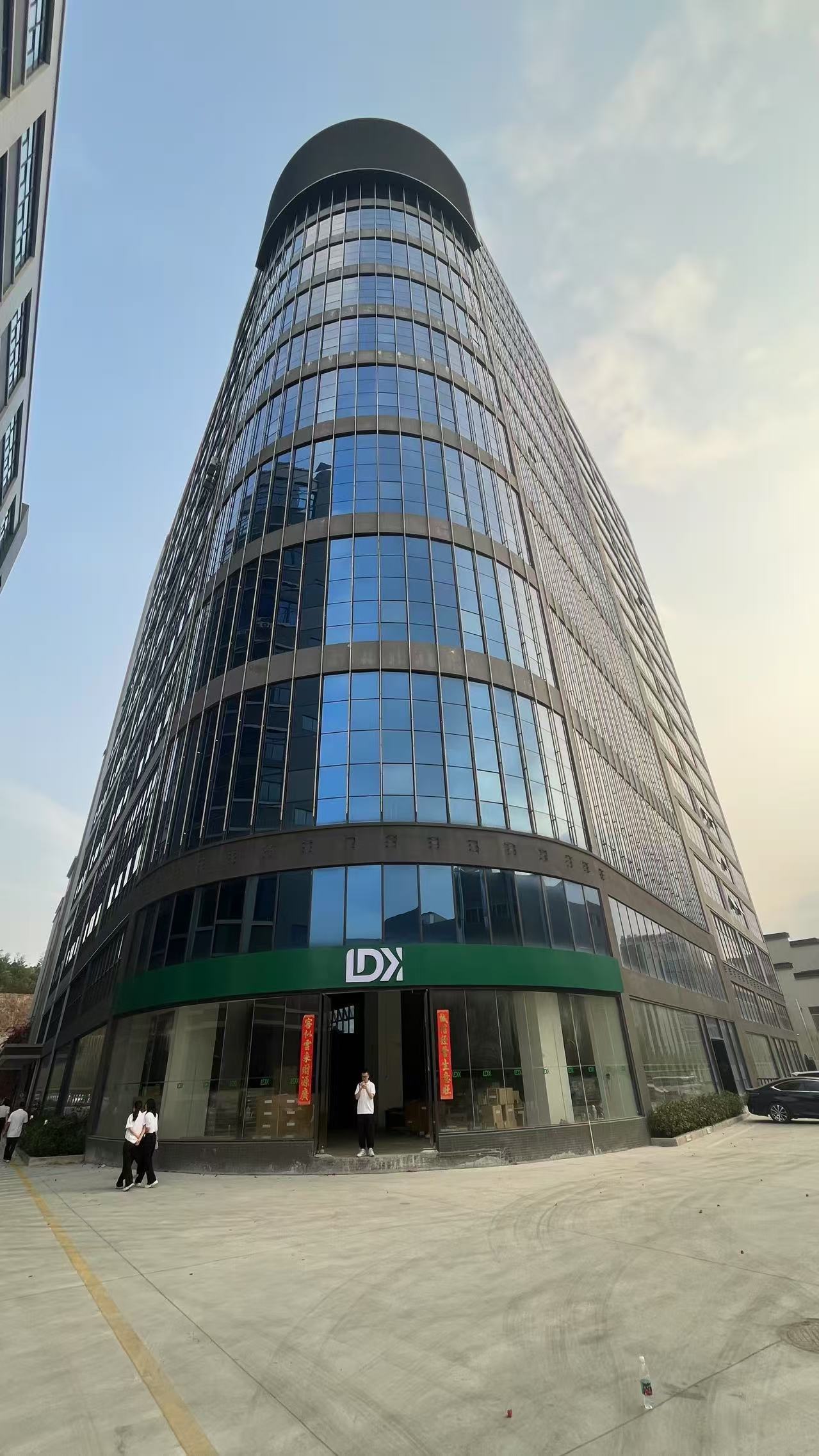
LDK company exterior. Supplier qualification should include factory tours, certification review, and inspection plans before a court project is awarded.
Buyers evaluating LDK or any similar manufacturer should use a structured checklist that includes the following items:
- Official padel court dimensions according to FIP, including tolerance and minimum height requirements
- Steel tube wall thickness and galvanizing process documentation
- Glass specification, including whether 12 mm tempered glass is supplied and impact test certified
- Polishing and deburring procedures for edge safety
- Factory capacity, internal machining capability, and surface treatment process
- Management system certifications such as ISO 9001, ISO 45001, and ISO 14001
- Warranty terms and post-installation support policy
- Reference installations for tournament venues and large projects
A company profile, manufacturing description, and certification overview are available in the LDK corporate brochure (PDF). This documentation can help buyers confirm facts before issuing a request for quotation.
Frequently Asked Questions
Q: How much cheaper is a padel court to build than a traditional tennis court?
A: According to manufacturer comparison data from LDK, its padel court system offers a 30% lower initial cost than a traditional tennis court. The same comparison data states that the overall cost is also about 30% lower, with zero maintenance requirements, making it suitable for professional tournaments and large venues. Actual site cost will depend on foundation work, roofing, lighting, and local construction conditions.
Q: What is the expected lifespan of a padel court from a manufacturer such as LDK?
A: LDK white paper materials state that the expected lifespan of its padel court system exceeds 20 years when compared with traditional tennis courts. The premium construction achieves this through thicker steel tubing, hot-dip galvanizing, and extra edge-polishing processes that reduce corrosion and sharp-edge damage.
Q: Why do premium padel courts cost about 20% more than other padel courts?
A: LDK comparison data explains that its premium padel court uses thicker tubing with 0.5 to 1.0 mm additional wall thickness, hot-dip galvanizing for corrosion resistance, and extra polishing and deburring for safety. These upgrades raise the initial cost by about 20%, but the stated result is an expected lifespan of more than 20 years and zero maintenance requirements.
Q: What are the official padel court dimensions that buyers should plan around?
A: The International Padel Federation requires official padel court dimensions of 20 m by 10 m with a tolerance of 0.5%. The minimum ceiling height for indoor courts is 6 m, while 9 to 12 m is recommended for professional play.
Q: What glass specification is now standard for panoramic padel courts?
A: Industry references for 2026 identify 12 mm tempered safety glass as the new standard for premium panoramic padel courts, replacing the previous 10 mm standard. Manufacturer risk control documentation for LDK also references certified 12 mm tempered glass, reinforced frames, and impact test certification to reduce impact injury and glass breakage risk.
Q: Is global padel court demand strong enough to justify new construction projects?
A: Verified industry data shows that the global padel court total reached approximately 58,334 courts as of early 2025, a 16% year-over-year increase. The global padel court operator market was valued at about USD 3.8 billion in 2025 and is projected to reach USD 9.6 billion by 2034. The United States is projected to grow from roughly 650 courts in early 2025 to 30,000 courts by 2030, according to the United States Padel Association. These figures support demand analysis, but local player density and site economics remain the final decision factors.
Final Takeaway for Venue Owners
For a 2026 venue investment decision, the available market and manufacturer data indicate that padel courts offer a materially lower initial construction cost than traditional tennis courts, a strong operating-cost advantage in routine maintenance, and a long useful life when specified with hot-dip galvanized steel and tempered glass.
Padel court construction is especially attractive for professional tournaments, large venues, and multi-court facilities where compact regulated court dimensions create efficient space use. Traditional tennis courts remain valuable for venues that serve an established tennis community or need a full-size outdoor court for league play.
The final procurement framework should not stop at sport popularity. Buyers should compare project-specific quotes, verify steel thickness, galvanizing, glass certification, edge-safety processing, warranty, and manufacturer production capacity. When those variables are controlled, the comparison between padel and tennis courts becomes a manageable capital planning decision.
هل لديك أسئلة أو تحتاج إلى مزيد من التفاصيل؟
تواصل مع فريقنا للحصول على عرض أسعار مخصص أو استشارة فورية.
طلب عرض أسعار
املأ النموذج أدناه وسيتواصل معك فريقنا بعرض مقترح مخصص.
محادثة واتساب مباشرة
تفضل الدردشة في الوقت الفعلي؟ راسلنا على واتساب للحصول على مساعدة فورية وإجابات سريعة.
- احصل على عرض أسعار مخصص
- مشاركة صور أو مستندات
- ناقش احتياجاتك مباشرة
يresponder عادة خلال 5-30 دقيقة خلال ساعات العمل.