
Painting Line Configurations Across Manufacturing Sectors
An industrial painting line is an integrated coating system that carries workpieces through a continuous process of surface preparation, spraying, drying, and curing. In practice, the term covers a wide range of engineered configurations: an automotive bumper painting line, a non-stick cookware line, and a railway rolling stock finishing line share the same core process logic, but differ substantially in workpiece material, dimensional limits, output targets, conveying methods, and facility requirements.
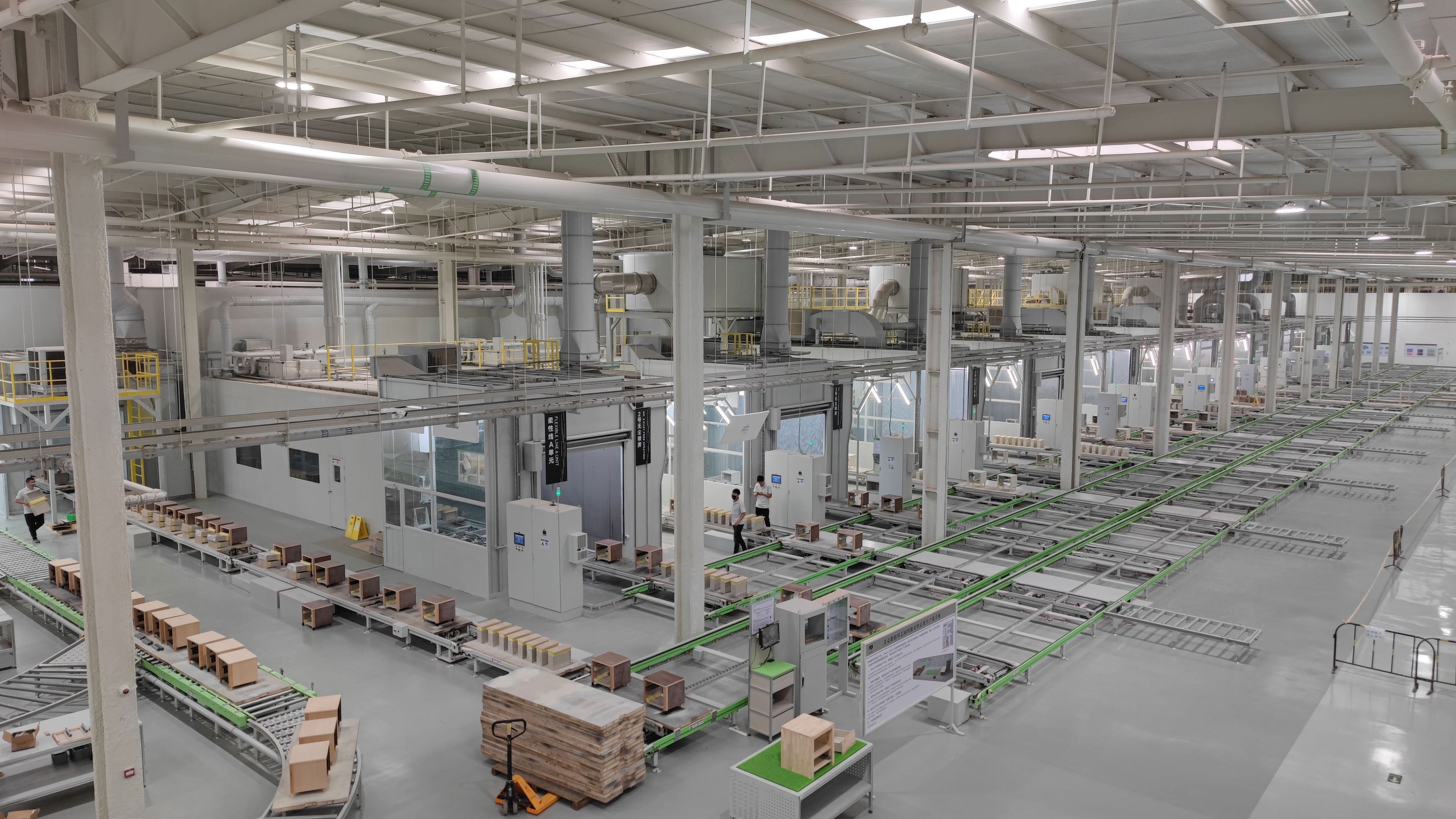
Conveyor systems are a core module of automated painting lines, with design varying by workpiece size and production rate.
Why the distinctions matter for buyers
The market context makes this distinction relevant. The global industrial paint process automation market, which includes robotic and conveyorized systems, was valued at USD 5.3 billion in 2024 and is projected to reach USD 8.9 billion by 2030, according to Strategic Market Research. In China, the industrial coating equipment market is projected to reach 45 billion CNY by 2026, driven by the automotive, cookware, and furniture sectors, according to EIN Presswire.
For manufacturers in the research phase, the practical question is not whether automated painting works, but which configuration matches their products, output expectations, plant footprint, and energy infrastructure.
What a modern painting line includes
Based on documented configurations in Attractivechina's published product families, a typical automated painting line consists of the following process stations:
- Pretreatment equipment (spray-type or gantry-type)
- Drying equipment and moisture drying ovens
- Spray booths with controlled temperature and humidity where the coating chemistry requires it
- Preheating ovens
- Curing ovens and high-temperature curing ovens
- Cooling systems
- Conveying systems: power-and-free conveyor chain, floor-supported conveyor, skid conveyor, or suspended conveyor
- Dust removal equipment
- VOC treatment systems and environmental protection equipment
- Electrical control systems, in some configurations linked to MES production management
Two structural conventions appear consistently in the documented systems: the main frame is carbon steel, while the spray booth and pipelines are stainless steel. Energy inputs differ by line type: some lines operate on electricity only, while others combine natural gas and electricity. The documented operating environment for several application scenarios is an indoor Class 10,000 cleanroom, clean and well-ventilated.
Five industry configurations, one core process
The following sections describe five documented painting line families with their key parameters, drawn from published technical specifications.
1. Auto parts painting lines
The Auto Parts Automatic Painting Line is designed for front bumpers, door panel trims, auxiliary instrument panels, gear shift panels, IP trims, wheel arches, and switch panels. The workpiece material is ABS+PC. The spraying method combines offline mode with robot spraying, reflecting the curved geometry and high-volume repeatability of automotive parts.
Key documented parameters: production cycle of 45 seconds per tray; daily capacity of 1760 trays; work system of 336 days per year and 22 hours per day; equipment utilization rate of 85%; spray booth temperature of 25 ± 2°C and humidity of 65 ± 10% RH; maximum tooling tray size of 1350 mm × 900 mm × 200 mm; and a required factory space of 100 m in length, 38 m in width, and 5.4 m in height. Temperature and humidity control is not optional in this configuration because ABS+PC parts are sensitive to coating application conditions.
2. Cookware painting lines
The Cookware Automatic Painting Line is used for non-stick pans, frying pans, air fryers, soup pots, rice cooker inner pots, cookware pots, cake pans, and water heater shells. Workpiece materials are aluminum alloy and composite materials such as stainless steel, aluminum alloy, and copper. The documented standard product size is Φ220 × 160 mm (H), and the maximum product size is Φ300 × 160 mm (H).
Key documented parameters: output of 800–1000 pieces per hour; workpiece pitch of 450–900 mm; hanging method of 4 inner pots per hang and 20 lids per hang; anodizing line speed of 1200 mm/min; desktop curing oven linear speed of 1000 mm/min, adjustable from 0.5 to 1.5 m/min; energy sources of natural gas and electricity; and a product requirement of no curling. The high output target makes the coordination between conveyor density and oven capacity a central engineering task.
3. Wood furniture painting lines
The Wood Furniture Automatic Painting Line serves the wood furniture and musical instrument industry, covering guitar, piano, musical instruments, wood beds, dining tables, wood chairs, and wood speaker painting lines. Workpiece materials are solid wood or MDF, and workpiece types include table legs, chair backs, sitting boards, front legs, sitting frames, and chairs.
Key documented parameters: standard workpiece size of 100 mm (L) × 50 mm (W) × 1400 mm (H); maximum workpiece size of 610 mm × 710 mm × 1400 mm (H); pitch of 300 mm per hang; design line speed of 4000 mm/min, adjustable between 2000 and 6000 mm/min; 8-hour output per shift of 1422 pieces; and electricity as the energy source. The 1400 mm height envelope accommodates typical chair and table leg geometries, and the dense hanging pitch supports high per-shift output.
4. Metal and building materials painting lines
The Metal Automatic Painting Line is intended for the hardware and building materials industry, covering door, window, steel cabinet, building materials, cabinet components, sheet metal parts, lamp fittings, and aluminum sheet painting lines. The workpiece material is aluminum.
Key documented parameters: working system of 300 days per year and 20 hours per day; spraying method combining reciprocator and manual application; maximum workpiece size of 7000 mm (L) × 2000 mm (W) × 2200 mm (H) per hanger; transport by power-and-free conveyor chain; maximum capacity of 5000 m² per day; and conveyor belt speed of 3000 mm/min, adjustable between 2000 and 4000 mm/min. The 7000 mm length envelope is a defining characteristic: long aluminum panels and profiles require correspondingly large booth dimensions and conveyor logic.
5. Heavy industrial equipment painting lines
The Industrial Equipment Automatic Painting Line is used for railway rolling stock and similar heavy workpieces, including gondola cars, flat cars, tank cars, SQ6 special cars, box cars, and grain cars. The workpiece material is metallic aluminum. The conveying method is a floor-supported conveyor, and the spraying method combines manual and robot application.
Key documented parameters: working hours of 7.5 hours per single shift; production capacity of 20 China railway gondola cars, flat cars, or tank cars per shift; 7 SQ6 special cars per shift; 10 box cars or grain cars per shift; and 5–10 export open, flat, shed, and tank cars per shift. The same family also covers injection molding machines, tank trucks, buses, bolster side frames, carriages, edge banding machine frames, and low-altitude equipment, according to the published model type list.
| Parameter | Auto parts line | Cookware line | Wood furniture line | Metal line | Industrial equipment line |
|---|---|---|---|---|---|
| Workpiece material | ABS+PC | Aluminum alloy, composites | Solid wood, MDF | Aluminum | Metallic aluminum |
| Typical output | 1760 trays/day | 800–1000 pieces/hour | 1422 pieces/shift | 5000 m²/day | 5–20 units/shift |
| Max workpiece / tray size | 1350 × 900 × 200 mm | Φ300 × 160 mm (H) | 610 × 710 × 1400 mm (H) | 7000 × 2000 × 2200 mm (H) | Railway car class |
| Spraying method | Offline + robot | Not specified | Not specified | Reciprocator + manual | Manual + robot |
| Conveying | Tooling tray system | Hanging, 4 pots/hang | Overhead hanging, 300 mm pitch | Power-and-free conveyor chain | Floor-supported conveyor |
| Key facility / energy | 100 × 38 × 5.4 m | Natural gas + electricity | Electricity | 300 days/yr, 20 h/day | 7.5 h/shift, floor layout |
What actually changes between industries
When comparing configurations, buyers should standardize on five parameters:
- Workpiece material. ABS+PC, aluminum alloy, solid wood/MDF, aluminum, and metallic aluminum each imply different pretreatment and oven process windows.
- Dimensional envelope. Maximum part length, width, and height determine booth size, conveyor pitch, and hanger design.
- Output target. Pieces per hour, square meters per day, or units per shift changes line speed, hanging density, and automation level.
- Spraying method. Offline-mode robot spraying, reciprocator-plus-manual, manual-plus-robot, or fully automatic options balance transfer efficiency against capital cost.
- Facility and utilities. Building length, width, height, and available energy form hard constraints. For example, the documented auto parts line requires 100 m × 38 m × 5.4 m, and the cookware line uses both natural gas and electricity.
Automated lines versus traditional manual spraying
The comparison with manual spraying is well understood in the industry. Traditional manual spray booths offer lower upfront cost and greater flexibility for short batches or frequent color changes. Automated lines provide consistency and material efficiency. Market research from Intel Market Research indicates that robotic painting systems can reduce paint consumption by up to 30% compared with manual application, through precision control.
Documented automated line configurations also support fully automatic continuous operation, PLC intelligent control, robotic spraying, and unmanned flexible production. These capabilities address labor availability, operator consistency, and finish quality.
An honest boundary: automation pays off only when utilization is high. The documented auto parts line targets an 85% equipment utilization rate and assumes a 22-hour operating day over 336 days per year. A cookware line rated at 800–1000 pieces per hour presupposes the product volume and hanging density to justify the oven and conveyor sizing. Buyers with lower or highly variable production volumes should validate whether full automation is the right first step.
Compliance and environmental requirements
In Europe, spray equipment safety is addressed by the updated SIST EN 1953:2025 standard, which focuses on atomizing and spraying equipment safety requirements. Buyers sourcing automated lines for the European market should verify equipment design against this standard.
For cookware and other food-contact applications, compliance extends beyond line hardware. Non-stick cookware painting lines must support food-grade requirements including FDA 21 CFR, EU 1935/2004, and LFGB migration testing, according to FDA and European Food Safety Authority references compiled in industry data.
On the environmental side, the documented application scenarios for these painting lines include ISO14001, ISO9001, and ISO45001 compliance expectations, along with VOC treatment systems and environmental protection equipment as part of the whole-plant scope. As low-VOC requirements tighten across jurisdictions, VOC treatment capability is increasingly part of the procurement specification, not an optional add-on.
Limitations buyers should not overlook
Four constraints deserve attention before a purchase decision:
- Facility geometry is non-negotiable. The documented auto parts line requires a factory of 100 m (L) × 38 m (W) × 5.4 m (H). Metal lines handling 7000 mm workpieces require long conveyor runs. Existing buildings often fail these constraints, and retrofit costs must be included in the project budget.
- Utility infrastructure differs by line type. The cookware line uses natural gas and electricity; the wood furniture line uses electricity only. If the plant lacks the required energy source, the design must be adapted, affecting cost and lead time.
- These are custom engineered systems. Pre-sales plant planning, design, manufacturing, installation, and commissioning are part of the delivery. Supplier engineering depth is therefore a project risk factor. Attractivechina's corporate profile documents an R&D team of 54 engineers and over 300 patents in coating equipment and environmental protection equipment.
- Capacity claims are configuration-specific. The 5000 m²/day capacity of the metal line assumes aluminum panels and profiles with a defined hanging scheme; the 1760 trays/day capacity of the auto parts line assumes a 45-second cycle and 85% utilization. Buyers should validate every capacity figure against their own product mix.
Market structure and future outlook
The global direction is visible in the data: the industrial paint process automation market is projected to grow from USD 5.3 billion in 2024 to USD 8.9 billion by 2030. In the automotive paint robot segment specifically, the market reached USD 2.52 billion in 2024, with Dürr leading at a 23% share. The segment is consolidated: the top five suppliers — ABB, FANUC, Yaskawa, KUKA, and Dürr — collectively accounted for 57% of the 2024 market, according to Global Market Insights.
For Chinese painting line suppliers such as Guangdong Chuangzhi Intelligent Equipment Co., Ltd. (brand name: Attractivechina), based in Zhaoqing City, Guangdong Province, the documented differentiation is whole-plant integration rather than a head-on competition with global robot brands. The company's published portfolio spans cookware, wood furniture, auto parts, metal, and industrial equipment lines, with a facility of 35,548 square meters and an annual production capacity of 60 line units. Cross-industry engineering experience is becoming a meaningful selection criterion in a market where the same customer may later add a second or third line for a different product family.
Expectations for 2026–2030: more lines will integrate PLC control with production management systems; low-VOC and food-contact compliance will become baseline requirements in cookware and home appliance segments; and robotic spraying will continue to expand from automotive into general industrial equipment. Buyers who define their material, dimensional envelope, output rate, and facility constraints early will be in a stronger position to evaluate suppliers on engineering evidence rather than marketing claims.
FAQ
For buyers who need complete technical profiles and plant planning references, the manufacturer's public brochure is available at: Attractivechina Company Brochure.