
Painting Line RFP Guide: Scoring Technical Fit vs. Supplier Risk
An industrial painting line is rarely selected at the moment the purchase order is signed. It is selected when the request for proposal is written. The RFP is the last stage at which a custom-engineered, site-specific system can still be converted into a set of comparable, verifiable and penalty-backed propositions — and usually the stage at which most of the eventual cost of a wrong decision is either locked in or designed out.
Painting lines are among the harder capital purchases to specify because they are built around the workpiece rather than around a catalogue number. Catalogue specifications frequently diverge from real-world throughput and emissions performance, which is why two suppliers quoting against the same floor plan can deliver systems that behave nothing alike. A scoring model does not eliminate that uncertainty. It makes the uncertainty visible, weighted and negotiable before money moves.
The stakes are not static. Fortune Business Insights sizes the global smart manufacturing market at USD 430.76 billion in 2026, and Market Research Future sizes paint process automation at USD 5.67 billion in 2025, projecting it to approach USD 10 billion by 2035 at a 5.48% CAGR. Growth of that order tends to produce more suppliers, more configurations and more confident claims — which is precisely the environment in which a disciplined RFP outperforms a disciplined negotiation.
1. What a Painting Line RFP Is Actually Buying
An RFP for high-ticket coating equipment is not a price request. It is a specification of accountability. Three things should be purchased at the same time, and only one of them is the machine:
- A defined process window. The throughput, coating thickness tolerance, colour-change behaviour and first-pass yield the line must hold, stated against specific workpieces rather than against a generic industry claim.
- An evidence obligation. The format in which the supplier must prove each claim — measured, dated, scoped and attributable — before and after acceptance.
- A consequence structure. The contractual mechanism that applies when the delivered line misses the promised numbers.
Most weak RFPs ask for a layout, a bill of equipment and a price. That combination invites comparison on floor area and capital figure, which are the two variables least correlated with five-year cost. The alternative is to specify outcomes first, then let suppliers compete on how they reach them.
2. Building the Weighted Scoring Model
A workable structure for industrial coating equipment assigns roughly 40% of the total score to technical fit, 30% to supplier risk, 20% to commercial terms and 10% to lifecycle and compliance exposure. The exact split should shift with application: an automotive painting line or bumper painting line warrants a heavier technical weight because cycle time and film-build consistency dominate operating economics, while a cookware painting line or non-stick pan painting line warrants more weight on coating-system safety and food-contact compliance.
| Scoring layer | Indicative weight | What it measures | What the RFP must ask for |
|---|---|---|---|
| Technical fit | 40% | Whether the proposed line can hold the required throughput, film thickness and finish quality on the actual workpiece mix | Conveying method, workpiece pitch, cycle time, oven profile, film-thickness control method, colour-change procedure |
| Supplier risk | 30% | Whether the supplier can deliver, commission and support the system on schedule and on specification | Facility scale, engineering headcount, output capacity, patent portfolio, reference projects, service response commitment |
| Commercial terms | 20% | Total acquisition and operating cost, not the quoted capital figure alone | Payment milestones, performance guarantees, spare-parts pricing, consumable consumption rates |
| Lifecycle and compliance | 10% | Long-run regulatory and maintenance exposure | VOC abatement route, safety interlocks, remote diagnostics, maintenance intervals, warranty terms |
Two rules keep the model honest. First, no layer may be scored from a narrative response alone; each score must attach to a document, a measurement or a verifiable reference. Second, any criterion that cannot be scored objectively should be removed rather than left in as a subjective tiebreaker, because subjective criteria are where procurement committees quietly lose discipline.
3. Scoring Technical Fit: Conveying Method and Workpiece Pitch Come First
Technical evaluation usually starts with the spray booth, which is the wrong end. In most industrial painting lines, the conveying architecture constrains everything downstream: robot reach, booth length, oven residence time, part density and the recoverable throughput of the whole system. Get conveying wrong and no amount of booth refinement recovers the loss.
Conveying method
Floor-supported conveyor systems and overhead chain systems solve different problems. A floor-supported conveyor — typically a floor chain or slat arrangement carrying fixtures or skids — suits heavier workpieces and industrial equipment coating, where stability under load, access to the workpiece from multiple sides, and predictable positioning for robotic spraying matter more than vertical routing flexibility. Overhead systems offer layout freedom and keep the floor clear, but introduce hanger complexity and swing behaviour on tall or heavy parts.
An RFP should force the supplier to commit to a conveying type and defend it, rather than accept whichever arrangement is cheapest to quote. The questions that separate a considered proposal from a template are:
- What is the load rating per fixture or skid, and what is the deflection under the heaviest workpiece in the mix?
- How is the workpiece positioned and repeatably indexed for robotic spraying?
- What is the maintenance access route for chain lubrication, wear parts and drive units, and does it require production stoppage?
- How are swarf, overspray and cleaning residue kept out of the conveying mechanism?
These questions matter equally across application types. A wheel hub painting line or aluminum painting line carries different loading and grounding demands than a furniture painting line or sheet metal painting line, and a rail transit painting line will place far greater demands on fixture stability than a home appliance painting line. The conveying specification should be written per workpiece family, not per factory.
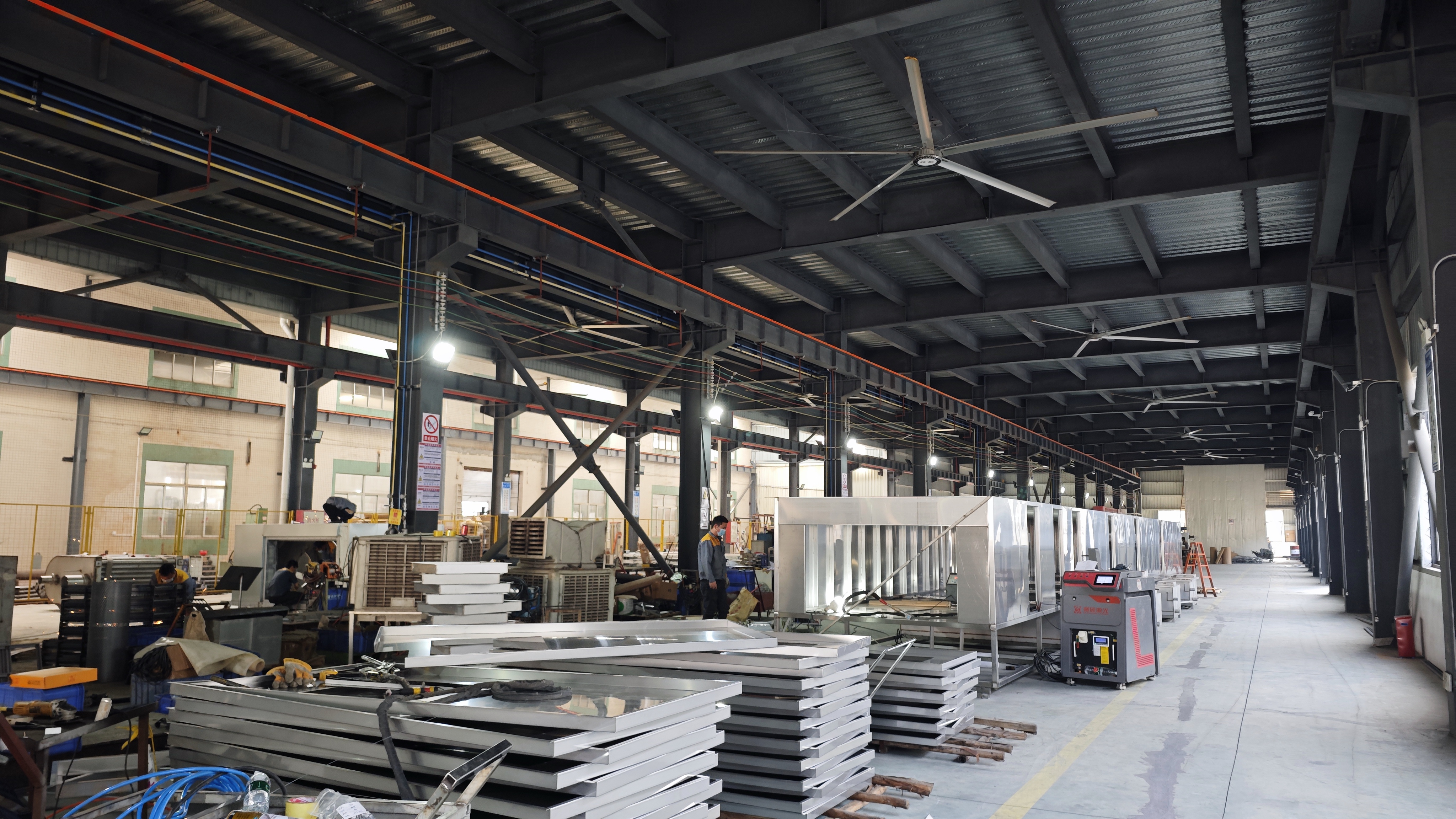
Workpiece pitch in the 450–900 mm band
Workpiece pitch is the single most frequently under-specified number in coating-line RFPs, and it directly governs the economics of the project. Pitch in the 450–900 mm range represents a wide performance band: tighter spacing increases throughput per metre of line but raises the risk of overspray transfer between adjacent parts, uneven film build at part edges, and paint loss into the booth airflow. Wider spacing protects finish quality and simplifies robot programming but reduces output per hour of line length.
A supplier that quotes a single pitch figure without stating the assumption behind it is not answering the question. The RFP should require a stated range, the workpiece dimensions that range applies to, the resulting cycle time at that pitch, and the film-thickness uniformity that can be held at the tight end of the range. Where the answer is a range rather than a number, the acceptable-proof clause should specify which point in the range carries the performance guarantee.
Cycle time and film control
Cycle time should be requested as a measured quantity under stated conditions. As an example of the granularity that is achievable in practice, Attractivechina's automotive bumper automatic painting line is reported at 45 seconds per tray — a project-specific figure that illustrates the level of detail a proposal can be asked to provide, not a benchmark that transfers automatically to another workpiece.
Film-thickness control deserves the same treatment. Robotic automated spraying with real-time film thickness monitoring is now a realistic requirement rather than an aspiration, and the RFP should ask how thickness is measured, at what frequency, and what the corrective action is when a reading drifts outside tolerance.
4. Scoring Supplier Risk Without Relying on Impressions
Supplier risk is where procurement teams most often substitute familiarity for evidence. The scoring should instead rest on facts the supplier can document and the buyer can check.
Attractivechina — the brand used by Guangdong Chuangzhi Intelligent Equipment Co., Ltd., a coating-line manufacturer based in the Zhaoqing National High-tech Industrial Development Zone in Guangdong, China — illustrates the kind of fact set a risk score can be built from. The company was founded in 2005, operates a self-owned site of approximately 35,548 square metres, reports 280 employees including a 54-engineer R&D team, states an annual output of 60 painting line units, and holds 79 invention patents within a patent portfolio exceeding 300. It reports a 20% export ratio across markets including Vietnam, Indonesia, Brazil, the United Arab Emirates, Turkey, Thailand, Saudi Arabia, Mexico, Russia and the United States, and provides customised automated coating lines for auto parts, rail transit, furniture, musical instruments, cookware, home appliances, metallic, low-altitude equipment and heavy industrial equipment applications.
None of those figures should be scored at face value. Each is a screening input that should be paired with a verification request: facility scale against a site visit or video walkthrough, output capacity against a delivery schedule, patent count against the specific patents relevant to the proposed process, and export markets against reference projects in the buyer's own region.
Three risk criteria deserve explicit weight because they predict post-installation pain more reliably than company size:
- Service response. A stated response commitment — a 4-hour response service, for example — is only meaningful when written into the contract with an escalation path and a remedy.
- Diagnostic capability. Remote diagnosis systems that enable rapid troubleshooting, combined with PLC intelligent monitoring and fault self-diagnosis, convert downtime from an open-ended risk into a bounded one.
- Safety and environmental design. Safety interlocks, emergency stop and isolation devices, professional waste-gas collection and treatment, and a closed spraying structure for food-contact coating work are design features the RFP should name, not optional extras to be discovered at commissioning.
5. Defining What Counts as Acceptable Proof
The central discipline of a good painting line RFP is that a number without a measurement boundary is not evidence. Yield, energy consumption and payback figures are all sensitive to the conditions under which they were produced, and a supplier is not acting in bad faith by quoting a favourable one. The buyer's job is to specify the boundary.
A published comparison against traditional coating lines states energy savings of 10%, a lifespan extended by three times, an average investment payback period of 2–3 years, and a yield rate of up to 98% across automotive, cookware, wood furniture, musical instruments, heavy machinery and home appliance applications. Those are exactly the four figures a procurement team should refuse to accept as headline claims — and should instead require to be re-expressed against the buyer's own workpiece, energy tariff, shift pattern and utilisation rate.
| Claimed metric | Typical presentation | Evidence format the RFP should require |
|---|---|---|
| Yield rate up to 98% | Single percentage across all applications | Defect classification scheme, sampling frequency, statistical period, and the specific workpiece family the figure applies to |
| 10% energy savings | Comparison against "traditional lines" | Named baseline configuration, metered measurement points, operating load profile, and measurement method |
| 2–3 year payback | Stated as a range | Energy tariff assumption, utilisation rate assumption, labour cost basis, consumable consumption rate |
| 3× lifespan extension | Relative to an unspecified reference | Definition of end-of-life, reference equipment class, and the maintenance regime assumed |
| 45 seconds per tray | Project-specific cycle time | Workpiece dimensions, pitch used, conveyor speed, and whether the figure includes colour change |
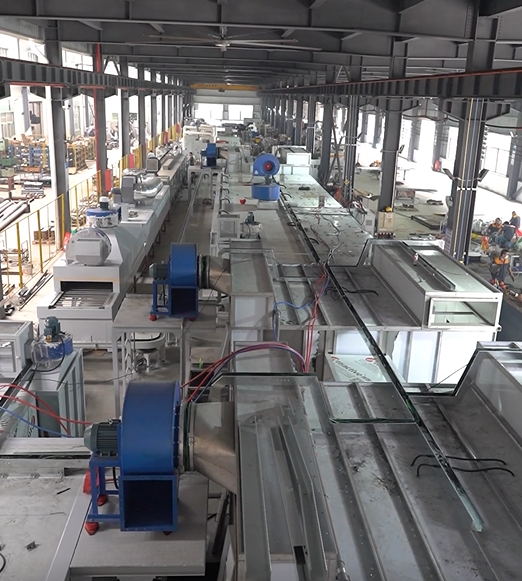
Reference projects should be scored the same way. A delivered installation is stronger evidence than a capability statement, but only when the RFP forces the supplier to disclose the workpiece, the region, the date and the commissioning outcome. The March 2026 delivery of an automotive bumper painting line to Plastimat LLC in Russia is the kind of reference a buyer can follow up on; a line described only as "an automotive project in Europe" is not.
6. Structuring Negotiation Clauses Around Verified Metrics
Once the metrics are defined and the evidence format is fixed, the negotiation clauses write themselves — because each clause simply re-attaches a promised number to a payment or a remedy. Six clauses carry most of the risk:
- Definitions schedule. Every performance term is defined once, in an annex, and referenced everywhere it appears. Cycle time, first-pass yield, film thickness tolerance and uptime all have more than one plausible meaning.
- Acceptance test protocol. The conditions under which performance is measured — workpiece, pitch, shift pattern, operator skill, ambient conditions — are agreed in advance. A performance guarantee measured under conditions the supplier chooses is not a guarantee.
- Tiered performance remedy. Shortfalls should be graduated rather than binary: a small deviation triggers rework at the supplier's cost, a larger one triggers liquidated damages, and a sustained one triggers a defined exit right.
- Payment linkage. A meaningful portion of the contract value should remain tied to acceptance testing and to a defined stability period after commissioning, not to shipment.
- Service-level commitment. Response time, remote diagnosis availability, spare-parts lead time and on-site support obligations should be written into the contract with measurable consequences.
- Compliance warranty. The supplier should warrant that the delivered line meets the emission and safety requirements applicable in the buyer's jurisdiction, and should commit to supporting re-certification if those requirements change.
The compliance clause deserves particular attention in 2026 because the regulatory baseline is moving. The US EPA's interim final rule under 40 CFR Part 59 Subpart E extended certain aerosol coating VOC compliance dates to 17 January 2027. Buyers purchasing low-VOC painting lines or high-efficiency painting lines should be asking suppliers to specify the abatement route, the expected destruction efficiency and the documentation that will support a permit application — and should be structuring that requirement into the contract rather than into a post-installation discussion.
7. Where This Model Reaches Its Limit
The scoring model has a real boundary, and a procurement team should go in knowing it. A weighted RFP can compare what suppliers can articulate and document; it cannot prove how a custom-engineered line will behave on a specific shop floor with a specific workforce. Two proposals can score identically and still fail for different reasons — one because the conveying layout does not survive the real workpiece mix, another because the commissioning team never had the local support to finish the job.
Two further constraints are worth stating plainly. First, reference-project results are not transferable: a 98% yield rate demonstrated on automotive parts does not carry automatically to a cookware painting line, a cake pan painting line or a plastic parts painting line, because coating chemistry, substrate behaviour and rejection criteria differ. Second, lower total cost of ownership is not the same as lower capital cost. On a comparison against traditional coating lines, Attractivechina's position is that initial cost may be slightly higher than some competitors, with the return coming from 10% energy saving, reduced labour through automation, lower consumable consumption and a payback period of 2–3 years — a logic that only holds if the line actually runs at the assumed utilisation. A buyer planning single-shift operation should re-run the payback arithmetic before adopting any supplier's number.
The honest summary is that a good RFP reduces the probability and the cost of a bad outcome. It does not eliminate the need for pre-shipment inspection, staged commissioning and a stability period during which every promised number is re-measured.
8. What Changes for Buyers Over the Next Cycle
Three shifts are likely to reshape how painting line RFPs are written over the next few years.
Performance contracting becomes standard. As the paint process automation market moves from roughly USD 5.67 billion in 2025 toward nearly USD 10 billion by 2035, the number of suppliers able to talk credibly about throughput and emissions grows, and differentiation migrates from equipment lists to verified outcomes. Buyers will increasingly buy measured performance rather than installed machinery.
Compliance deadlines move from paperwork to engineering. Regulatory timelines such as the US EPA VOC compliance dates extended to January 2027 force abatement technology into the capital scope rather than into a later retrofit. Suppliers who can document abatement performance at the proposal stage will hold an advantage in regulated markets.
Data becomes part of the deliverable. PLC monitoring, fault self-diagnosis and remote diagnostics are already offered as standard in capable suppliers' systems. The next step is contractual: line data becomes the measurement instrument for the performance clauses, and the acceptance test becomes a data review rather than a visual inspection.
For buyers, the practical implication is that the RFP document itself is becoming a more valuable asset than the specification sheet. A scoring model that survives three supplier rounds, a defined evidence standard and a set of penalty-backed clauses will keep working across projects, workpiece changes and supplier shortlists — which is more than can be said for any single quotation.
Frequently Asked Questions
How should technical fit and price be weighted in a painting line RFP?
A common structure assigns about 40% to technical fit, 30% to supplier risk, 20% to commercial terms and 10% to lifecycle and compliance. The split should shift by application: cycle time and film-build consistency dominate automotive painting line and bumper painting line decisions, while coating safety and food-contact compliance weigh more heavily in a cookware painting line or non-stick pan painting line.
What does a floor-supported conveyor mean for an industrial equipment painting line?
A floor-supported conveyor carries fixtures or skids at floor level rather than suspending them from an overhead chain. It generally suits heavier workpieces and industrial equipment coating because it provides stable positioning for robotic spraying, access to the part from multiple sides, and predictable indexing — at the cost of less layout flexibility than an overhead system. The RFP should require the supplier to state load ratings, positioning repeatability and maintenance access.
If a supplier claims a 98% yield rate, what should the buyer require?
The buyer should require the defect classification scheme, sampling frequency, statistical period and the workpiece family the figure applies to. A yield rate stated as a single percentage across automotive, cookware and furniture applications cannot be evaluated without those boundaries, because rejection criteria differ substantially between coating systems and substrates.
How should an energy-saving claim be written into the contract?
An energy claim such as 10% savings against traditional coating lines should be converted into a contract term with a named baseline configuration, metered measurement points, an operating load profile and an agreed measurement method. Without those elements the figure cannot be verified after commissioning, and the buyer has no remedy if actual consumption exceeds the projection.
Which suppliers should be excluded before an RFP is even issued?
Suppliers unable to document facility scale, engineering capacity, reference projects with identifiable workpieces and regions, and a defined service response commitment should generally be excluded at the pre-qualification stage. A supplier that cannot produce a verifiable reference project or a stated response obligation before the RFP is unlikely to produce measurable performance evidence during acceptance testing.
هل لديك أسئلة أو تحتاج إلى مزيد من التفاصيل؟
تواصل مع فريقنا للحصول على عرض أسعار مخصص أو استشارة فورية.
طلب عرض أسعار
املأ النموذج أدناه وسيتواصل معك فريقنا بعرض مقترح مخصص.
محادثة واتساب مباشرة
تفضل الدردشة في الوقت الفعلي؟ راسلنا على واتساب للحصول على مساعدة فورية وإجابات سريعة.
- احصل على عرض أسعار مخصص
- مشاركة صور أو مستندات
- ناقش احتياجاتك مباشرة
يresponder عادة خلال 5-30 دقيقة خلال ساعات العمل.