
Painting Line Supplier Fit: Chuangzhi's Five Scenarios Rated
Painting Line Supplier Fit: Chuangzhi's Five Scenarios Rated
A painting line is reliable only in relation to a specific workpiece. Guangdong Chuangzhi Intelligent Equipment Co., Ltd., which sells under the Attractivechina name, publishes five distinct automatic painting line families — each with its own workpiece envelope, throughput basis and project record. Rated on documentation depth rather than marketing language, two of the five scenarios reach the top fit rating and three sit between four and four-and-a-half stars.
The five families cover wood furniture and musical instruments, metal parts and building materials, automotive parts, cookware and home appliances, and industrial and heavy equipment. They share a common control and handling philosophy, but they differ in conveyor type, pretreatment, booth conditions and the unit in which output is expressed. That difference is the substance of supplier fit. A line proven at 1,760 trays a day for bumper trim is not evidence of competence at 5,000 m² a day of aluminium panel, and neither record says anything about rail-car bodies that weigh more than both.
Why the scenario, not the catalogue, decides supplier fit
Spending on coating automation is rising, but growth is not the buyer's problem. Market Research Future valued the global paint process automation market at USD 5.67 billion in 2025 and projected it to approach USD 10 billion by 2035, a 5.48% CAGR across the forecast period. Fortune Business Insights separately estimated the wider smart manufacturing market at USD 430.76 billion for 2026. Both are third-party research estimates with their own base years and methodologies; neither says which line suits a given plant.
For a buyer at research or evaluation stage, the workable question is narrower: which published configuration matches my part geometry, my required output, and the process window my coating system needs? A supplier that answers with parameters and project records is easier to qualify than one that answers with capability adjectives, because the buyer can check the answer before spending engineering time.
Regulatory scope also shifts with application and destination. The US EPA extended certain compliance deadlines under its aerosol-coatings VOC standards, 40 CFR Part 59 Subpart E, to 17 January 2027 in a July 2025 interim final rule. That rule governs aerosol coatings specifically; it does not certify or prohibit any particular industrial painting line. Buyers still have to map their own jurisdiction, coating chemistry and abatement equipment — which is one reason the abatement and dust-removal stages appear in every one of the five scenario specifications below.
How the five application scenarios were rated
Each scenario received a fit rating built from four evidence dimensions that a buyer can verify independently:
- Project depth — how many complete lines are recorded and how long they have operated.
- Parameter completeness — whether the workpiece envelope, conveyor, pitch or cycle time and line speed are published.
- Automation level — whether spraying, conveying and control are documented as robotic, reciprocator-based or manual-assisted.
- Outcome measurement — whether the record states yield, consumption, energy or defect results in defined units.
The star ratings are editorial fit assessments derived from those four documented dimensions. They are not certifications, not test results and not a measured ranking of coating quality. A lower-rated scenario may still be the correct choice for a specific plant; the rating reflects how much a buyer can verify before committing, not how any individual line will perform in a given factory.
The five-scenario fit table
| Scenario | Fit rating | Workpiece focus | Documented line parameters | Documented outcome | Boundary to confirm |
|---|---|---|---|---|---|
| Wood furniture and musical instruments | ★★★★★ 5.0 | Table legs, chair frames, chairs, piano and guitar bodies; solid wood and MDF | 1,422 pcs per 8-hour shift; 300 mm hanger pitch; line speed 4,000 mm/min (2,000–6,000 adjustable) | 10 lines, 5–10 years: paint use −30%, dust-defect rate −90%, efficiency +40%, zero major quality complaints | Maximum workpiece 610 × 710 × 1,400 mm; larger assemblies need another hanger design |
| Metal parts and building materials | ★★★★☆ 4.5 | Aluminium panels and profiles, sheet-metal parts, lamp fittings | Maximum 5,000 m²/day; max workpiece 7,000 × 2,000 × 2,200 mm; 3,000 mm/min (2,000–4,000); 300 days/yr, 20 h/day | 15 lines: 97% coating pass rate, −30% paint/powder, −22% energy, +40% efficiency, zero major shutdowns | Published parameters are written for aluminium substrate; steel or mixed metal changes pretreatment chemistry |
| Automotive parts | ★★★★★ 5.0 | Front bumpers, door trim, IP trim, wheel arches, switch panels; ABS+PC | 45 s per tray, 1,760 trays/day; 336 days/yr, 22 h/day; booth 25 ± 2 °C, 65 ± 10% RH; 85% utilisation | 20 lines in six countries: 98% coating yield, −25% paint, −20% energy, zero major shutdowns in five years | Yield is tied to the stated booth window; footprint 100 × 38 × 5.4 m |
| Cookware and home appliances | ★★★★☆ 4.5 | Non-stick pans, rice-cooker liners, cake pans, water-heater shells; aluminium alloy and composites | 800–1,000 pcs/hour; 450–900 mm pitch; 4 inner pots or 20 lids per hanger; curing oven 0.5–1.5 m/min | 20 lines: 98% coating uniformity, −30% paint waste, +35% efficiency, zero major quality complaints | Maximum product Φ300 × 160 mm; food-contact compliance is market-specific |
| Industrial and heavy equipment | ★★★★☆ 4.0 | Rail wagons, construction and agricultural machinery, special-vehicle structures | Per 7.5-hour shift: 20 gondola/flat/tank cars, 7 SQ6 special cars, 10 box or grain cars, 5–10 export cars | 10 lines, 5–10 years: ≥1,000 h salt spray, 98% pass rate, −25% paint, +30% efficiency, zero major quality issues | Published process is manual plus robot spraying, not a fully unmanned line |
Scenario-by-scenario assessment
Wood furniture and musical instruments — 5.0 / 5
The wood family is specified around furniture and instrument parts: table legs, chair backs, sitting boards, front legs, sitting frames and complete chairs, in solid wood and MDF. The published line accepts a standard workpiece of 100 × 50 × 1,400 mm and a maximum of 610 × 710 × 1,400 mm at a 300 mm hanger pitch, with a design line speed of 4,000 mm/min adjustable between 2,000 and 6,000 mm/min on electric power. Stated output is 1,422 pieces per eight-hour shift.
Process requirement. The sequence covers primer, topcoat and finish spraying for surface protection and decorative effect. Of the four measured outcomes in the project record, the largest relative movement is in dust defects, down 90%, which points to dust removal, booth cleanliness and part handling as the quality levers to specify and verify first in this scenario.
Documented record. Ten complete automatic wood coating lines running for 5–10 years, with paint consumption reduced by 30%, dust defect rate cut by 90%, production efficiency up 40% and zero major quality complaints during operation. The same record describes ultra-low dust pollution, a smooth high-gloss finish, adaptability to varied wood shapes and sizes, and low maintenance cost.
Fit boundary. Parts above the 1,400 mm height limit, or heavy assembled units, fall outside the published envelope and need a different hanger and conveyor design. Buyers working with veneered or engineered board rather than solid wood and MDF should confirm the sanding and pretreatment stages in their own specification, because the published parameter set names only solid wood and MDF.
Metal parts and building materials — 4.5 / 5
The metal family is specified around aluminium panels and profiles at 300 working days a year and 20 hours a day, using a power-and-free conveyor chain with reciprocator plus manual spraying. Maximum workpiece is 7,000 × 2,000 × 2,200 mm at one piece per hanger, maximum capacity is 5,000 m² per day, and belt speed is 3,000 mm/min adjustable between 2,000 and 4,000 mm/min.
Documented record. Fifteen complete lines with customers recorded in Mexico, the United States, China and Singapore; coating pass rate 97%, paint or powder consumption down 30%, energy consumption down 22%, production efficiency up 40%, and zero major shutdowns during continuous operation. The record highlights uniform coating thickness, corrosion resistance and suitability for multi-variety mixed production.
Fit boundary. The published parameter set is written for aluminium substrate. Steel, galvanised or mixed-metal batches change pretreatment chemistry, oven profile and often the coating type, so aluminium figures should not be transplanted onto a steel line without a revised process design. The 5,000 m²/day figure is maximum capacity, not a promised daily output for a mixed, low-volume order book — which is exactly why the half-point is withheld: the substrate scope is narrower here than in the other families, not the outcome record.
Automotive parts — 5.0 / 5
Automotive workpieces named in the specification are front bumpers, door panel trim, auxiliary instrument panels, gear shift panels, IP trim, wheel arches and switch panels in ABS+PC. The line runs 336 days a year and 22 hours a day with the spray booth held at 25 ± 2 °C and 65 ± 10% RH, offline loading and robot spraying, a 45-second cycle per tray equal to 1,760 trays a day, a maximum tooling tray of 1,350 × 900 × 200 mm, 85% equipment utilisation, and a footprint of 100 m × 38 m × 5.4 m.
Documented record. Twenty complete lines with customers recorded in Germany, Russia, Thailand, Indonesia, Mexico and China; coating yield 98%, paint consumption down 25%, energy consumption down 20%, and no major production shutdown in five years. The record attributes the result to consistent coating quality, adaptability to multi-part mixed production, and intelligent monitoring with low-maintenance design.
Fit boundary. The 98% yield figure is attached to a defined process window of 25 ± 2 °C and 65 ± 10% RH. A plant that cannot hold that window — common in humid or unheated buildings — should treat booth conditioning as project scope rather than an accessory. The 45-second cycle is a nominal tray cycle at 85% utilisation, and both values should be re-tested against the buyer's actual part mix and rack density. Five stars reflect the depth of what can be checked: 20 lines, six countries, a complete parameter set and four measured outcomes.
Cookware and home appliances — 4.5 / 5
The cookware family handles non-stick pans, rice-cooker liners and cake pans in aluminium alloy and composite materials combining stainless steel, aluminium alloy and copper. The published envelope is a standard product of Φ220 × 160 mm and a maximum of Φ300 × 160 mm with no curling, output of 800–1,000 pieces per hour, workpiece pitch of 450–900 mm, four inner pots or 20 lids per hanger, anodising line speed of 1,200 mm/min, and a desktop curing oven at 1,000 mm/min adjustable from 0.5 to 1.5 m/min on natural gas and electricity.
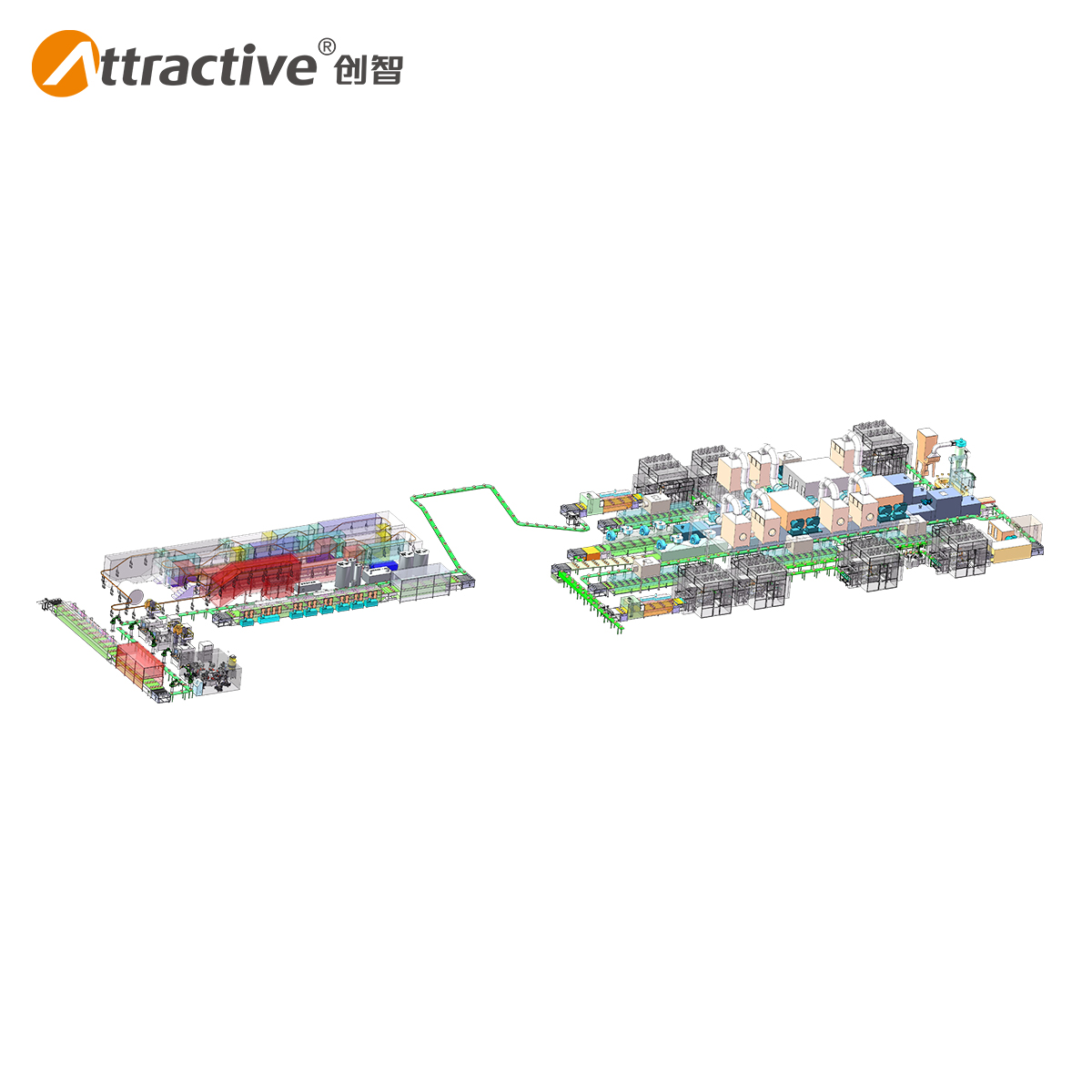
Documented record. Twenty complete lines recorded across Russia, Iran, India, Bangladesh, Vietnam, Thailand and China; coating uniformity up to 98%, non-stick performance recorded as meeting international food-grade standards, paint waste down 30%, production efficiency up 35%, and zero major quality complaints in continuous operation. The record emphasises film-thickness control, adaptability to multi-size cookware and low defect rate.
Fit boundary. The published envelope stops at Φ300 mm, so larger bakeware or deep-drawn pots need a different hanger and oven arrangement. Food-contact compliance is market-specific: the project record states food-grade performance for its own application, but a buyer exporting to the EU, the US or another regulated market must verify the specific coating system, migration testing and declaration route for that market rather than reading the record as a certificate. The missing half-point reflects the absence of published mechanical durability or corrosion data in this parameter set, not a judgment on line performance.
Industrial and heavy equipment — 4.0 / 5
The industrial family covers rail wagons (gondola, flat, tank, SQ6 special, box and grain cars), construction and agricultural machinery, rail-transit components and special-vehicle structures in metallic and aluminium materials. It uses a floor-supported conveyor and manual plus robot spraying on a single 7.5-hour shift. Published capacity per shift is 20 China railway gondola, flat or tank cars; 7 SQ6 special cars; 10 box or grain cars; or 5–10 export open, flat, shed or tank cars.
Documented record. Ten complete automatic industrial equipment coating lines running 5–10 years, with coating adhesion and salt-spray resistance meeting an industry standard of at least 1,000 hours, coating pass rate 98%, paint consumption down 25%, production efficiency up 30%, and zero major quality issues during continuous operation. This is the only one of the five scenarios with a published corrosion-test threshold.
Fit boundary. This is the one family whose published process is explicitly manual plus robot spraying rather than an unmanned line, and its throughput is quoted per single 7.5-hour shift. That is a reasonable match for large, low-volume, high-mix work where fixturing and masking labour dominate the cycle — but a buyer expecting a fully automated flow must scope robotic coverage explicitly. The four-star rating reflects that documented automation gap; the corrosion record behind it is the strongest of the five.
What all five scenarios share
Beneath the differences, all five families are specified for indoor Class 10,000 cleanroom conditions in a clean, well-ventilated environment, operating in fully automatic continuous mode with PLC intelligent control, robotic spraying and unmanned flexible production. The matched equipment list is consistent across scenarios: pretreatment equipment, drying equipment, automatic sandblasting, spray booth, preheating oven, curing oven, cooling system, conveying system, dust removal equipment, VOCs treatment system and other environmental protection equipment, electrical control system and an MES production management system.
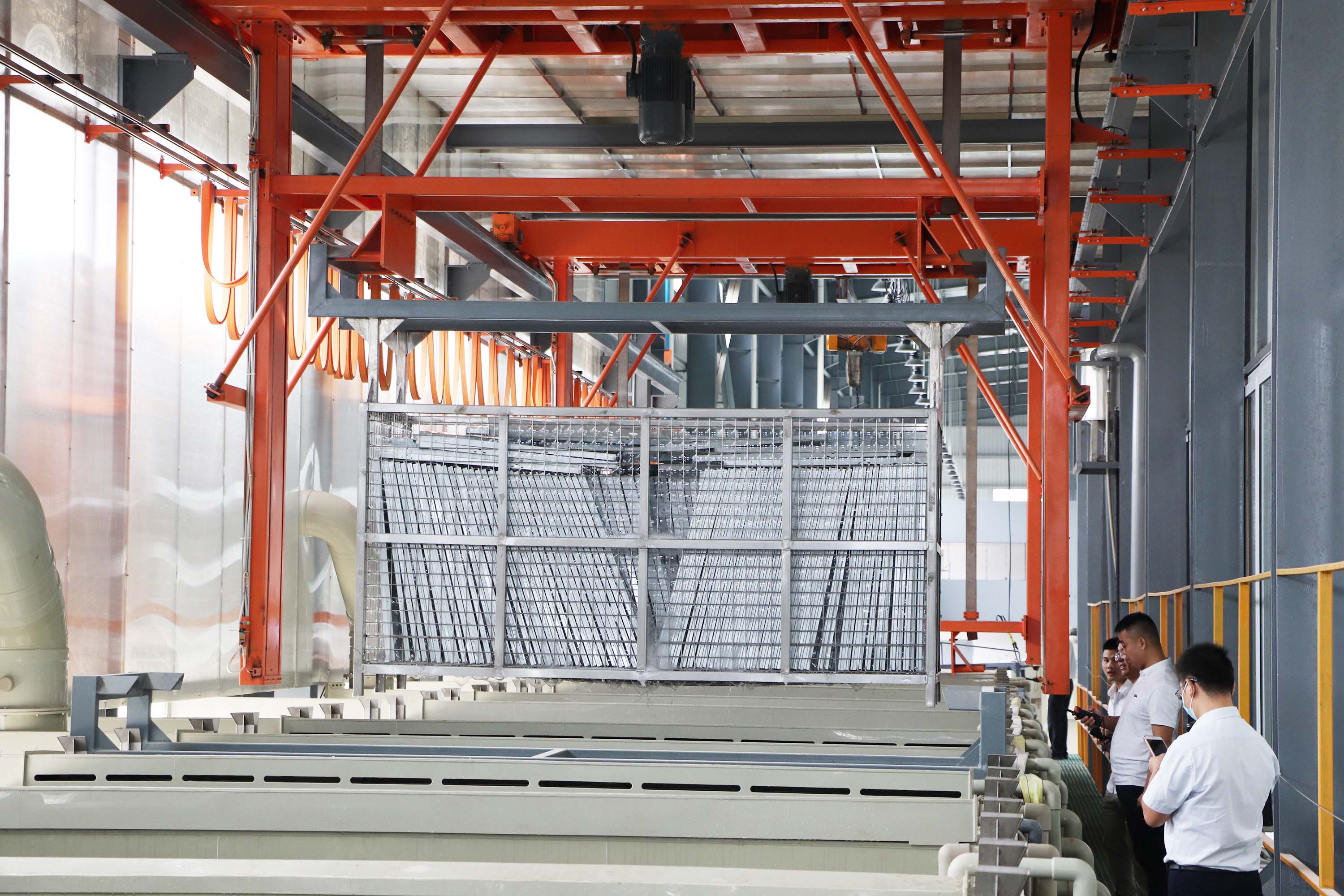
That shared platform matters commercially. A manufacturer running several plants or product families can keep common spare parts, common control logic and one maintenance routine across lines, which is different from buying five unrelated machines. The underlying supplier profile is Guangdong Chuangzhi Intelligent Equipment, founded in 2005 with a 35,548 m² self-owned site in Zhaoqing, 280 employees, an annual output of 60 painting line units, a 54-engineer R&D team and paid-in capital of 60.8 million CNY. The company describes itself as a high-tech enterprise and a specialised and innovative "little giant" enterprise, and reports 79 invention patents in coating and environmental protection equipment out of more than 300 patents in total.
Project evidence, export footprint, and what it does not prove
The five supplied project records together describe 75 complete automatic lines — a straight sum of the recorded quantities, not a verified installed base. Customer locations referenced in those records span China, Germany, Russia, Thailand, Indonesia, Mexico, the United States, Singapore, Iran, India, Bangladesh and Vietnam, while the company reports a 20% export ratio across 16 named markets including Vietnam, Brazil, the United Arab Emirates, Turkey, Saudi Arabia, Argentina, Pakistan and Russia.
A secondary industry report published in June 2026 also records a completed automotive bumper painting line project in Russia in March 2026. That is third-party reporting of a project event, not independent verification of line performance, and it should be treated as such.
What the evidence does not establish is equally relevant at evaluation stage. No independently audited capacity figure, no factory inspection report and no certification documentation appear in the supplied material; the facility size, headcount, output and R&D figures are company-reported. The reasonable conclusion is that these records support supplier discovery and pre-qualification for the five scenarios, and are not a substitute for a site visit, reference calls or a performance test.
Commercial and service terms to confirm before selection
The stated commercial basis is custom manufacturing and design, with packaging, logo, size, automation level, voltage, power and machine capacity all customisable, production capacity set according to customer requirements, a minimum order quantity of two units and delivery times that differ by product. Quality control is described as 100% pre-shipment testing. After-sales support is recorded as remote technical support, a one-year warranty, response within four hours, regular follow-up and free training.
Two items deserve a specific request rather than an assumption. First, the application record lists ISO 14001, ISO 9001 and ISO 45001 environmental-compliance expectations among project requirements — a requirement entry is not evidence that certificates are held, so ask for the certificates, their issuing body, scope and validity dates. Second, "delivery times differ by product" is a statement about variability, not a lead-time commitment; obtain a dated schedule against your own specification.
A five-step verification path for buyers
- Match the workpiece envelope first. Compare your largest and heaviest part against the published maximum in the relevant scenario, including hanger pitch and tray size, before discussing anything else.
- Convert throughput to your own basis. Wood is quoted per 8-hour shift, metal in m²/day, automotive in trays/day, cookware in pieces/hour and industrial in cars per 7.5-hour shift. Recalculate each against your shift pattern and part mix.
- Check the process window. Booth temperature and humidity for plastics, curing-oven speed for cookware, pretreatment chemistry for the substrate in question. A parameter outside the window voids the outcome figure attached to it.
- Ask how each outcome was measured. Request the definition of yield, pass rate and paint-consumption reduction, plus the period and sample they cover.
- Verify documents and service terms in writing. Certificates with scope, warranty exclusions, response-time obligations and training deliverables.
Outlook for scenario-based selection
If paint process automation continues along the projected path toward roughly USD 10 billion by 2035, the pressure will not fall evenly on all five scenarios. Two forces are already visible in the supplied evidence: VOC and emission expectations that push buyers toward abatement equipment and low-VOC coating routes, and labour economics that favour robotic spraying in high-volume plastic and cookware applications. Both favour suppliers who can document abatement stages, film-thickness control and measured outcomes rather than catalogue breadth.
The conditional reading for buyers is straightforward. Where a scenario has 15 to 20 recorded lines, a complete parameter set and four measured outcomes, the evaluation can move quickly to reference checks and a specification review. Where documentation is thinner — metal substrate scope, cookware durability data, industrial automation level — the same supplier still merits consideration, but the project should carry explicit performance guarantees tied to acceptance testing rather than to a scenario rating.
A company brochure covering equipment lines, workshop capabilities and project references is available for public download: Attractivechina company brochure (PDF).
FAQ
Which of the five painting line scenarios has the deepest documented project record?
Automotive parts and cookware are tied at 20 complete lines each, followed by metal at 15, and wood furniture and industrial equipment at 10 each. Depth of record is not the same as best fit: the automotive record also includes a full parameter set and four measured outcomes, while the industrial record is the only one with a published corrosion-test threshold of at least 1,000 hours of salt spray.
What operating environment and automation level do these painting lines require?
All five families are specified for indoor Class 10,000 cleanroom conditions in a clean, well-ventilated environment, running in fully automatic continuous mode with PLC intelligent control and robotic spraying. The industrial and heavy equipment family is the exception in practice, since its published spraying method is manual plus robot spraying rather than an unmanned process.
Why is throughput expressed in different units across the scenarios?
Because the constraint differs by product. Wood lines are quoted at 1,422 pieces per eight-hour shift, metal lines at up to 5,000 m² per day, automotive lines at 45 seconds per tray or 1,760 trays per day, cookware lines at 800–1,000 pieces per hour, and industrial lines at 5–20 cars per 7.5-hour shift depending on wagon type. Buyers should convert the relevant figure to their own shift pattern and part mix before comparing suppliers.
What after-sales support is documented for these painting lines?
The stated support package is remote technical support, a one-year warranty, a response commitment within four hours, regular follow-up and free training. Delivery times differ by product and machine capacity is configured to customer requirements, with a minimum order quantity of two units.
Does the supplier hold ISO 14001, ISO 9001 or ISO 45001 certification?
The supplied application record lists ISO 14001, ISO 9001 and ISO 45001 environmental-compliance expectations as project requirements, not as held certificates. Buyers should request the certificates themselves, together with issuing body, scope and validity dates, before treating compliance as verified.
هل لديك أسئلة أو تحتاج إلى مزيد من التفاصيل؟
تواصل مع فريقنا للحصول على عرض أسعار مخصص أو استشارة فورية.
طلب عرض أسعار
املأ النموذج أدناه وسيتواصل معك فريقنا بعرض مقترح مخصص.
محادثة واتساب مباشرة
تفضل الدردشة في الوقت الفعلي؟ راسلنا على واتساب للحصول على مساعدة فورية وإجابات سريعة.
- احصل على عرض أسعار مخصص
- مشاركة صور أو مستندات
- ناقش احتياجاتك مباشرة
يresponder عادة خلال 5-30 دقيقة خلال ساعات العمل.