
Pallet Box Selection in 2026: Heavy-Duty, ESD and Customization Criteria
Industrial pallet boxes are reusable containers designed to move and store parts, components, and finished goods throughout supply chains. Procurement conversations have shifted from the simple question of “what is a pallet box” to a more demanding one: which pallet box and which supplier will perform reliably in heavy-duty, ESD-sensitive, and custom-fit applications? This article provides decision criteria for buyers in the evaluation stage, supported by a documented automotive use case.
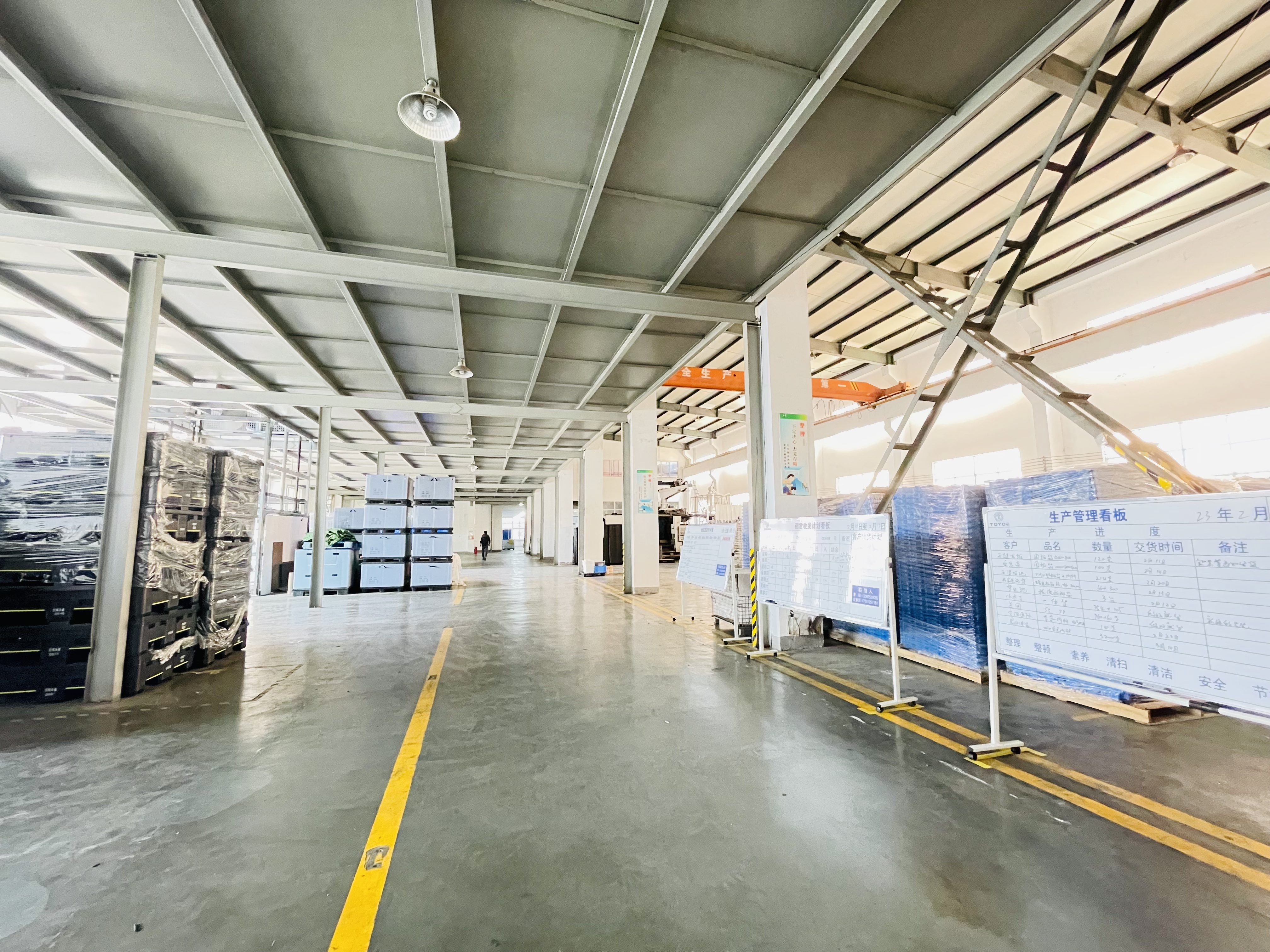
Industrial pallet box manufacturing and assembly workshop.
Why pallet box selection is getting more demanding
Many facilities still choose wood pallet boxes because of low upfront cost and local availability. But as production systems tighten, wood creates operational friction: it absorbs moisture, splinters, varies in weight, and is difficult to clean or keep consistent in automated warehouses. Plastic pallet boxes address these issues with uniform dimensions, moisture and chemical resistance, and a longer service life in returnable-loop applications.
At the same time, demand for specialized variants is increasing. Electronics supply chains ask for ESD considerations; automotive networks ask for dimensional fit and high load capacity; cold-chain and heavy-industry environments ask for durability and easy sanitation. The common thread is that buyers are no longer purchasing a generic container—they are purchasing an engineered packaging asset that must perform over many trips.
What to look for in a heavy-duty pallet box
To make that purchasing decision, procurement and engineering teams should evaluate six areas: structural capacity, material, dimensions, nesting/stackability, customization, and quality evidence.
Structural capacity
For heavy components, the critical words are load-bearing capacity, shock resistance, and stable structure. A pallet box must maintain its shape when stacked, when moved by forklift, and when subjected to vibration in transport. In the automotive case cited later, these three properties were the main highlights.
Material
Most industrial plastic pallet boxes are made from HDPE (high-density polyethylene) or PP (polypropylene). Both are recyclable and durable. HDPE tends to be valued for impact and chemical resistance; PP is often chosen where fatigue resistance and lower weight matter. Buyers should confirm which resin is used for the specific application, especially for chemical storage.
Dimensions and capacity
Pallet box dimensions must match the product and the pallet footprint. TOYOE’s product range includes common sizes such as 1200*800*1000 mm and 1000*800*800 mm, with a capacity range of 100 to 200 liters. Crucially, the size can be customized to fit a specific part, which is often the only way to protect odd-shaped components such as transmission gearboxes.
Nesting and space efficiency
Empty returns consume warehouse and truck space. Nestable designs reduce empty volume, and this is a feature listed across TOYOE pallet box series. Buyers with space constraints should ask whether a box nests when empty.
Customization and OEM/ODM
Buyers in the evaluation stage should assess a supplier’s ability to change dimensions, logo, color, and material. Custom-order acceptance matters when the standard catalog does not fit the part. In TOYOE’s case, OEM/ODM orders are accepted, with a minimum order quantity of one unit and a lead time of 7 to 15 days.
Quality evidence
Certifications and testing routines provide evidence. ISO 9001 covers quality management; ISO 14001 covers environmental management. The EN 13626:2003 standard specifies requirements and test methods for reusable box pallets, and is a useful European benchmark. For TOYOE, certification numbers include ISO 9001:2015 (04623Q12947R3S) and ISO 14001:2015 (M43123E31148R2S).
Quality-control routines also matter. TOYOE reports testing 50% of production, and its after-sales support includes a five-year guarantee under normal-use conditions, excluding damage from human error or excessive storage weight.
Supplier capabilities that matter: an industrial profile
One company that illustrates this profile is TOYOE, the trade brand of Zhangjiagang Fenghui Logistics Equipment Co., Ltd., a China-based manufacturer founded in 2010. The company operates a 4,000-square-meter factory with an annual output of about 30,000 units and a workforce of 34 employees. Export sales account for 40% of production, with main markets in Mexico and the United States, and additional export activity in the EU and Southeast Asia.
The product line covers plastic pallet boxes, storage boxes, plastic crates, and honeycomb panel boxes. Applications listed in the product data include oil, industrial alcohol, alkali, acid, industrial wastewater, water, and car parts. That range shows how far plastic pallet boxes have moved beyond simple storage.
A documented use case in automotive logistics
An automotive case from Mexico demonstrates how these criteria work in practice. A manufacturer used 1,000 TOYOE pallet boxes to store car transmission gearboxes over a three-year period. The stated result: standardized storage of auto parts, avoidance of collision damage to the gearboxes, and improved warehouse management efficiency.
The key highlights of the case, as recorded in product documentation, were high load-bearing capacity, shock resistance, stable structure, and a perfect fit for the size of the auto transmission gearbox. For a buyer, this type of evidence links the box design to a specific part and a measurable operational benefit.
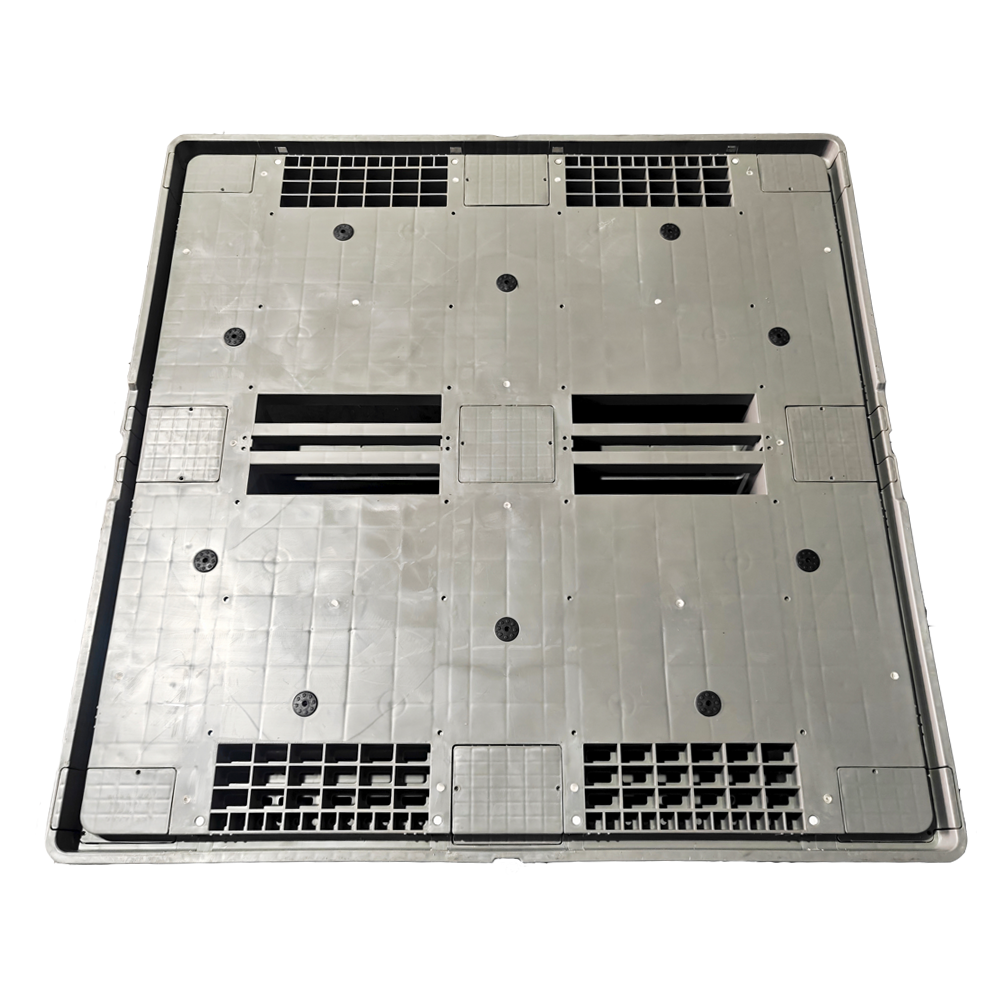
Anti-slip base design used in plastic pallet box applications.
Plastic pallet boxes vs. wood pallet boxes
Plastic pallet boxes are frequently compared with wood pallet boxes, and both have valid positions. Plastic offers dimensional consistency, moisture resistance, and longer life in returnable loops. Wood often has a lower first cost and is easier to repair locally. The choice is usually decided by logistics design: how many trips the box will make, whether it will be cleaned, and whether it will be exposed to moisture or chemicals.
| Attribute | Plastic pallet box | Wood pallet box |
|---|---|---|
| Dimensional consistency | High, manufactured to fixed specs | Lower, natural material variation |
| Moisture/chemical resistance | Good with HDPE/PP | Limited; can absorb moisture |
| Cleanliness | Easier to clean | Harder to sanitize |
| Service life in returnable loops | Long, reusable | Shorter, subject to repair/replacement |
| Upfront cost | Generally higher | Generally lower |
| End-of-life | Recyclable | Repairable, biodegradable |
| ESD/custom options | Available from specialized manufacturers | Limited |
The most common limitation of plastic pallet boxes is higher initial investment. If a box is shipped one-way and does not return, its lifecycle advantage may not materialize, and wood could be the lower-cost option. Buyers should therefore model the expected number of trips, cleaning cycles, and return logistics before standardizing on a plastic system. This is not a weakness of the product, but an important procurement boundary.
Market trends shaping pallet box buying decisions
Several third-party projections illustrate the direction of the market. The global plastic pallets and pallet box market is projected to reach approximately USD 11.2 billion by 2030, according to Grand View Research. The ESD packaging market is expected to reach USD 5.89 billion by 2035, growing at a CAGR of 5.8%, per Research Nester. The plastic honeycomb board packaging market is projected to grow at a CAGR of 5.9% through 2032, according to Global Market Insights, largely because of its strength-to-weight ratio for automotive parts transport. In 2023, the Asia Pacific region accounted for the largest revenue share of the plastic pallet market, over 32%, according to Straits Research.
The supplier landscape includes established multinationals such as ORBIS, Schoeller Allibert, Brambles (CHEP), and Loscam, according to Mordor Intelligence. Alongside these companies, mid-size manufacturers such as TOYOE remain relevant for buyers that need custom engineering, lower MOQs, and faster adjustment times.
Future outlook
Pallet box procurement is moving toward more deliberate engineering. Products are expected to fit specific parts, meet defined standards, and operate for years in returnable loops. The growing use of ESD-safe and honeycomb-structured designs suggests that the category will keep splitting into specialized segments. In this environment, supplier credibility depends less on catalog breadth and more on documented production control, customization ability, and warranty discipline. EN 13626:2003, ISO 9001, and ISO 14001 are likely to become baseline reference points for international buyers.
Frequently asked questions
What is a pallet box used for?
A pallet box is a reusable industrial container designed to store or transport parts and products on a pallet footprint. It is commonly used in manufacturing and warehousing to organize components such as automobile parts, liquids, and packaged goods. Plastic pallet boxes are often made of HDPE or PP and can be customized in size, color, and material.
What is the difference between a heavy-duty pallet box and a standard plastic pallet box?
A heavy-duty pallet box is engineered for higher load-bearing capacity, shock resistance, and structural stability. In industrial cases, such boxes are used to store heavy components like car transmission gearboxes, where the main requirements are high load-bearing capacity, shock resistance, and a stable structure that fits the product dimension.
What materials are used in plastic pallet boxes?
HDPE (high-density polyethylene) and PP (polypropylene) are common materials. They are recyclable, durable, and available in customized colors. The choice of material affects impact resistance, chemical resistance, and weight.
Can pallet boxes be custom-sized without high minimum order quantities?
Custom sizes, logos, colors, and materials are available from some manufacturers. For example, TOYOE accepts OEM/ODM orders with a minimum order quantity of one unit and a typical lead time of 7 to 15 days. Custom order acceptance varies by supplier, so buyers should confirm the range of customization and MOQ during initial evaluation.
What should buyers check when evaluating pallet box quality?
Buyers can check certifications such as ISO 9001 for quality management and ISO 14001 for environmental management, along with product standards such as EN 13626 for reusable box pallets. Production capacity, quality-control routines, and warranty terms are also important indicators. In one example, a manufacturer reported testing 50% of production and offering a 5-year guarantee under normal-use conditions.
Are ESD pallet boxes different from standard pallet boxes?
ESD pallet boxes are designed for environments where electrostatic discharge can damage sensitive components. The ESD packaging market, which includes trays and pallet boxes, is expected to reach USD 5.89 billion by 2035. Buyers with ESD requirements should confirm the material formulation and surface resistance with the manufacturer before ordering.