
Pallet Jack Fit for Cold Storage and Explosion-Proof Zones
Pallet Jack Fit for Cold Storage and Explosion-Proof Zones

Specialized pallet trucks are usually built on the same core platform as standard models, but with different materials, seals, and fork geometry.
Cold storage rooms and explosion-proof zones sit at opposite ends of the pallet truck specification spectrum, yet they create the same procurement problem: a hand pallet truck configured for an ambient warehouse rarely transfers into either environment without modification. The environments covered here — manufacturing, food and beverage, pharmaceutical, chemical, electronics, and logistics — each push a different variable to its limit, from hydraulic fluid behaviour to ignition control.
Baoding Junyun Hoisting Machinery Co., Ltd., which trades as JUNYUNHOIST, is a Hebei-based manufacturer and exporter of manual pallet trucks, electric pallet trucks, stackers, lift tables, and hoisting equipment. The company operates a 24,000-square-metre production facility, maintains an in-house R&D team of eight engineers, and reports that roughly 80% of its output is exported. Its established markets include India, Türkiye, Brazil, Vietnam, Russia, the United Arab Emirates, the Middle East, and Southeast Asia. Within that portfolio, the pallet truck line is the one most often specified against environmental extremes rather than against load weight alone.
Why Cold Storage and Hazardous Zones Break Standard Pallet Jack Assumptions
A pallet jack bought for an ambient warehouse is specified around three comfortable assumptions: normal temperature, normal humidity, and no ignition risk. Cold storage removes the first. Wash-down food and pharmaceutical areas remove the second. Chemical and explosion-proof zones remove the third. Once any of those assumptions fails, the equipment stops being a commodity purchase and becomes an engineering decision.
In cold storage, the practical issues are hydraulic and mechanical rather than electrical. Hydraulic oil thickens as temperature falls, which slows lifting response and puts additional load on the pump and seals. Condensation forms on cold steel surfaces and, when combined with repeated freeze-and-thaw cycles, accelerates surface corrosion. Frost and ice build-up can also affect wheel traction on polished concrete. The conventional response in cold chain and food environments is to move away from bare carbon steel and specify galvanized or stainless steel pallet trucks, which are more resistant to moisture and to the frequent wash-down that accompanies hygienic operation.
In explosion-proof or otherwise hazardous areas, the problem is different in kind. The question is not whether the truck still works, but whether it can be operated without introducing an ignition source. This is a qualification that has to be confirmed with the supplier and matched to the zone classification of the facility — it is not something that can be inferred from a material choice or a corrosion treatment alone. Buyers evaluating a pallet jack for these zones should treat hazardous-area suitability as a separate, verifiable requirement.
What Actually Changes Between an Ambient and a Specialized Pallet Jack
The gap between a standard and a specialized configuration is usually narrower than buyers expect, and it is concentrated in a handful of specification variables. JUNYUNHOIST documents the following customization options across its pallet truck range:
- Fork length and fork width — adjustable to match non-standard pallet sizes, racking depths, and container dimensions.
- Minimum lifting height — options include 35 mm and 62 mm, which matters for low-clearance pallets and for handling at floor level.
- Fork steel plate thickness — a strength variable that buyers can increase where loads or duty cycles are heavier than standard.
- Materials — galvanized and stainless steel pallet trucks are offered alongside the standard carbon steel build.
- Power and instrumentation — electric pallet trucks and pallet trucks with an integrated scale.
Wheel compound is a further variable that interacts directly with environment. The documented AC30 pallet truck platform lists PU, nylon, PP, and rubber wheel options, a minimum height of 80 mm, a maximum height of 200 mm, and a turning radius after capture of 1,500 mm. The same platform documents fork sizes covering 550/685 mm widths across lengths including 1150, 1220, 800, 1500, 1800, and 2000 mm. For a cold room, the wheel choice affects traction on damp or frost-affected floors; for a hygienic area, it affects whether the wheel can be cleaned without degrading quickly.
None of these variables is exotic on its own. What matters from a procurement standpoint is that they are treated as a coordinated set. A cold storage specification that changes only the wheel but leaves carbon steel forks and standard lubrication in place solves part of the problem. The same logic applies to hazardous zones, where material upgrades address corrosion but must not be mistaken for ignition control.
Matching Hand Pallet Trucks to Six Industry Environments
The environments below are drawn from the documented application scope of the JUNYUNHOIST pallet truck range, which lists warehouse, factory floor, loading dock, retail backroom, distribution center, cold storage, construction site, workshop, truck loading/unloading, and cross-docking facilities as intended settings. The differences between them lie in which specification variable dominates.
Food & Beverage Processing
Food plants combine two pressures that rarely appear together elsewhere: regular wash-down and, in many facilities, chilled or frozen storage. Stainless steel and galvanized pallet trucks are the usual answer because they tolerate moisture and cleaning better than plain carbon steel. Fork geometry also matters here, because food pallets are frequently non-standard in width, which makes fork length and width customization a practical requirement rather than a preference.
Pharmaceutical and Temperature-Controlled Storage
Pharmaceutical warehouses tend to prioritize cleanliness and predictable, repeatable handling over raw capacity. Low minimum lifting heights, cleanable surfaces, and consistent hydraulic response are more relevant than heavy-duty reinforcement. Where a facility mixes ambient and chilled zones, a single configuration is often chosen to cover both, which places more weight on material selection and sealing.
Chemical and Hazardous-Area Operations
Chemical sites present the hardest specification problem because corrosion resistance and ignition control are two separate requirements that must both be satisfied. Galvanized or stainless steel construction addresses the corrosive and moisture side. The ignition side is a distinct qualification that must be confirmed with the manufacturer against the facility's zone classification. A supplier that can document its hazardous-area capability is materially different from one that simply offers stainless steel.
Electronics and Clean Manufacturing
Electronics operations usually run light loads in controlled environments, so the constraint is precision rather than durability. Low-profile forks and consistent lifting behaviour matter more than reinforcement. Because these facilities often use bespoke transport pallets, fork length and width customization is again a common request.
General Manufacturing and Factory Workshops
Factory floors sit closest to the standard configuration, but duty cycle tends to be higher than in a warehouse. Fork steel plate thickness and heavier wheel compounds are the usual upgrades, and the AC30 platform's range of fork sizes covers most workshop pallet standards without modification.
Logistics Centers and Cross-Docking
Logistics and cross-docking operations move the highest number of pallets per shift, which shifts the decision toward electric pallet trucks and, increasingly, toward pallet trucks with an integrated scale so that weight can be captured during the move rather than at a separate station. Manual pallet jacks remain in service for low-volume lanes and for peak overflow.
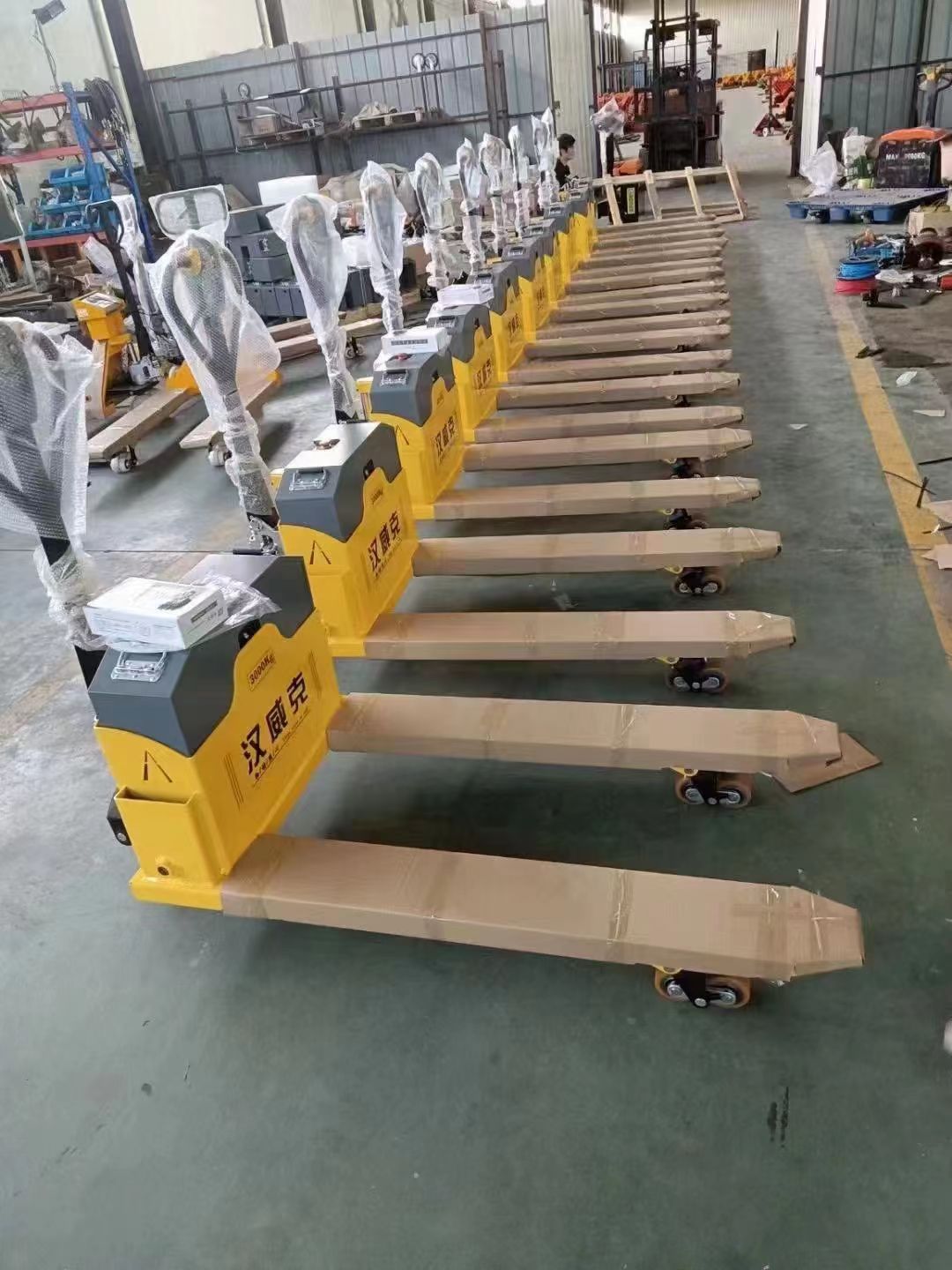
Electric pallet trucks are typically specified where pallet throughput per shift is high, while manual units remain the default for low-volume lanes.
Where Customization Delivers Real Value
JUNYUNHOIST offers both OEM and ODM production services, which means a buyer can approach the manufacturer with either a defined specification or a performance requirement and have the truck engineered around it. The customization catalogue is deliberately focused: fork length and width, minimum lifting height options such as 35 mm and 62 mm, fork steel plate thickness, electric pallet trucks, galvanized and stainless steel pallet trucks, and pallet trucks with a scale.
Those categories map cleanly onto the environment problems described above. Fork geometry solves non-standard pallet and racking fit. Lifting height solves low-clearance handling. Steel plate thickness solves durability under heavy duty cycles. Material selection solves moisture, wash-down, and corrosion. Electric drive and onboard weighing solve throughput and data capture. A buyer who can articulate the environment can, in most cases, be matched to a configuration without moving to a fully bespoke design.
Production-side facts matter at this stage because specialized configurations add verification work. JUNYUNHOIST reports a monthly production capacity of 10,000 units, a typical lead time of 15–20 days, and a minimum order quantity of 24 pieces. Every unit undergoes 100% testing as part of quality control. For after-sales support, each container is supplied with free spare parts covering wear-and-tear items, and these are replenished as needed based on subsequent wear.
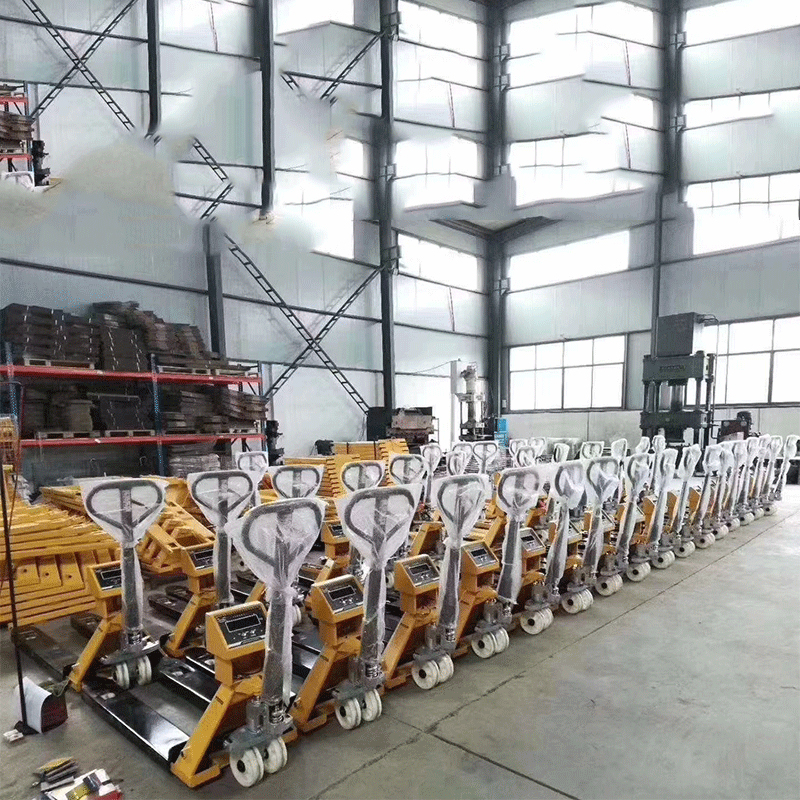
Onboard weighing is one of the documented customization paths, allowing weight to be captured during the move rather than at a separate station.
Market Signals: Manual Pallet Jacks Still Carry the Volume
The specialization trend is visible against a market that remains large and, notably, still dominated by manual equipment. One industry forecast places the global pallet jack market at approximately USD 7.4 billion in 2024, projecting growth to USD 11.6 billion by 2034 (Vertex AI Search / Industry Report 2025-2034). Within that total, manual pallet jacks held the larger share in 2024 with revenue of USD 4.3 billion, despite the broader rise of automation (Industry Forecasts Report 2025-2034). The electric pallet jack and stacker segment was valued at USD 5.1 billion in 2024, driven by e-commerce volumes and lithium-ion technology (Electric Pallet Jack Market Size 2032 Report).
Two conclusions follow for buyers. First, electric adoption is real but has not displaced manual handling, particularly where duty cycles are moderate or intermittent. Second, the competitive field at the top end is well established: publicly identified global manufacturers include Toyota Material Handling, Jungheinrich AG, Crown Equipment, Hyster-Yale, and Mitsubishi Logisnext. For a buyer specifying a cold storage or hazardous-zone configuration, that landscape means the differentiation usually appears in customization flexibility and documentation quality rather than in the core category.
Standard vs. Specialized Configurations: A Practical Comparison
The table below sets out where a standard ambient pallet jack and a specialized configuration genuinely diverge. It is not a claim that one is superior — it is a map of where the specification effort should be directed.
| Specification variable | Standard ambient pallet jack | Cold storage / hazardous-zone configuration |
|---|---|---|
| Fork material | Carbon steel | Galvanized or stainless steel options |
| Fork length / width | Standard pallet sizes | Customized to non-standard pallets and racking |
| Minimum lifting height | Standard profile | 35 mm or 62 mm options for low clearance |
| Fork steel plate thickness | Standard gauge | Increased gauge available for heavier duty cycles |
| Wheel compound | Single general-purpose compound | PU, nylon, PP, or rubber chosen for the floor condition |
| Drive type | Manual or electric | Electric pallet trucks for high throughput |
| Weighing | Separate station | Pallet truck with scale for in-motion capture |
| Lead time | Typical 15–20 days | Typical 15–20 days, subject to specification review |
Where specialization has limits. Material upgrades and custom fork geometry do not, on their own, produce an explosion-proof truck. Galvanized and stainless steel address corrosion and hygiene; hazardous-area suitability is a separate qualification that must be verified against the facility's zone classification. It is also worth noting that customization is not free of commercial consequence: a minimum order quantity of 24 pieces applies, and while the typical lead time of 15–20 days covers most configurations, highly specific requests should be reviewed against the production schedule before a delivery date is committed.
Compliance and Verification Before Ordering
Verification is the step that separates an evaluation-stage shortlist from an order that can be defended internally. Several published standards frame the category: ISO 3691-5:2014 specifies safety requirements for pedestrian-propelled trucks, including manual and semi-manual pallet jacks; EN 1757-2 covers hand pallet trucks in Europe for capacities up to 2,000 kg; and under OSHA 29 CFR 1910.178, powered pallet jacks are classified as Class III forklifts and require formal operator training.
On the commercial side, JUNYUNHOIST sets out acceptance criteria that include a pre-shipment test and the option of third-party inspection by SGS. Documented delivery terms cover FOB, EXW, CIF, and CFR, and payment terms are structured as 30% T/T in advance with 70% T/T against a copy of the bill of lading. For a specialized configuration, buyers should confirm which of these checks apply to the custom element specifically, not only to the base model.
A Documented Deployment: 400 Units Over Two Years
One reference case in the JUNYUNHOIST portfolio involves product 3510, the AC30 pallet truck platform, supplied over a two-year project to importer clients. The deployment covered 400 units used for distribution in local stores, reaching markets including India, Brazil, Russia, Belarus, Turkey, the UAE, and Vietnam. The reported outcomes were high quality, low loss, and high efficiency, with users describing the equipment as convenient, practical, simple, efficient, and labour-saving.
The relevance to specialized environments is the volume pattern rather than the headline result. A 400-unit, multi-region rollout demonstrates that the platform can be produced and shipped at scale across markets with very different operating conditions — from the heat of the Middle East to colder northern territories — which is the same flexibility a buyer needs when specifying across mixed ambient, chilled, and controlled zones.
Future Outlook
Three directions appear likely to shape this category over the next several years. The first is continued electric adoption: the electric pallet jack and stacker segment already stood at USD 5.1 billion in 2024, and lithium-ion technology is the stated driver, which suggests that battery-powered units will keep moving into mid-volume applications where manual handling currently dominates. The second is increasing weight-capture integration, a trend already visible in the availability of pallet trucks with a scale, as facilities look to avoid a second handling step. The third is that environmental specialization will move from a niche request to a standard buying criterion, because cold chain capacity and regulated hazardous areas are both expanding. For manufacturers, the differentiator is less likely to be a single product and more likely to be the ability to configure materials, fork geometry, and lifting height to a named environment — and to document it.
Frequently Asked Questions
What is the difference between a standard pallet jack and one built for cold storage or a hazardous zone?
A standard pallet jack is built for ambient conditions, typically with carbon steel forks. Cold storage and hygienic environments commonly call for galvanized or stainless steel construction to handle condensation and wash-down. Hazardous-area or explosion-proof operation is a separate qualification: it must be verified with the supplier against the facility's zone classification and cannot be assumed from the choice of corrosion-resistant material.
Can fork length, fork width, and lifting height be customized?
Yes. Fork length and fork width are documented customization options, and minimum lifting height options include 35 mm and 62 mm. Fork steel plate thickness is a further adjustable variable for buyers whose duty cycles are heavier than standard.
What is the minimum order quantity and the typical lead time?
The minimum order quantity is 24 pieces, and the typical production lead time is 15–20 days. Reported monthly production capacity is 10,000 units.
How is quality checked before shipment?
Quality control is based on 100% testing of units. The documented acceptance criteria also include a pre-shipment test, with third-party inspection by SGS available as an option.
Which materials suit cold storage and food processing?
Galvanized steel and stainless steel pallet trucks are the documented options for environments with moisture, condensation, and frequent cleaning. Standard carbon steel is the default for ambient warehouse and workshop use.
What after-sales support is included?
Each container is supplied with free spare parts for wear-and-tear components, and these are replenished as needed based on subsequent wear during the operating life of the equipment.
Which industries use these pallet truck configurations?
Documented application settings include warehouses, factory floors, loading docks, retail backrooms, distribution centers, cold storage, construction sites, workshops, truck loading and unloading, and cross-docking facilities.
Reference
A downloadable product brochure covering the pallet truck and material handling range is available here: JUNYUNHOIST product brochure (PDF).