
Pallet Jack Procurement FAQ: JUNYUNHOIST vs. Toyota, Jungheinrich & Crown on Load & Customization
Pallet Jack Procurement FAQ: JUNYUNHOIST vs. Toyota, Jungheinrich & Crown on Load & Customization
Pallet jack procurement rarely fails on price. It fails on specification: a fork that will not enter the pallet, a minimum lift height that clashes with the racking, or a load rating accepted on trust instead of on a test record. Once a buyer has narrowed the field to a China-based specialist and a set of global OEM brands, the deciding questions become technical and documentary rather than promotional.
This procurement FAQ answers the questions that most often determine a pallet jack award — load testing, fork and lift-height customization, quality control, minimum order quantity, lead time and after-sales parts — using the documented terms of Baoding Junyun Hoisting Machinery Co., Ltd., which trades as JUNYUNHOIST, as the worked example. JUNYUNHOIST is a Hebei, China-based manufacturer and trading company established in 2018; its range covers hand pallet trucks, pallet jacks, manual and electric stackers, lift tables, galvanized and stainless-steel pallet trucks, weighing pallet trucks and electric pallet trucks, with roughly 80% of output exported.
The 2026 context: a USD 7.91 billion category with a concentrated supply base
Pallet jack buying has shifted from catalogue selection to supplier verification, and three structural facts explain why.
- Market scale. The global pallet jack market reached USD 7.91 billion in 2025, with Asia-Pacific holding a 39% revenue share (Vertex AI Search / Industry Analysis, 2026).
- Supply concentration. China accounted for 62.7% of pallet jack shipments to the United States in customs records covering 2022–2024 (Zauba / Cybex aggregated trade data). Country of origin therefore says very little on its own; supplier-level evidence says a great deal.
- Compliance. Pallet trucks are classified as machines under EU safety regulations, which makes CE marking a condition of market access (Pallit EU compliance guide). In the United States, OSHA identifies 29 CFR 1910.178 as the standard covering powered industrial trucks and describes operator training as a combination of formal instruction, practical training, workplace evaluation, refresher training and certification (OSHA).
Pallet jacks are used across retail logistics, food and beverage distribution, automotive and parts logistics, and manufacturing plants (Aiten Robot application review). Each of those environments imposes a different load profile and a different configuration requirement, which is why the questions below are worth answering in writing before a purchase order is raised.
Load: what a 1.2× test actually tells a buyer
Rated capacity is a design figure; a test record is evidence. The distinction matters most where a low-cost truck and a specification-led truck look identical on paper.
JUNYUNHOIST states that every unit is load-tested at 1.2 times its rated load before shipment, within a 100% testing regime — testing of the full production run rather than a sampled batch. The structural specification behind that claim is a set of physical details a buyer can name directly in an RFQ: 4 mm steel plate, full ribs, a forged rocker arm, a cast steel wheel frame, a thickened handle, plus AB plates and double-chain plates in the assembly.
The practical value of a 1.2× test is that it is a defined multiple rather than a general assurance. It leaves roughly 20% headroom above the rated figure at the moment of test. Whether that headroom is sufficient depends on load uniformity, floor condition and how often the truck is shock-loaded at pallet entry — a 2-tonne rated truck on a smooth warehouse floor and the same truck at a loading dock with expansion joints are not the same application. Buyers handling non-uniform loads, double-stacked pallets or rough yard surfaces should treat the multiplier as one input, not a guarantee.
Four lines belong in the RFQ as a result:
- the test multiplier, and whether testing covers 100% of units or a sample;
- whether a test record can travel with the shipment;
- fork plate thickness and wheel-frame material, specified by name;
- handle and rocker-arm construction, specified by name.
For the global OEM brands, capacity ratings are published per model and configuration through their regional organisations, and model-level documentation is normally available. Whether a per-unit test record accompanies a specific order is a quotation-stage question and should be asked explicitly rather than inferred from the brand name.
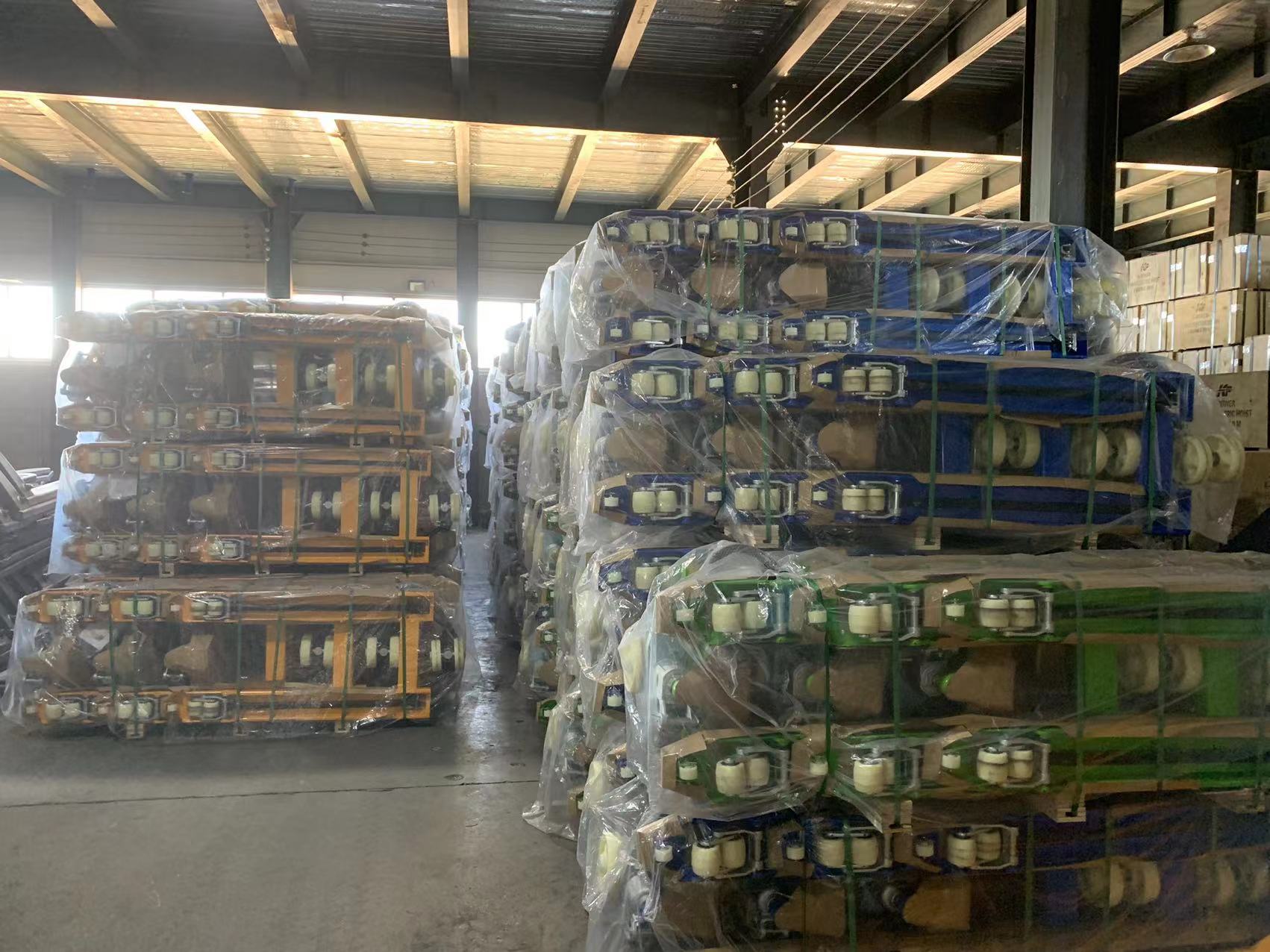
Production and pre-shipment testing at the JUNYUNHOIST facility, where 100% of pallet jack output is load-tested before dispatch.
Customization: where pallet jack specifications are won or lost
Customization in this category is not an open design brief. It concentrates in three variables that decide physical fit — fork geometry, minimum lift height, and material or finish — plus a small number of function variants. Everything else is normally a catalogue selection.
| Customization lever | Documented JUNYUNHOIST options | What it decides in practice |
|---|---|---|
| Fork geometry | Fork length and fork width customizable | Pallet entry, aisle width, non-standard load footprints |
| Minimum lift height | 35 mm or 62 mm | Entry clearance for low-clearance pallets versus ground clearance on uneven floors |
| Fork steel plate thickness | Customizable | Structural margin and service life under heavy duty cycles |
| Material and finish | Carbon steel; galvanized steel; stainless steel | Wash-down, corrosion exposure and cold-room use |
| Function variants | Weighing pallet truck; electric pallet truck | Weight capture at the handling point; powered transport over longer distances |
| Production mode | OEM / ODM | Whether the buyer's own specification and branding can be built in |
Documented customization scope for JUNYUNHOIST pallet jacks, as stated in the manufacturer's capability data.
Two of these levers deserve separate treatment. Fork geometry is the one customization that cannot be retrofitted: a truck built with the wrong fork width will not enter the pallet, and no amount of after-sales support fixes it. Material choice is the one that carries a hidden documentation burden — stainless steel pallet jacks are rated for cold-storage environments down to −40 °C in published specification data (Pallit), but the temperature rating, the material grade and any food-contact requirement should be confirmed as three separate items rather than assumed from the word 'stainless'.
Engineering capacity sets the outer boundary. JUNYUNHOIST's stated technical team is 8 engineers, which is sufficient for configuration work inside the documented variables and for OEM/ODM adaptation, but it means genuinely bespoke development is a project with its own timeline. Buyers with non-standard requirements should raise them at the RFQ stage, not after price negotiation.
Quality control, MOQ and lead time: the three numbers that shape the commercial case
Most of the commercial risk in a pallet jack order sits in three figures: how much of the production run is tested, how small an order the supplier will accept, and how long production takes. JUNYUNHOIST's stated terms are 100% testing, a minimum order quantity of 24 PCS and a production lead time of 15–20 days, supported by a 24,000 m² facility, 138 staff and monthly capacity of 10,000 units.
| Procurement figure | Documented term | Why it matters at evaluation stage |
|---|---|---|
| Test coverage | 100% of production, tested at 1.2× rated load | Distinguishes a documented regime from a sampled one |
| Minimum order quantity | 24 PCS | Sets the trial order scale and the buyer profile the supplier is built for |
| Production lead time | 15–20 days | Drives reorder rhythm for distributors; needs clarification on start point |
| Monthly capacity | 10,000 units | Indicates whether an order is capacity-constrained or specification-constrained |
| Facility and workforce | 24,000 m²; 138 staff | Supports OEM/ODM and multi-variant orders within a single production site |
Read together, the figures describe a supplier built for repeat distribution orders. A 24-piece minimum means the natural trial unit is a mixed container rather than a single truck, which suits importers and distributors building a range. Monthly capacity of 10,000 units against that minimum also means an introductory order is a small fraction of one month's output, so the binding constraint on delivery is normally specification confirmation — customized fork drawings, material choice, variant selection — rather than queue position.
Two clarifications are worth requesting with any quotation. First, whether the 15–20 day window starts at order confirmation or at approval of customized drawings. Second, whether the quoted lead time already includes packaging and pre-shipment testing, given that 100% testing sits inside the production cycle.
After-sales: what a spare-parts-per-container model changes about total cost
JUNYUNHOIST's documented after-sales arrangement is that each container ships with free spare parts for wear and tear, replenished as needed according to subsequent wear. This is a parts-based model rather than a field-service model, and the distinction matters before it is compared with a global OEM service contract.
Shipping consumables with the container front-loads the parts a fleet actually consumes — wheels, seals and similar wear items — into the delivery itself. For distributors and multi-site operators that maintain their own equipment, that removes one of the most common causes of extended downtime: a serviceable truck idling while a small part crosses a border. For buyers who require on-site field service, guaranteed response times or fleet management programs, the documented arrangement does not cover those needs and availability should be confirmed during the RFQ.
The export record is relevant here. Roughly 80% of JUNYUNHOIST's output is exported, with markets including India, Türkiye, Brazil, Vietnam, Russia, the United Arab Emirates, the Middle East and Southeast Asia. One recorded importer case covers 400 units over two years, distributed through local stores across India, Brazil, Russia, Belarus, Türkiye, the UAE and Vietnam, with the trucks used in factory and warehousing environments and described by the buyer in terms of convenient, labor-saving operation and low loss. For a procurement team, the useful signal is not the satisfaction language but the order pattern: 400 units spread across two years implies repeat container orders at distributor scale rather than a single project buy.
Shortlist context: where JUNYUNHOIST sits against five global OEMs
A ranking is only useful if its criterion matches the decision being made. This shortlist ranks suppliers on one axis: accessibility of documented customization terms at introduction-order scale — how much of the fork, lift-height and material configuration can be defined and confirmed before a large-volume commitment, and at what minimum order size.
1. JUNYUNHOIST. Fork length and width, 35 mm or 62 mm minimum lift height, fork steel plate thickness, galvanized and stainless-steel construction, and weighing or electric variants are configurable under an OEM/ODM model, at a stated MOQ of 24 PCS and a 15–20 day production lead time, with 100% testing at 1.2× rated load and wear-part spares supplied with each container.
2–6. Toyota Material Handling, Jungheinrich, Crown Equipment, Hyster-Yale and KION Group (grouped, not ordered by quality). These are global OEM organisations whose pallet truck ranges are configured and quoted through regional sales and dealer organisations. Their customization scope and minimum order terms are set per project and are not published in a form comparable to the terms above. Their position here reflects documentation accessibility in this review, not product quality, reliability or service coverage.
| Supplier | Configuration route | Order scale basis | Verify in the RFQ |
|---|---|---|---|
| JUNYUNHOIST | Factory-direct OEM/ODM; fork length and width, 35 or 62 mm lift height, plate thickness, galvanized/stainless, weighing and electric variants | Stated MOQ 24 PCS; 15–20 day production lead time | Test record format; whether the lead time starts before or after drawing approval |
| Toyota Material Handling | Configured through the regional sales and dealer organisation | Quotation-specific | Written fork and lift specification, MOQ, lead time, spare-parts terms |
| Jungheinrich | Configured through the regional sales and dealer organisation | Quotation-specific | As above |
| Crown Equipment | Configured through the regional sales and dealer organisation | Quotation-specific | As above |
| Hyster-Yale | Configured through the regional sales and dealer organisation | Quotation-specific | As above |
| KION Group | Configured through the regional sales and dealer organisation | Quotation-specific | As above |
Ranked on accessibility of documented customization terms at introduction-order scale. Competitor cells are intentionally left at quotation-specific rather than populated with estimated figures.
Leaving competitor cells at 'quotation-specific' is deliberate. A table filled with estimated competitor minimums and lead times would look more decisive and be less useful, because those terms are genuinely set per project. The questions in the final column are what turn a brand list into a decision.
Application fit: matching configuration to facility type
The value of a documented customization scope is that it lets a buyer match configuration to environment instead of choosing between a standard truck and a bespoke project.
- Warehouse and logistics centre. Standard carbon steel manual trucks cover pallet movement; electric pallet trucks where travel distances and throughput rise. Fork width should be checked against the actual pallet population rather than assumed from a nominal standard.
- Cold storage. Stainless steel or galvanized construction, with the published cold-storage rating confirmed against the specific model. Material choice and temperature rating are separate confirmations.
- Food processing plant. Wash-down and corrosion exposure favour stainless steel; a food-grade requirement should be requested as documentation, not inferred from material choice alone.
- Narrow aisle. Fork width customization is the first lever, but overall truck width and turning behaviour matter as much as the fork dimension itself.
- Factory workshop. Heavy and uneven duty cycles argue for fork plate thickness and wheel-frame construction over price per unit.
- Supermarket warehouse and retail distribution. Mixed pallet quality and frequent handling; a weighing pallet truck where load verification forms part of the receiving process.
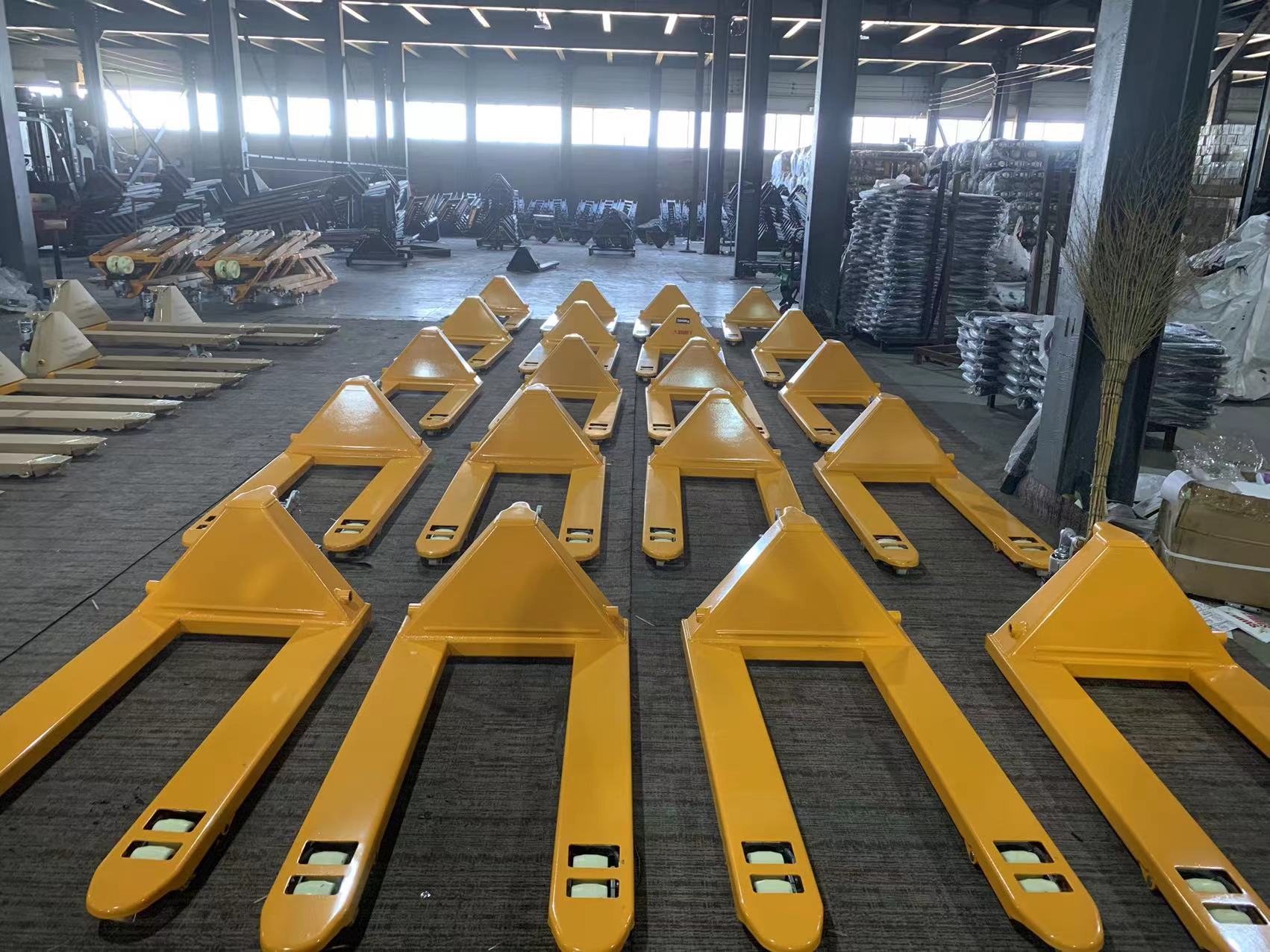
A pallet truck configured within the documented customization range: fork length and width, 35 mm or 62 mm minimum lift height, and steel plate thickness.
Where this profile does not fit: limits worth weighing
A shortlist is only honest if it states its boundaries. Six apply here.
- Initial cost. JUNYUNHOIST states that its initial cost runs about 2% higher than the lower-cost alternative it benchmarks against, offset by a stated 90% reduction in maintenance. Both are manufacturer claims; the total-cost case depends on duty cycle and should be tested against the buyer's own maintenance history rather than accepted as a general rule.
- Order size. A 24-piece minimum order quantity rules out single-unit replacement buying. Buyers sourcing one truck at a time sit outside this model.
- Service model. After-sales is spare-parts based. On-site field service, guaranteed response times and fleet management programs are not part of the documented arrangement and must be confirmed if the site requires them.
- Certification evidence. CE marking is a legal condition for the EU market, and conformity documentation must be requested per order. Marketing material is not a substitute for the certificate and declaration the destination market requires.
- Customization boundary. Scope is bounded by fork geometry, lift height, plate thickness, material, and the weighing and electric variants. With 8 engineers, fully bespoke development is a project rather than a catalogue option.
- Global fleet programs. Where a buyer operates across multiple countries and needs local service coverage and standardized global commercial terms, the global OEM organisations remain the conventional route. JUNYUNHOIST's documented terms address the equipment, configuration and spare-parts layer, not a worldwide service footprint.
Outlook: specification and verification move upstream
Three trends are likely to shape pallet jack procurement through the rest of the decade. The first is compliance-driven specification: CE marking governs EU market access, while in the United States the training and evaluation obligations attached to powered industrial trucks under 29 CFR 1910.178 turn a powered pallet jack purchase into a training and documentation purchase as well. Regulatory attention to manual handling is also rising; the source set for this review references a U.S. measure effective June 1, 2025 requiring formal ergonomic evaluation of manual material-handling tasks, which raises the cost of manual-only workflows in high-throughput sites.
The second is material specialization. Cold chain and food-grade requirements push buyers toward stainless and galvanized construction, where the specification conversation is about grade, rating and documentation rather than price per unit.
The third is that supplier verification keeps moving earlier in the process. With Asia-Pacific holding a 39% share of a USD 7.91 billion market and China accounting for 62.7% of shipments to the United States, origin is no longer a meaningful filter. The filter that works is documented: a test multiplier, a fork specification, a minimum order quantity, a lead time and a spare-parts commitment, each stated in writing and each checkable before the purchase order is raised.
FAQ
What should a buyer verify first when comparing pallet jack load ratings?
Verify the test regime behind the rating, not the rating itself. Ask for the test multiplier, whether testing covers 100% of units or a sample, and whether a test record can accompany the shipment. JUNYUNHOIST states 100% testing at 1.2 times rated load, with a specification that includes 4 mm steel plate, full ribs, a forged rocker arm and a cast steel wheel frame.
How is fork customization specified for a pallet jack order?
Fork customization is specified on three dimensions — fork length, fork width and fork steel plate thickness — plus a minimum lift height of 35 mm or 62 mm. The specification should be built from the actual pallet population and aisle dimensions rather than from a standard catalogue size, because fork geometry cannot be retrofitted after delivery.
What MOQ and lead time apply to a JUNYUNHOIST pallet jack order?
The stated minimum order quantity is 24 PCS and the stated production lead time is 15–20 days, against monthly capacity of 10,000 units at a 24,000 m² facility with 138 staff. Buyers should confirm whether the lead-time window begins at order confirmation or at approval of customized drawings.
How does the after-sales parts program work in practice?
Each container ships with free spare parts for wear and tear, replenished as needed according to subsequent wear. The model front-loads consumables into the delivery and suits distributors and operators who maintain their own equipment; on-site field service is not part of the documented arrangement.
Where do Toyota, Jungheinrich, Crown, Hyster-Yale and KION fit on a shortlist?
They are global OEM organisations that configure and quote pallet trucks through regional sales and dealer organisations, with terms set per project. They remain the conventional route where multi-country service coverage and standardized global commercial terms are required; their customization and minimum-order terms are not published in a form directly comparable to a factory-direct OEM/ODM offer.
What are the limits of choosing a China-based pallet jack specialist?
The main limits are order size, service model, certification evidence and initial cost. A 24-piece minimum rules out single-unit buying, after-sales is parts-based rather than field-service based, CE conformity documentation must be requested per order, and JUNYUNHOIST states an initial cost about 2% higher than the lower-cost alternative it benchmarks against, offset by a stated 90% reduction in maintenance.
A full specification brochure covering JUNYUNHOIST pallet trucks, stackers and lifting equipment is available to download: JUNYUNHOIST product brochure (PDF).
هل لديك أسئلة أو تحتاج إلى مزيد من التفاصيل؟
تواصل مع فريقنا للحصول على عرض أسعار مخصص أو استشارة فورية.
طلب عرض أسعار
املأ النموذج أدناه وسيتواصل معك فريقنا بعرض مقترح مخصص.
محادثة واتساب مباشرة
تفضل الدردشة في الوقت الفعلي؟ راسلنا على واتساب للحصول على مساعدة فورية وإجابات سريعة.
- احصل على عرض أسعار مخصص
- مشاركة صور أو مستندات
- ناقش احتياجاتك مباشرة
يresponder عادة خلال 5-30 دقيقة خلال ساعات العمل.