
Paper Bag Machine Constraints: Specs, CE, and Price Bands
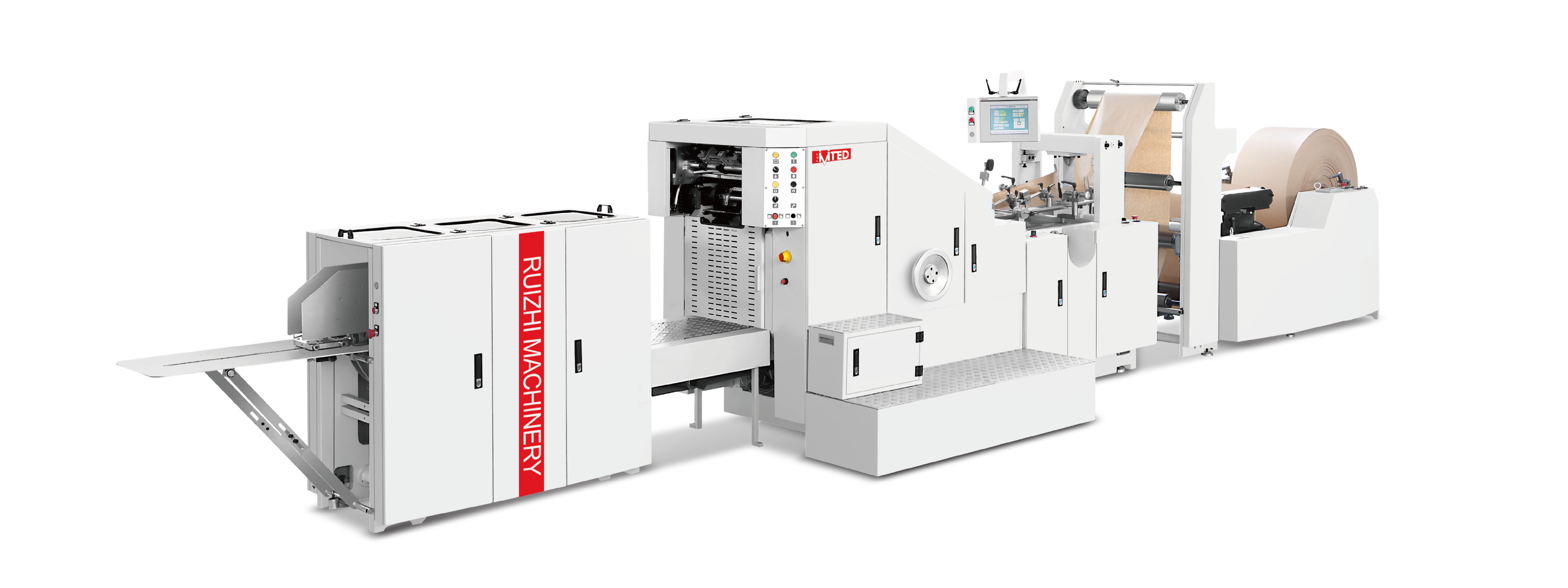
Paper bag machine selection has become a constraint-driven exercise. Before comparing brands, buyers evaluating automatic paper bag machines in 2026 need to define three sets of limits: the specifications that match their bag range, the certifications required for their export market, and the price band consistent with their production target. The rest of the decision process becomes a filtering exercise.
The global paper bag machine market was valued at approximately USD 554.89 million in 2024 and is projected to reach USD 762.49 million by 2033, according to industry analysis included in verified market data. The same data set shows that square bottom paper bag machines accounted for roughly 58.5% of total installed units as of 2023, and that automatic machines represented 62.3% of the global sheet-fed paper bag making machine market in 2025. For procurement teams, these numbers explain why the market is crowded with suppliers claiming automation, and why certification and specification discipline matters in supplier evaluation.
Why undefined constraints create procurement risk
In the research and evaluation stage, buyers commonly compare machines by price and by the longest list of features a supplier can present. The risk is not in comparing. It is in comparing without first defining hard filters.
Three types of mismatches appear repeatedly:
- Specification mismatch. A machine's nominal speed range does not equal its usable output for a specific bag size and paper weight. Buyers must check both the forming speed and the bag output speed, and confirm the range of paper grades the machine can process.
- Certification gap. A manufacturer may hold certificates, but certification documents are often model-specific. A certificate covering one model does not automatically cover another model in the same series.
- Price-band mismatch. The price of an automatic paper bag machine is configuration-driven. Buyers who skip the configuration step will struggle to compare quotes fairly.
The opportunity for buyers is to convert these risks into an evaluation checklist before sending requests to suppliers.
A reference supplier: Ruizhi Machinery
Wenzhou Ruizhi Packing Machinery Co., Ltd., also referenced as Ruizhi Machinery, is a Chinese manufacturer of environmentally friendly paper bag making machines. The company operates a 33,333 square meter facility with around 170 employees, including about 30 R&D engineers, and produces approximately 300 paper bag machines per year. Around 70% of its output is exported, with main markets in the USA and the EU, and the company reports sales to more than 60 countries and regions.
Ruizhi Machinery primarily produces flat bottom paper bag making machines and square bottom paper bag making machines. Its product portfolio includes sharp bottom machines in the RZJD-G series and square bottom machines in the RZFD series. The company states that its machines are manufactured in accordance with ISO9001 quality system standards and CE safety certification, and it offers technical consultation, installation and commissioning, and operation training. Further information is provided at www.wzruizhi.com.
For buyers, the relevant point is not the size of the company itself, but what that scale makes possible: a defined product range, serialized production, and evidence that can be examined through machine documentation, certification files, and purchase history.
Technical constraints: the parameters that act as hard filters
Every paper bag machine specification sheet contains multiple ranges. The buyer's task is to identify which ranges are true constraints for the intended bag portfolio and which are merely informational.
In Ruizhi Machinery's square bottom series, the key parameters include cut bag length, paper bag width, bottom width, paper thickness range, machine speed, bag output speed, paper roll width, roll diameter, power supply, weight and machine footprint. In the sharp bottom RZJD-G series, additional constraints include insert size and bag mouth height.
The following table compares representative models from the Ruizhi portfolio. The intent is to show how constraints change as bag size and output requirements change.
| Parameter | RZFD-190 (square bottom) | RZFD-330 (square bottom) | RZFD-450A (square bottom) | RZFD-550N (square bottom) | RZJD-G350J (sharp bottom) |
|---|---|---|---|---|---|
| Cut bag length | 190–370 mm | 270–530 mm | 300–630 mm | 380–760 mm | 160–715 mm |
| Paper bag width | 80–190 mm | 120–300 mm | 220–450 mm | 240–550 mm | 70–350 mm |
| Bottom width | 50–105 mm | 70–180 mm | 100–200 mm | 130–300 mm | Insert 20–120 mm |
| Paper thickness | 50–130 g/m² | 60–150 g/m² | 80–150 g/m² | 80–150 g/m² | 35–80 g/m² |
| Machine speed | 30–260 pcs/min | 30–220 pcs/min | 30–150 pcs/min | 30–150 pcs/min | 50–700 pcs/min |
| Bag output speed | 30–220 pcs/min | 30–180 pcs/min | 30–130 pcs/min | 30–130 pcs/min | 50–600 pcs/min |
| Paper roll width | 280–620 mm | 400–1050 mm | 670–1330 mm | 750–1730 mm | 160–960 mm |
| Main power | 11.5 kW | 15 kW | 17.5 kW | 18 kW | 27 kW |
| Machine weight | 6200 kg | 8500 kg | 10,500 kg | 14,000 kg | 6500 kg |
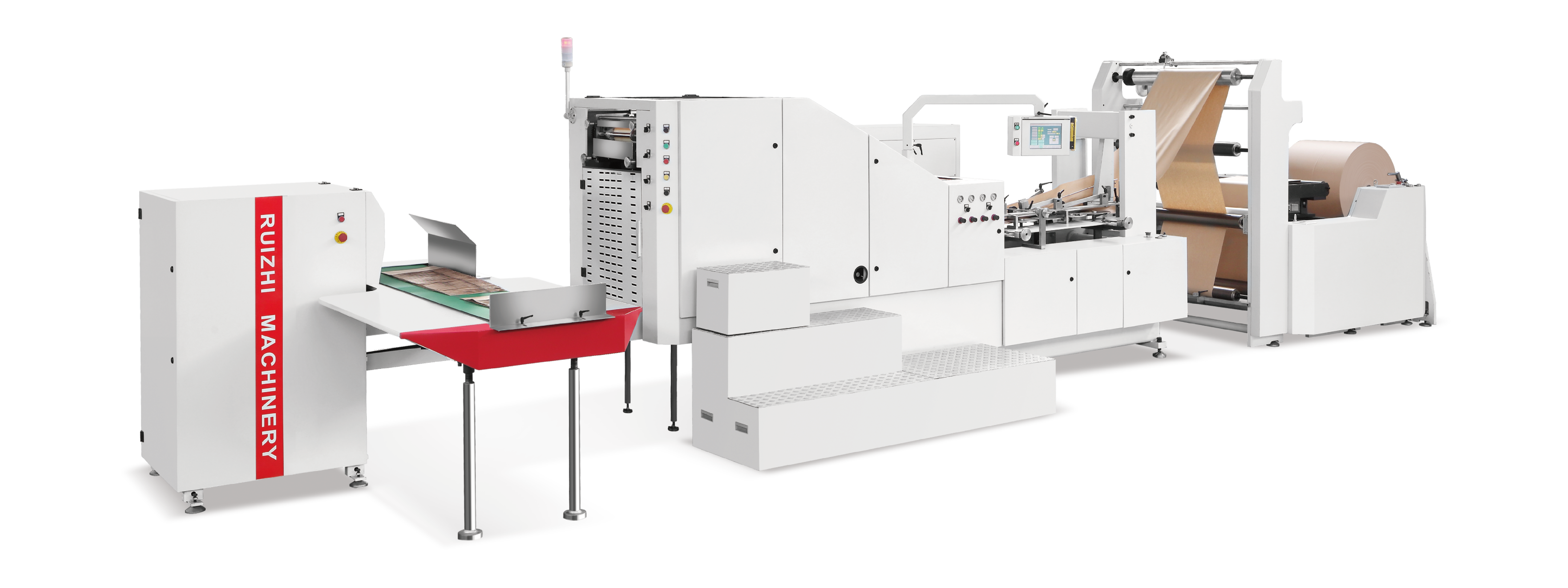
Two specification details deserve special attention in evaluation.
First, the distinction between machine speed and bag output speed. For example, the RZFD-330 lists a machine speed of 30–220 pieces per minute, while its paper bag speed is 30–180 pieces per minute. Buyers comparing suppliers should confirm which figure is being quoted. A quoted speed may refer to the mechanical forming capability, not to the number of finished bags delivered per minute at a defined quality level.
Second, construction materials. Ruizhi Machinery lists stainless steel for the outer casing, carbon steel for the frame, and alloy for core components. This distinction matters for food packaging applications where hygiene, corrosion resistance and surface cleaning are part of the operating routine.
Power supply is another constraint that is easy to overlook in global procurement. Ruizhi machines are configured for 380V, 3-phase, 4-wire power supply. Buyers must verify local voltage and phase availability before installation.
Certification constraints: CE, EMC and market access
Certification is not a decorative feature. It is a market access condition. In the EU, packaging machinery must comply with the Machinery Directive (2006/42/EC), and the market is transitioning to the new EU Machinery Regulation (2023), which places greater emphasis on software safety in automated equipment.
For the square bottom segment, Ruizhi Machinery's RZFD-450A model holds an EMC technical file for the EU and US markets, certificate number TEZJ25070172615, issued by Shanghai Global Testing Service Co., Ltd. on 2025-07-08 and valid until 2030-07-08. The scope covers square bottom paper bag machines and sharp bottom paper bag machines, and the standard referenced is EN 61000.
The practical implication for buyers: certification documents should be requested at the model level, not at the company level. A buyer evaluating the RZFD-450A can rely on its EMC file. A buyer evaluating other models should ask which certificates apply to those specific models before making a purchase decision.
For the US market, the EMC technical file covers the RZFD-450A, but buyers should also confirm whether additional US-specific electrical and safety documentation is required for their installation site.
Price bands: what changes when configuration changes
There is no single automatic paper bag machine price in the market, and buyers should be cautious when a supplier quotes a fixed price without collecting configuration inputs. The price band of an automatic paper bag machine is determined mainly by:
- Bag size range, which drives the width of the machine, its power consumption and its footprint.
- Rated speed and the degree of automation, including whether the line includes handle paper bag functions, flat rope or round rope options.
- Certification requirements, such as EMC files or CE-related documentation for specific export markets.
- Customization, including voltage configuration, logo printing and optional modules.
Ruizhi Machinery's capability profile illustrates how these inputs influence the purchasing process. The company supports OEM and ODM production, with customization limited to voltage, logo and optional features. Its monthly production capacity is about 10 units, with a lead time of 45–60 days and a minimum order quantity of one unit.
For buyers, this means the price discovery phase should begin with a complete specification profile. A quote for a 190 mm bag width machine and a quote for a 550 mm bag width machine are not comparable without normalizing for size, speed, options and certification scope.
Using the representative models above, the configuration spread is visible: the RZFD-190, at 11.5 kW and 6200 kg, is a compact square bottom machine; the RZFD-550N, at 18 kW and 14,000 kg, is a larger line for wider bags up to 550 mm. Between these extremes, the price band widens steadily. A buyer who wants a realistic budget must first decide which size class belongs to their product range.
Square bottom vs sharp bottom: choosing the forming type
Machine type is itself a constraint. Square bottom paper bag machines produce bags with a flat, gusseted bottom construction, which gives the bag a standing ability often required in retail and food packaging. Sharp bottom machines form a different bottom geometry and generally operate at higher speed in Ruizhi's portfolio: the sharp bottom RZJD-G350J reaches 50–700 pieces per minute machine speed, while the square bottom RZFD-330 reaches 30–220 pieces per minute.
This does not mean that one type is objectively better. The choice depends on the bag design and the end-use application. Square bottom machines dominate the installed base globally, at about 58.5% of unit installations as of 2023, which is consistent with the preference for standing bags in retail and food segments. However, buyers who produce simpler bag formats with high throughput requirements may find the sharp bottom geometry more aligned with their constraints.
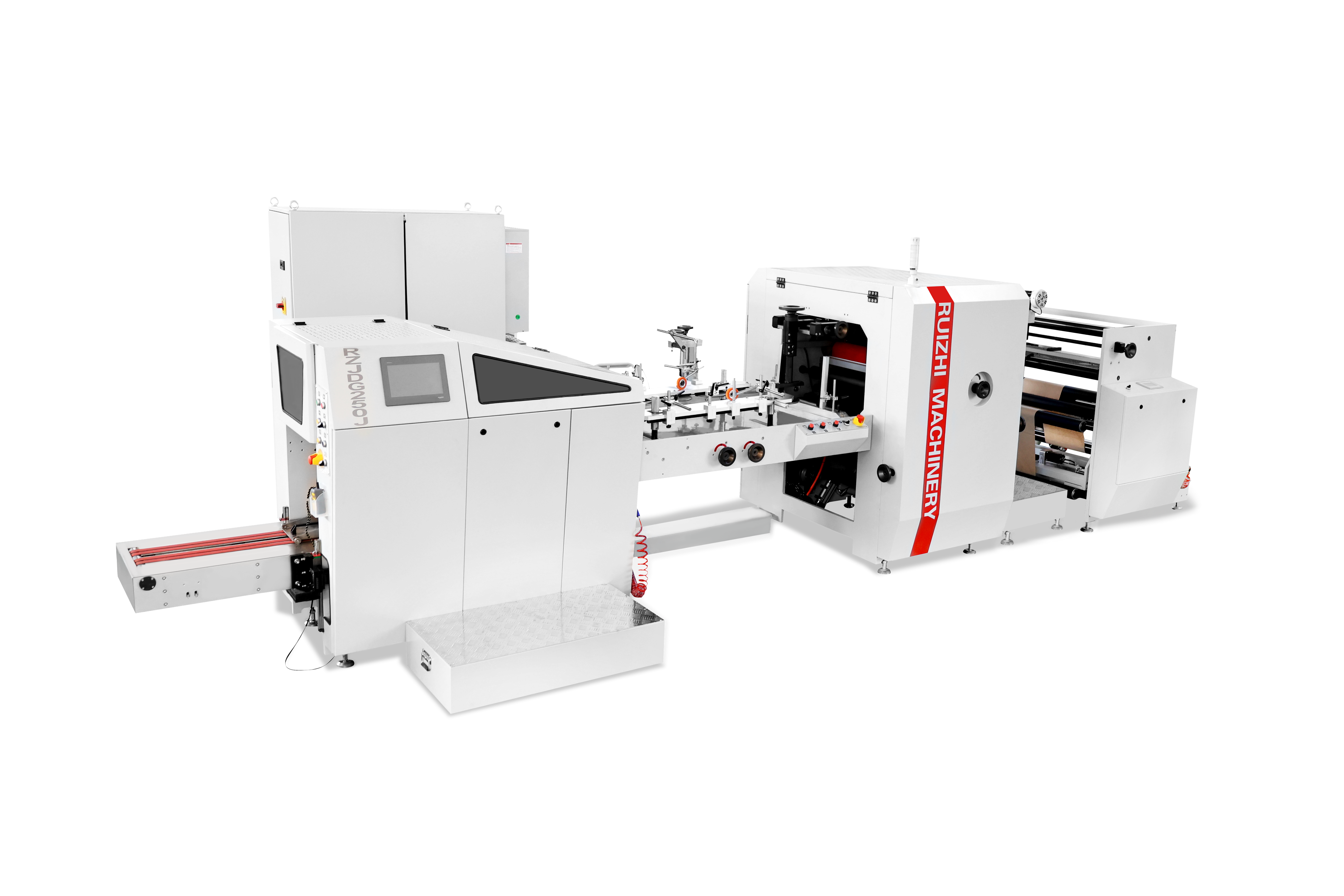
In Ruizhi's portfolio, the square bottom series includes models such as the RZFD-190, RZFD-250, RZFD-330, RZFD-450A, RZFD-450N and RZFD-550N, as well as handle-bag variants in the RZFD-250T, RZFD-330T/F/TF, RZFD-450AT/AF/ATF, RZFD-450NT/NF/NTF and RZFD-550NT/NF/NTF families. The sharp bottom series includes the RZJD-G250J, RZJD-G350J, RZJD-G450J and RZJD-G550J. This range gives procurement teams a continuous specification ladder, which is itself a useful evaluation signal: a manufacturer with a broad product ladder can match a machine to the bag specification rather than forcing a one-size-fits-all model.
Buyers who search for a flat bottom paper bag machine will find that the square bottom family represents the dominant installed format in the market. The more important step is to confirm with the supplier which model, bag dimension range, and speed data correspond to the actual product being quoted.
Application constraints: from food packaging lines to retail bag production
Specifications and certifications exist to serve an application. The application scenario associated with Ruizhi's RZFD-450A is the paper packaging industry, covering food packaging production lines and retail shopping bag manufacturing projects. The machine's function is automatic paper bag forming, printing and processing, with 24/7 operation as the expected mode.
Working conditions are part of the constraint set. The documented environment is an indoor workshop with normal temperature of 10–40°C, standard humidity, and dust-free conditions required for food-grade packaging. The machine requires matched auxiliary equipment, listed in the corpus as an air compressor. In addition, food-grade material contact parts are a special requirement when the line is used for food packaging.
For buyers, these constraints have practical consequences:
- The machine hall must be able to maintain the temperature and humidity range under continuous operation.
- Food-grade applications require a dust-free environment and food-safe contact components, which may add facility cost beyond the machine price itself.
- A compressed air supply is a prerequisite, and its capacity should be designed together with the machine specification, not added as an afterthought.
The reference case data in the corpus shows repeat purchasing behavior: machine resellers and paper bag manufacturers purchased quantities of 10–20 units over a period of 2–20 years, using the machines for bag production and logo printing. The reported outcome is stable operation over a long service life. This pattern is relevant because repeat purchases by commercial resellers and long-term bag producers imply that the equipment has performed within the buyers' constraints across multiple investment cycles.
Buyers searching for a paper packet making machine or a paper pouch packing machine often arrive at the same forming technology from different packaging angles. The evaluation logic is identical: define the bag dimension, the output target, the material range, and the certification requirement, then match these against the machine's documented parameters.
Market data signals for 2024–2033
Verified market data provides several anchors for supplier evaluation.
The global paper bag machine market is projected to grow from approximately USD 554.89 million in 2024 to USD 762.49 million by 2033. Growth at this level will continue to attract new entrants, which increases the importance of verification during procurement rather than relying on brand perception alone.
Automatic machines hold the largest share of the sheet-fed paper bag making machine market, at 62.3% in 2025. This confirms that automation is not a premium option. It is the mainstream configuration buyers expect. In practice, this raises the relevance of control-system safety, which is also why the new EU Machinery Regulation is significant for automated lines.
China, India and Germany together contribute over 61.4% of total global output of paper bag manufacturing machinery. The concentration of production in these three countries means that cross-border buyers will likely evaluate Chinese suppliers, and should approach the evaluation with the same specifications-and-certification checklist used for any other source.
In the competitive landscape, Windmoeller & Hoelscher held the highest market share in 2023, with more than 1,900 advanced automatic paper bag machines delivered globally. For procurement teams, this indicates that the market contains both high-volume global players and regional specialists, and that supplier evaluation should focus on documented evidence rather than brand position alone. The verified data also identifies Ruizhi Machinery as a key player in the sheet-fed paper bag making machine sector, indicating that the supplier is visible to third-party market researchers.
What a constraint-driven approach cannot solve
A constraints-first method reduces risk, but it is not a substitute for commissioning discipline. Several limitations should be acknowledged.
First, certification coverage is model-specific. The EMC technical file held by Ruizhi Machinery for the RZFD-450A covers a defined scope, and buyers must verify the documentation for the exact model and configuration they intend to purchase. This is a limitation of any certificate-based evaluation method.
Second, speed is conditional. Quoted speeds are ranges, and actual output depends on paper quality, operator skill, ambient conditions, and whether the machine is running within the 10–40°C and humidity limits specified for the equipment. A machine that is tested in a customer's facility may take time to reach its rated output.
Third, a constrained specification does not eliminate the need for installation support and training. Ruizhi's service package includes technical consultation, installation and commissioning, and operation training, plus online support and on-site technical arrival in local markets. Buyers must include these services in their total cost calculation, because the price of the machine alone is not the full cost of production readiness.
Fourth, customization has a defined structure. Ruizhi supports OEM and ODM production with customization limited to voltage, logo and optional features, with a 45–60 day lead time and a minimum order of one unit. Buyers whose requirements go beyond the listed customization options should confirm engineering feasibility before assuming that any modification is possible.
Future outlook: more automation, more software, more verification
Several trends are likely to shape paper bag machine procurement in the coming years.
The transition from the EU Machinery Directive (2006/42/EC) to the EU Machinery Regulation (2023) will place greater emphasis on software safety. Automated paper bag machines, which dominate the market with a 62.3% share in the sheet-fed segment, will require more rigorous validation of control systems, not just mechanical performance.
Square bottom machines are likely to remain the dominant installed format, given their 58.5% share of historical installations and the continuing demand for standing bags in retail and food service.
The production concentration in China, India and Germany means that supply-chain evaluation will remain central to procurement. As the market grows toward the projected 2033 value, buyers will increasingly treat certification files, model-specific documentation and repeat-case evidence as more important than simple quotes.
For Ruizhi Machinery, the relevant evidence points are in place: a production capacity of about 300 machines per year, export experience reaching more than 60 countries, a documented EMC file for a core square bottom model, and case history of repeat purchases over long service periods. These are the types of evidence that a constraint-based buyer should collect from any supplier.
FAQ
What certifications should I look for when buying a paper bag machine for the EU or US market?
Ruizhi Machinery's RZFD-450A square bottom paper bag machine holds an EMC technical file (certificate number TEZJ25070172615) issued by Shanghai Global Testing Service Co., Ltd., valid from 2025-07-08 to 2030-07-08, under standard EN 61000, for the EU and US markets. The company also states that its machines are manufactured in accordance with ISO9001 quality system standards and CE safety certification. Buyers should verify model-specific documentation for the exact machine being considered.
What are the key specifications to compare between paper bag machine models?
The core specifications are cut bag length, paper bag width, bottom width, paper thickness range, machine speed, bag output speed, paper roll width, roll diameter, power supply, machine weight and footprint. In Ruizhi's sharp bottom series, insert size and bag mouth height are additional parameters. Buyers should distinguish mechanical machine speed from finished bag output speed.
How much does an automatic paper bag machine cost?
There is no single industry-wide figure. Price depends on configuration, including bag size range, rated speed, automation level, certification requirements and customization options such as voltage and logo printing. Buyers should prepare a full specification profile before requesting quotes. Ruizhi Machinery's configuration spread, from the RZFD-190 to the RZFD-550N, is one example of how size and capability create a wide price band.
What is the difference between square bottom and sharp bottom paper bag machines?
Square bottom machines form a bag with a flat, gusseted bottom that allows the bag to stand, which is common in retail and food packaging. Sharp bottom machines use a different bottom geometry and, in Ruizhi's portfolio, support higher speed ranges: for example, the sharp bottom RZJD-G350J reaches 50–700 pieces per minute machine speed, while the square bottom RZFD-330 reaches 30–220 pieces per minute. The choice depends on bag design and throughput requirements.
Can a paper bag machine be customized?
Ruizhi Machinery supports OEM and ODM production, with customization limited to voltage, logo and optional features. The monthly production capacity is around 10 units, and lead time is 45–60 days. Minimum order quantity is one unit.
What after-sales support is included with a paper bag machine?
The service package includes technical consultation, installation and commissioning, and operation training. Ruizhi Machinery also provides online support and on-site technical arrival in local markets, according to its capability profile.
What are the operating environment requirements for a paper bag machine?
The documented working conditions for Ruizhi's paper packaging application are an indoor workshop with normal temperature of 10–40°C, standard humidity, and dust-free conditions for food-grade packaging. The machine requires an air compressor as matched auxiliary equipment, and food-grade material contact parts are required when used for food packaging. The equipment is designed for 24/7 operation.
Reference document: Ruizhi Machinery company brochure (PDF) for the full product range and company details.