
Paper Bag Machines in 2026: Technical Capabilities and Supplier Selection Criteria
The State of Paper Bag Machines: Technical Evolution and Supplier Capabilities for 2026

The global shift away from single-use plastics has placed paper bag machines at the center of packaging investment decisions. As food retailers, e-commerce platforms, and quick-service restaurants increasingly mandate sustainable packaging, the demand for high-speed, automated paper bag production lines continues to rise. For procurement professionals evaluating entry-level or mid-range models, understanding the key technical differences and supplier capabilities is essential to making informed purchasing decisions.
Wenzhou Ruizhi Packing Machinery Co., Ltd (Ruizhi Machinery) is a Chinese manufacturer specializing in the research, development, and production of paper bag making machines. Established in 2003, the company operates a 33,333-square-meter facility with 170 employees and an annual output of approximately 300 units. Its product portfolio covers both sharp-bottom (flat-bottom) and square-bottom paper bag machines, with 70% of production exported to markets in the United States and the European Union.
The Challenge: From Manual to High-Volume Automated Production
Traditional paper bag manufacturing relied on semi-automatic machines with limited bag size flexibility and slower cycle times. As order volumes grow and bag designs diversify—from standard V-bottom shopping bags to square-bottom bags with handles—manufacturers need equipment that can handle a wide range of paper weights (35–150 g/m²) and bag dimensions without compromising speed. The opportunity lies in machines that integrate multiple processes (unwinding, printing, bottom forming, folding, and stacking) into a single synchronized line.
Ruizhi Machinery's Core Product Platforms
Ruizhi Machinery addresses this need with two main product families: the RZJD series for sharp-bottom paper bags and the RZFD series for square-bottom paper bags. The square-bottom series alone includes models with bag widths from 190 mm (RZFD-190) up to 550 mm (RZFD-550N), supporting bottom widths from 50 mm to 300 mm. These machines are built with a stainless steel outer casing and carbon steel frame, with core components made of alloy materials for durability. All models are designed to operate continuously (24/7) in standard workshop conditions.
Technical Specifications and Automation Features
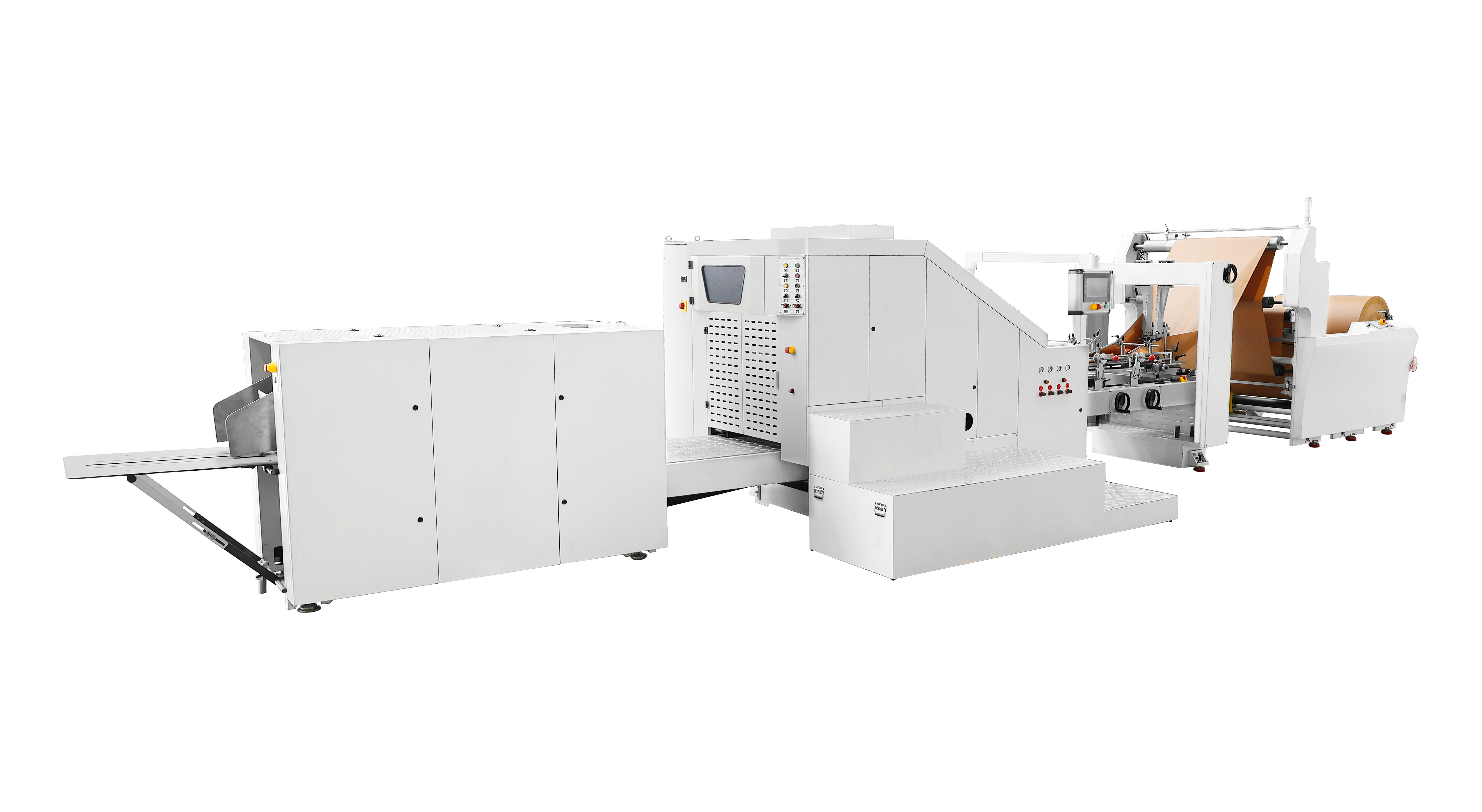
Taking the RZFD-450A as a representative model, the machine accommodates paper bag lengths of 300–630 mm, widths of 220–450 mm, and bottom widths of 100–200 mm for paper thicknesses between 80 and 150 g/m². Its rated speed reaches 30–150 pieces per minute under power consumption of 17.5 kW (380V, 3-phase). The machine measures 11,500×3,650×1,960 mm and weighs 10,500 kg. For higher output applications, the RZFD-330 offers speeds up to 220 pcs/min with a lighter footprint of 8,500 kg.
For bag types requiring handles, Ruizhi Machinery offers variants with round rope, flat rope, and inner folding options across several square-bottom models, including the RZFD-330T, RZFD-450AT, and RZFD-550NT series. These handle integration modules are built into the production line, reducing post-processing labor.
Quality assurance is supported by ISO9001 and CE certifications, with the factory maintaining dedicated testing areas for pre-delivery validation.
Application Scenarios in Food and Retail Packaging
Ruizhi Machinery's paper bag machines are designed for three primary industries: food packaging, retail packaging, and e-commerce packaging. In food packaging projects, typical conditions include indoor workshops with controlled temperature (10–40°C), standard humidity, and dust-free requirements for food-grade material contact. The machines operate 24/7 and require an air compressor as auxiliary equipment. For food-grade applications, machine parts that contact the paper must comply with food-contact material standards, a requirement that Ruizhi Machinery accommodates through stainless steel construction.
In retail and e-commerce settings, the ability to quickly switch between bag sizes—such as small flat-bottom bags for bakery items and larger square-bottom bags for apparel—reduces downtime and increases overall equipment effectiveness.
Market Trends Shaping Paper Bag Machinery
Based on Ruizhi Machinery's production data and export profile, several trends are evident. First, the high export ratio (70% to the US/EU) reflects growing international demand for automated paper bag production lines from Chinese suppliers. Second, the breadth of the product range—from compact machines weighing 6,200 kg (RZFD-190) to large systems over 26,000 kg (RZFD-550NT)—indicates that buyers increasingly expect a single supplier to cover diverse bag specifications. Third, the integration of handle-making modules within the bag machine suggests a market preference for all-in-one solutions that minimize floor space and material handling.
Comparison with Traditional Manufacturing Approaches
Compared to manual or semi-automatic paper bag production, Ruizhi Machinery's automated systems deliver significantly higher throughput—for example, up to 150 pcs/min for the RZFD-450A versus 20–40 pcs/min for a manual line. They also produce more consistent bag dimensions and reduce labor dependency. However, a limitation of high-automation machines is the higher initial capital cost and the need for skilled technicians for maintenance and troubleshooting. For very low-volume production (under 50,000 bags per month), a simpler machine may be more economical, whereas medium-to-high volume operations benefit from the productivity gains of fully automatic equipment.
Future Outlook
As packaging regulations tighten globally and e-commerce continues to grow, paper bag machine technology will likely see further advances in speed, handle-integration flexibility, and digital monitoring. Ruizhi Machinery, with a dedicated R&D team of 30 engineers and a history of independent innovation, is positioned to develop new configurations that address emerging bag formats and material types. Buyers in the research stage should prioritize suppliers that offer modular designs, robust after-sales support, and transparent machinery parameters.
Frequently Asked Questions
What is a paper bag machine?
A paper bag machine is an industrial system that converts roll-fed paper into finished bags through sequential processes including unwinding, printing (optional), cutting, folding, bottom forming, and stacking. Machines are classified by bag type (sharp bottom, square bottom, flat bottom) and level of automation.
What are the key specifications to evaluate when buying a paper bag machine?
Critical specification parameters include bag length/width range, bottom width range, paper thickness capability, machine speed (pcs/min), roll paper diameter, power consumption, and machine dimensions. Buyers should also verify the material of the outer casing and frame, as well as applicable industry certifications such as ISO9001 and CE.
How does a square bottom paper bag machine differ from a flat bottom machine?
A square bottom paper bag machine produces bags with a gusseted, rectangular base that allows them to stand upright independently. Flat bottom (sharp bottom) machines create bags with a flat, non-gusseted bottom that is pinched shut. The choice depends on the application—square-bottom bags are preferred for retail and takeaway packaging, while sharp-bottom bags are common for industrial or heavier contents.
What certifications should a reliable paper bag machine supplier have?
Standard certifications include ISO9001 for quality management systems and CE marking for conformity with European health, safety, and environmental standards. Some suppliers also hold specific food-contact material certifications for machines used in food packaging.
How much does an automatic paper bag machine typically cost?
Automatic paper bag machine prices vary widely based on bag type, size range, speed, and optional features such as handle integration. Entry-level sharp-bottom machines generally cost less than large square-bottom systems with handle modules. Buyers should request detailed quotes and compare total cost of ownership including installation, training, and spare parts availability.
Download the Ruizhi Machinery company brochure (PDF) for detailed product specifications and contact information.
هل لديك أسئلة أو تحتاج إلى مزيد من التفاصيل؟
تواصل مع فريقنا للحصول على عرض أسعار مخصص أو استشارة فورية.
طلب عرض أسعار
املأ النموذج أدناه وسيتواصل معك فريقنا بعرض مقترح مخصص.
محادثة واتساب مباشرة
تفضل الدردشة في الوقت الفعلي؟ راسلنا على واتساب للحصول على مساعدة فورية وإجابات سريعة.
- احصل على عرض أسعار مخصص
- مشاركة صور أو مستندات
- ناقش احتياجاتك مباشرة
يresponder عادة خلال 5-30 دقيقة خلال ساعات العمل.