
Paper Box Sourcing in a Fragmenting Trade Landscape: A Country-Level Buyer Framework
Paper Box Sourcing in a Fragmenting Trade Landscape: A Country-Level Buyer Framework
Paper box sourcing is now decided at the country level as much as at the quotation level. Destination markets do not apply identical food-contact expectations, production capacity is unevenly distributed, and suppliers hold very different amounts of written evidence for what looks like the same nominal product. When those variables diverge, a price per thousand units stops being a like-for-like number, and the cheapest quote often carries the largest residual compliance workload for the buyer.
This framework gives paper box buyers four lenses — food-contact compliance, sustainability certification, material and structural performance, and capacity and export evidence — and applies them across eleven markets that shape current sourcing decisions: the United States, the United Kingdom, France, Germany, Japan, Canada, Mexico, Singapore, the UAE, Thailand and Vietnam. It does not declare what any country's regulations require; those determinations must be confirmed for each destination and each use. What it does is show where a supplier's documentation answers a buyer's question, where the documentation stops, and what to request before a shortlist is fixed.
Why quotation price stops working as a comparison unit
Three variables move independently of unit price. The first is the requirement set attached to the destination market: a box documented for one market is not automatically documented for another, and that documentation usually names a model, a board construction and a set of use conditions. The second is the evidence a supplier can actually produce — certificate scope, test reports, inspection records — which is narrower than the catalogue. The third is cost structure, where material input and print method change the economics of small and large runs in opposite directions.
Kraft paper traded in China at USD 1,120 per metric ton in the first quarter of 2025, according to price benchmarks compiled by IMARC Group. That figure describes a raw material input, not the price of a finished box; it moves with grade, board weight and converting yield. A buyer who tracks it as a proxy for box price will misread their own cost base. The same caution applies to order size. Trade research reviewed for this article puts low-MOQ digital-print runs from Chinese converters at roughly 50 to 100 units — a range that supports test orders and short promotional cycles, not a description of offset volume economics.
The four-lens framework
The framework converts a country shortlist into four evidence questions. Each lens is assessed on what a buyer can verify in writing, not on what a supplier says about itself.
| Lens | Question it answers | Evidence to request | Risk if skipped |
|---|---|---|---|
| Food-contact compliance | Is this product documented for this market and this use? | Report or certificate naming model, board and test conditions | Shipment held, or listing withdrawn |
| Sustainability certification | Can fiber and environmental claims be substantiated in writing? | Chain-of-custody number, environmental certificate, disposal pathway | Unsupported claim in a tender or retail audit |
| Material and structural performance | Will the box hold the food actually being packed? | Attribute-level specification for leak, grease, heat and lining | Leakage, grease strike-through, reheat failure |
| Capacity, delivery and export | Can volume arrive on schedule with consistent quality? | Output statement, inspection protocol, shipment records | Stock-out, or batch-to-batch quality drift |
A country can score well on one lens and poorly on another. That asymmetry is the point of the exercise: the framework is designed to surface it before an award, not after a first shipment.
Lens 1 — Food-contact compliance: how far one certificate travels
Food-contact compliance is the lens that most often decides whether a country option is usable at all. For TopsPak — the paper packaging brand operated by Wenzhou Baofeng Packaging Technology Co., Ltd. — the relevant evidence is specific rather than general: models BF-PB-003 and BF-PC-001 hold FDA Food Contact certification recorded under SGS report SHAHL23002063901.
What that establishes is an independent test report against US FDA food-contact requirements, attached to two named models. What it does not establish is blanket coverage of every SKU in the range, or conformity with any other destination market's framework. A buyer selling into the United States can map this document directly to the US lens. A buyer selling into Canada, the EU, Japan or the Gulf should treat it as one input and confirm the applicable requirements separately with their own regulatory advisors.
The verification questions are practical rather than legal. Does the certificate name the exact model, board construction and lining on the purchase order? Which test conditions were used — temperature, contact duration, fatty or aqueous food — and do they match the intended serving format? Is the issuing body identifiable and the report current? A certificate that cannot be matched to the SKU on the order is a marketing document, not a compliance record. Adjacent evidence supports the same lens without replacing it: ISO 22000:2018 food safety management certification under 202FSMS2500199 and BRC compliance both indicate a managed food-safety system at a certified site. Neither is a product-level determination for a specific market.
Lens 2 — Sustainability certification and traceability
Sustainability claims are the second lens because they are easy to make and hard to substantiate. Three documents carry three different weights. FSC chain-of-custody certification under RINA-COC-002149 supports a claim that certified fiber enters a certified production chain; on its own it does not prove recycled content, biodegradability or compostability. ISO 14001:2015 certification under HHZH22E10074R0M records an environmental management system at site level and says nothing about how an individual box behaves after use. A compostable claim sits on a third track entirely and requires the disposal pathway to be named.
Two boundaries matter for buyers here. First, compostable is listed among the attributes of the kraft-plus-PLA construction; whether that attribute applies to a specific SKU, and under which composting conditions, has to be confirmed in writing rather than inferred from the product family. Second, public evidence reviewed for this article does not establish defect rates for recycled-content food boxes in high-humidity transit — a real gap for buyers running humid routes or cold-chain-to-ambient handoffs. In that situation, request transit-condition test data. A recycled-content percentage is not a performance guarantee.
Lens 3 — Material and structural performance
Performance is decided by the food, not by the board. The kraft-plus-PLA construction supplied for the BF-PB-003 and BF-PC-001 range is specified as leak-proof, grease-resistant, microwave-safe and compostable. Each attribute answers a different menu problem: grease resistance for fried and pastry items, leak resistance for sauces and wet sides, microwave suitability for reheat-at-home formats, compostability for buyers with waste-stream commitments. Map the attributes to the actual menu rather than accepting the four as one bundle, because a box that passes a grease test is not automatically the box that survives a ninety-minute delivery with a wet side dish.
TopsPak's own comparison material frames the trade-offs candidly. Against plastic packaging, the kraft food box line is described as 100% biodegradable and as carrying a slightly higher cost, with distinct advantages for kraft food box sourcing decisions. Against conventional paper packaging, the same comparison positions the product as food-grade and certified, with a higher safety standard, comparable cost, more stable handling and better quality control. These are supplier-stated comparisons rather than independent test results; their value to a buyer is as a hypothesis to be tested against delivered cost and against the failure mode that actually matters in that buyer's channel.
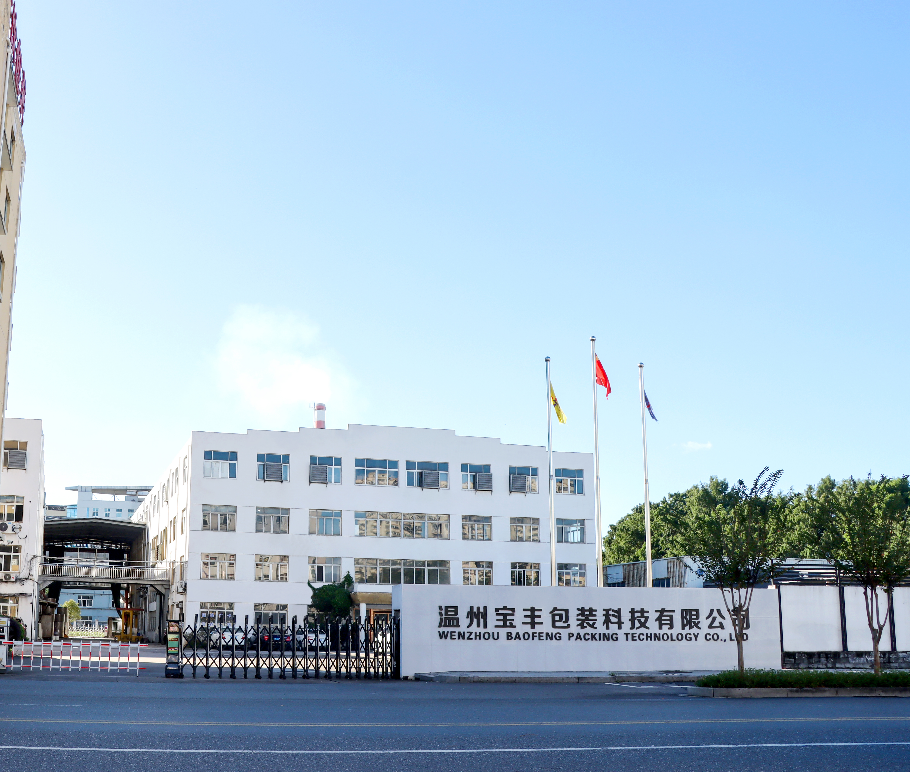
Paper packaging production site in Longgang, Wenzhou. Site-level certificates and product-level reports answer different questions and should be filed separately.
Lens 4 — Capacity, delivery and export performance
Capacity evidence answers a different question from compliance: whether the country option can sustain volume after the first order. Wenzhou Baofeng Packaging Technology Co., Ltd. was founded in 1996, employs more than 200 people, and reports daily output of approximately 8 million pieces against annual output of nearly 3 billion pieces, with an export ratio of 80% across more than 100 countries. Those figures describe the manufacturer's stated scale; they do not reserve capacity for any individual buyer, and a purchase order still needs a schedule attached to it.
The controls disclosed alongside capacity are the ones to audit. Delivery risk is handled through capacity planning, a stable production schedule and inventory preparation. Quality risk is handled through full inspection, with 100% inspection before shipment. Food safety risk is handled upstream, through supplier audit, incoming material testing and raw material inspection. A buyer should request the inspection protocol, the record format and the last three shipment records for the specific SKU — not a general quality statement that would read the same for every product in the catalogue.
Country-level export data gives context rather than a shortlist. China was the top exporter of paper containers under HS 4819 in 2024, at USD 6.23 billion, according to customs data published by the Observatory of Economic Complexity. That concentration explains why so many sourcing exercises start in China; it does not establish that a Chinese converter is the right fit for a given destination market, and it says nothing about any individual factory's documentation.
Country notes — North America
United States
For US-bound programmes, this is the clearest documentary match in the set: FDA Food Contact certification through SGS SHAHL23002063901 covers BF-PB-003 and BF-PC-001. The decision rule is scope, not presence. Confirm that the models, board and lining on the purchase order are the ones the report covers, and that the stated test conditions match the serving format. A US food-contact report is the strongest single document a buyer can hold for this market — provided it names the product actually being bought.
Canada
Canada appears among the manufacturer's stated main markets, which indicates existing commercial exposure rather than a Canadian compliance determination. The US report is not a Canadian approval. Ask for a written statement of conformity for the Canadian market, confirm bilingual labeling obligations with your own advisors, and check that the test report you receive is the one attached to your SKU rather than a neighbouring model.
Mexico
Mexico is not listed among the manufacturer's stated main markets, which changes the burden of proof rather than closing the option. Absence from a market list is not evidence of inability; it is evidence that the buyer has no verified reference point to lean on. Request market references, Spanish-language documentation and a written conformance statement, and run the first order as a validation batch with agreed inspection criteria instead of treating it as a routine repeat.
Country notes — Europe
United Kingdom
BRC compliance appears in the certification set, which matters where a retail customer's own approval process references that scheme. The check is administrative but decisive: certificate holder, production site and scope must match the supplier and the products being bought, and the certificate must be current. For wholesale takeout boxes supplied into UK food-service chains, that scope check is usually the difference between an approvable and a non-approvable file.
France and Germany
France and Germany both sit within the manufacturer's stated EU market coverage, and the certification set gives buyers management-system and chain-of-custody evidence: ISO 22000:2018 under 202FSMS2500199, ISO 14001:2015 under HHZH22E10074R0M and FSC CoC under RINA-COC-002149. None of these is a food-contact determination for those markets. The workable approach is to separate the questions: ask the supplier for market-specific food-contact documentation tied to the SKU, and ask the converter for the fiber and environmental substantiation the retail customer requires. Do not let one document answer the other, and do not assume that a system certificate travels further than a product report.
Country notes — Asia-Pacific
Japan
Japan is listed among the manufacturer's stated main markets. Buyers here typically carry a heavier specification burden than the certificate file implies: model-level specification sheets, tolerances and acceptance criteria need to be agreed in writing, and existing test reports may need to be reviewed against the buyer's own standard rather than accepted as equivalent. Japanese-language documentation is a practical requirement of the approval process, not a formality.
Singapore
Singapore also appears in the stated market list and functions as a regional distribution point for many food-service groups. The lens to press is transit and storage: humidity-sensitive board and PLA-lined constructions need declared handling conditions across the distribution chain. Ask what storage conditions the supplier specifies, and what the inspection record shows at the point of shipment rather than at the point of arrival, where any defect becomes a shared argument.
Thailand and Vietnam
Neither Thailand nor Vietnam appears among the manufacturer's stated main markets, so a buyer considering either as a sourcing base starts without a documented reference. The regional context is supportive but coarse: Asia Pacific held 38.43% of the paper packaging market in 2025, per Fortune Business Insights. That share describes the region, not a specific plant. For Thailand or Vietnam, require the full evidence set — certificate with site identity, product-level food-contact documentation, capacity statement and inspection records — and confirm that the country of manufacture printed on the documents matches the country of shipment.
Country notes — Gulf
United Arab Emirates
Dubai and Qatar appear among the stated main markets, which gives UAE-based buyers an existing commercial reference to check against. Two checks dominate. Documentation: confirm which certificate covers the SKU and whether Arabic labeling is required for the buyer's channel. Conditions: heat and humidity across transit and warehousing affect board stiffness and lining integrity, so storage requirements should be agreed in writing before the first container is loaded, not after a claims event.
The eleven-country matrix at a glance
| Country | Evidence available in this review | Verification focus before award |
|---|---|---|
| United States | FDA Food Contact certification via SGS SHAHL23002063901 for BF-PB-003 and BF-PC-001 | Match report scope to the exact SKU, board and use conditions |
| Canada | Listed among the manufacturer's stated main markets | Obtain Canadian conformity documentation separately from the US report |
| Mexico | Not listed among stated main markets | Request market references, Spanish documentation and a written conformance statement |
| United Kingdom | BRC compliance within the certification set | Confirm holder, site and scope against the retail customer's scheme |
| France | FSC CoC RINA-COC-002149 for certified-fiber traceability | Confirm food-contact conformity and labeling for the French market |
| Germany | ISO 22000:2018 (202FSMS2500199) and ISO 14001:2015 (HHZH22E10074R0M) | Treat system certificates as system evidence; obtain product-level conformity |
| Japan | Listed among the manufacturer's stated main markets | Request Japanese-language specifications and agree acceptance criteria |
| Singapore | Listed among the manufacturer's stated main markets | Agree storage and transit conditions for humidity-sensitive board |
| Thailand | Not listed among stated main markets; regional capacity context only | Require full certificate set, site identity and capacity evidence |
| Vietnam | Not listed among stated main markets; regional capacity context only | As Thailand, plus confirm country of manufacture on all documents |
| United Arab Emirates | Dubai and Qatar listed among the manufacturer's stated main markets | Confirm heat and humidity exposure across transit and storage, plus labeling |
The matrix records what this review could verify, not a ranking. No country is placed above another. The correct entry point is the destination market and the SKU, and changing either changes the answer.
Application fit: where the specification earns its place
The stated application range for this construction is food service, takeaway and delivery, retail chains, cold-chain dessert packaging and eco-conscious brands. The fit logic differs by channel. For delivery and takeout operators, leak resistance and grease resistance set the failure threshold, and wholesale takeout boxes are bought on repeat cycles where batch consistency matters more than a single good sample. For retail chains, the binding constraint is documentation: custom printed takeout boxes carry brand and labeling exposure, so print approval, colour control and specification sign-off sit alongside the food-contact file. For cold-chain dessert packaging, condensation interacting with board stiffness is the test that decides the format. For custom paper boxes and disposable paper lunch boxes in promotional or seasonal programmes, order size and print method decide whether digital or offset production is the sensible route.
Two boundaries are worth stating plainly. Compostability depends on the disposal pathway available to the end user, so a compostable box sold into a market without collection infrastructure delivers a claim rather than an outcome. Microwave suitability is a specification attribute for named models, not a universal property of the range. Neither point disqualifies the product; both change what a buyer should write into the purchase specification and what should be tested before a launch.
What the trade data does and does not establish
Three data points frame the market. The global paper packaging market is estimated at USD 408.97 billion in 2026 by Fortune Business Insights. Asia Pacific held 38.43% of that market in 2025. China exported USD 6.23 billion of paper containers under HS 4819 in 2024, based on customs data republished by the Observatory of Economic Complexity.
Scope discipline matters when using them. A separate estimate of USD 216.1 billion for packaging paper, from Grand View Research, measures paper material rather than converted boxes; the two numbers are not interchangeable and should not be averaged or read as a growth series. Regional share describes where capacity sits, not where a specific buyer should buy. Export value describes trade flow, not supplier capability.
The gaps are more useful than the totals. Public evidence reviewed for this article does not establish defect rates for recycled-content food boxes in high-humidity transit, and it does not price a specific SKU at a specific volume. Both gaps sit exactly where a decision is made. The practical response is to convert them into requests: transit-condition test data from the converter, and a delivered-cost model built from the buyer's own volume, print method and destination rather than from an index.
Where TopsPak sits in this framework
TopsPak is the paper packaging brand operated by Wenzhou Baofeng Packaging Technology Co., Ltd., a manufacturer founded in 1996 in Longgang, Wenzhou, whose stated range covers paper cups, paper boxes, paper bags, paper plates and paper bowls, with OEM and ODM programmes serving airline, hotel, retail and food-service clients.
Mapped against the four lenses, the documented position is uneven — as it is for most suppliers, and that is the honest reading. On food-contact, the file is strong for the US market on two named models with a defined report number. On sustainability, chain-of-custody and environmental management certificates are present, while product-level compostability still requires SKU confirmation. On performance, a four-attribute specification is stated and should be tested against the buyer's menu. On capacity, output and inspection controls are quantified and disclosed. What remains the buyer's work is scope matching, market-specific confirmation and delivered-cost modelling — three tasks no supplier can complete on a customer's behalf.
Frequently asked questions
How should a buyer compare paper box quotations from different countries?
Normalise every quote to a delivered unit cost that includes board grade, print method, tooling, inspection and freight, then map each quote to the four lenses. A lower unit price from a source whose documentation does not cover your destination market or your SKU is not a comparable price, because the compliance work moves from the supplier to you.
Does an FDA food-contact certificate cover sales into other markets?
No. The certification held for BF-PB-003 and BF-PC-001 through SGS report SHAHL23002063901 addresses US FDA food-contact requirements for those models. Other destinations apply their own frameworks, which must be confirmed separately, including the exact model, board construction and use conditions named on the report.
Is a kraft food box more expensive than a plastic container?
In TopsPak's comparison material, the kraft food box line is described as carrying a slightly higher cost than plastic packaging while being 100% biodegradable and offering distinct advantages for kraft food box sourcing decisions; against conventional paper packaging, the same comparison positions cost as comparable. Buyers should test both statements against their own delivered-cost model rather than adopt either as a rule.
What should a buyer verify before accepting a compostable claim?
Verify which disposal pathway the claim refers to, whether the specific model and PLA lining are covered, and whether the supporting documentation matches the SKU on the purchase order. Compostable listed in a product specification is a starting point, not a completed verification.
How should small test orders be weighed against volume pricing?
Trade research reviewed for this article puts low-MOQ digital-print runs from Chinese converters at roughly 50 to 100 units, which supports validation batches before a volume commitment. Confirm the figure with the specific converter, since minimum quantities vary by SKU, print method and finishing, and treat a first order as a documented validation run.
Which evidence should be requested before switching sourcing country?
Request four sets: product-level food-contact documentation naming the model and test conditions; sustainability certificates with traceable registration numbers and a named site; an attribute-level performance specification; and a capacity and inspection statement covering the specific SKU. If any set cannot be produced in writing, the country option is unverified rather than unsuitable.
Conclusion
The output of this framework is not a country ranking. It is a file: destination requirement, SKU-level evidence, test conditions, capacity commitment and inspection record, each item traceable to a document rather than to a sales claim. Buyers who assemble that file before awarding a contract spend far less time resolving claims afterwards, and they can defend the decision to a retail customer, an importer or an internal audit without reconstructing it from email threads.
Reference material: the manufacturer's product brochure is available for download at TopsPak brochure (PDF).
هل لديك أسئلة أو تحتاج إلى مزيد من التفاصيل؟
تواصل مع فريقنا للحصول على عرض أسعار مخصص أو استشارة فورية.
طلب عرض أسعار
املأ النموذج أدناه وسيتواصل معك فريقنا بعرض مقترح مخصص.
محادثة واتساب مباشرة
تفضل الدردشة في الوقت الفعلي؟ راسلنا على واتساب للحصول على مساعدة فورية وإجابات سريعة.
- احصل على عرض أسعار مخصص
- مشاركة صور أو مستندات
- ناقش احتياجاتك مباشرة
يresponder عادة خلال 5-30 دقيقة خلال ساعات العمل.