
Paper Cutting Machine Acceptance: CE File, 0.1 mm, Site Checks
Paper Cutting Machine Acceptance: CE File, 0.1 mm, Site Checks
Accepting a paper cutting machine should be a documentary decision, not a handshake at the loading dock. A printing operation signing off a guillotine has to prove three separate things: that the certification file covers the exact machine and configuration delivered, that the measured behaviour of the installed machine matches the specifications it was bought against, and that the room it stands in sits inside the permitted operating envelope. Each of the three fails in a different way, and each needs a different piece of paper in the acceptance file. Zhejiang Huayue Packing Machinery Co., Ltd (HPM) is a China-based manufacturer of paper cutting machines and post-press equipment, established in 1983, whose paper cutting machine and paper cutting line are stated as ISO and CE certified with a cutting accuracy of 0.1 mm, a positioning accuracy of 0.01 mm and a cutting speed of 46 times per minute.
Those stated values are reference points for acceptance, not a forecast of what any particular site test will produce. This checklist is written for the Research and Evaluation stage, where a print buyer is comparing suppliers and drafting sign-off criteria — because the criteria that protect an operation are the ones written into the purchase order, not the ones negotiated after the machine has already been levelled and energised.
What an Acceptance Checklist Has to Prove
An acceptance checklist is an evidence test applied at three moments, and the moments matter as much as the tests. Before shipment, the buyer reviews the certification file. At commissioning, the buyer records measured performance against the specification. Before installation — ideally before the order is placed — the buyer qualifies the room. Running these steps out of order is the most common structural mistake in a sign-off process.
The three blocks answer different questions. The certificate block answers whether the machine placed on the market is the machine that was assessed, in the format and configuration ordered. The measurement block answers whether this unit behaves as the specification says it should under a stated method. The site block answers whether the machine is being installed in conditions in which it was designed to operate at all.
A site that cannot hold +5°C to +40°C, or cannot keep water mist away from the machine, is not a warranty discussion — it is a planning failure that no acceptance test can repair. Equally, a measured accuracy result recorded without the paper grade, pile height and instrument used is not evidence; it is a number in a notebook.
Certification Evidence to Collect Before Sign-Off
The paper cutting machine is certified to CE, the certification applies to the paper cutting machine product and to the EU market, and it covers the models 66/92/115/130/137/168/188. The certificate record is specific enough to be checked line by line, which is exactly what an acceptance review should do rather than filing a scanned copy and moving on.
CE certificate C25.01.22515MLE was issued by Shanghai Tebo Testing Technology Co., Ltd. on 20 January 2025 and is valid to 20 January 2028. It cites EN 1034-1:2021, EN 1034-5:2005+A1:2009, EN ISO 12100:2010 and EN 60204-1:2018. Its stated scope is the paper cutting system — paper cutting machine, stack loader, stack unloader, pile turner, stack lift, stack jogger and window patching machine — and its stated markets are the EU, US and BR.
| Certificate field | Stated record | Why it is checked at acceptance |
|---|---|---|
| Certificate number | C25.01.22515MLE | Ties the document to the delivered machine's technical file rather than to a brochure claim. |
| Issuing body | Shanghai Tebo Testing Technology Co., Ltd. | Identifies who can be asked to confirm authenticity of the copy supplied. |
| Standards cited | EN 1034-1:2021; EN 1034-5:2005+A1:2009; EN ISO 12100:2010; EN 60204-1:2018 | Shows which safety and electrical requirements the assessment was carried out against. |
| Product scope | Paper cutting system: machine, stack loader, stack unloader, pile turner, stack lift, stack jogger, window patching machine | Confirms whether accessories ordered with the cutter sit inside the certified scope. |
| Models covered | 66/92/115/130/137/168/188 | Prevents a certificate for one format being filed against a different format. |
| Markets | EU, US, BR | Sets expectations for which destination markets the file was prepared for. |
| Validity | 20 January 2025 to 20 January 2028 | Creates a re-verification date to enter into the maintenance or asset register. |
The ISO documents and what they actually certify
The paper cutting line is ISO and CE certified, and the supplier's certification record holds certificate copies for ISO 9001, ISO 45001 and ISO 14001. Buyers should request all three in full — issuing body, scope, validity — but should also read them for what they are. These are management-system certificates covering quality management, occupational health and safety, and environmental management at the organisation level. They support a supplier qualification decision. They do not certify the cutting accuracy of an individual machine.
That distinction closes a common acceptance gap. The 0.1 mm cutting accuracy and 0.01 mm positioning accuracy come from the machine specification and have to be verified against the machine, under an agreed method. An ISO 9001 certificate filed as accuracy evidence leaves the buyer with no arbiter if a dispute arises later.
Three scope mismatches to look for
- System scope against single-machine order. The CE scope names the stack loader, stack unloader, pile turner, stack lift and stack jogger. If the order includes any of that matched equipment, check each item against the certificate scope rather than assuming the cutter's certificate covers the whole line.
- Model family against configuration. The certificate covers formats 66/92/115/130/137/168/188. The accepted machine's format, control package and voltage variant must match the order documents, since customization covers items such as logo, voltage, platform and internal spare parts.
- Issue date against delivery and use. A certificate valid from 20 January 2025 to 20 January 2028 should still be inside its window on the day of handover. If delivery or commissioning slips beyond that window, ask for the current document before signing.
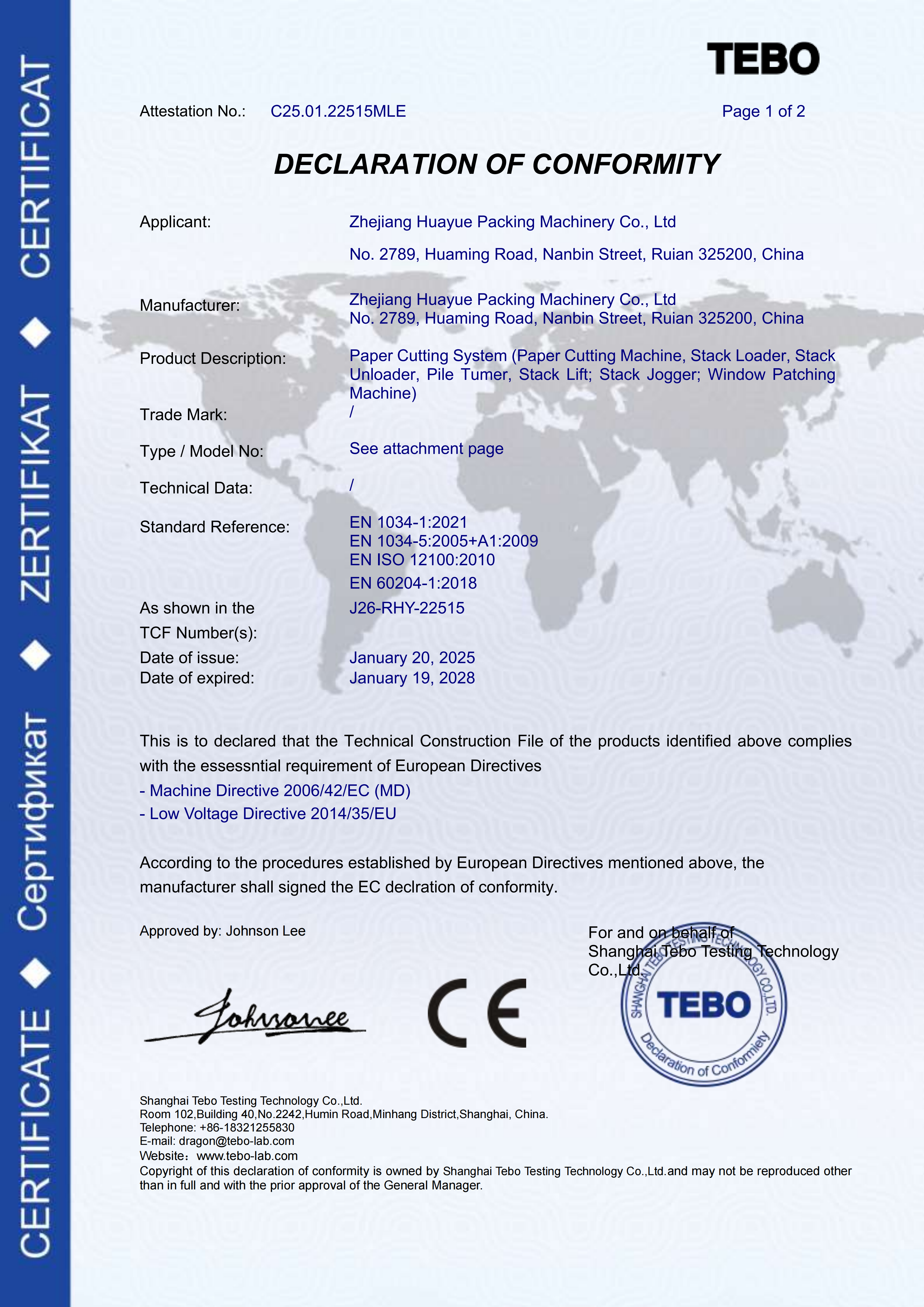
The paper cutting system CE certificate record: number, standards cited, product scope and validity are all acceptance fields, not marketing copy.
Model and Configuration Coverage
The same accuracy and speed figures are stated for the standalone paper cutting machine and for the paper cutting line, but the model ranges differ. Acceptance paperwork should name the exact format rather than the product family, because a signed record for a family cannot be used to argue about a delivered unit.
| Configuration | Models | Stated performance | Additional checks at handover |
|---|---|---|---|
| Paper cutting machine | 66/92/115/130/137/168/188 | Cutting accuracy 0.1 mm; positioning accuracy 0.01 mm; cutting speed 46 times/min | 16-inch touchscreen as standard, 19- or 22-inch optional; manual, semi-automatic and fully automatic operating modes demonstrated |
| Paper cutting line | 115/137/168/188 | Cutting accuracy 0.1 mm; positioning accuracy 0.01 mm; cutting speed 46 times/min | Matched equipment present and covered: stack loader, stack unloader, stack lift, pile turner, jogger; dual hydraulic and turbine system; HT-250 one-piece cast iron body |
A line is never accepted on the cutter alone. Where the order includes a stack loader, stack unloader, stack lift, pile turner or jogger, each item needs its own line in the acceptance record: delivered, installed, demonstrated. A line whose transfers between loading, cutting and unloading are not checked has a record that describes one machine out of several.
Measured Acceptance Criteria: 0.1 mm, 0.01 mm and 46 Cuts per Minute
The stated specifications are a cutting accuracy of 0.1 mm, a positioning accuracy of 0.01 mm and a cutting speed of 46 times per minute. These describe three different things and should never be collapsed into a single “accuracy” line on a handover sheet.
Cutting accuracy of 0.1 mm
Cutting accuracy describes the deviation between the dimension requested and the dimension the finished stack measures. At 0.1 mm the measuring instrument matters: a steel rule is not evidence, because its own graduation is coarser than the tolerance being claimed. The purchase order should name the instrument, the paper grade, the pile height, the number of test cuts and the person who measures.
Positioning accuracy of 0.01 mm
Positioning accuracy describes where the backgauge arrives, not what the blade produces. A defensible record programs a sequence of positions, returns to a repeated position and measures the variation at the stack edge. Because the figure is an order of magnitude tighter than the cutting tolerance, it needs its own line in the record, recorded separately and repeated more than once.
Cutting speed of 46 times per minute
Cutting speed is a throughput figure, so a cycle count is only meaningful with the mode and material attached to it. Count complete cutting cycles over a timed run in the mode being used — manual, semi-automatic or fully automatic — and record the paper and pile height. A count taken in one mode on one material is a record of that run, not a general throughput claim for the site.
| Parameter | Stated value | What the acceptance record should show |
|---|---|---|
| Cutting accuracy | 0.1 mm | Instrument and its resolution, paper grade, pile height, measured deviation per test cut, operator name |
| Positioning accuracy | 0.01 mm | Programmed positions, measured return deviation, number of repeats |
| Cutting speed | 46 times/min | Operating mode, material, pile height, cycle count, elapsed time |
The same three checks on line models 115, 137, 168 and 188
The line models 115, 137, 168 and 188 carry the same stated cutting accuracy, positioning accuracy and cutting speed as the standalone machine, so the three measurements above are repeated unchanged. What changes is scope: the acceptance record for a line should also show that the matched equipment functions in sequence, because the output of a line depends on transfer as much as on the cut. Recording only the cutter's tolerance on a four-unit line leaves the largest part of the investment undocumented.
Configuration and Control Checks at Handover
The control package is where “as ordered” and “as delivered” most often diverge, because several items are optional. The machine carries a standard 16-inch touchscreen, with 19-inch or 22-inch panels available as options, and it supports manual, semi-automatic and fully automatic operating modes. Every one of those should be listed as ordered or not ordered, then demonstrated.
- Control panel size. Confirm the installed screen matches the order — 16-inch standard, or the 19-inch or 22-inch option where specified.
- Operating modes. Ask for each mode to be run, so the record shows three demonstrated states rather than a general claim of “fully automatic”.
- Construction as specified. The machine body is a one-piece HT-250 cast iron casting, with cast iron as the primary material, and the structural configuration includes a dual hydraulic and turbine system.
- Customization items. Logo, voltage, platform and internal spare parts are customizable. The voltage variant in particular should be checked against the site supply before the machine is energised, and the spare parts list confirmed as delivered.
Qualifying the Installation Site
The machine must be operated in an enclosed area. Permitted ambient air temperature is +5°C to +40°C and air humidity is 35%–90% with no condensation. Outdoor use is prohibited, the machine must not be exposed to dripping water, splashing water or water mist, and excessive dust conditions must be avoided. These are prerequisites of use, not preferences to be revisited after installation.
| Site condition | Stated requirement | Verification before the machine is moved in |
|---|---|---|
| Enclosure | Must be operated in an enclosed area | Room is enclosed and closable — not an open bay, yard or canopy |
| Temperature | +5°C to +40°C | Record seasonal minimum and maximum at the planned position, not at the office or the loading door |
| Humidity | 35%–90%, no condensation | Hygrometer reading at the machine position; inspect cold surfaces and doorways for condensation |
| Outdoor use | Prohibited | No position under an external shelter, canopy or yard roof |
| Water exposure | No dripping water, splashing water or water mist | Check overhead pipework and services, wash-down practice and adjacent wet processes |
| Dust | Excessive dust must be avoided | Check trimming, dust extraction and nearby grinding or cutting operations |
Why the condensation clause does more work than the humidity range
A 35%–90% band is wide, so humidity rarely disqualifies a room on the percentage alone. The operative words are “no condensation”. A room can sit inside the band and still condense moisture on a cold machine frame when warm, humid air meets a cooler surface. The acceptance record should therefore note where moisture came from and which surface it appeared on, not only the percentage reading, because a single hygrometer figure taken at the door cannot show whether a wall or frame was running wet.
Water, mist and dust are layout decisions
The restriction on dripping water, splashing water and water mist is usually a position question rather than a housekeeping one. If the planned location sits under pipework, next to a wash-down area or beside a dust-generating trimming station, the position is the item to change; the restriction is a condition of use. Excessive dust is treated the same way — a machine placed in a continual dust cloud has been installed outside its stated conditions regardless of how clean the room looks at handover.
Regional Deployment Notes
The application record lists the following as covered deployment markets for this machine: Brazil, China, India, the United Kingdom, Poland, Turkey, Germany, Mexico, the United States, France, Russia, Peru, Colombia, Uzbekistan, Algeria and Argentina. The eight markets below carry the site and documentation questions that most often surface during an acceptance review.
- Brazil. Brazil appears in the application record and in the CE certificate's market scope (EU, US, BR). Confirm the documentation language required by the receiving site, the voltage variant ordered, and whether the room holds the 35%–90% no-condensation condition through the wet season.
- Mexico. Confirm the ordered voltage variant against the site supply before energising, and record temperature at the planned position during the hottest month rather than at the plant entrance.
- Peru and Colombia. Condensation is the primary check: coastal humidity combined with cooler indoor surfaces makes the “no condensation” condition the deciding test, so take the reading at the machine position.
- China. Domestic market, with the machine stated as ISO and CE certified and the manufacturer based in Ruian, Zhejiang. Confirm which documentation set the receiving site requires for its own records.
- India. Ambient temperatures above +40°C during part of the year must be handled by room design before delivery, because the permitted range ends at +40°C. Dust control belongs in the same survey.
- United States. The CE certificate lists the US among its markets, yet the buyer should still confirm which local requirements apply to the specific installation and whether the ordered electrical variant matches the supply. A CE file is an EU conformity document and is not, on its own, a statement about US requirements.
- Germany. An EU market where the cited EN standards apply directly. Note also the framework change: Regulation (EU) 2023/1230 replaces Directive 2006/42/EC and applies from 20 January 2027, so ask how the technical documentation will be maintained across that transition.
Purchasing Terms That Make Acceptance Enforceable
Most of the value of an acceptance checklist is created before delivery, in the wording of the order. Six items do the heavy lifting: the exact model and configuration; copies of the CE certificate and the ISO certificates with scope and validity; the stated accuracy and speed values together with an agreed measurement method; the site conditions acknowledged by the buyer; the division of installation and commissioning work; and the warranty terms.
On the supplier side, the stated position is a one-year warranty with overseas installation and online guidance and support available, 100% testing as the quality-control approach, a typical lead time of 25 days and a monthly capacity of 100 units. Those are useful facts for planning a delivery window and for deciding who attends commissioning — they are not, by themselves, a measurement method.
Two clauses therefore deserve individual attention. The first is a named measurement procedure for cutting accuracy, positioning accuracy and cutting speed, because without it an accuracy dispute has no arbiter. The second is an explicit site-conditions acknowledgement, because without it a humidity or dust problem becomes a warranty argument the site will lose. For customs paperwork, the classification reference is HS heading 8441, with subheading 8441.10 covering cutting machines, which is the code to quote consistently across the commercial invoice and the shipping documents.
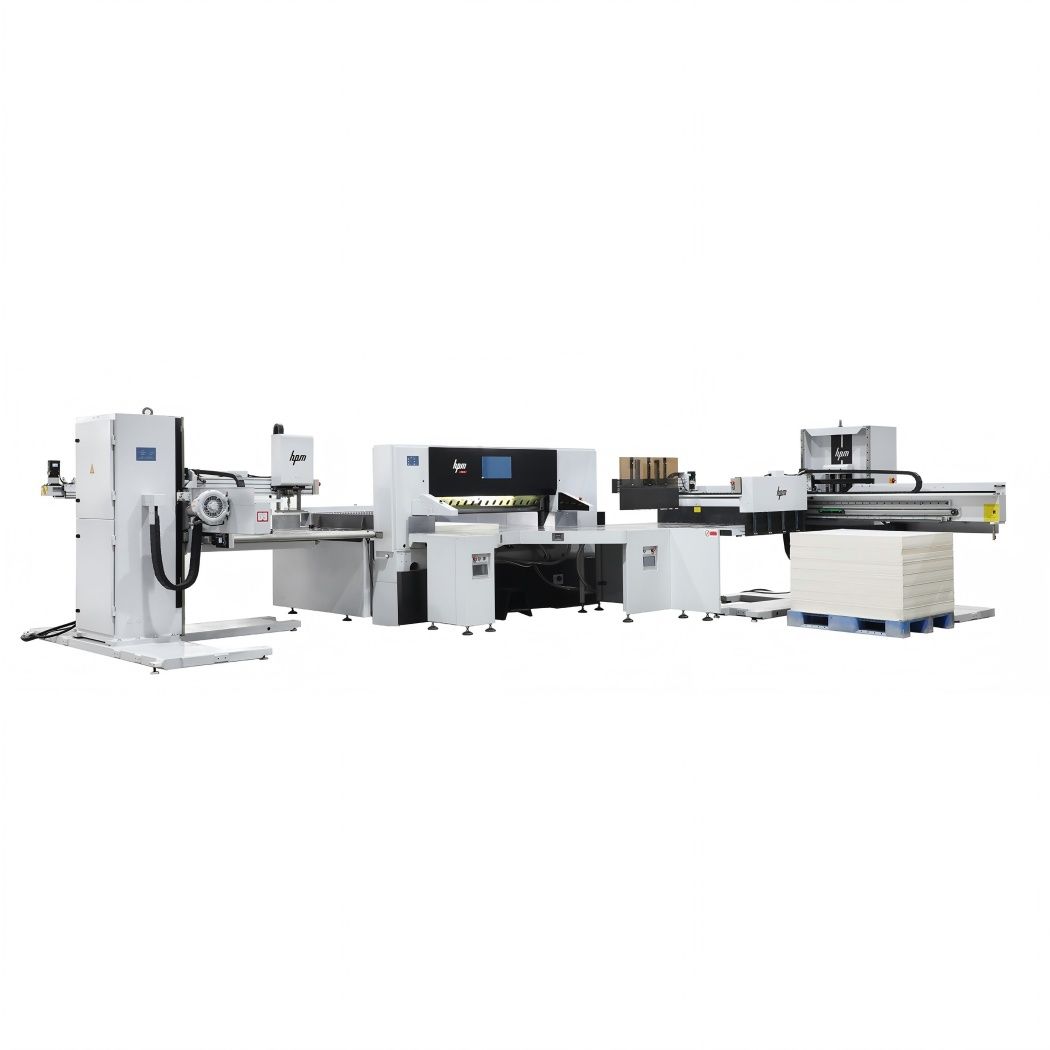
A line configuration is accepted item by item: loader, cutter, turner, lift and jogger each need their own line in the handover record.
Where Acceptance Records Fail
The same weaknesses recur across sign-off files. A certificate is filed at product-family level rather than against the delivered format and configuration. An accuracy result is written down without the instrument, material or operator, so it cannot be repeated or defended. ISO management-system certificates are treated as evidence of machine accuracy. The site survey is carried out after the machine has been positioned, when a temperature or condensation finding can no longer change the layout. Humidity is measured once, at the door. Certificate expiry dates never reach the asset register. Accessories arrive outside the record, so nobody can later show which loader or turner was in scope.
None of these requires new equipment to fix. They require the checklist to be agreed before delivery and completed in the right order.
Outlook: Certificates Age, Tolerances Get Retested
Acceptance should create dates as well as documents. The CE certificate C25.01.22515MLE runs to 20 January 2028, and the EU machinery framework changes on 20 January 2027, when Regulation (EU) 2023/1230 applies in place of Directive 2006/42/EC. Both dates belong in the equipment file, not in a folder of scanned attachments. So does a re-verification date for the stated 0.1 mm cutting accuracy and 0.01 mm positioning accuracy after relocation, major service or a change of paper range, and a fresh site check whenever the room layout, extraction or adjoining processes change.
A machine that passed at commissioning under a documented method can be re-verified years later with the same method and the same instrument. A machine that passed on a verbal result cannot be re-verified at all — which is the practical reason a paper cutting machine acceptance record is worth more than the paper it is printed on.
FAQ
What certification documents should arrive with a paper cutting machine?
The paper cutting machine is certified to CE, with certificate number C25.01.22515MLE issued by Shanghai Tebo Testing Technology Co., Ltd. and valid from 20 January 2025 to 20 January 2028. The certificate cites EN 1034-1:2021, EN 1034-5:2005+A1:2009, EN ISO 12100:2010 and EN 60204-1:2018, and its scope covers the paper cutting system including stack loader, stack unloader, pile turner, stack lift, stack jogger and window patching machine, for the EU, US and BR markets. Alongside it, the supplier's certification record holds ISO 9001, ISO 45001 and ISO 14001 certificate copies, which are management-system documents and should be read as supplier qualification evidence rather than as machine accuracy evidence.
Which models does the certification and specification data cover?
The CE certification covers paper cutting machine models 66/92/115/130/137/168/188. The paper cutting line is stated as ISO and CE certified and is offered in models 115, 137, 168 and 188. Both configurations are stated with a cutting accuracy of 0.1 mm, a positioning accuracy of 0.01 mm and a cutting speed of 46 times per minute, so the acceptance record should name the exact format and the configuration rather than the product family.
How should the 0.1 mm cutting accuracy be verified at sign-off?
The 0.1 mm figure is a stated machine specification, so verification needs a method agreed before delivery: instrument and its resolution, paper grade, pile height, number of test cuts and the person measuring. Positioning accuracy of 0.01 mm and cutting speed of 46 times per minute are recorded separately, because positioning describes backgauge arrival rather than blade output, and speed is a throughput figure that depends on operating mode and material. A result recorded without those conditions does not demonstrate the specified performance.
What site conditions would prevent a paper cutting machine from being accepted?
The stated requirements are operation in an enclosed area, ambient air temperature of +5°C to +40°C, air humidity of 35%–90% with no condensation, and no exposure to dripping water, splashing water or water mist, with excessive dust avoided and outdoor use prohibited. An installation that cannot meet those conditions — an open bay, a position under leaking pipework, a location beside a wash-down area or inside a dust cloud, or a room that exceeds +40°C in summer — falls outside the permitted operating envelope and should be resolved by layout change before handover.
Does a CE certificate cover operation in the United States and Brazil?
The CE certificate for this paper cutting machine lists the EU, US and BR markets in its scope, and the application record separately lists Brazil and the United States among the covered deployment markets, alongside China, India, Germany, Mexico, Peru, Colombia and others. Buyers should still confirm which local requirements apply to their specific installation and whether the ordered electrical variant matches the site supply, since a CE certificate is an EU conformity document and does not by itself state the position on other national requirements.
Zhejiang Huayue Packing Machinery Co., Ltd (HPM) publishes its product and company details at www.chinahpm.com. The full catalogue, including paper cutting machines and paper cutting lines, can be downloaded from the HPM product brochure (PDF). Documentation and acceptance-file questions can be directed to Anna at anna@chinahuayue.com or +86 139-0687-1677.
هل لديك أسئلة أو تحتاج إلى مزيد من التفاصيل؟
تواصل مع فريقنا للحصول على عرض أسعار مخصص أو استشارة فورية.
طلب عرض أسعار
املأ النموذج أدناه وسيتواصل معك فريقنا بعرض مقترح مخصص.
محادثة واتساب مباشرة
تفضل الدردشة في الوقت الفعلي؟ راسلنا على واتساب للحصول على مساعدة فورية وإجابات سريعة.
- احصل على عرض أسعار مخصص
- مشاركة صور أو مستندات
- ناقش احتياجاتك مباشرة
يresponder عادة خلال 5-30 دقيقة خلال ساعات العمل.