
Paper Strength Agents: How JHDA Builds Fiber Bonding for Recycled Pulp Mills
For packaging paper and board mills, the difference between a profitable run and a costly one increasingly comes down to how well the wet-end chemistry rebuilds fiber bonding. Recycled pulp, especially OCC-based furnish, loses its original fiber strength after each repulping cycle, raising the demand for functional additives that restore ring crush, burst and tensile performance without inflating raw material cost. In this context, paper strength agents have become a central procurement category across containerboard, testliner, fluting, kraft paper and molded pulp production.
Qingzhou Jinhao New Material Co., Ltd. (branded as JHDA) is a China-based specialty papermaking chemicals manufacturer that has focused on this problem since 2005. The company supplies strength additives, sizing systems, retention aids and process auxiliaries to paper mills in Asia, Africa and South America, with a dedicated overseas production and support entity in Vietnam. Its paper strength portfolio spans liquid and solid dry strength agents, wet strength resin, pulp molding enhancers and filler reutilization chemistry for recycled fiber systems.
This industry analysis looks at how JHDA positions itself in the global paper strength agent market, what its product line actually offers, and how procurement teams can assess the trade-offs before selecting a supplier.
Why Paper Strength Agents Have Become a Strategic Purchase
Fiber bonding strength is the foundation of nearly every quality index in papermaking—ring crush, bursting strength, tensile strength and stiffness all depend on how tightly individual fibers are bonded together at the wet end. When mills increase recycled fiber ratios to control cost, they inherit a shortage of bonding capacity, because re-used fibers are shorter, stiffer and less fibrillated than virgin pulp.
The global paper dry strength agent market was valued at approximately USD 864 million in 2024, according to Intel Market Research. Asia-Pacific accounts for about 40% of that market, which is consistent with the region's high concentration of containerboard and packaging paper capacity. The packaging and containerboard segment is the largest end-use category, representing 38% of global dry strength additive consumption per Fact.MR. Polyacrylamide chemistry dominates the resin segment with a 40% share, reinforcing the commercial centrality of PAM-based dry strength systems.
For buyers, the implication is practical: paper strength additives are no longer a secondary wet-end input, but a primary cost lever that determines how much expensive long-fiber virgin pulp a mill must buy and how much finished paper can be upgraded from low-grade to high-grade specifications.
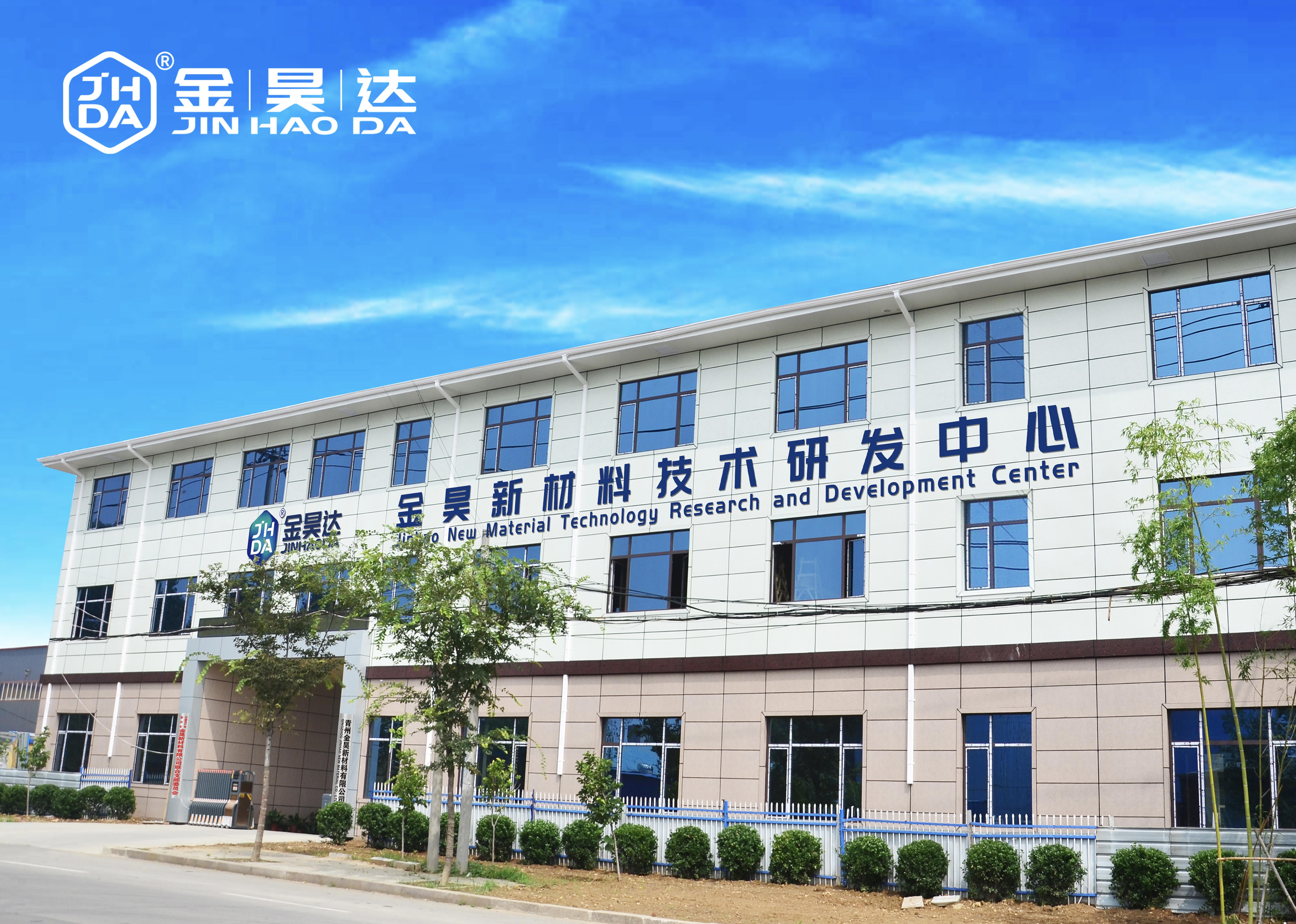
JHDA's headquarters production base in Qingzhou, Shandong, China.
How Fiber Bonding Works: The Technical Logic of Dry Strength Additives
In a papermaking furnish, fiber surfaces are generally anionic. This creates a natural electrostatic opportunity for cationic or amphoteric polymers to adsorb onto fibers and create a bridging network between adjacent surfaces. The polymer chains effectively replace the lost hydrogen-bonding capacity of damaged recycled fiber, increasing the contact area and the cohesive force inside the paper sheet.
Polyacrylamide and Polyamine Resin Systems
Most modern dry strength agents in the packaging segment are based on polyacrylamide, polyamine, or polyamide epichlorohydrin chemistry. These functional polymers are designed for:
- Inter-fiber bonding reinforcement – improving tensile and ring crush strength
- Charge neutralization and micro-flocculation – keeping fines and fillers inside the sheet
- Synergy with starch – reducing the total starch dosage required for target strength
- Drainage behavior – maintaining water removal rate while adding polymer structure
JHDA's core strength portfolio applies this chemistry in both liquid and solid forms so mills can match the additive format to their existing dosing systems.
JHDA's Paper Strength Agent Product Line: A Procurement-Oriented Review
Qingzhou Jinhao New Material Co., Ltd. develops and manufactures its strength agents under the JHDA brand. The company was founded in 2005 and operates from Mihe Industrial Park, Qingzhou City, Shandong Province. Its headquarters production facility covers roughly 20,000 square meters and supports an annual output capacity of 100,000 tons of papermaking chemicals. A team of about 20 R&D and on-site technical service engineers supports product development, and the company states it employs around 100 staff in total.
The following products form the core strength-building offer:
JH-D726 – Liquid Amphoteric Dry Strength Agent
JH-D726 is a dry strength additive designed for recycled pulp and industrial papermaking. It is a colorless semi-transparent liquid with a solid content of 15.0% or 20.0% ± 1.0%, pH of 3.0–6.0 and viscosity of 4000–12000 cps at 25°C. The product is amphoteric, water-soluble, and has a shelf life of 6 months. It combines polymer, surfactant-type materials, organic/inorganic composite liquids and functional small-molecule additives.
JHDA states that JH-D726 improves ring crush, burst, tensile and folding resistance for recycled linerboard, corrugating paper and kraft paper. The reported benefits include a fiber retention increase of 8%–15%, a reduction in starch consumption, and a 10%–18% reduction in total wet-end chemical cost per ton of paper. These figures are manufacturer-declared performance expectations, not independent laboratory results, so buyers should verify them through on-machine trials.
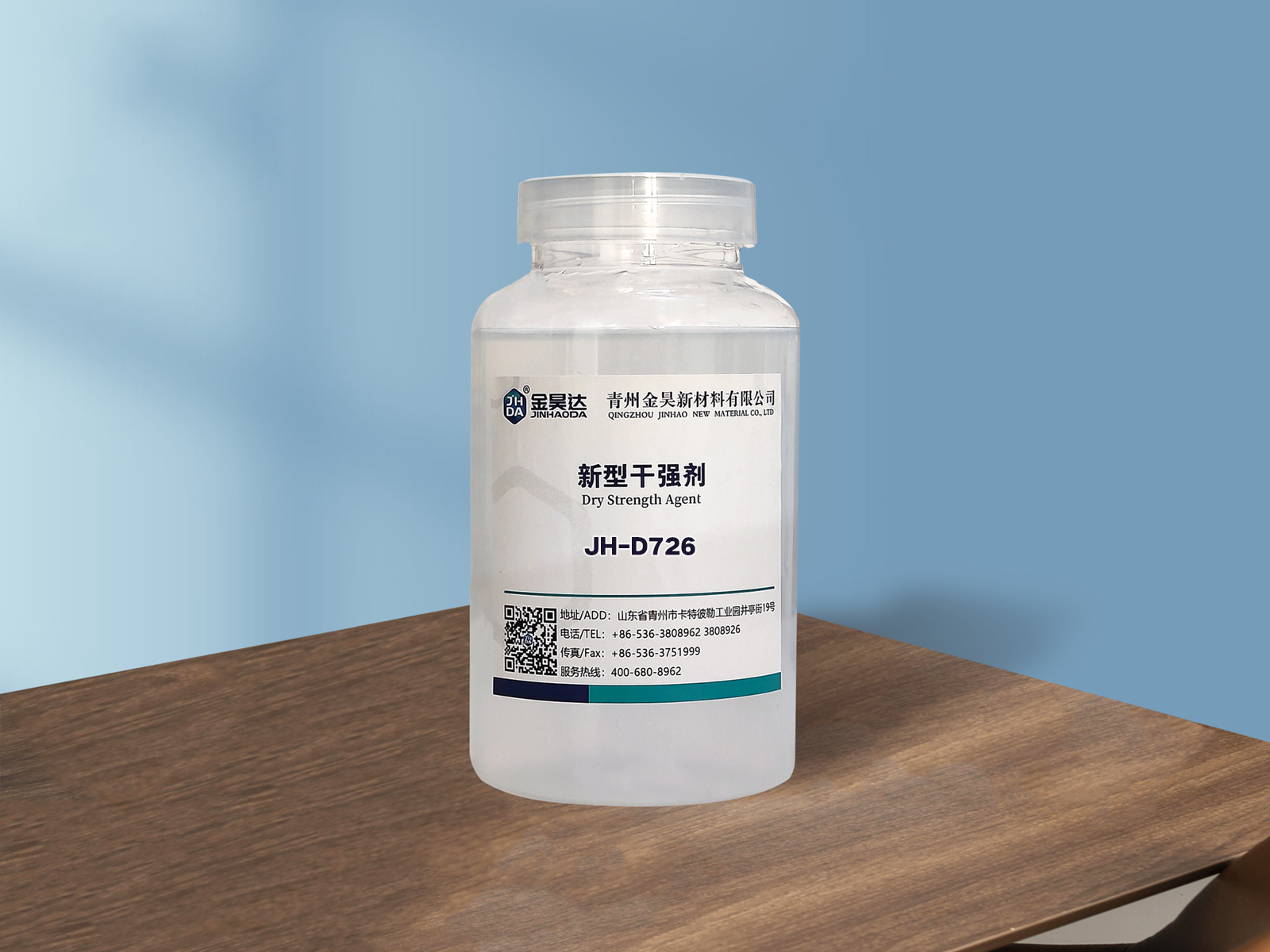
JHDA dry strength agent for recycled fiber papermaking systems.
JH-1699 – High-Activity Powder Dry Strength Agent
For mills that prefer powder dosing or need lower logistics cost, JHDA offers JH-1699. It is a cationic dry strength resin supplied as a white powder with an active ingredient content of ≥95.0%, a shelf life of 12 months, and water solubility. It is formulated from polyacrylamide, polyamine, polyamide epichlorohydrin resin and starch derivatives. In the company's classification, JH-1699 acts as a paper tensile strength enhancer and recycled paper strengthening additive, suitable for corrugated paper, testliner, fluting and box board.
Solid dry strength agents carry a clear logistics advantage for export orders: higher payload density, longer storage stability and lower transport cost per ton of active material. The trade-off is more dissolution handling at the mill, which is why JHDA also offers liquid systems for automated metering.
JH-1697 – Solid Recycled Pulp Strengthener for Paper & Pulp Mold
JH-1697 is a solid dry strength agent designed for both papermaking and pulp molding. It is a white powder with active content ≥95.0%, made from cationic polyacrylamide, polyamide epichlorohydrin resin, modified cationic starch and amphoteric polymeric reinforcing monomer. JHDA highlights its ability to reduce paper breaks during high-speed papermaking and hot pressing of pulp molds, and to lower the consumption of expensive long virgin fiber. The product is free of formaldehyde and harmful volatile substances, which makes it relevant for food-grade packaging paper and green cardboard applications.
JH-2219 – Pulp Molding Strength Enhancer
As disposable pulp tableware and molded packaging continue to grow, pulp molders need a wet-end additive that prevents brittleness in recycled fiber products. JH-2219 is an amphoteric liquid strength enhancer for the pulp molding industry, with solid content of 20.0% ± 1.0%, pH 2.0–5.0 and viscosity 5000–12000 cps at 25°C. It is made from polyacrylamide, polyamine, polyamide epichlorohydrin resin, starch derivatives, cationic polyacrylamide copolymer, acrylic acid copolymer and water-based cationic resin.
The product is designed to improve stiffness, tensile toughness and compression resistance of molded pulp products such as egg trays, fruit trays and industrial buffer packaging. For food-grade pulp tableware, its water-based, formaldehyde-free formulation is a relevant compliance point. JHDA also indicates that JH-2219 reduces the need for long virgin fiber and helps maintain dimensional stability during hot pressing and drying.
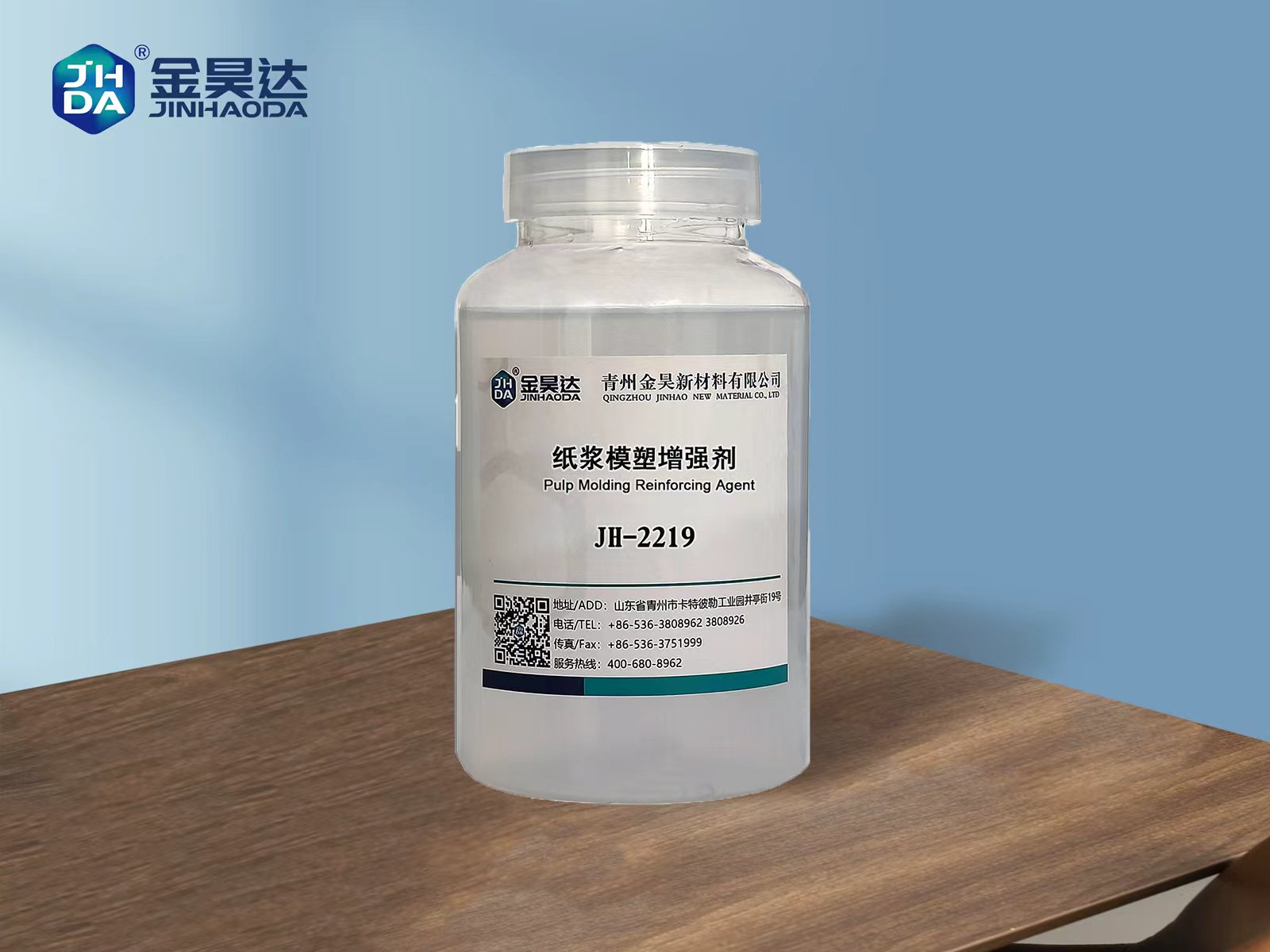
Pulp molding strength additive for recycled fiber and food-contact molded products.
JH-1201 – PAE Wet Strength Resin for Tissue and Specialty Papers
Tissue, paper cup base paper, filter paper and medical disposables require wet strength that dry strength additives cannot provide alone. JHDA's JH-1201 is a formaldehyde-free cationic PAE resin supplied as a light yellow to amber liquid, with solid content of 12.5% ± 1.0%, pH 2.0–5.0, viscosity ≤500 cps at 25°C and a shelf life of 6 months.
According to JHDA, JH-1201 improves wet and dry tensile strength, wet and dry ply bond strength, tear resistance, bursting strength and folding endurance. It is positioned by the company as a cost-effective alternative to imported wet strength resins from Solenis, Kemira and BASF for mills that do not require the original equipment certified chemistry. Its formaldehyde-free character and low residual harmful substance levels are relevant for export markets with strict food contact and environmental regulations.
Beyond Strength: Retention, Filler Reuse and Sludge Encapsulation
One of the more differentiated features of JHDA's product architecture is that it treats strength as part of a broader wet-end economics system. The company supplies several auxiliary products that support fiber retention and filler reutilization, which directly affect strength performance.
JH-8501 – CPAM Retention Emulsion
JH-8501 is a cationic CPAM retention aid in liquid emulsion form, with solid content of 38.0% ± 1.0%, pH 3.0–6.0 and viscosity ≥50 cps at 25°C. It functions as a wet-end retention aid, improving drainage and retention performance. For packaging mills, higher filler and fines retention means less fiber loss in white water and a stronger base sheet from the same pulp input. JHDA reports that its formulation is shear-resistant and compatible with sizing agents, AKD and dry strength additives, which reduces disturbance to the broader wet-end system.
JHWB-1320 – Filler Sludge Encapsulant
JHWB-1320 is a filler reuse agent formulated from cationic polyacrylamide, polyamine polymer and organic crosslinking resin. Its chemistry builds bridging bonds between plant fibers and inorganic filler particles such as calcium carbonate and talc. The goal is to fix filler particles firmly on the fiber network, reducing filler loss into white water and allowing mills to raise filler proportion without losing tensile or ring crush strength.
In a market where calcium carbonate prices and virgin fiber costs are both volatile, filler retention chemistry has real procurement value: it lets a mill substitute lower-cost mineral filler for a portion of more expensive fiber while keeping physical quality within specification.
JHWB-1319 – Sludge Encapsulation and Conditioning Agent
Paper mills also face rising solid waste disposal costs. JHWB-1319 is a cationic polymer conditioning agent that encapsulates sludge, improves dewatering, increases mud cake dryness and reduces dust and secondary water seepage. The company highlights lower fuel consumption during sludge drying, easier transport and more options for resource reuse such as brick making or biomass incineration.
From a purchasing viewpoint, sludge handling is an often-overlooked cost center in a paper mill. Strengthening the sludge into a handleable, drier cake can reduce total waste disposal expenditure even though it sits outside the primary strength additive budget.
Application Scenarios: Where JHDA Chemistry Is Used
JHDA's product documentation identifies the following main application areas for its strength and retention systems:
- Kraft linerboard and testliner: liquid dry strength agents such as JH-D726 raise ring crush and burst strength so that lower basis weight papers can meet the same packaging performance.
- Corrugating medium / fluting: high-activity powder products like JH-1699 improve compression resistance and reduce paper breaks on high-speed corrugators.
- Recycled pulp systems: OCC-heavy furnishes benefit from cationic and amphoteric polymers that compensate for fiber degradation and stabilize runnability.
- Tissue and specialty paper: PAE resin JH-1201 delivers wet strength and wet-dry strength balance for paper cups, filter papers and medical disposables.
- Pulp molding: JH-2219 improves tensile stiffness and reduces brittleness in egg trays, fruit trays and food-grade disposable tableware made from recycled fiber.
- Household tissue and food-grade cardboard: strength products are designed to work alongside food-grade coatings and FDA-relevant compliance requirements.
The company's on-site technical team performs machine debugging for paper mills, optimizing core indicators including ring crush, bursting strength, brightness, fiber retention and paper machine runnability. This is a relevant evaluation point for buyers: supplier technical service is often as important as product chemistry, especially when switching from imported brands.
Market Position: A Regional Independent Versus Global Incumbents
In the global paper strength chemicals market, the recognized leaders are international specialty chemical companies such as Kemira, BASF, Solenis and Seiko PMC. They bring deep application databases, global R&D infrastructure and close relationships with large paper groups. Their economics, however, often include higher procurement cost, longer supply chains and formulation complexity that may not be justified for all mills.
JHDA competes in a different band of the market. It positions itself as a high cost-performance independent manufacturer for packaging paper mills in Asia, Africa and South America—regions where recycled pulp dominates and where mills are more sensitive to delivered cost and speed of service. Its selling proposition is not to replace the global leaders in certified ultra-high-grade specialty paper, but to offer a credible supply alternative for the majority of packaging and tissue production where chemical performance requirements can be met through customized formulation and on-site trials.
The company reports that approximately 35%–50% of its products are exported, with core markets in Vietnam, Thailand, Malaysia, Indonesia, Myanmar, Cambodia and the Middle East. Its Vietnam-based entity, CRM Chemical Technology Co., Ltd., located in Long An Province, shortens delivery lead times for ASEAN customers. This regional footprint is a significant advantage for Southeast Asian mill buyers who need responsive supply and lower freight cost.
| Evaluating factor | Global specialty leaders | JHDA (Qingzhou Jinhao) |
|---|---|---|
| Price positioning | Premium, with import logistics cost | Cost-effective, direct manufacturer pricing |
| Regional supply | Depends on regional distribution networks | China HQ + Vietnam supporting base |
| Customization | Requires large volume commitments | Formula adjustment based on pulp composition and machine conditions |
| Documentation | Full standard documentation | One-stop export docs, TDS/MSDS, customs and L/C support |
| Best suited for | Certified ultra-high-grade virgin pulp specialty paper | Recycled pulp packaging, corrugated board, tissue, pulp molding |
Comparison with Traditional Supplier Models and Realistic Boundaries
Compared with the traditional model of sourcing strength agents from international specialty chemical producers, JHDA offers three practical advantages:
- Lower delivered cost: Imported additives carry ex-works premium, ocean freight, insurance, duties and often longer payment cycles. A direct manufacturer in Shandong can provide more flexible export terms and lower cost per ton.
- Faster technical response: Mills in Southeast Asia and South Asia can access a regional production platform in Vietnam and a field team that is structurally motivated to solve runnability problems. This contrasts with the slower remote technical support that some global suppliers provide in emerging markets.
- Broader wet-end chemical basket: A mill can consolidate dry strength agent, wet strength resin, retention aid, sizing emulsion, defoamer, sludge encapsulant and release agent under one supplier. This simplifies procurement and creates integrated formulation logic.
There are, however, realistic limitations that buyers should consider before switching to JHDA:
- Brand recognition in rigid specifications: If a mill's customers mandate a specific supplier or chemical audit trail—for example, EU food contact export to a multinational buyer with a fixed chemical list—the original brand may still be required.
- Independent performance benchmarks: JHDA's strength and cost-savings figures (8%–15% fiber retention improvement, 10%–18% total wet-end chemical cost reduction, 20%–30% fabric life extension) are company-stated, not third-party verified. Procurement teams should validate them through laboratory trials and production-scale evaluation before relying on them for financial modeling.
- R&D scale relative to global majors: A 20-engineer R&D and field service team is substantial for an independent Chinese manufacturer, but it is not comparable to the global research infrastructure of Kemira, BASF or Solenis. Mills pursuing breakthrough chemistry or highly novel functional papers should assess whether the supplier's development capacity matches the project's ambition.
- Recorded international reference base: JHDA reports over ten years of stable cooperation with large packaging paper mills in Southeast Asia, but its documented public case history is thinner than that of the global incumbents. Buyer-side reference checks are therefore more important in the evaluation process.
Quality, Compliance, and Export Reliability
For importers, chemical quality is inseparable from certification, documentation and logistics reliability. JHDA holds ISO9001 quality management system certification and ISO14001 environmental management system certification. The company also reports passing SGS product compliance test reports, and its brand qualification materials reference HALAL certification for applicable products.
For food-contact paper applications, compliance is a more complex matter. The EU requires food contact paper and board to meet standards such as EN 645, EN 646 and EN 648 for colorfastness and fluorescent fastness, while Germany's BfR Recommendation XXXVI is often cited globally for paper and board chemicals in food contact. Formaldehyde-free wet strength resins and low residual epichlorohydrin formulations (ECH < 50ppm) are considered critical thresholds for EU market access by industry sources. JHDA's wet strength resin JH-1201 is described as formaldehyde-free, which aligns with these market access requirements, but suppliers should be asked to demonstrate specific compliance documentation for the target destination rather than generic statements.
On export documentation, JHDA provides a one-stop service that includes commercial invoice, packing list, certificate of origin, pre-shipment inspection report, MSDS, TDS and dangerous goods transport certification. It also supports payment terms such as sight L/C, T/T and DP for large chemical orders. For a first-time importer, this removes a substantial administrative barrier compared with buying through a trading intermediary.
For full corporate background, product brochures and plant information, JHDA publishes a company introduction document at the following link: JHDA Company Introduction 2026 (PDF).
Future Outlook: What It Means for the Paper Chemicals Supply Chain
Several market trends point toward a stronger role for independent chemical manufacturers like JHDA in the next five-year period.
Recycled fiber ratios will keep rising. U.S. mills already used recycled paper for 44.4% of all fiber consumed in 2024, according to the American Forest & Paper Association. As consumer and regulatory pressure to increase recycled content extends to Asia and other regions, mills will need more effective strength additives to compensate for weaker secondary fiber.
Cost pressure will intensify. The global paper dry strength agent market is projected to reach USD 1.4 billion by 2026, with a CAGR of 4.8% through 2036 by one forecast. This growth will attract new capacity and intensify price competition. Manufacturers that control production cost, like Chinese integrated producers, will be positioned to capture volume-sensitive buyers.
Consolidation of wet-end chemical supply. Rather than buying each additive from a different brand, medium-sized paper mills increasingly prefer one supplier that can solve strength, retention, sizing, foaming and sludge problems together. JHDA's breadth across the wet-end chemical basket supports this procurement model.
Localized production in emerging markets. The presence of CRM Chemical Technology Co., Ltd. in Vietnam is aligned with the broader trend of chemical manufacturers building regional production platforms to avoid long shipping times and serve ASEAN buyers more responsively. More Chinese chemical companies are expected to follow this path as Southeast Asia becomes the global center of packaging paper capacity expansion.
Procurement Recommendations
For a packaging paper mill evaluating JHDA, the following practical steps are recommended:
- Run a laboratory comparison of JH-D726 or JH-1699 against the incumbent dry strength agent using the mill's own OCC pulp and white water conditions.
- Request a production-scale trial with clear success metrics: ring crush, burst strength, tensile index, total starch dosage, sheet breaks, drying energy consumption.
- Verify compliance documentation for the destination market, especially for food-contact grades.
- Evaluate total landed cost, not price per ton: include delivery lead time, payment terms, export paperwork, potential non-conformance risk, and technical service response.
- Perform a financial model with conservative estimates, based on measured mill results rather than supplier-declared percentages.
- Involve production and quality teams in the reference check process with other mills using JHDA products in the same region.
FAQ
What is a paper strength agent?
A paper strength agent is a wet-end chemical additive that improves the bonding between paper fibers. Dry strength agents such as polyacrylamide resins enhance tensile, ring crush and burst strength; wet strength agents such as PAE resin also protect paper when it is wet. JHDA's product line includes both, with models tailored for recycled pulp, packaging paper, tissue and pulp molding.
Is JHDA a manufacturer or a trading company?
Qingzhou Jinhao New Material Co., Ltd. is a manufacturer of papermaking fine chemicals, established in 2005 in Qingzhou City, Shandong Province. It operates a headquarters production facility of about 20,000 square meters with an annual production capacity of 100,000 tons, and an overseas supporting production entity in Vietnam (CRM Chemical Technology Co., Ltd.).
Can JHDA dry strength agents replace imported products from Kemira or BASF?
In most recycled pulp packaging paper applications, JHDA's dry strength agents are positioned as feasible replacements for imported products, with lower procurement cost, shorter supply cycles and formula adaptation to waste-pulp systems. For high-grade virgin pulp specialty paper with fixed certification specifications or multinational chemical audit requirements, retaining the original imported product is the more prudent option.
What certifications does JHDA hold?
JHDA holds ISO9001 quality management system certification, ISO14001 environmental management system certification, and reports SGS product compliance test reports. The company's qualification materials also reference HALAL certification for applicable products.
Which products are suitable for food contact paper?
JHDA's product range includes formaldehyde-free wet strength resin (JH-1201) and water-based pulp molding strength enhancers such as JH-2219 that avoid formaldehyde and harmful volatile substances. The company also supplies food-grade water vapor barrier coating and hydrophobic coating for food packaging paper. Buyers should verify destination-market compliance documentation such as EU food contact standards before use.
How does JHDA support overseas customers logistically?
JHDA provides one-stop export document services covering commercial invoice, packing list, certificate of origin, pre-shipment inspection report, MSDS, TDS and dangerous goods transport certification. It supports payment terms such as sight L/C, T/T and DP, and operates a Vietnam production entity to shorten delivery lead times for ASEAN customers.