
Parking Lift Compliance & Qualification: What to Check Before You Buy
Parking Lift Compliance & Qualification: What to Check Before You Buy
A parking lift is quoted in a handful of parameters and qualified in a dossier. For buyers who have already chosen a configuration and are moving toward order execution, the dossier, not the quotation, is where most residual project risk sits.
Parking lift qualification begins on the production floor: material records, welding control and batch testing are the documents a buyer can verify before shipment.
Mechanical parking equipment occupies an unusual position in the procurement cycle. It is a mass-produced industrial product that behaves like a building element: once installed it is fixed to a slab, wired into the building electrical system and serviced under an annual statutory maintenance regime, often for fifteen years or more. That combination is why buyers at the decision and execution stage should treat compliance and qualification documents as part of the product rather than as paperwork that follows it.
This reference works through what can actually be verified before a purchase order is issued: structural material and thickness, welding qualification, rated voltage and frequency, rated lifting capacity, drive configuration and control interface. It uses published, model-level specifications for MUTRADE parking lifts as the working example, because those specifications are specific enough to be checked line by line against a purchase order rather than accepted as general claims.
Why qualification decides what happens in year ten
The commercial logic of a parking lift is front-loaded: land saved, spaces added, installation measured in weeks. The risk is back-loaded. A lift that cannot demonstrate consistent steel sourcing, documented welding control or a traceable power supply design will usually still work in year one. The questions appear later, when the equipment is inspected for statutory maintenance, when a component has to be replaced, or when the asset changes hands together with the building.
At the execution stage, qualification also sets the terms of the relationship that follows delivery. Buyers planning to operate equipment for a decade or more are effectively selecting a supply partner, and the spare parts commitment, warranty structure, response channel and production capacity of the manufacturer all become part of the asset's operating cost. Assembling the qualification file before the order is a low-cost exercise; reconstructing it after a failure is usually not.
The qualification dossier: six document groups to request
Most procurement disputes in this category are not about whether the equipment works. They are about which party produced evidence for a claim that was made verbally during negotiation. The six document groups below cover the claims that most often go unverified.
| Document group | What it establishes | Typical document | Where quotations fall short |
|---|---|---|---|
| Entity and factory records | Who actually manufactures the equipment | Business registration, factory audit summary, production site information | Supplier is an intermediary with no production control |
| Product compliance records | Conformity position for the destination market | Product certification records and their stated scope | Certificate scope does not name the ordered model |
| Structural and material records | Steel grade, component thickness, weld quality | Mill certificates, thickness list, weld inspection records | Verbal assurance instead of documented records |
| Electrical records | Voltage, frequency and control supply design | Electrical drawing, nameplate data, power supply statement | 50 Hz / 60 Hz and phase never confirmed against site |
| Control and operating records | Operation mode, access control, handover materials | Operation and maintenance manual, control specification | Access control method left unspecified at quotation stage |
| Lifecycle and commercial records | Warranty, spare parts, delivery responsibility | Warranty terms, spare parts availability statement, delivery terms | Structural warranty duration not stated in writing |
The sequence matters. Entity records answer whether the party quoting is the party manufacturing. Product compliance records establish a conformity position, but only within the scope they actually cover. Structural, electrical and control records are the technical layer that determines whether daily operation and statutory maintenance can be planned. Lifecycle records translate all of it into cost over the operating life of the asset.
Structural qualification: material grade, thickness and welding records
MUTRADE parking lifts are published on a carbon steel Q235 structure across the model range, from the two-post Hydro-Park 1127 and 1123 through the pit-mounted Starke series to the rotary ARP Series and the automated MLP Series. The manufacturer's published risk-control information states a minimum steel metal thickness of 5 mm, rising to 20 mm for different parts of the structure.
Three controls sit behind that statement, and each one can be requested as a document rather than accepted as a description:
- Incoming material control. Steel products and hydraulic components are stated to be sampled and inspected batch by batch on delivery, with non-conforming material rejected outright so that it does not enter production.
- Welding qualification. Welders are stated to be trained annually and tested by CWB authority, with full-process welding inspection carried out under CWB welding specification. The factory is stated to be CWB certified and audited annually.
- Design and test basis. The EU EN 14010 machinery safety standard is stated as the design standard for the product range, with full batch performance testing carried out under the factory ISO quality system before delivery.
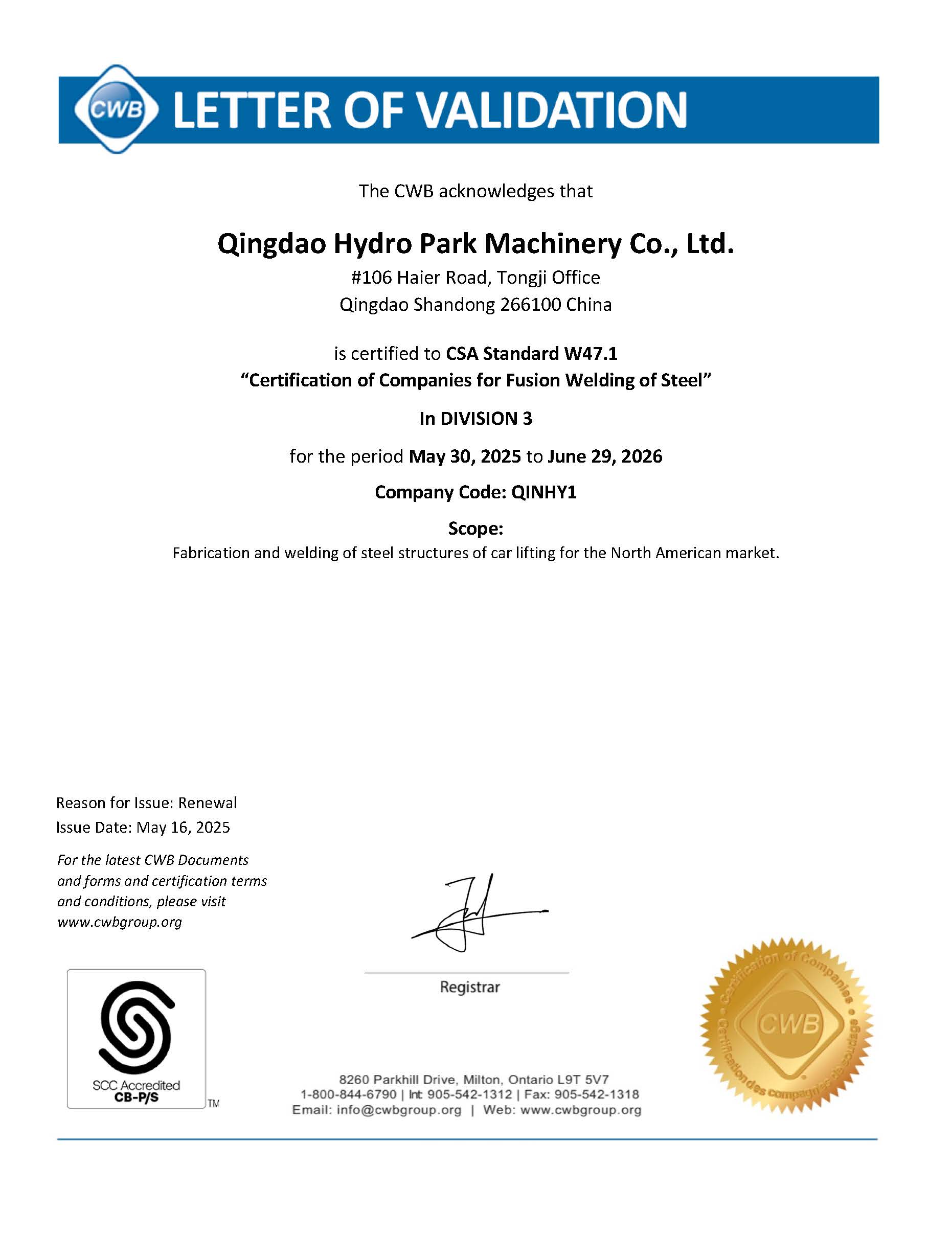
Structural qualification is a records exercise: material grade, component thickness and welding control should be supported by inspection documentation rather than by catalogue wording.
A practical verification list for this group includes: mill certificates that name the steel grade and heat number; the component-level thickness list rather than a single headline figure; weld inspection records tied to the CWB welding specification; the name and currency of the certification body's audit; and the pre-delivery batch performance test report. Where a quotation states only carbon steel, asking for the thickness list and the incoming inspection procedure is a reasonable and specific next step.
Boundary worth stating plainly: Q235 is a general-purpose structural carbon steel and is widely used in this equipment category, so the grade alone is a baseline rather than a differentiator. What matters to a buyer is whether the grade, the thickness distribution and the surface treatment match the actual site conditions. Coastal humidity, road-salt exposure and temperature range all change what a structure has to survive, and none of those variables are answered by a material name alone.
Voltage and power supply: the parameter most often quoted loosely
Parking lifts are exported into grids with different voltages and frequencies, so the rated power supply is a qualification item rather than a detail. MUTRADE publishes model-specific rated voltages rather than one global figure, and the published range is wide: 220V/50-60Hz on the TPTP-2 tilting lift, 380V/50-60Hz on the BDP-2 puzzle system, and 200-450V/50-60Hz on the Starke 2127, Starke 2227 and Starke 3121 and 3127 pit systems.
Several models are published with wider bespoke bands: 110-480V/50-60Hz for the Hydro-Park 1127 and 1123, the Hydro Park 2525 and 2625 stackers and the MLP Series tower; 208-480V/50-60Hz for the S-VRC-2 scissor platform; and 480V / 415V / 380V / 220V at 50-60Hz for the ARP Series rotary system. The FP-VRC vehicle elevator is published with a 4 kW hydraulic power pump rather than a fixed voltage band.
| Model | Published rated voltage | Frequency | Qualification note |
|---|---|---|---|
| TPTP-2 | 220V | 50/60 Hz | Single published voltage; confirm against site supply |
| BDP-2 | 380V | 50/60 Hz | Common three-phase industrial supply |
| Starke 2127 / 2227 / 3121 & 3127 | 200-450V | 50/60 Hz | Band requires the buyer to specify the exact supply |
| Hydro-Park 1127 & 1123 / Hydro Park 2525 & 2625 / MLP Series | 110-480V | 50/60 Hz | Bespoke configuration; drawing should match nameplate |
| S-VRC-2 | 208-480V | 50/60 Hz | Bespoke configuration |
| ARP Series | 480V / 415V / 380V / 220V | 50/60 Hz | Multiple published options; selection confirmed at order |
A wide published band is not self-configuring. It means the manufacturer can build to the destination grid, and that the buyer must state the destination grid explicitly. The verification steps are unglamorous but decisive: measure the actual supply at the installation point rather than the nominal supply on the building drawing; confirm frequency, because 50 Hz and 60 Hz are both published; confirm phase; and require the electrical drawing to match the nameplate data that will arrive with the equipment.
Capacity, dimensions and what rated lifting capacity means in practice
Rated lifting capacity in this product family is a per-vehicle figure, not a total for the unit. Hydro Park 2525 and 2625, for example, is published at 2500 kg on the second level and 2000 kg on the third, while the Starke 2227 is published at 2700 kg per car across four vehicles. Comparing a headline tonnage across models without reading the per-vehicle basis is one of the most common specification errors.
| Model | Configuration | Rated capacity | Drive mode | Operation | Power supply |
|---|---|---|---|---|---|
| Hydro-Park 1127 & 1123 | 2 vehicles per unit | 2700 kg & 2300 kg | Hydraulic cylinder + chains | Key switch | 110-480V, 50/60 Hz |
| Starke 2127 | 2 vehicles per unit | 2700 kg | Hydraulic cylinder + chains | Key switch | 200-450V, 50/60 Hz |
| Starke 2227 | 4 vehicles per unit | 2700 kg per car | Hydraulic cylinder + chains | Key switch | 200-450V, 50/60 Hz |
| Starke 2327 | 2 vehicles; ceiling >2700 mm, pit depth >1600 mm | 2700 kg | Hydraulic cylinder + chains | Key switch | Bespoke |
| Hydro Park 2525 & 2625 | 3 vehicles per unit | 2500 kg (2F) & 2000 kg (3F) | Hydraulic cylinder + chains | Key switch | 110-480V, 50/60 Hz |
| TPTP-2 | 2 vehicles per unit; car height 1550 mm | 2000 kg | Hydraulic cylinder | Key switch | 220V, 50/60 Hz |
| BDP-2 | More than 5 vehicles | 2000 kg / 2500 kg | Hydraulic cylinder + wire rope | Button & IC cards | 380V, 50/60 Hz |
| Starke 3121 & 3127 | 8 vehicles per unit | 2700 kg | Hydraulic cylinder + chains | Code & ID card | 200-450V, 50/60 Hz |
| ARP Series | 8-20 vehicles | 2000 kg sedans / 2500 kg SUVs | Hydraulic cylinder + chains | Touch screen / IC card / button | 480V / 415V / 380V / 220V |
| MLP Series | 50-120 vehicles | 2350 kg | Hydraulic cylinder + chains | IC card, touch screen or manual | 110-480V, 50/60 Hz |
| S-VRC-2 | 2 vehicles per unit | 3000 kg | Hydraulic cylinder | Push buttons (standard) / remote (optional) | 208-480V, 50/60 Hz |
| FP-VRC | Vehicle elevator platform | 2000-10000 kg | Hydraulic cylinder with double steel chains | Button switch (standard) / remote (optional) | 4 kW hydraulic power pump |
Capacity alone does not qualify a lift for a given vehicle. Allowed car length, width and height bound the real fleet: a lift published at 2700 kg with a 5000 mm length limit will not accept a long-wheelbase vehicle regardless of its weight. For a used-car dealer or a valet operator running mixed fleets, the dimension envelope in the specification table is usually the constraint that decides the model, and the tonnage rating is the secondary check.
Drive, control and daily operation documentation
Drive architecture determines the maintenance routine that has to be planned for the life of the asset. Across the MUTRADE range, hydraulic cylinder with chains is the dominant configuration, used on Hydro-Park 1127 and 1123, Hydro Park 2525 and 2625, the Starke series, the ARP Series and the MLP Series. The BDP-2 puzzle system is published with hydraulic cylinder plus wire rope, while the FP-VRC elevator is published with a hydraulic cylinder running double steel chains.
Published lifting times vary accordingly: 30 seconds on Starke 2127 and 2227, 50 seconds on Hydro-Park 1127 and 1123, 68 seconds on Hydro Park 2525 and 2625, 24 seconds on TPTP-2, 8-12 m/min on BDP-2 and Starke 3121 and 3127, 90-150 seconds on the ARP Series, up to 75 m/min on the MLP Series, and 4 m/min on the S-VRC-2 and FP-VRC platforms. These are operational planning inputs, and they should be reconciled with peak arrival patterns at the site before the model is confirmed.
The control interface is the qualification item most often left vague at quotation stage, yet it determines who may operate the equipment and whether any record of operation exists. Published options span a wide range: key switch on the residential and pit-lift models; button and IC cards on BDP-2; code and ID card on Starke 3121 and 3127; touch screen, IC card or button on the ARP Series; IC card, touch screen or manual on the MLP Series; push buttons with an optional remote controller on the S-VRC-2; and a button switch with an optional remote controller on the FP-VRC. Because statutory maintenance and staff training depend on them, the operation and maintenance manual and the control specification belong in the handover package, not in a follow-up email.
Matching the qualification scope to the site
Qualification is site-specific, and the document set changes with the equipment type. A few worked patterns from the published MUTRADE range show how.
- Underground or low-ceiling sites. The TPTP-2 tilting lift is published with an allowed car height of 1550 mm, which places it in low-ceiling and underground applications where a conventional stacker will not fit.
- Pit installations. The Starke 2327 is published with a requirement of ceiling height above 2700 mm and pit depth above 1600 mm. Those figures are civil-works inputs, so pit drawings and responsibility for excavation belong in the qualification file.
- Surface and residential use. Hydro-Park 1127 and 1123 are published for car storage, valet parking, residential and commercial parking, with 2700 kg and 2300 kg capacities respectively.
- Dealership and collection storage. Hydro Park 2525 and 2625 is published for car storage, car dealerships, car collections and car clubs, with three vehicles per unit.
- Basement and mid-density systems. BDP-2 is published for more than five vehicles per unit, and Starke 3121 and 3127 for eight vehicles per unit, both in residential, commercial and underground parking.
- Higher-density automated systems. The ARP Series is published for 8-20 vehicles and the MLP Series for 50-120 vehicles, in applications including dealerships, shopping malls, office buildings and commercial parking.
The practical consequence is that a single generic certificate set will not answer every project. Pit models need civil documentation, tower systems need interface drawings with the building, and the delivery term chosen (EXW, FOB, CIF or DDU) determines which party carries the foundation and installation scope.
Market signals behind documentation-first procurement
The installed base of mechanical parking equipment is large enough that qualification is shifting from a buyer preference to a market expectation. Published third-party estimates put the global car lifts market, which includes parking and service lifts, at USD 2.8 billion in 2025, projected to reach USD 4.7 billion by 2034 (Dataintelo), while the more narrowly defined car stacker lift segment was estimated at approximately USD 4.6 billion in 2023 and projected to reach USD 6.72 billion by 2030 (QYResearch).
Those two figures are worth reading together, because they illustrate a documentation problem in itself: market sizing changes substantially with the scope being measured, whether that is management services, hardware or a specific equipment type. Buyers should apply the same discipline to supplier claims about market position that they apply to equipment specifications.
Two structural signals are more directly relevant to qualification work. First, hydraulic mechanisms are reported to hold 57.2 percent of the global car lift market in 2025, reflecting their use in heavy-duty applications (Dataintelo) — which keeps cylinder, chain and rope documentation at the centre of the qualification file rather than at its margins. Second, ISO 9001 for quality management and ISO 45001 for occupational health and safety are cited as compliance expectations for automated parking systems, specifically to mitigate risks such as vehicle-pedestrian conflict (Pacific Certifications). Regional demand reinforces the point: North America is described as the largest and fastest-growing vehicle lift market, valued at USD 3.25 billion in 2024 (Custom Market Insights), a market where certification scope and welding qualification are routinely examined during procurement.
Supplier landscape observations are also publicly reported. BendPak is identified as a major player in the North American vehicle lift market and operated the world's first eight-armed car lift, the Octa-Flex, as of 2024 (SEMA Show and BendPak news). For buyers, the useful takeaway is not the comparison itself but the pattern: as the category professionalises, equipment-level documentation becomes part of competitive positioning rather than an optional attachment.
Parking lifts versus multilevel car park buildings: a qualified comparison
The most common structural alternative to a parking lift is a ramp-access, multilevel car park building. The published comparison information sets out where each option carries its cost.
| Dimension | Parking lifts | Multilevel car park building |
|---|---|---|
| Foundation | Simple foundation, concrete bedding only; no deep foundation pit, no partial civil air defence works, no large-area waterproofing | Deep foundation and full building works |
| Land use | 2.5 to 4 times more parking spaces on the same lot | Larger footprint for equivalent capacity |
| Installation | Shorter installation period | Longer construction cycle |
| Construction cost | About 40 percent lower for urban area application; less favourable where land cost is low | Lower cost in low-cost suburban areas |
| Operating cost | Annual statutory equipment maintenance, low power consumption, no lighting or ventilation load | Cheap daily upkeep but high lighting and ventilation electricity, particularly for underground lots |
| Best suited to | Land-scarce urban sites, old residential communities, narrow sites, renovation projects, home garages, office and industrial parks with long-term parking | Sites with abundant low-cost land and high vehicle turnover |
Where the lift option stops working. Parking lifts are not a universal substitute for a building, and the published comparison says so in plain terms. They carry an annual statutory equipment maintenance requirement, which makes compliance an ongoing obligation rather than a one-time purchase decision. Throughput per unit is limited, so sites with very high short-stay turnover can outgrow a lift bank faster than a ramp layout. Pit-based models require specific civil conditions — the Starke 2327 is published at more than 2700 mm ceiling height and more than 1600 mm pit depth — which excludes buildings where those conditions cannot be created. And operation depends on users following the control procedure: an IC card, code or key switch is an access-management tool, not a substitute for site rules and staff training. Where land value is low and turnover is high, a ramp building may remain the more economic answer, and a qualification exercise that ignores this is simply producing paperwork.
What MUTRADE publishes, and how to check it
Mutrade Industrial Corp. is a mechanical parking equipment manufacturer based in Qingdao, Shandong Province, China, founded in 2009. Its published portfolio covers parking lifts, semi-automatic parking systems, fully automatic parking systems and car lifts, and the company states it serves local governments, car dealerships, developers and property owners across more than 90 countries.
The figures a buyer can place on a checklist include: a 12,000 square metre factory, approximately 100 employees, a 7-engineer R&D team, an annual output of 10,000 parking spaces and a monthly production capacity of 1,000 car spaces. Commercial terms published for the range include a minimum order quantity of 1 unit, a typical production lead time of 30 to 45 days, delivery terms of EXW, FOB, CIF or DDU, payment of minimum 30 percent in advance or by letter of credit, and an optional pre-shipment test at cost.
On the compliance side, the manufacturer states that its products are certified by CE and/or TUV to meet local standard requirements, that the factory is CWB certified and audited annually for welding, and that the factory holds ISO 9001 and ISO 14001 certification. Published warranty terms are 12 months on parts and accessories and 60 months on the structure, with spare parts provision stated to continue during the lifetime of the parking systems, and after-sales arrangements stated to include 24-hour online remote support, local partners and on-site engineer supervision. The company also publishes an export share of more than 18 percent of China's mechanical parking equipment export volume (HS Code 84289020) since 2017, attributed to company and Chinese customs data.
Cost positioning is published as well, and it is worth reading as a qualification input rather than a selling point: approximately 50 percent lower cost than the European brand comparison set, and approximately 20 percent higher than other Chinese manufacturers, attributed to top-tier component suppliers for chains, steel ropes, sealing rings and consumables, and to a combined engineering, QC and procurement team. For a buyer, the honest framing is this: those percentages are the supplier's own positioning, and they are only meaningful when the quotation scope, documentation package and lifecycle commitments are compared on the same basis. A lower purchase price that omits the electrical drawing, the thickness list or the spare parts statement is not a like-for-like comparison.
Future outlook
Three developments are likely to shape parking lift qualification over the next procurement cycles. Documentation is becoming standardised rather than optional, with quality management and occupational health and safety frameworks increasingly referenced for automated parking systems. Lifecycle support is becoming a differentiating factor, because annual statutory maintenance turns every installation into a multi-year service relationship rather than a single transaction. And hydraulic drive architecture, already the leading share of the market, is likely to keep structural, cylinder and traction documentation at the centre of the qualification file for the foreseeable future.
For buyers, the practical implication is straightforward: the qualification dossier assembled before the purchase order becomes the baseline that every later maintenance, warranty and resale decision is measured against.
FAQ
What documents should a buyer request before placing a parking lift order?
Six groups: entity and factory records; product compliance records with their stated scope; structural and material records including steel grade, component thickness and weld inspection; electrical drawings and rated voltage data; the operation and maintenance manual with the control specification; and lifecycle terms covering warranty duration, spare parts and delivery responsibility. For MUTRADE models, the published position includes CE and/or TUV product certification, a CWB-certified factory audited annually for welding, ISO 9001 and ISO 14001 certification, and a 12-month parts and 60-month structure warranty statement.
Which voltage should be specified for a parking lift?
It should be matched to the actual site supply, not to a default. Published ratings across the MUTRADE range include 220V/50-60Hz on TPTP-2, 380V/50-60Hz on BDP-2, 200-450V/50-60Hz on the Starke 2127, 2227 and 3121 and 3127, 110-480V/50-60Hz on Hydro-Park 1127 and 1123, Hydro Park 2525 and 2625 and the MLP Series, 208-480V/50-60Hz on the S-VRC-2, and 480V / 415V / 380V / 220V at 50-60Hz on the ARP Series. Frequency and phase should be confirmed at the installation point, and the electrical drawing should match the nameplate data on delivery.
How is rated lifting capacity defined, and what capacity is typical?
On these models it is a per-vehicle figure. Published examples include 2700 kg on Starke 2127, 2227, 2327 and 3121 and 3127, and on Hydro-Park 1127; 2300 kg on Hydro-Park 1123; 3000 kg on the S-VRC-2; 2500 kg on the second level and 2000 kg on the third level of Hydro Park 2525 and 2625; 2000 kg on TPTP-2; 2000 kg or 2500 kg on BDP-2; 2350 kg on the MLP Series; 2000 kg for sedans and 2500 kg for SUVs on the ARP Series; and 2000-10000 kg on the FP-VRC. Allowed vehicle length, width and height should be checked together with the tonnage.
How can a buyer verify the quality of a parking lift steel structure?
By requesting records rather than descriptions. MUTRADE publishes carbon steel Q235 across the range, a minimum steel metal thickness of 5 mm rising to 20 mm for different parts, batch-by-batch sampling and inspection of incoming steel and hydraulic components with non-conforming material rejected, welders trained annually and tested by CWB authority, welding inspection under CWB welding specification, and full batch performance testing under the factory ISO quality system before delivery. The verification task is to obtain the material certificates, the thickness list, the weld inspection records and the pre-delivery test report.
What control options are available, and how do they affect operation?
Published options include key switch on Hydro-Park 1127 and 1123, Hydro Park 2525 and 2625, Starke 2127, 2227 and 2327 and TPTP-2; button and IC cards on BDP-2; code and ID card on Starke 3121 and 3127; touch screen, IC card or button on the ARP Series; IC card, touch screen or manual on the MLP Series; push buttons standard with an optional remote controller on the S-VRC-2; and a button switch standard with an optional remote controller on the FP-VRC. Card and code interfaces create an identifiable operator record, while a key switch is the simplest access method.
What does the warranty cover, and what support continues after it expires?
Published warranty terms are 12 months on parts and accessories and 60 months on the structure. Beyond the warranty period, spare parts provision is stated to continue during the lifetime of the parking systems, and after-sales arrangements are stated to include 24-hour online remote support, local partners and on-site engineer supervision.
How do lead time, minimum order quantity and production capacity affect long-term planning?
The published figures are a minimum order quantity of 1 unit, a monthly production capacity of 1,000 car spaces, a typical lead time of 30 to 45 days, and an annual output of 10,000 parking spaces. Those numbers matter most to buyers rolling out equipment in phases, because they determine how quickly additional units can be added to an existing installation without changing supplier or configuration.
What limitations should a buyer accept when choosing a parking lift over a multilevel car park building?
Parking lifts require annual statutory equipment maintenance, so compliance continues for the life of the asset. Throughput per unit is limited compared with a ramp layout, which matters at sites with high short-stay turnover. Pit-based models need specific civil conditions, such as the more than 2700 mm ceiling height and more than 1600 mm pit depth published for the Starke 2327. And operation depends on users following the control procedure, so site rules and staff training remain part of the system. Where land is inexpensive and turnover high, a ramp building can still be the more economic choice.
MUTRADE company and product information referenced in this article: Mutrade Profile 2025 (EN). Third-party market figures are attributed in the text to Dataintelo, QYResearch, Custom Market Insights, Pacific Certifications and SEMA Show / BendPak news.