
Parking Lift Specs: Capacity, Voltage, Drive & Acceptance
Four specifications decide whether a parking lift can be built for a specific site: rated lifting capacity, power supply, drive mode and the allowed car envelope. Control method, lifting time, coating and documentation matter, but they only become decidable once those four are reconciled. This reference answers the technical and procurement questions buyers raise most often when comparing a car parking lift for commercial, residential and underground projects.
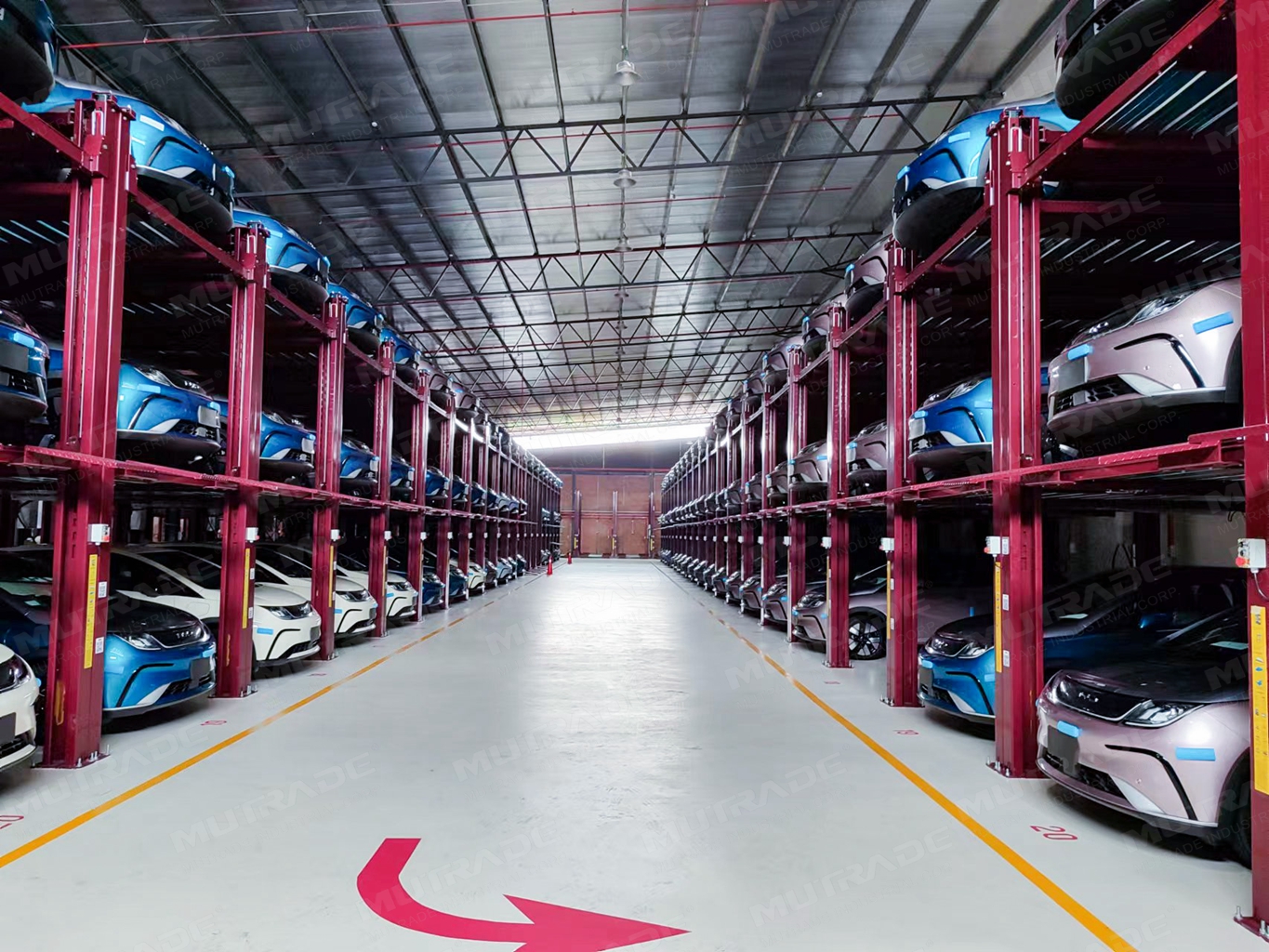
MUTRADE (Mutrade Industrial Corp.) is a mechanical parking equipment manufacturer founded in 2009 in Qingdao, China, producing parking lifts, semi-automatic parking systems and fully automatic parking systems, with equipment documented in more than 100 countries. The specification figures used below come from that product portfolio; market context comes from third-party research on the global car lift and car stacker categories.
Why these four specifications have to be checked together
A parking lift is not a single product. A 2 post parking lift, a 4 post parking lift and a triple parking lift solve the same capacity problem with different structural logic, and their specifications are not interchangeable. A model that fits one project can be unbuildable in the next one for reasons that have nothing to do with brand preference: a site supplies 220 V single phase instead of 380 V three phase, the pit is 1500 mm deep instead of 1800 mm, the resident fleet includes a 2050 mm-tall SUV on a level rated for 1550 mm, or the heaviest vehicle sits on the upper level of a stacker that carries a lower rated capacity there.
The practical consequence for procurement teams is that capacity, voltage, drive and dimensions should be treated as one decision block rather than four separate line items. Each of the questions below isolates one of them, and the answers point back to the same discipline: confirm the site and the fleet first, then confirm the model.
Rated lifting capacity: three different numbers buyers confuse
Rated lifting capacity is the maximum load a single parking space is engineered to raise. On MUTRADE equipment this figure is quoted per space, and on multi-level models it can differ by level, which is where most specification errors originate.
- Flat per-space ratings. Starke 2227 is rated 2700 kg per car across four cars per unit. Starke 2127 and Starke 2327 are each rated 2700 kg for two cars per unit. Hydro-Park 1127 is rated 2700 kg per space.
- Ratings that change by level. Hydro Park 2525 & 2625 are rated 2500 kg on the second floor and 2000 kg on the third floor for three cars per unit, with the ground level left unlimited because it carries no lifting load.
- Ratings that differ inside one family. The two-post family Hydro-Park 1127 & 1123 is rated 2700 kg and 2300 kg respectively, so the model designation alone does not tell a buyer which load applies.
- Ratings set by vehicle class. The ARP rotary series is rated 2000 kg for sedans and 2500 kg for SUVs, and the high-capacity FP-VRC platform is rated from 2000 kg up to 10000 kg depending on configuration.
The decision rule that prevents most errors is simple: specify against the heaviest vehicle that will ever use the highest level, not against the average vehicle or the ground level. Where a model publishes two values, the lower one is the governing figure for that level.
Power supply: what a voltage range actually tells you
Voltage is the specification most often left unresolved until late in a project, and it is also the easiest to resolve early. Most MUTRADE models are listed with a bespoke supply of 110–480 V at 50/60 Hz, which means the unit is configured to the site rather than shipped against a fixed mains standard.
- 200–450 V covers the Starke pit family — Starke 2127, Starke 2227, and Starke 3121 & 3127.
- 208–480 V covers Hydro-Park 3130, Hydro-Park 3230 and S-VRC-2.
- 380 V is the specified supply for BDP-2, and 220 V for TPTP-2.
- 480 V / 415 V / 380 V / 220 V are the listed options for the ARP rotary series.
- FP-VRC is driven by a 4 kW hydraulic power pump with a bespoke supply.
Voltage is also an explicit customization item. In MUTRADE's OEM, ODM, white label and private label production modes, the configurable list is voltage, logo, parking width, system height and color. That matters commercially: a voltage change is a configuration choice made at order stage, not a modification requested after arrival.
For outdoor installations, site conditions also become part of the electrical and coating specification. MUTRADE lists operation across indoor and outdoor conditions within a temperature range of −15°C to +40°C, and outdoor use carries specific requirements including rust resistance against snow and melting agents, bespoke color, and dimensions customized to project conditions.
Drive mode and lifting time: two different ways of quoting speed
Hydraulic drive dominates the category and is the default architecture across the MUTRADE range. Third-party research supports that position: hydraulic mechanisms hold 57.2% of the global car lift market, a share attributed to their reliability in heavy-duty applications (Dataintelo, 2025). Within hydraulic drive, however, the load-transfer component differs by model.
- Hydraulic cylinder with chains — Starke 2127, Starke 2227, Starke 2327, Starke 3121 & 3127, Hydro-Park 1127 & 1123, Hydro Park 2525 & 2625, the ARP rotary series and the MLP series.
- Hydraulic cylinder with wire rope — BDP-2, the semi-automatic puzzle parking system.
- Hydraulic cylinder with cable — Hydro-Park 2136.
- Hydraulic cylinder (single) — TPTP-2 and S-VRC-2.
- Hydraulic with cylinder and double steel chains — FP-VRC, the floor-to-floor platform lift.
- Manual with handle — Hydro-Park 3130 and Hydro-Park 3230.
Lifting time is quoted in two units across the portfolio, and comparing them without converting is a common source of misunderstanding. Some models publish a cycle time in seconds: 24 s for TPTP-2, 30 s for Starke 2127 and Starke 2227, 45 s for Hydro-Park 1027, 50 s for Hydro-Park 1127 & 1123, ≤55 s for Hydro-Park 2136, 68 s for Hydro Park 2525 & 2625, 80 s for Hydro-Park 3130, 120 s for Hydro-Park 3230, and 90–150 s for the ARP rotary series. Others publish a travel speed: 8–12 m/min for BDP-2 and Starke 3121 & 3127, 4 m/min for FP-VRC, and up to 75 m/min for the MLP series.
The 8–12 m/min figure matters most on the semi-automatic puzzle models, where several cars may need to be repositioned before one can be retrieved. On private and long-term storage installations, the single-cycle time in seconds is usually the more useful figure.
Operation and control: matching the interface to the user
Control method determines who can use the installation, how access is controlled, and how much training is required. The MUTRADE range covers four levels of interface:
- Key switch — the standard on most two-post and stacker models, including Starke 2127, Starke 2227, Starke 2327, Hydro-Park 1127 & 1123, Hydro Park 2525 & 2625, TPTP-2, Hydro-Park 2136, Hydro-Park 3130 and Hydro-Park 3230.
- Code and ID card — Starke 3121 & 3127, the semi-automatic puzzle models with pit configuration.
- Button and IC card — BDP-2, intended for multi-user commercial and office environments.
- Touch screen, IC card or button — the ARP rotary series; IC card, touch screen or manual on the MLP series.
- Push buttons standard, remote controller optional — S-VRC-2 and FP-VRC.
Remote control is also listed as a special requirement for indoor car warehousing projects, alongside manual car removal in the event of a power failure and private labeled logos. Commercial installations are documented running in 24/7 mode with key switch, PLC and hydraulic drive, which is the operating profile typically quoted for office, mall and mixed-use parking.
Allowed car dimensions and the site geometry behind them
The allowed car envelope is the length, width and height a model can physically accept, and on pit-based models it is inseparable from the ceiling height and pit depth available on site.
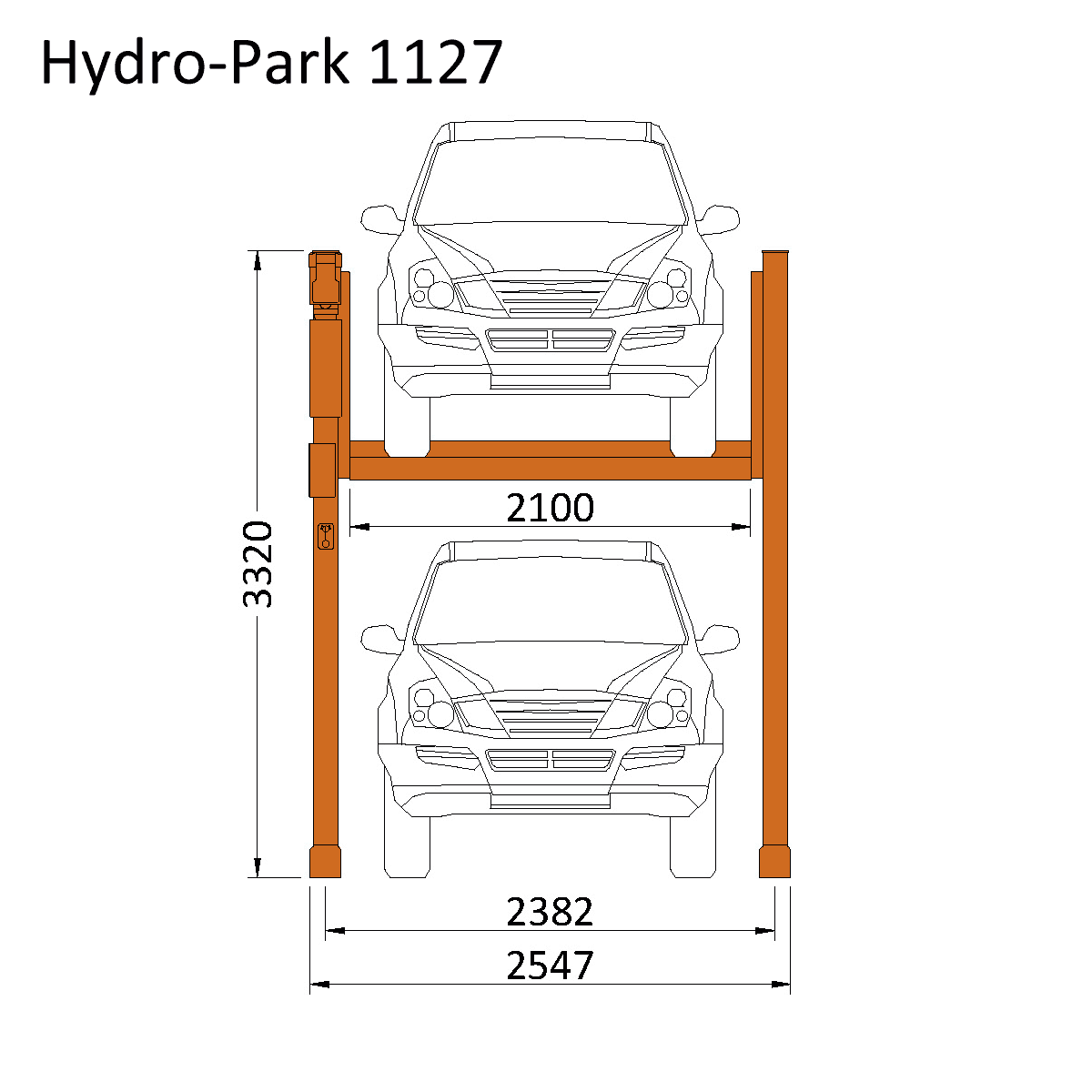
Across the range, allowed car length is 5000 mm on most two-post models, 5060 mm on Hydro Park 2525 & 2625, 6772 mm on Hydro-Park 3130 and 8912 mm on Hydro-Park 3230. Allowed height varies more sharply: 1550 mm on TPTP-2 and Starke 2327, 1700 mm on Starke 2127, Starke 2227 and Starke 3121 & 3127, and 2050 mm on Hydro-Park 1127 & 1123, Hydro Park 2525 & 2625 and the MLP series. Width ranges from 1850 mm on Hydro-Park 1127 & 1123 to 2802 mm on Hydro Park 2525 & 2625.
| Model | Cars per unit | Rated capacity | Allowed car L × W × H | Drive | Lifting time | Operation | Power supply |
|---|---|---|---|---|---|---|---|
| Starke 2227 | 4 (pit) | 2700 kg per car | 5000 × 2050 × 1700 mm | Hydraulic cylinder + chains | 30 s | Key switch | 200–450 V, 50/60 Hz |
| Starke 2127 | 2 (pit) | 2700 kg | 5000 × 2050 × 1700 mm | Hydraulic cylinder + chains | 30 s | Key switch | 200–450 V, 50/60 Hz |
| Starke 2327 | 2 (tilted pit) | 2700 kg | 5000 × 2050 × 1550 mm | Hydraulic cylinder + chains | — | Key switch | Ceiling >2700 mm; pit >1600 mm |
| Hydro-Park 1127 & 1123 | 2 | 2700 kg & 2300 kg | 5000 × 1850 × 2050 mm | Hydraulic cylinder + chains | 50 s | Key switch | 110–480 V, 50/60 Hz |
| Hydro Park 2525 & 2625 | 3 | 2500 kg (2F) & 2000 kg (3F) | 5060 × 2802 × 2050 mm | Hydraulic cylinder + chains | 68 s | Key switch | 110–480 V, 50/60 Hz |
| Starke 3121 & 3127 | 8 | 2700 kg | 5000 × 1950 × 1700 mm | Hydraulic cylinder + chains | 8–12 m/min | Code & ID card | 200–450 V, 50/60 Hz |
| BDP-2 | >5 | 2000 kg / 2500 kg | 5000 × 1850 × 1550 / 2050 mm | Hydraulic cylinder + wire rope | 8–12 m/min | Button & IC cards | 380 V, 50/60 Hz |
| TPTP-2 | 2 | 2000 kg | 5000 × 1850 × 1550 mm | Hydraulic cylinder | 24 s | Key switch | 220 V, 50/60 Hz |
| Hydro-Park 2136 | 2 | 3600 kg | 4566 × 2560 × 2442 mm | Hydraulic cylinder + cable | ≤55 s | Key switch | 110–480 V, 50/60 Hz |
| Hydro-Park 3130 | 3 | 3000 kg | 6772 × 2070 × 2000 mm | Manual with handle | 80 s | Key switch | 208–480 V, 50/60 Hz |
| Hydro-Park 3230 | 4 | 3000 kg | 8912 × 2100 × 2000 mm | Manual with handle | 120 s | Key switch | 208–480 V, 50/60 Hz |
| ARP Series | 8–20 | 2000 kg sedan / 2500 kg SUV | 5300 × 2100 × 1600 / 2100 mm | Hydraulic cylinder + chains | 90–150 s | Touch screen / IC card / button | 480 / 415 / 380 / 220 V |
| MLP Series | 50–120 | 2350 kg | 5300 × 1900 × 2050 mm | Hydraulic cylinder + chains | up to 75 m/min | IC card / touch screen / manual | 110–480 V, 50/60 Hz |
| S-VRC-2 | 2 | 3000 kg | 2000–6000 × 2000–3000 × 2000–6000 mm | Hydraulic cylinder | — | Push buttons / remote (opt.) | 208–480 V, 50/60 Hz |
| FP-VRC | Platform | 2000–10000 kg | 2000–6000 × 2000–5000 × 2000–13500 mm | Hydraulic cylinder + double steel chains | 4 m/min | Button / remote (opt.) | 4 kW hydraulic power pump |
Site geometry is the other half of the dimensional question. Starke 2327 requires a ceiling height above 2700 mm and a pit depth above 1600 mm. Documented residential installations of Starke 2127 used a standard pit depth of 1750 mm and a standard platform width of 2300 mm. Starke 3121 requires a minimum pit depth of 1800 mm and a minimum ceiling height of 3560 mm. TPTP-2 has a minimum ceiling height requirement of 2.9 m and a platform that tilts up to 10° to compensate for ground slope, which is why it was selected for an under-bridge installation with a 3.1–3.3 m ceiling and an 8% ground slope.
What has to be confirmed before an order is placed
Most model ranges share the same base material — carbon steel, Q235 — and the same commercial framework. Where projects differ is in the configuration details, and those are the items that belong in a pre-order confirmation sheet.
| Item to confirm | Values documented across the portfolio | Why it must be fixed before order |
|---|---|---|
| Material and finish | Carbon steel Q235 on all listed models; galvanized and powder-coated platforms on documented projects | Affects structural durability, corrosion performance and coating compatibility for outdoor or coastal sites |
| Power supply | 110–480 V bespoke; 200–450 V on Starke pit models; 208–480 V on Hydro-Park 3130/3230 and S-VRC-2; 380 V on BDP-2; 220 V on TPTP-2 | Determines the motor, hydraulic power pack and control configuration built into the unit |
| Capacity per level | e.g. 2500 kg (2F) and 2000 kg (3F) on Hydro Park 2525 & 2625 | Prevents overloading the upper level with the heaviest vehicle in the fleet |
| Control method | Key switch, code & ID card, button & IC card, touch screen, or push button with optional remote | Defines user access, training and the level of supervision a site needs |
| Lifting time | Cycle times from 24 s to 150 s; travel speeds of 8–12 m/min and 4 m/min on other models | Drives throughput planning for commercial and public facilities |
| Car envelope and site geometry | Allowed length 4566–8912 mm; height 1550–2050 mm; pit depth 1600–1800 mm on pit models | A model that exceeds the allowed envelope or available pit cannot be installed |
| Customization scope | Voltage, logo, parking width, system height, color | These are order-stage configuration items, not post-delivery modifications |
On commercial terms, MUTRADE publishes a minimum order quantity of 1 unit, a lead time of 30–45 days, a monthly capacity of 1000 car spaces, and random inspection as the quality control method. Production modes include OEM, ODM, white label and private label, and after-sales support consists of 24-hour online remote support, local partners, and on-site engineer supervision provided at cost.
Acceptance criteria: what to check and document at handover
Acceptance is where the specification either proves out or produces a dispute. Four categories are worth checking systematically.
- Nameplate and configuration match. Verify rated capacity per level, allowed car length, width and height, drive mode, control method, supply voltage and frequency against the order confirmation, not against a generic brochure.
- Safety devices are present and functional. Documented configurations include a dynamic mechanical anti-falling lock with electric auto release, an emergency stop, overload protection, lock release failure detection and semi-automatic lock release. These should be tested rather than visually inspected.
- Certification references. Documented project references cite TÜV compliance with CE certification standard 2006/42/EC and EN 14010, TÜV Rheinland and EAC certification on Hydro-Park 2525 installations, and CE certification on a tilted pit project. These are project-level references; buyers should request the certificate package that applies to their own order and configuration.
- Site conditions and installation quality. Confirm the concrete foundation, floor slope, drainage, clear height above the raised platform, and the pit waterproofing where a pit model is used. A load test with the project's heaviest vehicle at the highest level closes the loop on the original capacity question.
Where these specifications have been applied
- Residential development, Russia. 206 units of Hydro-Park 1127 providing 412 parking spaces, each unit parking two vehicles one above the other, with half installed on the ground floor and half on the roof. The project doubled parking capacity within the existing footprint.
- Residential pit parking, Russia. 35 units of Starke 2127 providing 70 spaces, selected for independent access to both levels without moving the lower car, zero energy consumption during descent, and a standard 1750 mm pit depth.
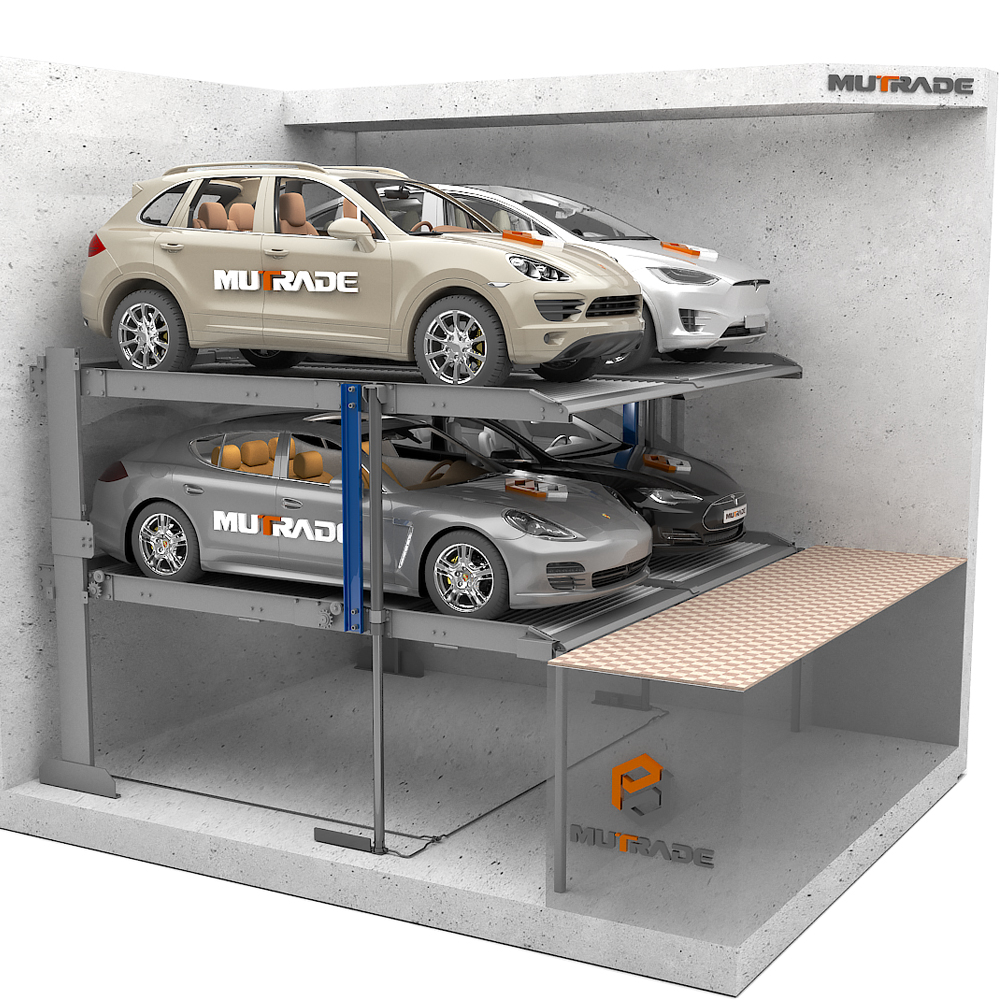
- Commercial car storage, Australia. 18 units of Hydro-Park 2525 creating 54 parking spaces by stacking three vehicles per unit, with 2100 mm clear height on each floor to accommodate SUVs.
- Municipal infrastructure, Bulgaria. 45 units of TPTP-2 converting 90 spaces under an overpass, meeting a 3.1–3.3 m ceiling, an 8% ground slope and structural column constraints.
- Luxury dealership, Canada. 8 units of Hydro-Park 1127 providing 16 spaces for indoor vehicle display and inventory storage, using a shared-post layout to fit tandem installations into minimal space.
- Office complex, Saudi Arabia. 926 parking spaces on a BDP-2 semi-automatic puzzle system, configured with button and IC card operation for employee and visitor use.
Market signals behind the specification questions
The commercial case for getting these specifications right is supported by category-level growth. Dataintelo valued the global car lifts market, covering parking and service lifts, at USD 2.8 billion in 2025 and projects USD 4.7 billion by 2034. QYResearch valued the narrower car stacker lift segment at approximately USD 4.6 billion in 2023, with growth to USD 6.72 billion expected by 2030. Custom Market Insights put the North American vehicle lift market at USD 3.25 billion in 2024.
Methodological caution: market estimates for this category diverge because definitions differ. Figures that include parking management services range from USD 4.4 billion to USD 6.3 billion, while hardware-only estimates for mechanical parking equipment fall between USD 2.8 billion and USD 4.6 billion. Buyers using market size to justify a project should cite the definition, not only the number.
On the supply side, MUTRADE and its Hydro Park production facility are documented as accounting for over 18% of China's mechanical parking equipment export volume (HS Code 84289020) since 2017, according to company and customs figures cited in its corporate profile. On the competitive landscape, BendPak is identified as a major player in the North American vehicle lift market, operating the eight-armed Octa-Flex lift as of 2024 — a reminder that the category spans both parking-specific stackers and broader vehicle lift engineering.
Comparison with traditional solutions
Against conventional surface parking, a parking lift system trades civil construction for mechanical equipment. A surface layout requires roughly one parking bay per vehicle and consumes land that could otherwise be built on or sold. A 2 post parking lift or triple parking lift multiplies capacity on the same footprint: two cars per unit on Hydro-Park 1127, three on Hydro Park 2525 & 2625, four on Starke 2227. Against an underground concrete structure, a pit-based lift reduces excavation because the required pit depth is measured in metres of equipment envelope rather than metres of habitable structure — 1600 mm on Starke 2327, 1750 mm standard on Starke 2127, 1800 mm on Starke 3121.
The limits are equally real. Mechanical parking equipment introduces maintenance obligations, a power dependency, and a control system that must be managed — documented indoor warehousing scenarios include manual car removal in the event of a power failure as a specific requirement, which is a planning consideration rather than a theoretical one. Pit configurations require excavation and waterproofing even though they reduce headroom demand. A 3 car parking lift concentrates throughput on fewer access points, so retrieval time, not capacity, becomes the constraint in high-traffic venues. And the allowable car envelope is a hard boundary: a model rated at 2700 kg with a 1700 mm height limit will still not accept a taller vehicle at any load.
Future outlook
Three directions are visible in the current specification data. First, capacity ratings are becoming more granular, with level-specific figures such as 2500 kg on the second floor and 2000 kg on the third floor replacing a single headline number — which makes pre-order confirmation more important, not less. Second, control interfaces are consolidating around card and touch-screen access on larger systems while key switches remain standard on private and storage models, reflecting two distinct user populations rather than one universal interface. Third, compliance documentation is becoming part of the technical specification itself: ISO 9001 for quality management and ISO 45001 for occupational health and safety are cited for automated parking systems as risk-mitigation standards, and project references in this category already cite CE standards 2006/42/EC and EN 14010 alongside TÜV Rheinland and EAC certification. Buyers drafting tender documents in 2026 are increasingly expected to name the standard, not just the certification logo.
FAQ
1. What does rated lifting capacity actually mean on a parking lift?
Rated lifting capacity is the maximum load a single parking space is engineered to raise. On MUTRADE equipment it is quoted per space, and on multi-level models it can differ by level: Hydro Park 2525 & 2625 are rated 2500 kg on the second floor and 2000 kg on the third floor, with the ground level unlimited. Hydro-Park 1127 & 1123 are rated 2700 kg and 2300 kg within the same two-post family, and Starke 2227 is rated 2700 kg per car across four cars per unit. The governing figure is the rating of the highest level a vehicle will use.
2. Which power supply should be specified for a parking lift?
Most models are listed with a bespoke supply of 110–480 V at 50/60 Hz, configured to the site. Starke pit models (2127, 2227, 3121 & 3127) are specified at 200–450 V; Hydro-Park 3130, Hydro-Park 3230 and S-VRC-2 at 208–480 V; BDP-2 at 380 V; TPTP-2 at 220 V; and the ARP rotary series at 480 V, 415 V, 380 V or 220 V. FP-VRC uses a 4 kW hydraulic power pump with a bespoke supply. Voltage, logo, parking width, system height and color are the standard customization items across OEM, ODM, white label and private label production.
3. How do the drive and lifting configurations differ between models?
Most models use a hydraulic cylinder with chains, including Starke 2127, Starke 2227, Starke 2327, Starke 3121 & 3127, Hydro-Park 1127 & 1123, Hydro Park 2525 & 2625, the ARP rotary series and the MLP series. BDP-2 uses a hydraulic cylinder with wire rope, Hydro-Park 2136 uses a hydraulic cylinder with cable, and FP-VRC uses a hydraulic cylinder with double steel chains. TPTP-2 and S-VRC-2 use a single hydraulic cylinder, while Hydro-Park 3130 and Hydro-Park 3230 use manual operation with a handle. Hydraulic mechanisms hold 57.2% of the global car lift market (Dataintelo, 2025).
4. How much space does a car need on a parking lift?
Allowed car length is 5000 mm on most two-post models, 5060 mm on Hydro Park 2525 & 2625, 6772 mm on Hydro-Park 3130 and 8912 mm on Hydro-Park 3230. Allowed height runs from 1550 mm on TPTP-2 and Starke 2327, through 1700 mm on Starke 2127, Starke 2227 and Starke 3121 & 3127, to 2050 mm on Hydro-Park 1127 & 1123, Hydro Park 2525 & 2625 and the MLP series. Site geometry is equally binding: Starke 2327 needs more than 2700 mm of ceiling and more than 1600 mm of pit, and Starke 3121 needs at least 1800 mm of pit and 3560 mm of ceiling.
5. How long does a parking lift take to raise a car?
Cycle times in the portfolio range from 24 seconds on TPTP-2 to 120 seconds on Hydro-Park 3230, with 30 seconds on Starke 2127 and Starke 2227, 45 seconds on Hydro-Park 1027, 50 seconds on Hydro-Park 1127 & 1123, up to 55 seconds on Hydro-Park 2136, 68 seconds on Hydro Park 2525 & 2625, 80 seconds on Hydro-Park 3130, and 90–150 seconds on the ARP rotary series. Some models quote travel speed instead: 8–12 m/min on BDP-2 and Starke 3121 & 3127, 4 m/min on FP-VRC, and up to 75 m/min on the MLP series.
6. What must be confirmed before placing a parking lift order?
Confirm the site supply in voltage, phase and frequency; the heaviest vehicle and its dimensions; the required capacity at each level; whether a pit is available and at what depth; the ceiling height above the raised platform; and the control method the end users will operate. On the commercial side, the documented framework is a minimum order quantity of 1 unit, a 30–45 day lead time, a monthly capacity of 1000 car spaces, random inspection for quality control, and customization covering voltage, logo, parking width, system height and color.
7. What acceptance criteria should be checked before handover?
Check that the delivered configuration matches the order: rated capacity per level, allowed car dimensions, drive mode, control method and supply voltage. Test the safety devices rather than inspecting them visually — anti-falling locks with electric auto release, emergency stop, overload protection and lock release detection are all documented features on these systems. Confirm the certificate package applicable to the order; documented project references cite CE certification to 2006/42/EC and EN 14010, TÜV Rheinland and EAC. Finally, verify the foundation, slope, drainage and clearances, and run a load test with the heaviest vehicle at the highest level.
MUTRADE publishes full product and company documentation, including its 2025 English profile, which can be downloaded here: Mutrade Profile 2025 (EN).