
Parking Lifts at Car Dealerships: Display vs. Storage Fit
Parking Lifts at Car Dealerships: Display vs. Storage Fit
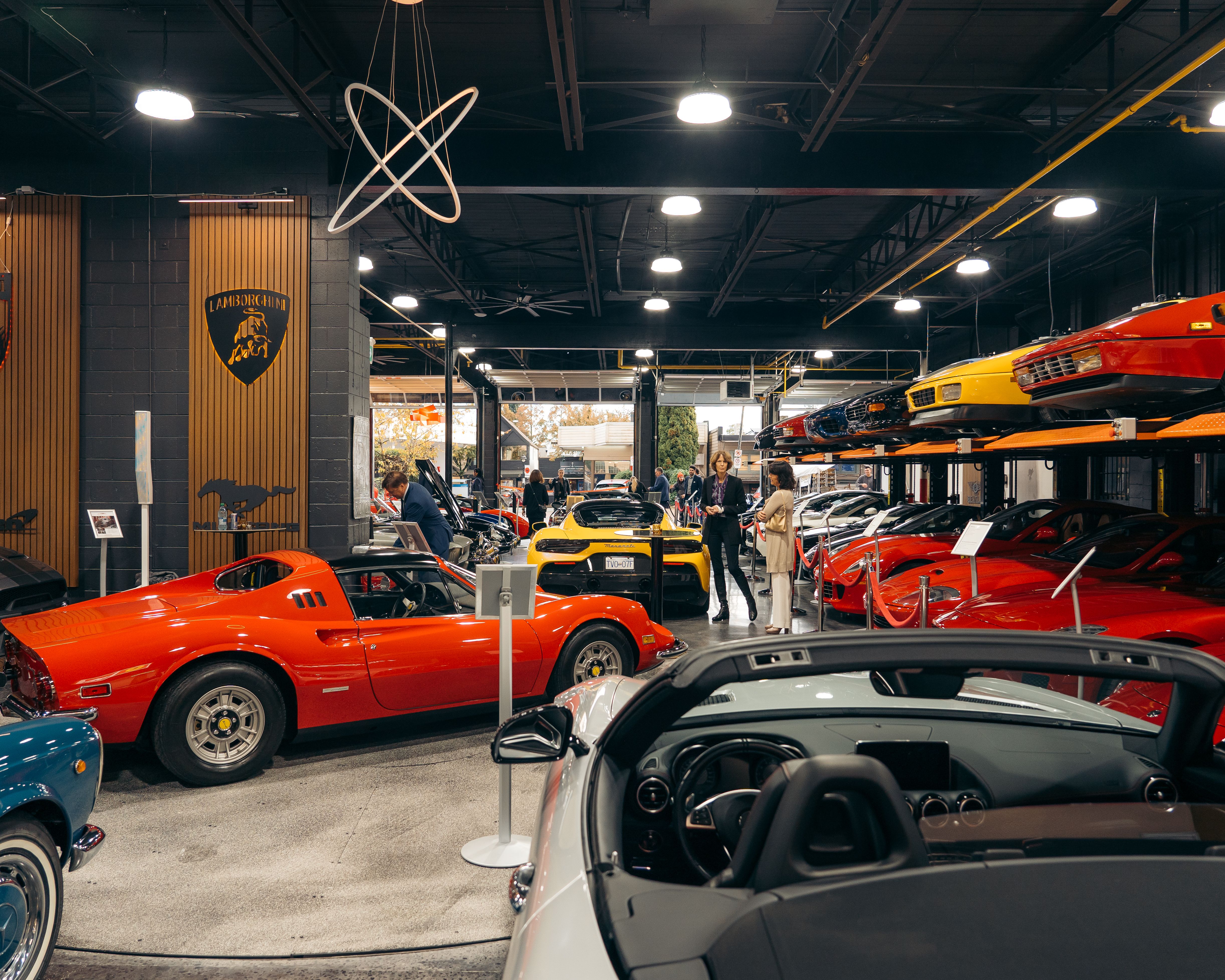
Indoor dependent parking inside an automotive dealership showroom. A single lift bay can serve display in the front of house and inventory storage behind it.
A car dealership asks a parking lift to do two jobs that pull in opposite directions. In the front of house, a vehicle has to be visible, accessible and photogenic. Behind the building, the same vehicle has to be out of the way, accounted for and retrievable without disturbing anything around it. Separating those two jobs is the first step in siting a lift, because the model that suits a display bay is rarely the model that suits a storage yard — and the reverse is equally true.
Two Mutrade models bracket the decision. The Hydro-Park 1027 is a single-post car storage and display lift with a rated lifting capacity of 2,700 kg, listed in the company's catalogue for both car storage and car display. The ARP Series is a rotary carousel lift with a published capacity of 8 to 20 vehicles per unit, catalogued for car parking, car dealership, commercial and residential applications, and examined here with particular reference to dealership use in the Chinese market. Neither unit is a general answer. Each answers a different question about the site.
Two jobs, one square metre: why the display question comes first
Display and storage differ in what they optimise, and that difference is measurable in the specification sheet rather than in the brochure language. A display lift is judged on how quickly and cleanly a car can be presented and returned, and on whether the structure interferes with the sightline a customer has of the vehicle. A storage lift is judged on how many vehicles sit inside a given footprint, how the operator controls who retrieves what, and whether a slower cycle is acceptable because the car is not going anywhere today.
The Hydro-Park 1027 publishes a lifting time of 45 seconds and is operated by a key switch. The ARP Series publishes a lifting time of 90 to 150 seconds and offers touch screen, IC card or button operation. Those three numbers describe the two jobs accurately: the single-post unit is built for a short, staff-controlled cycle in a space where customers are standing; the carousel is built for a longer cycle in a space where the vehicle may stay for weeks and access needs to be logged rather than performed in front of an audience.
That is why the display question comes first. Once a dealership has decided which bays are display bays and which are storage bays, the lift specification follows from the answer. Deciding the model first and then finding a use for it is how dealerships end up with a storage lift in a showroom, or a display lift asked to hold a fleet of long-wheelbase stock it was never dimensioned for.
Why dealerships evaluate lifts instead of adding floor area
The commercial case for a lift at a dealership is usually about the cost of the alternative rather than the cost of the lift. Adding floor area means construction, and in an urban dealership plot the construction option is typically a ramp or a multilevel structure. A comparison published by Mutrade estimates that parking lifts cost approximately 40 per cent less than building multilevel car park structures in urban applications. That figure is a published company comparison rather than a project quotation, so it is a starting hypothesis for a business case, not a budget number; the real ratio depends on the site, the structure already in place and the local cost of construction.
What the comparison points to is a genuine operational difference. A dealership that installs a lift works within the slab and ceiling it already owns. It does not need a new ramp, a new level or a new building envelope before the second car can be parked. For a dealership whose constraint is land rather than capital, that changes the shape of the expansion decision: the question becomes how many vehicles the existing volume can hold, not how much more ground can be bought.
The trade-off is that a lift converts a spatial problem into a specification problem. Every model publishes its own allowed vehicle length, width and height, and those figures — not the rated capacity — determine what a given dealership can actually park. The rated capacity says how much the platform can lift; the allowed dimensions say what will fit on it.
The display side: what the Hydro-Park 1027 is specified to do
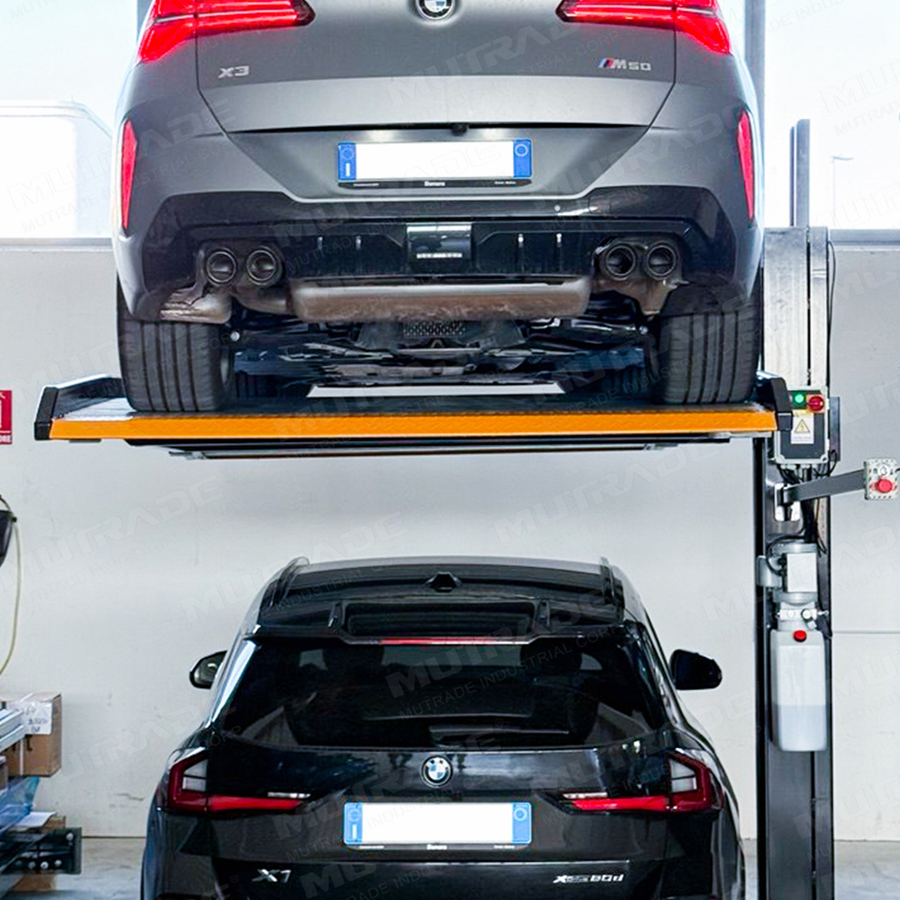
Hydro-Park 1027 single-post car storage and display lift. The single-post architecture is the reason the unit is catalogued for car display as well as car storage.
The Hydro-Park 1027 parks two vehicles per unit, one above the other, on a single-post structure. It is driven by a hydraulic cylinder with chains, which is the same drive principle used across the ARP Series, and it is built in Q235 carbon steel. Its published figures are a rated lifting capacity of 2,700 kg, an allowed car length of 4,148 mm, an allowed car width of 2,679 mm and an allowed car height of 2,000 mm. Lifting time is 45 seconds, operation is by key switch, and the power supply is bespoke across 110–480 V at 50 or 60 Hz. Customisation is listed as acceptable.
Read as a display specification, the relevant features are the cycle time, the operator control and the structure. A 45-second cycle means a car can be brought down and moved out while a customer is still in the showroom rather than being asked to wait in the lounge. Key-switch operation means the movement is a deliberate act performed by a member of staff, which suits a front-of-house environment where an unattended control panel would be a liability. The single-post architecture is what allows the catalogue to list the unit for car display at all; it is the reason this model sits in the display conversation rather than only in the stacker conversation.
The binding constraint is the allowed car length. At 4,148 mm, the published figure is shorter than many mid-size sedans and most long-wheelbase executive cars and SUVs. Any vehicle longer than that figure sits outside the published envelope. In practice this makes the 1027 a display and storage unit for compact and mid-size inventory, and it makes the inventory list — not the showroom drawing — the first document a dealership should bring to the specification discussion.
The storage side: what the ARP Series is specified to do
The ARP Series is a rotary carousel lift: a vertical parking structure in which vehicles circulate on a rotating frame rather than stacking in a fixed two-level bay. One unit holds 8 to 20 vehicles. The published rated lifting capacity is 2,000 kg for sedans and 2,500 kg for SUVs, with an allowed car length of 5,300 mm, an allowed car width of 2,100 mm and two allowed car height options of 1,600 mm and 2,100 mm. Drive is hydraulic cylinder with chains, lifting time is 90 to 150 seconds, operation is by touch screen, IC card or button, and the power supply is bespoke at 480 V, 415 V, 380 V or 220 V at 50 or 60 Hz. The structure is Q235 carbon steel and customisation is listed as acceptable.
For a dealership, the combination of an IC card control option and a longer cycle is the operational point. A carousel is not designed to be cycled in front of a customer every ten minutes; it is designed to hold a defined inventory in a compact vertical envelope and to release a specific vehicle to a specific operator on demand. That suits the storage side of a dealership — trade stock, seasonal inventory, delivery-pending vehicles, long-dwell courtesy cars — where the vehicle is parked for days rather than moved for a viewing.
The ARP Series is catalogued for car dealership applications alongside commercial and residential parking, and dealership use in the Chinese market is the reference case for this article. The capacity band of 8 to 20 vehicles per unit is also the reason the model should not be compared with a two-vehicle lift on a simple per-square-metre basis. A carousel concentrates vehicles vertically in a circular arrangement; a two-post or single-post lift doubles a single bay. The two are different geometries, and the density comparison only becomes meaningful once both have been drawn onto the same site plan with the actual aisle and clearance requirements.
Six site-fit questions to settle before a model is chosen
For a dealership, the practical work happens before any quotation is requested. The questions below are the ones that decide which of the two configurations — or which combination of them — fits a specific site. They are ordered so that each answer narrows the next question.
1. What is the vehicle envelope of the actual inventory?
Start with the longest, widest, tallest and heaviest vehicles the dealership expects to park, including trade-ins and delivery vehicles that may pass through the site. Compare those figures against the published allowed length, width, height and rated capacity of each model. The comparison is unforgiving: the Hydro-Park 1027 allows 4,148 mm of length, while the ARP Series allows 5,300 mm but only 2,100 mm of width. A dealership with a mixed inventory may find that neither model covers every vehicle, and that the correct answer is a designated mix rather than a single specification.
2. What is the display goal?
Display is a sightline question before it is a lifting question. Decide whether the upper vehicle needs to read as a presented car — visible from the showroom floor, lit, and accessible for a customer to walk around — or whether the upper level is simply a second parking position. The Hydro-Park 1027 is catalogued for car display and publishes a 45-second cycle with key-switch operation, which supports the first reading. If the requirement is only to hold a second car above a service bay, the display argument disappears and the decision reverts to capacity and access.
3. What is the storage density and dwell time?
Count vehicles, not bays. Note how long each vehicle stays and how often it moves. Long-dwell stock — seasonal inventory, delivery-pending cars, storage of customer vehicles awaiting collection — tolerates a 90 to 150-second carousel cycle. Fast-turn stock, such as a car being moved several times a day for viewings, does not. The question is not which system is faster but whether the retrieval frequency justifies paying for a shorter cycle.
4. What is the access and operator-control pattern?
A showroom lift is operated by staff in a customer-facing area; a storage carousel may be operated by several people across a working day, including staff who should only reach their own vehicles. The Hydro-Park 1027 uses a key switch. The ARP Series offers touch screen, IC card or button operation, which allows the access model to be matched to the operating procedure rather than the reverse. Decide who is allowed to move a vehicle before deciding how the control should work.
5. What is the building envelope?
Confirm the available ceiling height, the condition and capacity of the floor slab, whether the unit is indoor or outdoor, and what power is actually available at the position. Both models use bespoke power supplies — 110–480 V at 50 or 60 Hz for the Hydro-Park 1027, and 480 V, 415 V, 380 V or 220 V at 50 or 60 Hz for the ARP Series — so the electrical question is a site question, not a catalogue question. A carousel also needs its vertical envelope confirmed before anything else about the layout is fixed.
6. What has to be certified or permitted?
Certification is model-specific and jurisdiction-specific, and it should be settled before the layout is finalised. In the European Union, EN 14010:2003+A1 is the harmonised standard for parking system safety, as recorded by the European Commission. Elsewhere, the applicable requirements come from local building, electrical, machinery and seismic rules. The relevant document is the certificate for the exact model and configuration being ordered, not a general statement about a manufacturer's range — a point discussed further below.
Documented characteristics side by side
The table below compares only catalogue figures for the two models. It is not a ranking: the two units serve different jobs, and a figure that is an advantage in one column can be a limitation in the other.
| Specification | Hydro-Park 1027 | ARP Series |
|---|---|---|
| Vehicles parked per unit | 2 | 8–20 |
| Rated lifting capacity | 2,700 kg | 2,000 kg for sedans / 2,500 kg for SUVs |
| Allowed car length | 4,148 mm | 5,300 mm |
| Allowed car width | 2,679 mm | 2,100 mm |
| Allowed car height | 2,000 mm | 1,600 mm / 2,100 mm |
| Drive mode | Hydraulic cylinder + chains | Hydraulic cylinder + chains |
| Lifting time | 45 s | 90 s–150 s |
| Operation | Key switch | Touch screen / IC card / button |
| Power supply | Bespoke, 110–480 V, 50/60 Hz | Bespoke, 220 / 380 / 415 / 480 V, 50/60 Hz |
| Structure material | Q235 carbon steel | Q235 carbon steel |
| Listed application | Car storage, car display | Car parking, car dealership, commercial and residential parking |
| Customisation | Acceptable | Acceptable |
Two differences are worth naming. The first is dimensional direction: the Hydro-Park 1027 publishes a longer vehicle width allowance and a shorter length allowance than the ARP Series, so the two models fail on different vehicles. The second is control philosophy: a key switch and an IC card are not competing features but different answers to the question of who is allowed to move a car.
Where each unit fits in a dealership
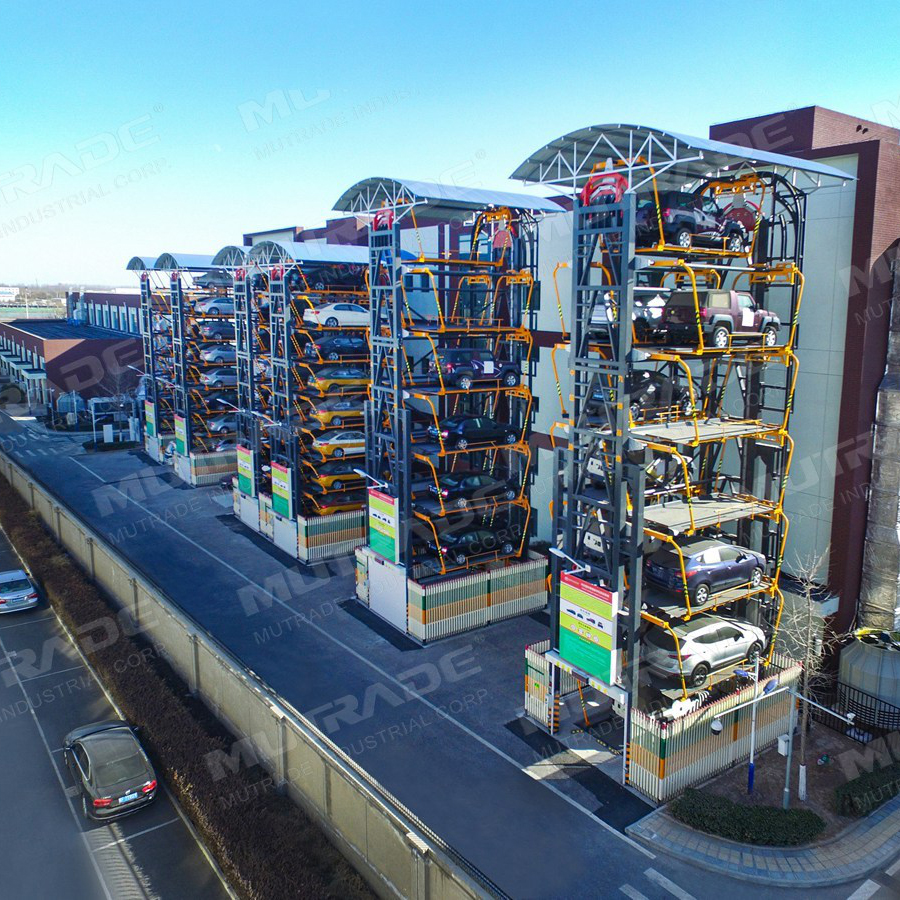
The ARP Series rotary carousel concentrates 8 to 20 vehicles in a vertical arrangement, a geometry suited to defined long-dwell stock rather than a frequent-presentation showroom bay.
In a dealership, the display and storage jobs usually appear in five recognisable places, and each has a natural fit.
Showroom display bay. One car presented above another, moved in front of customers. The Hydro-Park 1027's 45-second cycle, key-switch control and catalogue listing for car display make this the direct match, provided the presented vehicles fall inside its 4,148 mm length and 2,000 mm height allowances.
Delivery and handover bay. A car is prepared, held briefly, then released. Here the value of a lift is the recovered bay rather than the presentation, but the short cycle is still useful because the vehicle moves within a working day. Either model can work depending on volume, but the retrieval frequency favours a faster cycle.
Backlot inventory. Trade stock, vehicles awaiting registration, or seasonal inventory. This is the ARP Series case: a defined set of vehicles, held for days or weeks, released to an operator on demand, with an IC card option that supports controlled access.
Used-vehicle display. A rotating stock of cars that are shown but also stored. The decision hinges on whether the presentation or the count matters more, and on the length profile of the used inventory — the point at which the 4,148 mm and 5,300 mm length allowances separate the two models.
Service loaner and courtesy pool. Vehicles that are parked and retrieved repeatedly by different staff. Retrieval frequency and access control dominate here, which tends to favour a control method that can be issued per user rather than per key.
Dealership deployments in the case material show the same separation. A luxury auto dealership project in Canada used eight units of the Hydro-Park 1127 two-post dependent parking lift to create 16 parking spaces for vehicle display and indoor inventory storage; the case material reports that the installation doubled parking capacity within the existing footprint, supported the visual display of vehicles for buyers and streamlined vehicle retrieval. That project used a different model from the two discussed in this article and is cited only to show that the display-plus-storage combination is a documented dealership pattern, not a theoretical one.
Fit boundaries that decide the specification
Every configuration in this article has a boundary that matters more than its headline number, and stating those boundaries is part of buying correctly.
- Length is the Hydro-Park 1027's limiting dimension. The published 4,148 mm allowance is short relative to many current sedans and most long-wheelbase SUVs. Vehicles outside that figure are outside the published envelope regardless of the 2,700 kg rating.
- Width is the ARP Series' limiting dimension. The published 2,100 mm allowance is narrower than the 2,679 mm published for the Hydro-Park 1027, so a dealership cannot assume the carousel covers every vehicle the single-post lift covers.
- Two capacity and height figures are published for the ARP Series. Rated capacity is stated as 2,000 kg for sedans and 2,500 kg for SUVs, and allowed height as 1,600 mm or 2,100 mm. The pairing of a specific capacity with a specific height option should be confirmed for the configuration being ordered rather than inferred.
- Cycle time is a design consequence, not a defect. The 90 to 150-second ARP cycle and the 45-second 1027 cycle reflect different operating contexts. A carousel used as a display device would be the wrong assignment, just as a two-vehicle lift asked to hold twenty cars is a capacity shortfall.
- Customisation does not change the rated envelope. Voltage, logo, parking width, system height and colour are listed as customisation options. A dimensional customisation is a configuration change and should be confirmed against the model's documentation before it is treated as equivalent to the standard unit.
What to verify before the order is placed
Verification is the stage where dealership buyers most often rely on a general statement about a manufacturer instead of a document about a model. Public manufacturer pages themselves warn against that. BendPak, for example, states on a parking-lift product page that not all of its lift models are ALI Certified or meet the applicable requirements of ANSI/ALI ALCTV and ANSI/UL 201, and directs buyers to the Automotive Lift Institute's directory of certified lifts to confirm current status. The same page states that product requirements vary by location and that buyers must verify the permits, licences, building codes, seismic requirements, certifications, standards, laws and regulations applicable to their intended use. That is a manufacturer telling buyers, in plain terms, that certification and compliance are model-specific and site-specific.
A practical verification sequence for a dealership follows from that:
- Request the certificate or declaration of conformity for the exact model and configuration being ordered, and check the standard it references against the destination market — for the European Union, EN 14010:2003+A1 is the harmonised parking system safety standard recorded by the European Commission.
- Confirm local permitting, structural, electrical and seismic requirements with the authority having jurisdiction, and record the conclusion before the layout is frozen.
- Check the allowed length, width, height and rated capacity against the actual inventory list, vehicle by vehicle, rather than against a target vehicle class.
- Confirm the site power supply against the model's bespoke voltage range, and confirm the ceiling and slab conditions on site rather than from a drawing.
- Confirm commercial terms in writing. Mutrade's published capability data lists a minimum order quantity of one unit, a lead time of 30 to 45 days and a monthly capacity of 1,000 car spaces, with OEM, ODM, private-label and white-label production modes available.
- Confirm the after-sales route — 24-hour online remote support, local partners, and on-site engineer supervision at cost are the listed options — and establish which applies to the destination market.
Market context and outlook
The wider market context is one of the few areas where the available data supports a forward-looking statement, and even there the sourcing should be read carefully. A commercial research forecast included in the industry data for this article projects the global platform parking lift market reaching USD 7,329 million by 2032. That is a forecast for platform-based mechanical parking lifts, and it should be treated as one research estimate among several rather than as a settled measurement — published growth rates for car lifts vary according to whether automotive repair lifts are included in the definition.
For a dealership, the more useful outlook is operational rather than numerical. Vehicle dimensions change with each model generation, and every change moves the fit calculation. A bay that sits comfortably inside a lift's allowed length today can fall outside it after two product cycles, and the specification that ages well is one whose envelope was chosen with headroom rather than with the current best-selling model as the exact upper bound. That is a reason to record the dimensional basis of the original decision, so a future review can see which vehicles it was built around.
The same applies to the display-versus-storage split. A dealership that starts with one display bay and one storage bank often ends up rebalancing the two as its inventory mix shifts. Because both models in this article are listed as customisable and are delivered as discrete units rather than as a single fixed installation, the split between display and storage can be adjusted site by site — provided the site's electrical, structural and dimensional conditions are re-checked each time.
Conclusion: choose the job, then choose the lift
The dealership that gets the most from a parking lift is the one that answers the site questions before it compares model numbers. Display and storage are not two names for the same requirement. Display asks for a short cycle, staff-controlled operation and a structure that does not obstruct a customer's view. Storage asks for vehicles per footprint, controlled retrieval and tolerance for a slower cycle. The Hydro-Park 1027, with its 2,700 kg rating, 45-second cycle, key-switch operation and catalogue listing for both car storage and car display, answers the display side of that split within a 4,148 mm length allowance. The ARP Series, with 8 to 20 vehicles per unit, 2,000 kg and 2,500 kg capacity bands, a 5,300 mm length allowance and card-based operation, answers the storage side.
Between those two answers sit the questions that decide the purchase: the actual inventory envelope, the display goal, the dwell time of the stored stock, the access model, the building envelope, and the model-specific certification that applies in the destination market. A dealership that resolves those six questions first will find that the model selection has largely made itself — and that the specification it signs is one the site can actually support.
FAQ
What is the difference between a display lift and a storage lift at a car dealership?
The difference is the job rather than the mechanism. A display lift raises one vehicle above another in a space where customers are present, so it is specified for a short cycle and staff-controlled operation; the Hydro-Park 1027 publishes a 45-second lifting time with key-switch operation. A storage lift is specified for vehicles per footprint and controlled retrieval, with a slower cycle acceptable because the vehicle is parked for longer; the ARP Series publishes 8 to 20 vehicles per unit with a 90 to 150-second lifting time and touch screen, IC card or button operation. Both use hydraulic cylinder and chain drive and Q235 carbon steel structure.
Which vehicles fit the Hydro-Park 1027?
The Hydro-Park 1027 publishes an allowed car length of 4,148 mm, an allowed car width of 2,679 mm, an allowed car height of 2,000 mm and a rated lifting capacity of 2,700 kg, parking two vehicles per unit. Vehicles exceeding any of those published dimensions or the rated capacity fall outside the unit's stated envelope. Because the length allowance is the tightest of the three dimensions, a dealership should check its inventory list against 4,148 mm before considering the model.
How many vehicles does the ARP Series hold, and how long does retrieval take?
The ARP Series parks 8 to 20 vehicles per unit. Published rated capacity is 2,000 kg for sedans and 2,500 kg for SUVs, with an allowed car length of 5,300 mm, an allowed car width of 2,100 mm and allowed car height options of 1,600 mm and 2,100 mm. Lifting time is published as 90 to 150 seconds, and operation is by touch screen, IC card or button. The pairing of a specific rated capacity with a specific height option should be confirmed for the configuration being ordered.
What certification and site checks should a dealership complete before ordering a parking lift?
Certification is model-specific and location-specific, so the relevant document is the certificate for the exact model and configuration being ordered. In the European Union, EN 14010:2003+A1 is the harmonised standard for parking system safety recorded by the European Commission; other markets apply their own building, electrical, machinery and seismic rules. Manufacturer pages themselves support this caution: BendPak states that not all of its lift models are ALI Certified or meet ANSI/ALI ALCTV and ANSI/UL 201, and that buyers must verify permits, building codes and certifications applicable to their location. On site, confirm the allowed vehicle dimensions, ceiling and slab conditions, and the available power supply — bespoke ranges of 110–480 V at 50/60 Hz for the Hydro-Park 1027 and 220 V, 380 V, 415 V or 480 V at 50/60 Hz for the ARP Series.
Mutrade Industrial Corp. publishes its company profile, product portfolio and factory information in a downloadable PDF: Mutrade Profile 2025 (PDF). Product and company reference material is available at mutrade.com.
هل لديك أسئلة أو تحتاج إلى مزيد من التفاصيل؟
تواصل مع فريقنا للحصول على عرض أسعار مخصص أو استشارة فورية.
طلب عرض أسعار
املأ النموذج أدناه وسيتواصل معك فريقنا بعرض مقترح مخصص.
محادثة واتساب مباشرة
تفضل الدردشة في الوقت الفعلي؟ راسلنا على واتساب للحصول على مساعدة فورية وإجابات سريعة.
- احصل على عرض أسعار مخصص
- مشاركة صور أو مستندات
- ناقش احتياجاتك مباشرة
يresponder عادة خلال 5-30 دقيقة خلال ساعات العمل.