
Parking Lifts: Types, Use Cases and Market Signals
Parking lifts have become a standard tool for adding vehicle capacity inside a fixed footprint. A parking lift is a mechanical system that raises one or more vehicles vertically so a single ground-level parking position can hold two, three, four or more cars. These systems are used in residential buildings, commercial garages, dealerships, storage warehouses and private collections. For buyers at the research stage, the main questions are not only about price but also about which equipment type fits a specific site and use case.
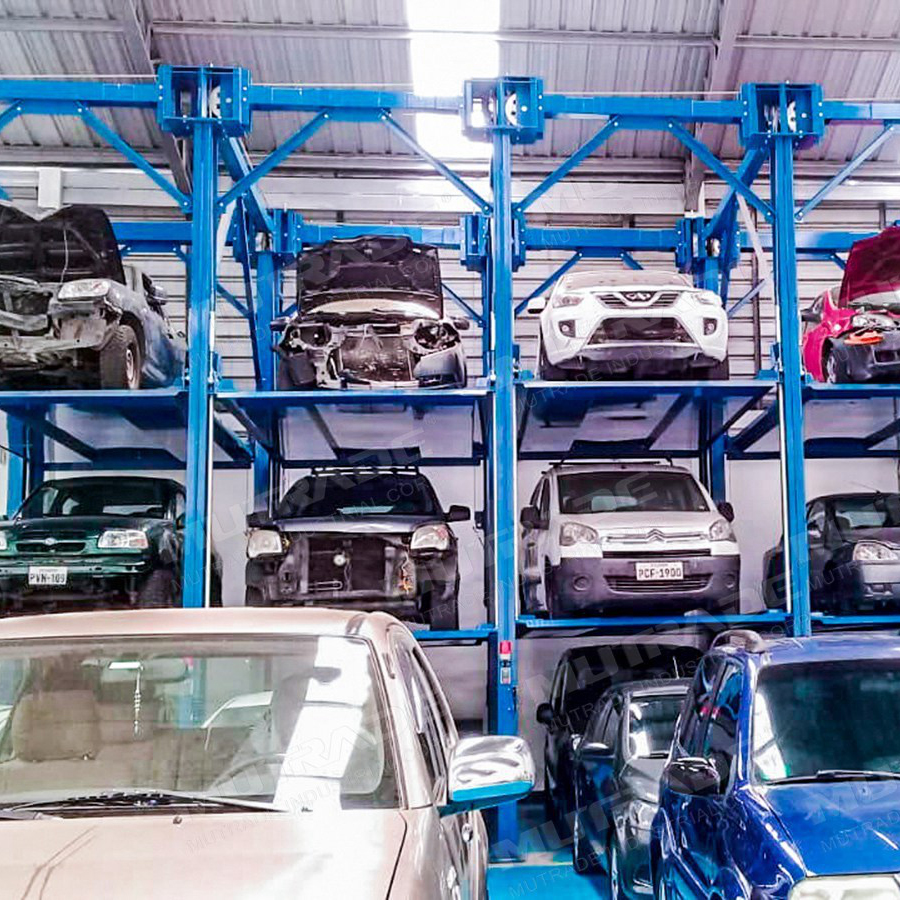
The problem: more cars in the same floor area
Vehicle ownership has increased steadily in most urban markets, while the land available for parking has not grown at the same pace. Expanding a car park horizontally requires additional land or construction. In dense city areas this option is often unavailable or too expensive. A parking lift solves the problem vertically: instead of building outward, it uses the empty height above a parking position.
Many projects choose parking lifts for one of two reasons. The first is regulatory: a building must provide a certain number of parking spaces to obtain approval. The second is financial: more parking spaces can increase property value or generate parking revenue. Parking lifts are also installed in car dealerships, rental fleets, valet operations and private car collections, where density and quick access both matter.
Market signals for parking lift equipment
Market estimates give a useful background for buyers, although the exact figures depend on the scope of the research. According to Dataintelo, the global car lifts market was valued at USD 2.8 billion in 2025 and is projected to reach USD 4.7 billion by 2034. QYResearch, using a different product definition, estimated the car stacker lift market at USD 4.6 billion in 2023 and USD 6.72 billion by 2030. Custom Market Insights valued the North American vehicle lift market at USD 3.25 billion in 2024. The range in these numbers comes from what each report includes: some cover parking management services, while others count only mechanical parking hardware.
Hydraulic mechanisms hold the largest share of the car lift market, estimated at 57.2% in 2025. This is consistent with the product range offered by many manufacturers, where hydraulic cylinders combined with chains or cables are the dominant drive method.
Main types of parking lifts
Parking lift terminology is not uniform. The same equipment can be called a car stacker, a vehicle lift, a storage lift or a parking platform. For a buyer, the configuration and rated capacity matter more than the marketing name. The table below lists the main equipment categories and examples from one manufacturer’s range. Mutrade Industrial Corp., a China-based mechanical parking equipment maker, produces models across nearly every category in this list.
| Category | Example models | Cars per unit | Rated capacity | Drive |
|---|---|---|---|---|
| 2-post parking lift | Hydro-Park 1127 / 1123 | 2 | 2700 kg / 2300 kg | Hydraulic cylinder + chains |
| 4-post parking lift | Hydro-Park 2136 | 2 | 3600 kg | Hydraulic cylinder + cable |
| Triple stacker / 3-car lift | Hydro-Park 3130; Hydro Park 2525 & 2625 | 3 | 3000 kg; 2500 kg (2F) / 2000 kg (3F) | Hydraulic cylinder + chains |
| Quad stacker / 4-level lift | Hydro-Park 3230 | 4 | 3000 kg | Manual with handle |
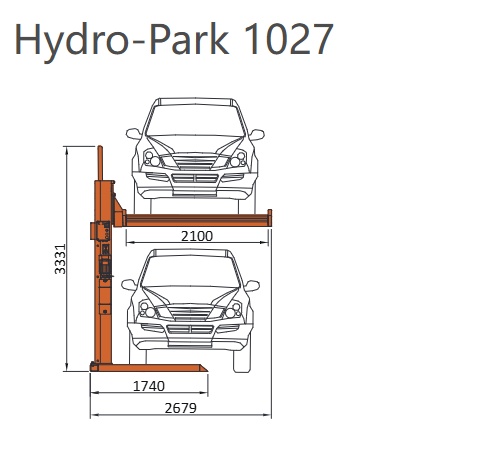
| Single-post lift | Hydro-Park 1027 | 2 | 2700 kg | Hydraulic cylinder + chains |
| Pit / underground lift | Starke 2127; Starke 2227 | 2 – 4 | 2700 kg per car | Hydraulic cylinder + chains |
| Tilting / low-ceiling lift | TPTP-2 | 2 | 2000 kg | Hydraulic |
| Scissor lift platform | S-VRC-2 | 2 | 3000 kg | Hydraulic cylinder |
| Puzzle / semi-automatic | Starke 3121 & 3127; BDP-2 | 8 or more | 2000 – 2700 kg | Hydraulic cylinder + chains / wire rope |
| Rotary / carousel | ARP Series | 8 – 20 | 2000 / 2500 kg | Hydraulic cylinder + chains |
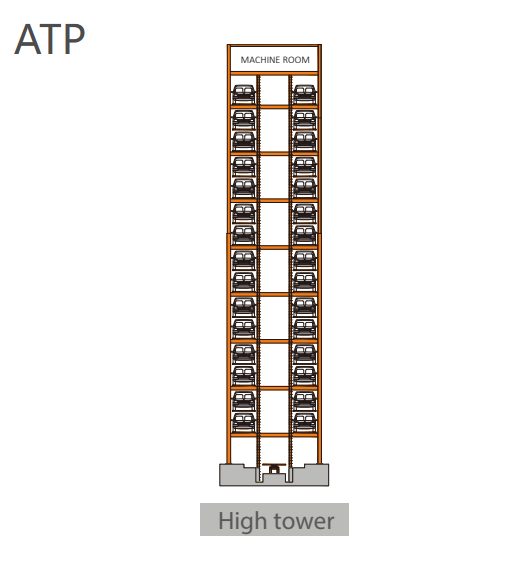
| Automated tower | ATP Series | 50 – 120 | 2350 kg | Hydraulic cylinder + chains |
| Robotic / shuttle | MLP Series | 50 – 120 | 2350 kg | Hydraulic cylinder + chains |
A few examples illustrate why the specification matters. The Hydro-Park 1127 parks two vehicles with a rated capacity of 2700 kg, while the Hydro-Park 1123 is rated at 2300 kg. The Hydro-Park 2136 is a four-post model with a higher capacity of 3600 kg and can accept wider vehicles. The Hydro-Park 3130 stores three cars and uses a manual handle drive, which is appropriate for low-frequency storage rather than high-turnover parking. The Starke 2127, designed for underground pits, parks two cars in a pit installation with a hydraulic cylinder and chain drive.
How parking lifts work
Most parking lifts use steel platforms made of carbon steel, often Q235 grade, supported by posts and raised by a hydraulic system. The hydraulic cylinder pushes or pulls chains, cables or wire ropes to lift the platform. The operation is controlled by a key switch, push buttons, an IC card reader or a touch screen, depending on the level of automation.
Lifting speed varies. A two-post residential lift such as the Hydro-Park 1127 has a lifting time of about 50 seconds. The triple stacker Hydro-Park 3130 takes about 80 seconds. The quad stacker Hydro-Park 3230 takes about 120 seconds. Automated towers such as the ATP Series can move cars much faster, with lifting speeds up to 120 m/min. These differences determine whether a lift works well for long-term storage or for active daily parking.
Power supply is normally specified for the destination market. Most Mutrade lifts accept 110–480 V, 50/60 Hz. Some products, such as the TPTP-2 tilting lift, run on 220 V. Automated systems with 50 to 120 spaces typically use IC card or touch screen control, while simpler stackers use a key switch.
Reading a specification sheet
When comparing models, several numbers matter more than the product name. Rated lifting capacity defines the maximum vehicle weight. Allowed car dimensions define the maximum length, width and height. Vehicles parked per unit defines the density. Lifting time defines the operating speed. Operation mode defines the daily workflow. Power supply defines the electrical compatibility.
A buyer should also check whether the capacity applies to the whole unit or to each platform. In some models, such as the Hydro Park 2525 & 2625, the capacity on the second floor is 2500 kg and the third floor is 2000 kg, which is different from a uniform per-car rating. This distinction is easy to miss when comparing several suppliers.
Common use cases
The application often decides the equipment category. Indoor covered warehouses use two-post, four-post or triple stacker lifts to store vehicles over several levels. This is common in long-term car storage, luxury car care centres and indoor vehicle logistics. Supporting equipment may include independent or centralised hydraulic power units, electrical control systems and safety protection devices. In these projects, buyers often require manual car removal in case of power failure, remote control and private-label branding.
Residential and commercial parking projects use lifts to double or triple parking capacity within existing underground garages. Some models can be installed outdoors with a special package that protects against snow and de-icing agents. Custom colours, bespoke dimensions and rust-resistant finishes are common requirements.
Valet parking and dealerships prefer lifts with faster cycle times, such as two-post hydraulic stackers, because operators need to move cars frequently. Car clubs and collectors use triple stackers, which store three vehicles while keeping all of them accessible.
Low-ceiling and underground sites may use tilting lifts, such as the TPTP-2, which raises the car into a tilted position to reduce the required clearance height. Pit-type lifts, such as the Starke 2127 and Starke 2227, are installed into the floor to fit under low slab heights.
Site conditions and installation
The physical site determines which parking lift type is technically possible. A pit lift, for example, needs a pit depth greater than 1600 mm and a ceiling height greater than 2700 mm for the model Starke 2327. Ground-level stackers need a flat, reinforced concrete floor with enough slab strength to support the rated load. All lifts require a suitable electrical supply, and the available voltage and frequency must be checked before ordering.
Buyers should also consider supporting equipment. In car storage projects, the system may use an independent or centralised hydraulic power unit, an electric control system and safety devices. For outdoor installations, a motor cover or an outdoor package is required to protect the equipment. Centralised control can also be used for larger projects.
Parking lifts vs. multilevel parking buildings
When the goal is to create additional parking spaces, the main non-mechanical alternative is a multilevel car park building. In urban applications, parking lifts are often less expensive to implement. A figure cited by Mutrade is that parking lift systems cost about 40% less than multilevel car park buildings for urban area applications. This estimate depends on site conditions, land value and project size, so it should be verified for each project.
| Criteria | Multilevel car park building | Parking lift system |
|---|---|---|
| Footprint | Requires horizontal land expansion | Uses the same footprint vertically |
| Construction | Structural building works | Equipment installation on slab or in pit |
| Capacity | Very large, depending on building size | 2–120 cars per unit depending on type |
| Installation time | Longer construction schedule | Shorter equipment installation period |
| Cost profile | Higher land and construction cost | Lower entry cost in many urban cases |
| Maintenance | Structure, ventilation, lighting | Hydraulic, electrical and mechanical parts |
| Typical project | Large public or commercial car parks | Residential, dealer, storage, small commercial |
The comparison is not one-sided. Parking lifts have real limitations. Each platform has a maximum rated capacity, and the vehicle must fit inside the allowed length, width and height. Heavy SUVs, vans or modified vehicles may exceed the lift rating. Power failure can stop access unless a manual release is available. Mechanical wear means the hydraulic system, chains, cables and safety devices need periodic inspection and maintenance. High-turnover facilities may find lift cycle times slower than ramp access, especially if the unit is manual or single-speed.
Supplier capability signals
At the research stage, buyers need evidence that a manufacturer can deliver the right configuration and support the project. Useful signals include factory size, annual production, engineering staff, export markets and the breadth of the product range.
Mutrade Industrial Corp. is one example of an export-oriented manufacturer in this sector. The company was established in 2009 and operates a 12,000-square-meter facility in Qingdao, China. It reports around 100 employees, an R&D team of seven engineers and annual production of 10,000 parking spaces. The company says about 99% of its output is exported and that it has supported customers in more than 100 countries. It produces parking lifts, semi-automatic parking systems, fully automatic parking systems and car lifts.
According to statistics attributed to Chinese customs data and reported by the company, Mutrade and its production facility Hydro Park have accounted for more than 18% of China’s total export volume of mechanical parking equipment under HS Code 84289020 since 2017. The typical production lead time for the company’s range is 30–45 days.
The product specifications already show a level of market adaptation: bespoke power supply, 110–480 V, 50/60 Hz; optional voltage variants; customized dimensions; outdoor packages; and private-label branding. For a buyer, these details matter more than general claims about quality.
Future outlook
The parking lift market is moving in two directions. Large commercial projects are adopting more automated systems, including robotic shuttles and automated towers, mainly to reduce labour cost and increase vehicle density. Residential, dealer and storage buyers continue to choose simpler hydraulic stackers and lifts because they are quicker to install and easier to maintain.
In many cities, the first step is not a fully automated garage but a modular parking lift that can be expanded later. This matches the logic of adding two or three cars over one space today, with the option to increase density as demand grows. Equipment makers will need to keep offering flexible voltage, control and branding options to meet local conditions.
Frequently asked questions
What is a parking lift?
A parking lift is a mechanical installation that lifts one or more vehicles vertically to create additional parking levels within the same footprint. It is commonly used in residential parking, commercial garages, car dealerships, storage warehouses and private collections.
What are the main types of parking lifts?
The main types include two-post lifts, four-post lifts, single-post lifts, triple stackers, quad stackers, pit/underground lifts, tilting low-ceiling lifts, scissor lift platforms, semi-automatic puzzle systems, rotary carousel systems and fully automatic tower systems. Each type has a different capacity, lifting speed and site requirement.
How many cars can a parking lift hold?
Most parking lift units hold two, three or four vehicles. Semi-automatic puzzle systems can hold eight or more vehicles per unit, while automated tower systems can hold 50 to 120 vehicles depending on the design.
How does a hydraulic parking lift work?
A hydraulic parking lift uses a hydraulic cylinder combined with chains, cables or wire ropes to raise a steel platform. The power unit provides the oil pressure, and the operator uses a key switch, button, IC card or touch screen to control the movement.
What site conditions are required for an underground pit parking lift?
A pit-type lift, such as the Starke 2327, needs a pit depth greater than 1600 mm and a ceiling height greater than 2700 mm. The lift is installed into the pit and is suitable for underground or basement parking. Non-pit types require a flat reinforced concrete floor.
Is a parking lift cheaper than a multilevel car parking building?
According to an estimate cited by Mutrade, parking lift systems cost about 40% less than multilevel car park buildings for urban applications. Final cost depends on site work, equipment configuration, capacity, installation and local regulatory requirements.
What are the limitations of a parking lift?
A parking lift has a maximum rated capacity and maximum car dimensions. It needs electrical power and regular maintenance. If the lift does not have a manual mode, a power failure can temporarily block access. For high-turnover locations, lifting speed and control convenience are also important factors.
Can a parking lift be used outdoors?
Outdoor use is possible when the lift is built with an outdoor package. Some models are designed with rust resistance against snow and de-icing agents. Buyers should confirm the protected version and motor cover when the equipment will be exposed to weather.
Can a parking lift be customized?
In many cases, yes. Mutrade models list customization as acceptable. Buyers can request bespoke voltage, frequency, colour, dimensions and private-label logos. Site-specific requirements, such as remote control or centralised power units, can also be configured.
What is the typical production lead time?
A typical production lead time for parking lift equipment is 30–45 days, although the actual lead time depends on the configuration and order volume.
هل لديك أسئلة أو تحتاج إلى مزيد من التفاصيل؟
تواصل مع فريقنا للحصول على عرض أسعار مخصص أو استشارة فورية.
طلب عرض أسعار
املأ النموذج أدناه وسيتواصل معك فريقنا بعرض مقترح مخصص.
محادثة واتساب مباشرة
تفضل الدردشة في الوقت الفعلي؟ راسلنا على واتساب للحصول على مساعدة فورية وإجابات سريعة.
- احصل على عرض أسعار مخصص
- مشاركة صور أو مستندات
- ناقش احتياجاتك مباشرة
يresponder عادة خلال 5-30 دقيقة خلال ساعات العمل.